Understanding the Big Picture: What “Program Selection Strategy” Really Means
Choosing where to apply for psychiatry residency is one of the most consequential decisions in your training. This is more than “how many programs to apply” or simply browsing a list of well-known names. Program selection strategy is a deliberate, structured process for:
- Identifying what you need to become the psychiatrist you want to be
- Matching those needs to specific program characteristics
- Balancing risk (not matching) against fit (where you’ll truly thrive)
- Allocating your time, energy, and money wisely during the psych match
For psychiatry residency in particular, strategy matters. The specialty is growing, programs are diverse (from psychoanalytic powerhouses to biologically focused research centers), and your training environment will profoundly influence your clinical style, comfort with psychotherapy, approach to psychopharmacology, and career trajectory.
This guide walks you step-by-step through a program selection strategy tailored to psychiatry, with practical tools you can use immediately: self-assessment questions, tiering frameworks, and clear guidance on how to choose residency programs and how many programs to apply to for a safe but smart psych match.
Step 1: Clarify Your Goals and Priorities in Psychiatry
Before opening any program list, clarify who you are and what you want. Your internal clarity will determine whether your program selection is strategic—or random and anxiety-driven.
A. Clinical and Career Identity: Who Are You Becoming?
Ask yourself:
Clinical focus interests
- Are you drawn to:
- Severe mental illness in inpatient settings?
- Outpatient continuity care and long-term relationships?
- Child and adolescent psychiatry?
- Addiction, forensic, psychosomatic, or geriatric psychiatry?
- Are you excited by:
- Psychotherapy and deep narrative work?
- Biological psychiatry, neuroimaging, and psychopharmacology?
- Public and community mental health?
- Are you drawn to:
Career trajectory
- Academic psychiatry vs. community practice vs. hybrid
- Research-heavy vs. primarily clinical
- Interest in leadership, advocacy, public policy, or global mental health
Lifestyle and personal needs
- Geographic constraints (family, partner’s job, immigration issues)
- Tolerance for call burden, work hours, and commute
- Need for specific benefits (childcare, parental leave, wellness support)
Write a brief “training mission statement” (2–3 sentences). For example:
“I want a psychiatry residency with strong psychotherapy training and broad exposure to severe mental illness, with opportunities for addiction and community psychiatry. Long-term, I see myself in an academic-affiliated outpatient setting with time for teaching.”
You’ll use this mission statement to evaluate programs systematically.
B. Constraint Check: Non-Negotiables vs. Preferences
Separate your criteria into:
Non-negotiables
- Must be in the Northeast
- Must sponsor visas (if applicable)
- Must have child and adolescent exposure
- Must be within 45 minutes of partner’s job
Strong preferences
- Robust psychotherapy curriculum
- Supportive culture with strong mentorship
- Opportunities for research but not a research powerhouse
This distinction will prevent you from wasting applications on programs that cannot meet your essential needs.

Step 2: Understand the Psychiatry Landscape and Program Types
To build a smart program selection strategy, you need to understand how psychiatry residency programs differ.
A. Key Dimensions of Variation in Psychiatry Programs
Clinical Emphasis
- Inpatient-heavy vs. outpatient-focused
- Some programs center on acute, severe mental illness in locked units.
- Others emphasize continuity clinics, integrated care, and community psychiatry.
- Psychotherapy vs. psychopharmacology emphasis
- Classic “psychodynamic” or psychoanalytically influenced programs
- Biologically oriented programs with strong neuroscience and research culture
- Many fall in the middle—good mixture of both.
- Inpatient-heavy vs. outpatient-focused
Setting and Population
- County/public vs. private/VA/academic
- County: high volumes, limited resources, intense pathology, strong systems learning.
- VA: robust resources, structured systems, veteran population, excellent benefits.
- University: subspecialty clinics, fellowships, academic opportunities.
- Urban vs. suburban vs. rural
- Urban: diverse and complex populations, more community mental health.
- Rural: broader generalist experience, underserved populations, more autonomy.
- County/public vs. private/VA/academic
Culture and Climate
- Collegial vs. hierarchical
- Resident autonomy vs. close supervision
- Wellness culture vs. “old-school toughness”
- Diversity, equity, and inclusion efforts; representation in faculty and residents
Academic and Research Opportunities
- NIH-funded labs, T32 training grants, research tracks
- Protected research time in PGY3–4
- Dual pathways (e.g., MD/PhD or research scholars programs)
Fellowships and Advanced Training
- In-house fellowships: child & adolescent, addiction, forensic, psychosomatic, geriatric, etc.
- Strength and reputation of those fellowships
- Integrated or fast-track options (especially for child and adolescent psychiatry)
B. Why Program Type Matters to Strategy
If your goal is high-level academic psychiatry with a research career, your program selection strategy should heavily weight:
- University-based, research-intensive programs
- Research tracks, mentors, and protected time
- Proven track record of fellows entering competitive subspecialties
If your goal is community outpatient practice, your strategy should emphasize:
- Strong outpatient and community psychiatry exposure
- Behavioral health integration in primary care
- Training in collaborative care models
- Emphasis on practical, real-world psychopharmacology and psychotherapy
Knowing where different program types excel helps you align your applications with your goals rather than relying on name recognition alone.
Step 3: Building Your Initial Psychiatry Program List
Now you translate self-knowledge and landscape understanding into an actionable list.
A. Sources for Identifying Programs
Use multiple sources to build a broad starting list:
- FREIDA (AMA Residency & Fellowship Database)
- ERAS program listings
- Program websites and institutional GME pages
- NRMP and specialty organizations (e.g., American Psychiatric Association resources)
- Advice from:
- Psychiatry faculty and advisors
- Recent graduates or senior residents
- Mentors familiar with your specific background (IMG, DO, career-changer, etc.)
B. Screening for Basic Eligibility
Before diving deep, filter programs based on:
- US MD vs. DO vs. IMG friendliness
- Visa policies (J-1, H-1B)
- US clinical experience requirements
- Step/COMLEX score cutoffs (if published)
- Graduation year limits (e.g., within 5 years of medical school)
This first pass might remove 10–40% of programs that are clearly incompatible with your profile or constraints.
C. Geographic and Personal Filters
Next, apply your non-negotiables:
- Exclude regions where you categorically will not live.
- Filter for climate, cost of living, proximity to support systems, and safety if those are essential.
- Consider your partner’s or family’s needs (two-body problem is very real in the psych match).
Your goal at this stage: Create an “eligible and acceptable” program pool, not yet the final tailored list.
Step 4: Tiers, Fit, and Risk: How Many Psychiatry Programs to Apply To
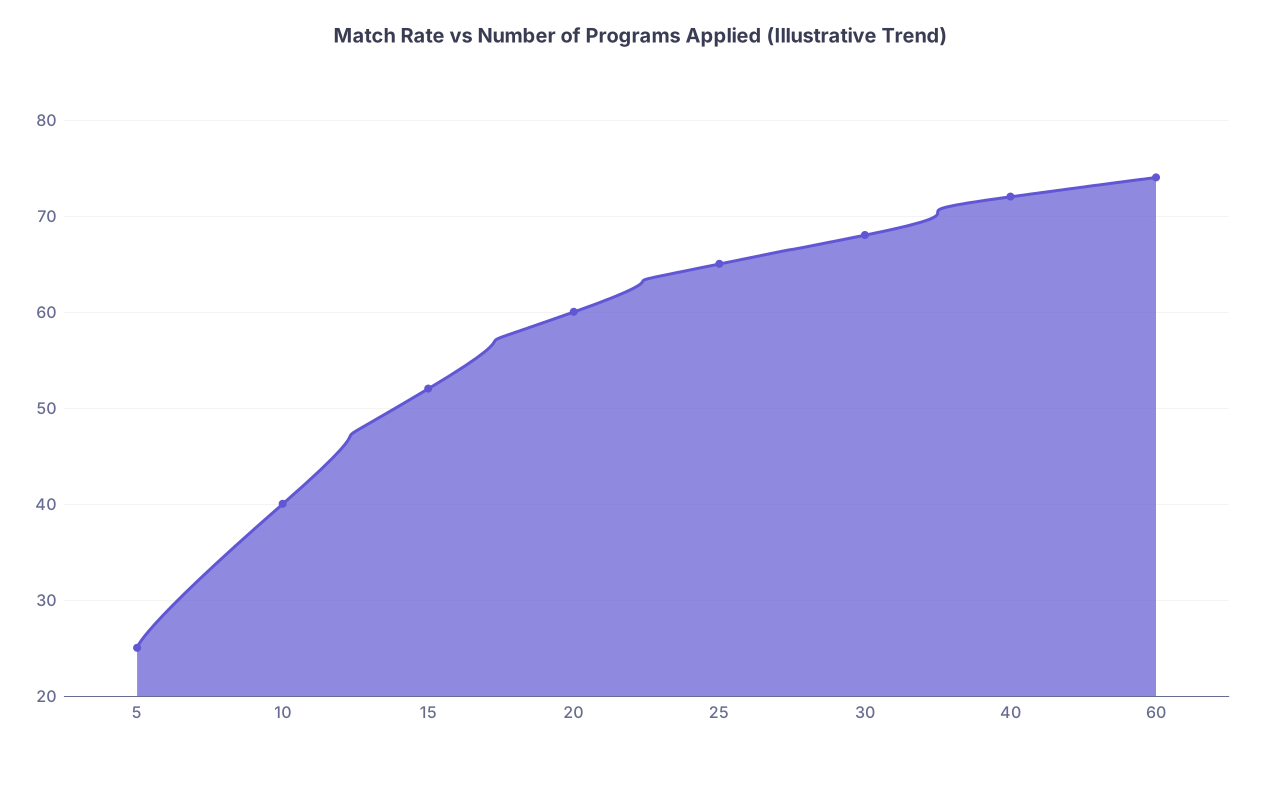
Understanding how many programs to apply is central to any program selection strategy. You must balance match security with financial and emotional bandwidth.
A. General Psychiatry Residency Application Ranges
The exact number depends on your competitiveness and constraints, but rough guidelines:
Highly competitive applicants (strong scores, strong clinical performance, robust psychiatry experiences, no major red flags):
- US MD: 15–25 programs
- DO or IMG with strong US experience: 20–30 programs
Moderately competitive applicants (average scores, solid but not outstanding application, one minor concern like a single exam retake):
- US MD: 25–35 programs
- DO/IMG: 30–45 programs
Higher-risk applicants (significant red flags: multiple exam failures, major gaps, older graduation year, limited US experience):
- Often 40–60+ programs, with heavy inclusion of IMG/DO-friendly and community hospitals
These are not rigid numbers, but they can guide how many programs to apply so you’re not severely under- or over-applying.
B. Tiering Framework: A, B, and C Programs
An effective program selection strategy uses tiers to balance aspiration and safety.
Tier A (“Reach but Reasonable” Programs)
- Programs where your profile is slightly below their typical matched resident on paper, or they are highly selective/name-brand.
- You should still be a plausible candidate (e.g., aligned interests, solid letters, good narrative).
- Typically 15–25% of your list.
Tier B (“Realistic Fit” Programs)
- Your stats and experiences are well within their typical range.
- You meet or exceed many desired characteristics.
- These should be the majority of your applications: 50–60% of your list.
Tier C (“Safety and Underrated” Programs)
- Programs where your profile is stronger than their average matched resident, or they are less competitive due to geography or lesser-known reputation.
- Often include community programs, newer programs, or IMG/DO-friendly sites.
- 20–30% of your list, especially if you have any risk factors.
Example for a moderately competitive US MD applicant:
- Total: 30 psychiatry residency programs
- Tier A: 6–7
- Tier B: 16–18
- Tier C: 6–7
This tiered portfolio increases your chance of matching while still giving you access to aspirational programs.
C. Balancing Volume with Quality
More applications are not always better:
- Each additional program adds:
- Application fees
- Time for research and tracking
- Cognitive load and decision fatigue
If your personal statement, program-specific tailoring, and interview preparation suffer because you applied to 80+ programs, your overall competitiveness may decrease.
Rule of thumb: Aim for the smallest number of programs that still makes not matching statistically unlikely, given your profile and risk factors—and then commit to researching those programs well.

Step 5: Evaluating Individual Psychiatry Programs: What Really Matters
Once you have a manageable list, you move into deep evaluation—this is the core of “how to choose residency programs” in a thoughtful way.
A. Core Training Quality Indicators
When reviewing websites, talking to residents, and reading between the lines, focus on:
Clinical Breadth and Depth
- Do residents see:
- Severe mental illness (schizophrenia, bipolar disorder)
- Personality disorders
- Dual diagnosis (substance use plus other psychiatric illness)
- Neurocognitive disorders, geriatric populations
- How robust is the child and adolescent experience?
- Are there required or elective rotations in addiction, forensic, consultation-liaison (psychosomatic), women’s mental health, etc.?
- Do residents see:
Psychotherapy Training
- Formal curriculum in:
- Supportive therapy
- CBT and other evidence-based modalities
- Psychodynamic/psychoanalytic therapy (if of interest)
- Family and group therapy
- Number of individual psychotherapy cases and supervision structure
- Availability of highly trained psychotherapy supervisors (e.g., psychoanalysts, CBT experts)
- Formal curriculum in:
Supervision and Autonomy
- Is there graduated responsibility from PGY1–4?
- Do residents feel “thrown in” or well-supported?
- Is there night float, and how is supervision overnight handled?
Board Pass Rates and Outcomes
- Psychiatry board exam pass rates (if shared)
- Fellowship match outcomes (e.g., do graduates match competitive child/addiction/forensic programs?)
- Career paths: academics, community practice, subspecialty practice
B. Culture, Wellness, and Resident Satisfaction
Psychiatry training is emotionally demanding; the program culture can make or break your experience.
Look for indicators of a healthy environment:
- Low resident attrition
- Sincere wellness initiatives (not just buzzwords)
- Reasonable call schedules and duty hours compliance
- Protected didactic time truly honored
- Programs openly discussing burnout, support, and mental health resources for residents
- Diversity and inclusion efforts that go beyond statements (mentoring programs, resident demographics, leadership representation)
When possible, talk directly to current residents about:
- How approachable are attendings?
- How does the program respond to resident feedback?
- Is there psychological safety to express concerns or mistakes?
C. Academic and Career Development Support
For residents interested in academics, leadership, or subspecialty practice, examine:
- Availability of research mentors and active projects
- Protected time for scholarly activity
- Opportunities to teach medical students or junior residents
- Supported attendance at conferences (APA, subspecialty meetings)
- Structured career advising and CV/portfolio development
D. Practical Realities: Location, Cost of Living, and Life Outside Work
No matter how great the training, you still live there for 4 years:
- Cost of living vs. salary
- Neighborhood safety and commute times
- Access to social support, hobbies, and community
- If relevant: schools for children, partner job market, immigration considerations
These factors are part of a realistic program selection strategy; burnout is higher when personal life is chronically strained.
Step 6: Applying Strategy in Action: Putting It All Together
To operationalize your psych match strategy, create a simple spreadsheet or tracking system. Include columns such as:
- Program name
- Location
- Program type (university, county, VA, community)
- Tier (A/B/C)
- Psychotherapy strength (1–5)
- Research opportunities (1–5)
- Fit with your mission statement (1–5)
- Visa policy / IMG friendliness / DO friendliness (if relevant)
- Call schedule overview
- Notes from resident conversations or open houses
- Subjective “vibe” score
Example: Evaluating Two Hypothetical Programs
Applicant profile: US MD, average scores, strong clinical comments, wants solid psychotherapy training and eventual outpatient career with some academic involvement.
Program X – University-based, Northeast
- Strong psychotherapy curriculum with required cases
- Mixed inpatient/outpatient balance, heavy PGY1–2 inpatient
- Established fellows in addiction and CL; some research but not heavy
- City location, high cost of living, but near family
- Residents describe supportive faculty but high workload
Fit assessment:
- Psychotherapy: 4/5
- Research: 3/5
- Lifestyle: 2.5/5
- Overall fit: Good, but may be demanding—Tier A/B depending on competitiveness.
Program Y – Community program, Midwestern city
- Strong outpatient presence, large continuity clinic
- Moderate psychotherapy focus, mostly supportive/CBT, less psychodynamic
- Faculty supportive, close-knit resident group, affordable city
- Fewer fellows, but graduates easily match into fellowships when they choose
Fit assessment:
- Psychotherapy: 3/5
- Research: 2/5
- Lifestyle: 4/5
- Overall fit: Excellent for lifestyle and outpatient goals—likely Tier B/C.
With a clear mission and structured comparison, you can see that neither is “better” in absolute terms. The question is: which is better for your specific goals and risk profile? That is the heart of program selection strategy.
Frequently Asked Questions (FAQ)
1. How many psychiatry residency programs should I apply to if I’m a US MD without red flags?
For most US MD applicants with average-to-strong applications and no major red flags, a typical range is 20–30 psychiatry residency programs. Within this:
- 15–20 should be realistic Tier B programs
- 3–6 Tier A “reach” programs
- 3–6 Tier C safety/less competitive but acceptable programs
Adjust upward if you have geographic restrictions (e.g., only one region) or downward if your application is especially strong and you are geographically flexible.
2. I’m an IMG/DO applicant. How should my program selection strategy differ?
As an IMG or DO applicant, program selection strategy should place special emphasis on:
- History of interviewing and matching IMGs/DOs (check program rosters)
- Clear statements of visa sponsorship policies if needed
- Applying to a larger number of programs—often 30–50+—depending on your exam scores, US clinical experience, and graduation year
- Including more Tier C programs and community hospitals, not just big university names
Strong US clinical experience, well-aligned letters from psychiatrists, and a compelling personal story aligned with psychiatry can significantly improve your odds, but volume and targeted selection are crucial.
3. How can I tell if a program really values psychotherapy training?
Look for concrete evidence beyond buzzwords:
- Detailed psychotherapy curriculum on the website with specified modalities
- Required minimum number of long-term therapy cases
- Availability of supervision by trained psychotherapists or analysts
- Residents presenting psychotherapy cases at didactics or conferences
- When you ask residents, they can clearly describe:
- The structure of their therapy training
- How many patients they see in therapy
- How confident they feel in providing psychotherapy by PGY3–4
If psychotherapy is a major part of your identity as a future psychiatrist, place significant weight on these factors in your program selection strategy.
4. What if my interests change during residency—should I still choose a very “narrow” program?
Most applicants’ interests evolve during training. To protect against regret:
- Favor programs with broad exposure (inpatient, outpatient, consultation-liaison, addiction, child & adolescent, community psychiatry) unless you’re absolutely certain.
- Look for a program culture that:
- Encourages elective time
- Supports exploring multiple subspecialties
- Has access (even if via affiliate sites) to fellowships and niche experiences
Choosing a program with flexibility and breadth is often safer than picking a very narrowly focused site—especially early in your career, when you’re still discovering who you are as a psychiatrist.
A thoughtful program selection strategy in psychiatry is about more than numbers or prestige. It’s aligning who you are, who you hope to become, and what each program truly offers. If you approach the psych match with clarity, structure, and intentionality, your list of programs—and ultimately your rank list—will reflect not just where you can match, but where you can thrive.