Radiology residency is one of the most competitive and strategically complex specialties for program selection. With a wide range of program types—large academic centers, hybrid programs, and strong community-based residencies—your program selection strategy in diagnostic radiology has a major impact on your training experience, fellowship options, and early career.
This guide walks you step-by-step through how to build a smart, personalized program list for the diagnostic radiology match, with a focus on:
- How to choose residency programs that actually fit your profile and goals
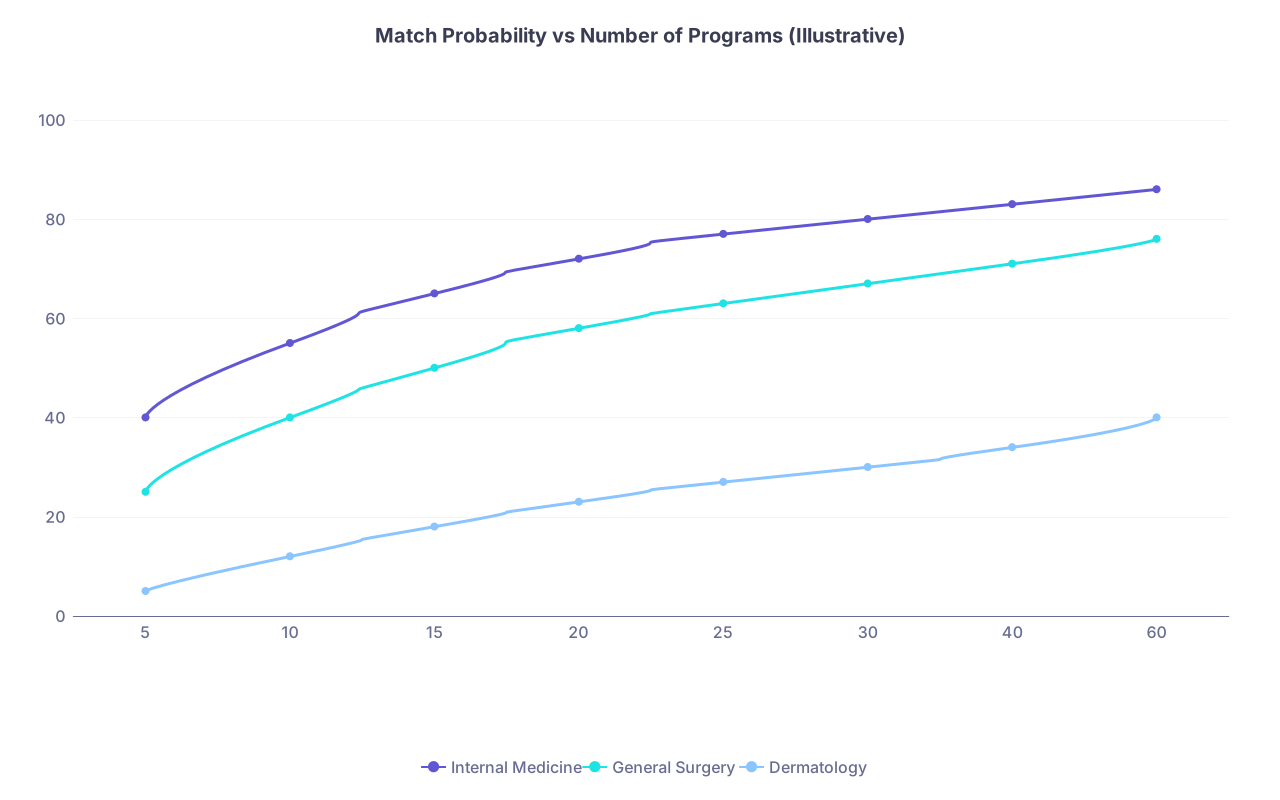
- How many programs to apply to for radiology residency
- How to evaluate programs beyond name and reputation
- Practical frameworks to structure your program selection strategy
Understanding the Structure of Diagnostic Radiology Training
Before you can build a program list, you need to be crystal clear on the structure and terminology specific to radiology.
DR vs. IR/DR vs. ESIR
Most applicants reading this will be applying to Diagnostic Radiology (DR), but you’ll need to understand related pathways:
- Diagnostic Radiology (DR) – The “classic” 4-year residency (PGY-2 to PGY-5) focused on all imaging modalities and subspecialties.
- Integrated Interventional Radiology (IR/DR) – A separate, highly competitive pathway that combines diagnostic and interventional training in a single matched program.
- Early Specialization in Interventional Radiology (ESIR) – A track within DR programs that allows a resident to complete more IR during residency and shorten independent IR training later.
Your program selection strategy will look different depending on whether you are:
- DR-focused
- IR-focused but still applying DR
- Open to both DR and IR/DR
Be honest with yourself about your primary goal before you build your list.
Advanced vs. Categorical Positions
Radiology residency is typically an advanced position:
- Advanced programs (PGY-2 start): You need a separate 1-year preliminary or transitional year (TY) position for PGY-1.
- Categorical programs (PGY-1 built-in): Less common, but some radiology programs include the intern year.
This matters for your program selection strategy because:
You are effectively managing two parallel application processes:
- Radiology residency (advanced)
- Intern year (prelim medicine, prelim surgery, or transitional year)
The geography of your intern year and DR program might differ, unless you deliberately align them.
When thinking about how many programs to apply to, remember that your overall match success depends on both parts of the equation: a DR match and an intern year match.
Clarifying Your Priorities: What Actually Matters for You
One of the biggest mistakes applicants make is applying based on name recognition alone. Instead, start by defining your training, lifestyle, and career priorities, then use those to drive your program selection strategy.
A helpful way to think about this is to group your priorities into four buckets:
- Training and Career Priorities
- Environment and Culture
- Location and Lifestyle
- Personal Circumstances
1. Training and Career Priorities
Ask yourself:
- Do I want a career in academics, private practice, or a mix?
- How interested am I in fellowship (neuro, MSK, body, IR, breast, etc.)?
- Do I care if the program has in-house fellowships vs. sending residents elsewhere?
- Am I aiming for a highly competitive fellowship at a top-tier institution?
Important training-related factors:
Case volume and breadth
- Do residents see a high volume of bread-and-butter cases and complex pathology?
- Is there robust exposure to all subspecialties (neuro, MSK, body, thoracic, pediatrics, IR, nuclear medicine, breast)?
Subspecialty exposure and fellowship matches
- Where do graduates match for fellowships?
- Are there organized fellowship “pipelines” (e.g., many residents matching at the same top centers)?
Teaching and educational structure
- Protected didactics? Daily conferences?
- Physics teaching integrated into the curriculum?
- Support for boards: pass rates, paid board review resources?
Research opportunities
- Is research expected, optional, or minimal?
- Are there funded research blocks or protected time?
- How many residents present at major meetings (RSNA, ARRS, subspecialty societies)?
If you want an academic career, prioritize strong research infrastructure, high-end subspecialty exposure, and robust fellowship pipelines. If you’re aiming for community or private practice, emphasize high clinical volume, efficiency, and autonomy in graduated responsibility.
2. Environment and Culture
Culture is harder to quantify but critical for long-term satisfaction.
Consider:
- Resident autonomy – Are senior residents making first calls on complex cases, interacting directly with clinicians, and reading high-acuity studies?
- Faculty support and mentorship – Are attendings approachable? Are there formal mentorship programs?
- Resident cohesion – Do residents socialize together? How do they describe their culture during interviews?
- Workload and expectations – Is there a culture of reasonable service vs. constant burnout?
Look for consistent signals: what residents say in pre-interview socials, how honestly they respond to challenging questions, and how PDs talk about wellness vs. productivity.
3. Location and Lifestyle
For a 4+1 years (intern + DR) commitment, geography will strongly influence your happiness.
Key questions:
- Urban vs. suburban vs. mid-sized city vs. rural?
- Proximity to family, partner, or support systems?
- Cost of living and housing affordability?
- Commuting logistics (parking, traffic, call travel)?
Some applicants choose a “location-first” program selection strategy, starting with a map and drawing circles around acceptable cities or regions. Others are “program-first”, willing to relocate anywhere for top training. Decide where you fall on that spectrum.
4. Personal Circumstances
Don’t underestimate:
- Partner or spouse career needs (“two-body problem”)
- Visa status (for IMGs)
- Family responsibilities (young children, caregiving)
- Health needs (access to specific medical care or support)
These factors should refine your list, not dominate it, but ignoring them can lead to significant regret.
How Many Radiology Programs to Apply To? A Data-Informed Framework
In diagnostic radiology, the question of how many programs to apply cannot be answered with a single number—it depends on your competitiveness and risk tolerance. However, you can use a structured, tiered approach.
Step 1: Honestly Assess Your Competitiveness
Consider:
- USMLE/COMLEX scores (or pass/fail context and class quartile for Step 2)
- Clerkship and radiology-specific evaluations
- Home radiology department reputation and advocacy
- Research output (especially in radiology)
- Letters of recommendation (particularly from radiologists)
- Red flags (failed exams, leave of absence, professionalism issues)
- IMG status, visa needs, or non-traditional path
You can roughly categorize yourself as:
- Highly competitive – Top tier scores or strong Step 2, AOA, strong clinical record, radiology research, strong home program support.
- Moderately competitive – Solid but not standout metrics, some radiology exposure or research, decent letters.
- At risk / less competitive – Below-average metrics, limited radiology exposure, fewer letters from radiologists, significant red flags, or IMG/visa needs.
Step 2: Target Application Range by Competitiveness
Diagnostic radiology is middle-to-high competitiveness, with substantial variability by applicant profile and program tier.
A reasonable starting range for the diagnostic radiology match (advanced positions only) is:
- Highly competitive applicants:
- 25–40 DR programs
- Moderately competitive applicants:
- 40–60 DR programs
- Less competitive / at-risk applicants (including many IMGs):
- 60–80+ DR programs
Then add prelim/TY applications:
- Typically 10–20 preliminary or transitional year programs, depending on your geographic flexibility and competitiveness in those fields.
This might feel like a lot, but radiology has many strong mid-tier programs where you can get excellent training. Your program selection strategy should be about building depth in your “middle tier,” not just amassing big-name applications.

Building Your List: A Step-by-Step Program Selection Strategy
Now that you’ve framed your priorities and approximate application volume, it’s time to systematically build your list.
Step 1: Start Broad With Databases and Filters
Use tools like:
- FREIDA (AMA)
- NRMP’s interactive data reports
- Program websites
- Specialty-specific resources (e.g., ACR, Association of University Radiologists)
Filter by:
- Program type: University, community, university-affiliated
- Location: Regions or specific states you’re open to
- Position type: Advanced vs. categorical
- Visa sponsorship (if relevant)
Create a master spreadsheet with:
- Program name
- Location
- Program type (academic, community, hybrid)
- Number of residents per year
- IR/DR and ESIR availability
- In-house fellowships (yes/no, which ones)
- Notes section
Step 2: Categorize Programs Into Tiers
Rather than relying on vague “top 10” lists, create your own tier system that reflects your goals.
You might define:
Reach programs
- Very competitive academic centers or popular geographic areas (e.g., big coastal cities)
- Programs where your stats may be below their usual range, but still reasonably in the ballpark
Target programs
- Solid academic or hybrid programs where your metrics align well with recent matches
- Good track record of fellowships and job placement
Safety programs
- Community or less well-known academic programs, often in less popular locations
- You would still be comfortable training there and can see them as viable backup options
For each category, assign approximate numbers:
Highly competitive applicant:
- 5–10 reach
- 15–20 target
- 5–10 safety
Moderately competitive applicant:
- 5–10 reach
- 20–30 target
- 10–15 safety
Less competitive applicant:
- 10–15 reach (including less competitive academic centers)
- 20–30 target
- 20–30 safety
The key: Your “safety” list should not be an afterthought. Many strong radiologists train in lesser-known programs with excellent case volume and solid outcomes.
Step 3: Evaluate Programs Using a Standardized Framework
To avoid getting overwhelmed by marketing language and glossy websites, use a consistent rubric for each program.
Consider scoring each program (e.g., 1–5) across:
Training Quality
- Case volume and complexity
- Diversity of imaging modalities and subspecialty rotations
- Call structure (night float vs. home call, frequency)
Educational Environment
- Protected teaching time
- Board pass rates
- Physics education
- Feedback and evaluation processes
Research and Academic Opportunities
- Publications and presentations by residents
- Availability of mentors
- Time protected for projects
IR/DR and ESIR Options (if relevant)
- Number of IR attendings
- ESIR-approved spots
- IR call exposure and procedure volume
Culture and Support
- Resident testimonials (websites, social media, word of mouth)
- Wellness initiatives
- Program responsiveness to feedback (e.g., changes after COVID, call adjustments)
Location and Lifestyle
- Geography, cost of living
- Partner/family considerations
- Commute, parking, on-call facilities
You don’t need a perfect scorecard, but even a rough comparison will help you make rational decisions instead of relying on reputation alone.
Step 4: Adjust Based on Interview Offers
Your initial list is just that—initial. As interview season progresses:
- If you receive fewer DR interviews than expected (for your competitiveness), consider applying to additional safety and mid-tier programs earlier in the season.
- If you receive interviews mostly from your target tier, you can stop sending out new applications.
- If your invites are heavily clustered in safety programs only, think carefully about adding more programs in similar or slightly stronger tiers to reduce risk.
Monitor the diagnostic radiology match trends for your year—student advisors, online forums, and specialty societies often comment on whether a year is “tighter” or more applicant-heavy than usual.
Special Considerations by Applicant Type
Your program selection strategy should be customized based on your specific applicant profile.
U.S. MD Seniors With Strong Home Programs
Advantages:
- Strong letters from radiologists
- Department advocacy and networking
- Better understanding of the field’s expectations
Strategy tips:
- Use advisors and home attendings to identify programs that fit your profile.
- Consider your home program seriously—it often belongs in your top tier unless it truly doesn’t align with your goals.
- You can afford a somewhat smaller list if you’re clearly above average (but don’t under-apply).
U.S. DO Students
Many radiology programs are increasingly DO-friendly, but some remain more traditional.
Strategy tips:
- Pay attention to previous DO matches in program rosters.
- Highlight any radiology electives, research, and strong Step 2 performance.
- Expand your list somewhat, especially with community and hybrid programs open to DOs.
International Medical Graduates (IMGs)
Diagnostic radiology remains challenging for IMGs, but matches do happen every year.
Strategy tips:
- Prioritize programs with a documented history of taking IMGs.
- Use filters for visa sponsorship.
- Expect to apply broadly (60–90+ programs), with heavy emphasis on safety and mid-tier options.
- Secure strong U.S.-based radiology letters if possible, via observerships or electives.
Applicants Interested in IR/DR or ESIR
If you’re IR-leaning:
- Apply to a mix of IR/DR and DR programs with ESIR.
- For DR programs, specifically examine:
- ESIR approval status
- Number of IR faculty
- Procedure volume and resident involvement
- Recognize that the integrated IR/DR match is more competitive and build a robust DR list as well.

Practical Tips and Common Pitfalls in Program Selection
Avoid Over-Indexing on Prestige Alone
Well-known academic centers are attractive, but:
- Many mid-tier and community-based radiology residency programs offer excellent case volume, close faculty supervision, and robust job placement.
- Fellowship directors care about your performance and letters, not just your residency name.
Ask: “Would I be happy training here for four years, even if this weren’t a brand-name program?”
Don’t Ignore the Importance of Call and Workload
Radiology call structure dramatically shapes your life:
- Night float vs. traditional call
- Home call vs. in-house requirements
- How early in residency you start taking call
- Support on call (e.g., teleradiology backup, attending availability)
A place with punishing call and poor backup may impact wellness, learning, and boards prep more than marginal differences in prestige.
Use Away Rotations Strategically (If Available)
If you’re still early enough in your timeline:
- Consider at most 1–2 away rotations at programs that:
- Are realistic match targets
- Align with your long-term goals
- Have a history of ranking rotators highly
An away rotation can:
- Strengthen your application with a strong letter
- Give you deep insight into that program’s culture
- Help you decide if a high-reputation program is actually a good personal fit
Plan for the Parallel Intern Year Strategy
Remember that your overall match requires both:
- A diagnostic radiology (or IR/DR) position
- A preliminary or transitional year
When deciding how many programs to apply to, and which, consider:
- Whether you prefer transitional year (more balanced) vs. prelim medicine/surgery (more specialty-specific)
- If you want your intern year geographically close to your DR program
- Whether any of your DR programs have strong linked intern positions or preferred prelim sites
Some applicants anchor their intern applications to regions that overlap most with their DR program list, increasing the chance of geographic alignment.
Putting It All Together: A Sample Strategy
Imagine you are a U.S. MD senior with:
- Solid but not outstanding Step 2
- A few radiology research projects
- Strong letters from your home DR department
- Preference for mid-sized to large cities, flexible geographically
A reasonable program selection strategy for the diagnostic radiology match might be:
45 DR applications total
- 8–10 reach academic programs in major cities
- 20–25 target academic or hybrid programs across multiple regions
- 10–12 safety programs, mostly community or smaller academic centers, some in less popular locations
15 intern year applications
- 8–10 transitional/prelim medicine spots in regions overlapping your DR programs
- 5–7 additional prelim positions in slightly broader regions as backup
You then refine your list during interview season:
- If by mid-season you have fewer than ~8–10 DR interviews, you consider adding more safety/mid-tier programs.
- If you’ve reached ~12–15 DR interviews (a strong number), you may not need additional applications.
Your ranking then prioritizes:
- Strong educational culture and case mix
- Reasonable lifestyle and location
- A balanced mix of academic recognition and day-to-day training quality
Frequently Asked Questions (FAQ)
1. How many radiology residency programs should I apply to if I’m an average applicant?
For a moderately competitive U.S. applicant in diagnostic radiology, a typical range is:
- 40–60 DR programs, plus
- 10–20 prelim/TY programs
Lean toward the higher end if you have significant geographic preferences, a lower Step 2, limited radiology exposure, or any mild red flags. Your goal is to secure enough interviews (often >10 is considered relatively safe) to comfortably rank a diverse list of programs.
2. How can I tell if a community radiology residency is “good enough”?
Strong community-based DR programs usually have:
- High clinical case volume, including emergency and inpatient studies
- Exposure to all major subspecialties (even if fewer dedicated subspecialty attendings)
- Graduates who successfully match into solid fellowships
- Faculty invested in teaching, with regular conferences and didactics
- Reasonable workload and supportive culture
Look at resident rosters, alumni destinations, and resident testimonials. Don’t dismiss community programs; they can produce excellent, very employable radiologists.
3. Should I prioritize programs that have ESIR if I’m interested in IR?
If you are seriously IR-oriented, yes—ESIR availability should influence your program selection strategy, but it shouldn’t be the only factor. Consider:
- Programs with ESIR designation and clear IR training pathways
- Number of IR faculty and procedures
- How many residents per year are realistically supported for ESIR
- Overall DR training quality, since even IRs must be strong diagnosticians
Also keep in mind that pathways and accreditation evolve; choose a program where both diagnostic and interventional education are robust.
4. Is it a bad idea to choose programs mainly based on location?
It’s not inherently bad, but it’s risky if you ignore training quality. A location-first strategy is reasonable if:
- You have strong personal reasons (family, partner, health)
- You ensure that every program on your list still meets minimum standards for case mix, education, and culture
However, if you overly restrict geography—especially in a competitive specialty like radiology—you may need to apply to more programs within that region and accept a narrower range of program types to maintain a safe chance of matching.
Thoughtful program selection in diagnostic radiology is about more than just numbers—it’s about aligning your personal priorities, competitiveness, and long-term career goals with a realistic, well-balanced application strategy. By structuring your program list intentionally and staying flexible as the match season unfolds, you dramatically improve both your odds of matching and your satisfaction with where you’ll spend the next five crucial years of your training.