Understanding the Landscape: EM-IM Combined Residency for DO Graduates
Choosing a program selection strategy as a DO graduate interested in Emergency Medicine-Internal Medicine (EM-IM) means navigating a niche but highly rewarding path. Combined EM IM programs are limited in number, highly structured, and tend to be competitive. At the same time, DO applicants have some unique strengths and considerations—especially around osteopathic recognition, COMLEX vs USMLE, and geographic and program culture fit.
This article is designed to walk you through how to choose residency programs strategically, with a specific focus on:
- How many programs to apply to as a DO graduate targeting EM-IM
- How to build and refine your list
- How to realistically assess your competitiveness
- How to integrate categorical Emergency Medicine and Internal Medicine programs into your backup strategy
- How to approach osteopathic residency match considerations in the single accreditation era
Throughout, the emphasis is on a deliberate, data-informed program selection strategy that balances ambition with realism.
Step 1: Know Your Niche – What Makes EM-IM Unique?
Combined Emergency Medicine-Internal Medicine residencies train physicians to be board-eligible in both EM and IM, typically over five years. These programs are ideal if you want:
- A blended career (e.g., splitting time between ED shifts and inpatient medicine)
- A strong foundation in complex medical management with acute care skills
- Potential fellowship options in either EM or IM (e.g., critical care, ultrasound, cardiology, palliative, administration)
- Flexibility to work in community settings, academic hospitals, or leadership roles
Limited Number of Programs
One of the most important realities driving your program selection strategy: the small number of EM-IM combined programs. At any given cycle, you may see:
- ~10–15 EM-IM programs nationally
- Most offering only a few positions per year (often 2–4 spots)
This limited supply translates into:
- High competition per seat
- Less flexibility with geography
- Greater need for an intentional backup approach (e.g., including EM-only and IM-only programs)
How DO Status Factors In
As a DO graduate, your profile is absolutely appropriate for EM-IM, but you should understand how DO applicants are viewed:
- Many programs are now familiar and comfortable with DO graduates due to the single accreditation system.
- Some EM-IM programs have a strong track record of training DO residents; others have historically taken mostly MDs.
- Programs may differ in their comfort interpreting COMLEX vs USMLE scores.
Your strategy should therefore include:
- Identifying programs that consistently interview and rank DO graduates
- Clarifying whether programs accept COMLEX alone or prefer/require USMLE
- Recognizing that your DO background can be a strength, especially in systems-oriented care and holistic patient management
Step 2: Assess Your Competitiveness as a DO EM-IM Applicant
Before deciding how many programs to apply to—or which ones—you need an honest assessment of your competitiveness. This is central to any strong program selection strategy.
Core Components to Evaluate
Board Scores (COMLEX and/or USMLE)
- For EM-IM: competitive scores help, but they’re not everything.
- Programs often use filters or general thresholds.
- If you took USMLE:
- Check your scores relative to EM and IM national averages.
- If you only took COMLEX:
- Confirm which programs accept COMLEX alone.
Clinical Performance and MSPE Comments
- Performance on EM, IM, and ICU rotations is particularly important.
- Honors/high pass designations in EM/IM or strong narrative comments can be highly influential.
- Sub-internships or acting internships in EM or IM (particularly at EM-IM sites) matter.
Letters of Recommendation (LoRs)
- At least:
- 1–2 EM-specific letters (often from SLOEs if available)
- 1–2 IM or sub-specialty IM letters
- Strong, detailed letters that highlight work ethic, clinical reasoning, and ED performance significantly boost your application.
- At least:
Dual Interest Evidence
Programs want to see genuine interest in both Emergency Medicine and Internal Medicine:- Research or QI projects crossing EM and IM (e.g., sepsis, heart failure, chest pain pathways)
- Dual-focused personal statement, clearly articulating why EM-IM (not just EM or IM separately)
- Electives or experiences in both acute care and complex chronic disease management
Red Flags
- Course failures, professionalism concerns, multiple attempts at COMLEX/USMLE, or large gaps in training.
- Red flags don’t automatically exclude you, but they demand a more conservative program selection strategy and broader application list.
Self-Categorize: Reach, Target, and Safety Programs
Using the above elements, roughly classify your fit with EM-IM and categorical EM/IM programs:
- Highly Competitive EM-IM Applicant
- Strong COMLEX and/or USMLE scores (around or above national EM/IM matched means)
- Honors on EM and IM rotations; strong SLOEs and IM letters
- No major red flags
- Moderately Competitive
- Scores around the national average; a mix of honors/high pass/passes
- Solid letters; maybe one minor concern (e.g., slow start, one low shelf score)
- Less Competitive / Risk Factors
- Scores notably below average, failed exam attempt, or concerning narrative comments
- Limited EM exposure or weaker letters
- Nontraditional graduate (older, gap years) with unclear explanation
Your self-categorization will help determine how many programs to apply and how heavily to rely on EM/IM backup options.

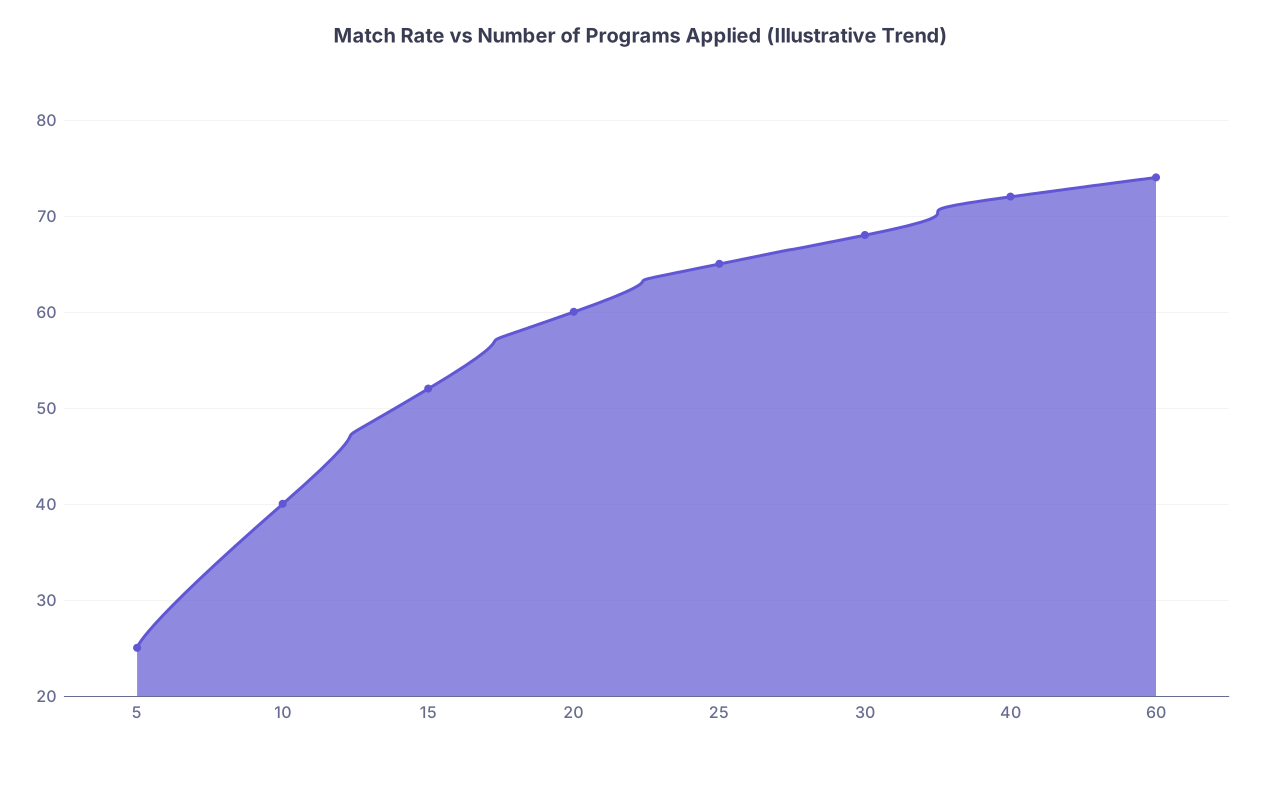
Step 3: How Many Programs to Apply To in EM-IM (and Beyond)
Because EM-IM has so few positions nationally, focusing only on combined programs is high risk—even for strong applicants. Your program selection strategy must balance your passion for EM-IM with a realistic backup plan.
Baseline Numbers for EM-IM Applications
Numbers vary by year, but for most DO graduates:
- Pure EM-IM Applications Alone
- Number of EM-IM programs nationwide: ~10–15
- Realistically, you’ll apply to every EM-IM program that is even a moderate geographic or academic fit.
- This is usually 10–15 applications.
However, this number alone is inadequate. You should strongly consider adding:
- Categorical Emergency Medicine programs
- Categorical Internal Medicine programs
especially if EM-IM is your top choice but not your only acceptable outcome.
Integrated Strategy: EM-IM + Categorical EM + Categorical IM
A solid, data-informed approach for DO graduates interested in EM-IM could look like this (adjust based on your competitiveness):
For Highly Competitive DO EM-IM Applicants
- EM-IM: Apply to all feasible programs: 10–15
- Emergency Medicine (EM-only):
- If you’d be happy matching to EM categorical: 25–35 EM programs
- Internal Medicine (IM-only):
- As a secondary backup: 10–15 IM programs, preferably at academic or EM-heavy centers you like
Total applications: Around 45–65 programs
For Moderately Competitive Applicants
- EM-IM: All feasible programs: 10–15
- EM-only: 30–40 EM programs (focus on DO-friendly, mid-tier academic and strong community EM programs)
- IM-only: 15–20 programs, especially those with strong critical care/ED ties
Total applications: Around 55–75 programs
For Less Competitive / Risk-Factor Applicants
- EM-IM is still possible, but treat it as a reach.
- EM-IM: 10–15 (all realistic)
- EM-only: 35–45+ programs, emphasizing community-based, DO-friendly, and geographically broad options
- IM-only: 20–25 programs, including a mix of academic and strong community IM
Total applications: Around 65–85 programs
These numbers are not rigid rules, but they offer a realistic range when you’re wondering how many programs to apply to as a DO graduate targeting emergency medicine internal medicine combined training.
Factors That May Push You to Apply to More Programs
- Below-average board scores
- Limited EM exposure (few SLOEs, late EM rotations)
- Geographic restrictions (e.g., “I must stay in one region”)
- Red flags (failed exam, professionalism issues, repeated year)
- Applying late in the season
Factors That May Allow Fewer Applications
- Very strong scores and letters, robust dual EM/IM track record
- Broad geographic flexibility
- Prior networking with EM-IM faculty or away rotations at EM-IM programs
- Strong home EM and IM departments with robust advocacy
Step 4: Building Your List – A Structured Program Selection Strategy
Once you have a sense of how many programs to apply to, the next step is deciding which ones. This is where a formal program selection strategy matters.
1. Start With All EM-IM Programs
Begin by listing all current EM-IM combined programs using:
- ERAS Directory
- FREIDA
- Individual institution websites
- EM-IM-specific interest groups or national society resources
For each EM-IM program, collect:
- Number of positions per year
- Recent match lists and resident rosters
- Whether DOs are currently or recently in the program
- Board exam requirements (COMLEX accepted? USMLE preferred/required?)
- Program size, faculty interests, and hospital setting (quaternary, academic, community-academic)
Remove only those programs that are absolute nonstarters (e.g., you cannot live in that region, severe misalignment of values, or clear non-acceptance of DOs).
2. Layer in Categorical EM and IM Programs
For your EM-only and IM-only lists, use several filters:
- DO-Friendliness:
- Check how many DO residents are listed on the website.
- Talk to mentors, older DO graduates, and alumni.
- Geographic Preferences:
- Prioritize areas where you have ties: family, prior work or school, meaningful long-term connections.
- Geographic ties increase interview chances.
- Program Type:
- Academic vs community vs hybrid.
- As an EM-IM–interested applicant, you may favor:
- Academic centers with strong IM and critical care
- EM programs with substantial IM collaboration and ICU exposure
3. Categorize Programs by Competitiveness
Create a spreadsheet and classify each program—EM-IM, EM, and IM—as:
- Reach: More competitive than your profile (e.g., top academic centers, very high board averages, few DOs)
- Target: Good alignment with your scores, experiences, and letters.
- Safety / More Attainable: Historically DO-friendly, less competitive locations, strong community programs.
Aim for a balanced distribution:
- 20–30% Reach
- 40–50% Target
- 20–30% More Attainable
This framework helps ensure you’re not overloading your list with ultra-competitive programs.
4. Evaluate Program Culture and Fit
Program selection is not just about “Can I match?” but also “Will I thrive there?” For EM-IM, consider:
- How integrated the EM and IM components are
- Resident satisfaction and wellness initiatives
- Scheduling structures (e.g., how EM vs IM blocks are split annually)
- Support for fellowships in EM or IM
- Track records of graduates: academic, community, fellowship pathways
Use:
- Virtual open houses
- Program websites and social media
- DO and EM-IM-specific interest groups
- Conversations with current residents (especially DOs)

Step 5: Special Considerations for DO Graduates in EM-IM
As a DO graduate, you bring unique strengths and logistics to your osteopathic residency match strategy, even within the now-unified ACGME system.
COMLEX vs USMLE: Impact on Program Selection
If you have COMLEX only:
- Focus on programs that explicitly accept COMLEX without USMLE.
- Review program FAQs or reach out politely via email if unclear.
- EM-only programs may more often prefer USMLE, but many are increasingly comfortable with COMLEX.
If you have both COMLEX and USMLE:
- Include both in ERAS unless advised otherwise by your dean’s office.
- If one exam is significantly weaker, strategize with an advisor about whether to report it (if allowed by the cycle’s rules and program preferences).
Your exam portfolio may slightly shape how many programs to apply to—more “unknowns” or complications usually argue for a broader list.
Osteopathic Recognition and Culture
Some Internal Medicine or EM programs have historical osteopathic roots, or previously had AOA accreditation. These programs may:
- Be especially DO-friendly
- Have faculty trained in osteopathic manipulative treatment (OMT)
- Value holistic, systems-based care in a way that aligns well with DO training
Even if the EM-IM combined program itself doesn’t have formal osteopathic recognition, the larger institution or departments may. Those environments can feel more welcoming and supportive to DO graduates.
Away Rotations and Networking
For EM-IM–focused DO applicants:
An away rotation at an EM-IM site (if available) is extremely valuable:
- Direct exposure to combined training
- Ability to obtain high-quality letters from EM-IM faculty
- Demonstrates clear interest in emergency medicine internal medicine combined training
If EM-IM rotations are not available:
- Do an EM away at a strong academic EM site
- Aim for an IM sub-internship at a program known for strong critical care or complex medicine
Networking and visibility can offset some disadvantages of being an “unknown DO school” or coming from a smaller institution.
Backup Planning Without Abandoning Your Goal
Your understandable goal is to match into an EM-IM combined program. But your program selection strategy must assume risk and protect your ability to train in at least one of your core interests. Strategies include:
- Ranking EM-IM programs highest if you interview there
- Then ranking EM-only and/or IM-only programs according to genuine preference
- Being honest with yourself:
- Would you rather train in EM than in IM if EM-IM doesn’t work out?
- Or would a strong IM program with a robust ED/ICU experience be more satisfying long-term?
Clarifying this early shapes which categorical programs you emphasize in your application and rank list.
Practical Example: Building a Realistic List as a DO EM-IM Applicant
Imagine you are a DO graduate with:
- COMLEX-L1 and L2 in the average range
- USMLE Step 2 slightly below the EM average but passing on first attempt
- Strong clinical grades in both EM and IM
- One away EM rotation and good SLOEs
- No major red flags, but coming from a newer DO school without a home EM program
A reasonable program selection strategy might be:
EM-IM Combined:
- Identify all 10–15 available EM-IM programs
- Eliminate 1–2 massive geographic outliers (e.g., places you’d absolutely never move)
- Apply to 12–14 EM-IM programs
Emergency Medicine (categorical):
- Use EMRA Match, FREIDA, and word-of-mouth to identify DO-friendly EM programs
- Include a mix of academic and strong community programs
- Apply to 30–35 EM programs, focusing on:
- Midwest, South, and regions known for DO acceptance
- Programs with at least a few DO residents on their rosters
Internal Medicine (categorical):
- Focus on university-affiliated IM programs with strong critical care and ED collaboration
- Include some “safety” community IM programs
- Apply to 15–18 IM programs
Total: ~60–67 applications.
This list appropriately balances your passion for emergency medicine internal medicine combined training with the practical question of how many programs to apply to for a reasonable chance to match.
Final Tips: Executing Your Program Selection Strategy
Start Early
- Begin researching EM-IM and categorical programs in the spring of MS3.
- Meet with an advisor who understands the match landscape for DO graduates.
Use a Detailed Spreadsheet
- Columns: Program name, type (EM-IM/EM/IM), location, DO-friendliness, COMLEX/USMLE policy, perceived competitiveness, personal notes, and priority (reach/target/safety).
Be Honest About Geography
- The more flexible you are, the fewer total applications you may need.
- If you restrict yourself heavily, plan to apply to more programs overall.
Update Your Strategy as New Information Arrives
- If away rotations go extremely well and your SLOEs are excellent, you may slightly adjust your balance of reach vs target programs.
- If new issues arise (e.g., exam retake), expand your list and focus more on IM backups.
Apply Thoughtfully, Not Randomly
- Volume alone does not guarantee success.
- Tailor your personal statement and experiences to highlight your genuine interest in emergency medicine internal medicine, even when applying to categorical programs.
FAQ: Program Selection Strategy for DO Graduates in EM-IM
1. As a DO graduate, can I realistically match into an EM-IM combined residency?
Yes. DO graduates do successfully match into EM-IM programs each year. Your chances improve if you:
- Apply to all EM-IM programs where you’re a reasonable fit
- Present strong EM and IM letters (ideally including SLOEs)
- Demonstrate clear, well-articulated interest in dual training
- Include a robust set of EM and/or IM categorical programs as backups
DO status alone is not a barrier; your holistic application and program selection strategy are more important.
2. How many EM-IM programs should I apply to?
In most cases: every EM-IM program that is even remotely acceptable to you—usually around 10–15. The small national pool of EM-IM positions means it’s unwise to be overly selective at the application stage. Then supplement with a substantial number of EM-only and IM-only programs based on your competitiveness.
3. Do I need to take USMLE in addition to COMLEX for EM-IM?
Not universally, but it helps at many programs. Some EM-IM and EM programs:
- Prefer or require USMLE scores
- Are still adapting to interpreting COMLEX
If you are early in training and considering EM-IM or EM, talk with your dean’s office or an advisor about the pros and cons of adding USMLE. If you already completed only COMLEX, focus on programs that explicitly accept COMLEX and emphasize your other strengths—clinical performance, letters, and dual-interest experiences.
4. Should I prioritize EM or IM programs as my backup if I want EM-IM?
This depends on your personal priorities:
- If your primary identity is as an emergency physician, favor more EM categorical programs as backup.
- If you value longitudinal patient care or are strongly considering IM-based fellowships (e.g., cardiology, heme/onc), weighting more IM programs might make sense.
- Many EM-IM–oriented applicants choose a balanced backup: a solid pool of EM programs and a meaningful set of IM programs, so that both potential outcomes align with their long-term goals.
Whichever you choose, integrate that preference into your overall program selection strategy and be realistic about how many programs to apply to in each category based on your competitiveness.
By combining honest self-assessment, knowledge of EM-IM program structures, and a deliberate approach to how many programs to apply to across EM-IM, EM-only, and IM-only options, you can create a robust, flexible program selection strategy that maximizes your chances of entering a training path aligned with your skills and values as a DO graduate.