Understanding the Landscape: Addiction Medicine Pathways for US Citizen IMGs
As a US citizen IMG (American studying abroad), planning a program selection strategy in addiction medicine means thinking in two layers:
- Primary residency (Internal Medicine, Family Medicine, Psychiatry, Pediatrics, or Emergency Medicine)
- Addiction Medicine fellowship (ACGME-accredited subspecialty training after residency)
Because Addiction Medicine is almost always a fellowship rather than a standalone residency, your immediate focus is:
- How to choose residency programs that will:
- Accept and support a US citizen IMG
- Offer strong substance abuse training
- Provide exposure, mentorship, and research opportunities in addiction medicine
Your program selection strategy should therefore integrate:
- Match probabilities as a US citizen IMG
- Geographic and visa considerations (less restrictive for you than non-US IMGs)
- Addiction-related clinical opportunities
- Future competitiveness for an addiction medicine fellowship
Throughout this article, “programs” primarily refers to residency programs, with targeted attention to selecting environments that set you up for addiction medicine fellowship success.
Step 1: Clarify Your Pathway and Competitiveness
Before you decide how many programs to apply to or which ones, you need to understand:
- Where you fit compared to typical matched US citizen IMGs
- How your path aligns with eventual addiction medicine fellowship training
A. Confirm Your Training Pathway
Most Addiction Medicine physicians follow:
- Residency:
- Internal Medicine
- Family Medicine
- Psychiatry
- Pediatrics
- (In some cases) Emergency Medicine or Preventive Medicine
- Addiction Medicine Fellowship (1 year, ACGME-accredited)
For a US citizen IMG motivated by addiction medicine, the most common routes are:
- Psychiatry → Addiction Psychiatry or Addiction Medicine fellowship
- Internal or Family Medicine → Addiction Medicine fellowship
When you’re choosing residency programs, you’re really asking:
“Which programs best prepare me for an addiction medicine fellowship and a career in substance use disorder care?”
B. Assess Your Competitiveness Objectively
Your program selection strategy should match your actual profile. Consider:
- Licensing exams:
- USMLE Step 1 (pass/fail, but performance still matters to some programs)
- Step 2 CK score (critical)
- Number of attempts (any failures matter)
- Gaps in training / year of graduation
- Clinical experience:
- US clinical experience (USCE): electives, clerkships, observerships
- Addiction-related rotations (e.g., detox, rehab, psychiatry, pain clinics)
- Research and scholarly work:
- Substance use disorder, mental health, public health, or health systems
- Letters of recommendation (especially from US attendings, addiction or psychiatry faculty are a plus)
- Language/cultural skills relevant to high-risk communities
For US citizen IMGs, program directors often ask:
- Why did this American studying abroad choose an international school?
- Have they demonstrated commitment and performance equivalent to US grads?
- Are they ready for the complexity of patients with co-occurring medical and substance use issues?
Practical Exercise: Self-Ranking
Create a simple table with three tiers:
Tier 1: Strong applicant
- Step 2 CK ≥ ~240
- No exam failures
- Recent graduation (≤ 2 years)
- 2–3 US clinical experiences with strong letters
- Some addiction-related exposure or research
Tier 2: Mid-range applicant
- Step 2 CK ~225–239
- Maybe ≥ 1 minor gap or older graduation
- Limited USCE but at least 1 strong US letter
- Demonstrated interest in substance abuse training through electives/volunteering
Tier 3: At-risk applicant
- Step 2 CK < 225 or exam failures
- Significant gap since graduation
- Minimal USCE or no solid US letters
- Little documented addiction-related experience
Your tier helps determine how many programs to apply to and how broad your program list should be.
Step 2: How Many Programs to Apply To as a US Citizen IMG
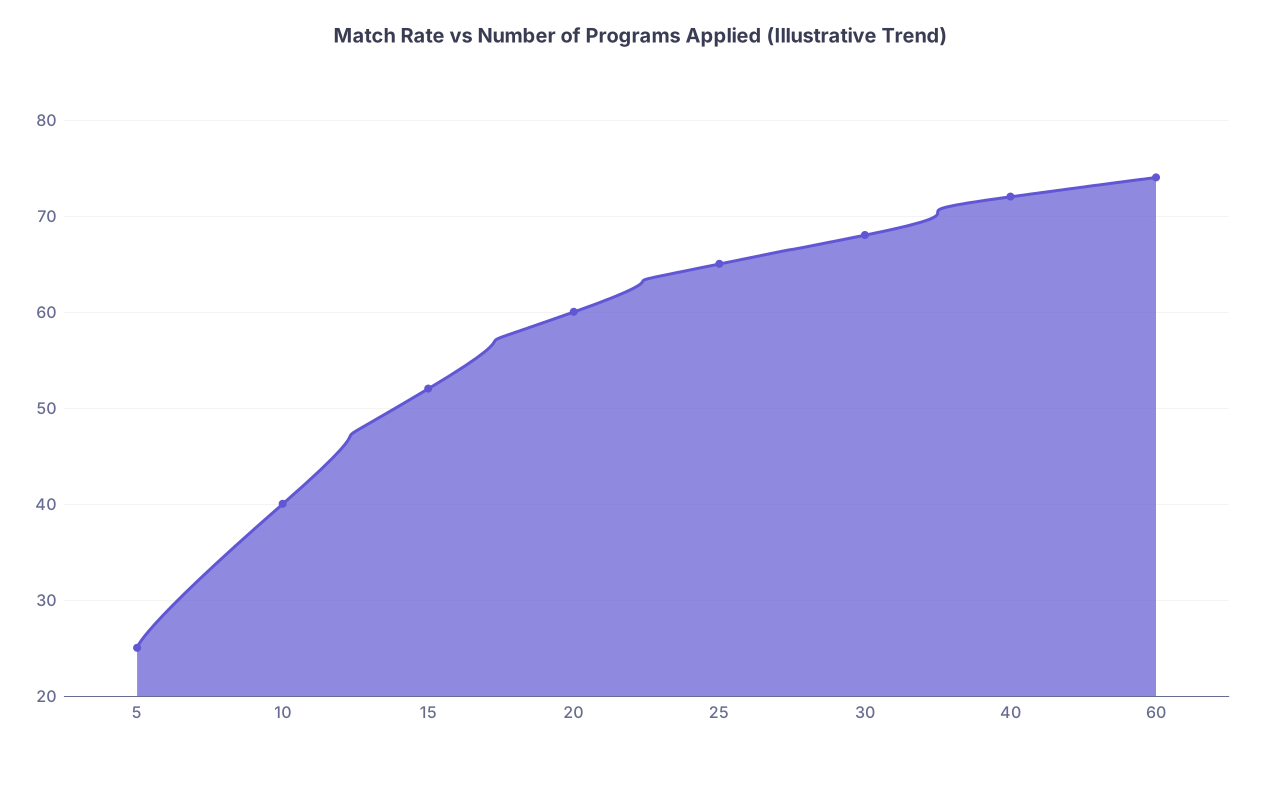
For US citizen IMGs, application volume is often a key part of match strategy. When targeting fields that can lead to addiction medicine (e.g., psychiatry, internal medicine, family medicine), you should balance:
- Realistic match odds
- ERAS application cost
- Bandwidth for tailored applications and interviews
A. General Numerical Guidance
These are general ranges, not rigid rules, assuming you’re applying to a single core specialty:
- Tier 1 (strong) US citizen IMG
- Psychiatry: ~25–40 programs
- Internal Medicine or Family Medicine: ~25–40 programs
- Tier 2 (mid-range)
- Psychiatry: ~40–60 programs
- Internal/Family Medicine: ~40–60 programs
- Tier 3 (at-risk)
- Psychiatry: ~60–80+ programs
- Internal/Family Medicine: ~60–100+ programs
If you are dual-applying (e.g., Psychiatry + Family Medicine), you can:
- Apply to fewer in each specialty but keep the total number in a similar or slightly larger range:
- Mid-range IMG dual-applying: ~70–90 total programs (e.g., 40 psych + 30 FM)
These numbers shift depending on:
- How late you’re applying
- Number of exam failures
- Older year of graduation
- Limited USCE
In those cases, use the higher end of the ranges.
B. Avoid the “Apply Everywhere” Trap
Many US citizen IMGs are told to “apply to every program that accepts IMGs.” This is:
- Expensive
- Strategically inefficient
- Often results in many low-yield applications
A better strategy:
- Define your core target list (programs realistically in your range)
- Add reach programs (a bit above your metrics but still IMG-friendly)
- Add safety programs (known IMG-heavy, community-based)
As you decide how many programs to apply to, remember:
Your goal is not maximum volume; it’s maximum interview yield from well-chosen programs.

Step 3: Building a Targeted List – Filters and Priorities
Now to the heart of program selection strategy: which programs should go on your list?
A. Step 1: Filter by IMG-Friendliness and Eligibility
As a US citizen IMG, visa is not your primary barrier, but IMG friendliness still matters.
Key data sources:
- FREIDA (AMA residency database)
- Residency program websites
- NRMP “Charting Outcomes in the Match”
- Program social media and resident bios
Filter programs by:
IMG presence
- Do current residents or alumni include IMGs?
- Are any clearly US citizen IMG or American studying abroad?
USMLE requirements
- Minimum Step 2 CK score or cutoffs?
- Number of allowable attempts?
- Requirement for graduation within X years?
ECFMG certification timing
- Do they require certification by rank list deadline or before intern year?
Stance on Step 1 pass/fail (if applicable)
- Do they explicitly emphasize Step 2 CK?
Make a shortlist of programs you’re eligible for and where IMGs have matched historically.
B. Step 2: Prioritize Addiction Medicine–Relevant Features
Your long-term aim—addiction medicine fellowship—should actively shape your program list. Look for residency programs that offer:
1. Robust Substance Abuse Training
Evaluate:
- Required addiction rotations (e.g., inpatient detox, outpatient substance use clinics)
- Integrated care settings:
- Primary care + MAT (medication-assisted treatment)
- Co-occurring mental health and substance use clinics
- Exposure to:
- Opioid use disorder treatment (buprenorphine, methadone, naltrexone)
- Alcohol withdrawal management
- Stimulant and polysubstance use
- Harm reduction services (needle exchange, naloxone distribution)
Program websites may highlight:
- “Dedicated addiction curriculum”
- “Substance use disorder clinic”
- “Addiction consult service”
These are green flags if you’re committed to addiction medicine.
2. Presence of Addiction Medicine Faculty or Fellowship
Strong predictors of your future fellowship competitiveness:
Does the institution have:
- An addiction medicine fellowship?
- An addiction psychiatry fellowship?
- A division/center for substance use disorders?
Are there faculty with titles such as:
- Director of Addiction Services
- Addiction Psychiatrist
- Addiction Medicine Specialist
These people can become your:
- Mentors
- Letter writers
- Research supervisors
3. Research and Scholarly Opportunities in Addiction
Look for:
- Ongoing projects in:
- Opioid epidemic
- Harm reduction
- Overdose prevention
- Integrated behavioral health
- Population health related to substance use
- Mention of:
- NIH grants
- Community partnerships
- Buprenorphine training and X-waiver (or equivalent)
- Resident-led QI projects in:
- ED-initiated buprenorphine
- Screening, Brief Intervention, and Referral to Treatment (SBIRT)
The more addiction-related activity, the easier it is to build a strong fellowship application later.
C. Step 3: Geographic and Lifestyle Realities
As a US citizen IMG, you may have more flexibility geographically than non-citizen IMGs. But you still must be realistic:
IMG-friendly regions:
- Often more IMG-receptive:
- New York
- New Jersey
- Michigan
- Ohio
- Pennsylvania
- Some programs in the South and Midwest
- Often more IMG-receptive:
Addiction burden and public health priorities:
- States with high opioid or substance use disorder rates often have stronger funding for addiction programs (e.g., West Virginia, Ohio, Kentucky, parts of New England).
Personal considerations:
- Family support
- Cost of living
- Urban vs rural preference
- Willingness to work in safety-net or underserved settings (often central to addiction care)
Use geography as a secondary factor—after IMG friendliness and addiction medicine resources—rather than your primary filter.
Step 4: Tiering Programs – Reach, Target, and Safety
Once you have a filtered list of programs that:
- Are IMG-friendly
- Offer solid substance abuse training
- Align with your geographic constraints
You need to tier them for a focused program selection strategy.
A. Define Your Tiers
Reach Programs
- Higher average Step 2 CK than yours
- Highly academic or prestigious programs
- Currently match mostly US MD/DO with few IMGs
- Strong addiction medicine fellowship infrastructure
Target Programs
- Your metrics are within or slightly below their typical range
- Moderate proportion of IMGs; see evidence of US citizen IMG residents
- Reasonable addiction exposure (rotations, clinics, faculty interest)
Safety Programs
- Historically many IMGs
- Community-based or smaller university-affiliated
- May not have an in-house addiction fellowship but:
- Serve high SUD populations
- Have buprenorphine clinics, detox units, or strong psych/addiction collaborations
B. Suggested Distribution of Applications
For a mid-range US citizen IMG focusing on, for example, Psychiatry with addiction interest:
- Total programs: ~50
- Reach: 10–12
- Target: 25–30
- Safety: 10–15
If you’re stronger:
- You can skew more towards reach and target programs.
If you have exam failures or older graduation:
- Heavily weight towards safety programs, but do not skip the few reach programs that match your addiction focus—you might be a good “mission fit.”
C. Example: Two Hypothetical Applicants
Applicant A – Strong US citizen IMG (Psychiatry)
- Step 2 CK: 245
- Recent graduate, 2 US psych electives, 1 addiction consult elective
- Poster on opioid use disorder in primary care
Program distribution (45 applications):
- 15 Reach (university programs with addiction psychiatry fellowships)
- 20 Target (university-affiliated/community with robust SUD curriculum)
- 10 Safety (community psych programs with high SUD caseloads)
Applicant B – Mid-range US citizen IMG (Internal Medicine)
- Step 2 CK: 228, no failures, 3 years since graduation
- 1 USCE rotation in IM, volunteer work at a needle exchange program
Program distribution (60 applications):
- 10 Reach (university IM programs with addiction medicine fellowship)
- 30 Target (university-affiliated/community IM, some addiction focus)
- 20 Safety (IMG-heavy community IM programs serving high-need populations)
Both are aligning their program selection strategy not just to match, but also to be positioned for addiction medicine fellowship later.

Step 5: Evaluating Programs Beyond the Website – Addiction-Specific Signals
Once you have a preliminary list, deepen your evaluation by looking for subtle but important addiction-related signals.
A. Use Interviews and Open Houses Strategically
During virtual/in-person open houses, Q&A sessions, or interviews, ask targeted questions:
- “What opportunities do residents have for substance abuse training during residency?”
- “Are there rotations in detox, methadone clinics, or integrated addiction clinics?”
- “Does your program collaborate with an addiction medicine fellowship or center?”
- “Are residents able to obtain training in buprenorphine prescribing during residency?”
- “Have any recent graduates matched into addiction medicine fellowships? Where?”
Good answers might include:
- Specific addiction rotations
- Protected time in addiction clinics
- Structured MAT training curriculum
- Examples of alumni in addiction fellowships
B. Examine Resident Profiles and Scholarly Activity
Look at:
- Resident CVs or bios on program websites
- Abstracts, posters, or publications from the institution
Signals of addiction focus:
- Projects on opioid overdose, stimulant use, alcohol use disorder
- QI around SBIRT, ED-initiated buprenorphine, or overdose prevention
- Community-based initiatives targeting substance use
These details help you distinguish between:
- Programs that mention addiction vaguely
- Programs where addiction medicine is a real institutional priority
C. Consider Culture and Mission Fit
You will treat very complex, marginalized patients in addiction medicine. As a US citizen IMG, you may also bring unique cultural, linguistic, and life experience advantages.
Look for programs that:
- Emphasize care for underserved populations
- Express harm reduction philosophy and non-stigmatizing care
- Provide trauma-informed care training
- Value diverse educational backgrounds (including IMGs and Americans studying abroad)
These cultural and mission-related threads can be as important as exam scores when it comes to thriving in—and contributing meaningfully to—a program.
Step 6: Balancing Realism and Ambition as a US Citizen IMG
A strong program selection strategy for a US citizen IMG in addiction medicine must strike a balance between:
- Realistic match prospects
- Ambitious long-term goals
A. Use Data, Not Fear, to Guide You
Common pitfalls:
- Over-applying out of fear → diluted effort, generic applications
- Under-applying due to over-confidence → too few interviews
- Choosing programs only by name/prestige → mismatch of support/fit
Counter these by:
- Using NRMP and FREIDA data for IMG match rates
- Talking to mentors or advisors familiar with US citizen IMG match patterns
- Reviewing past match lists when available
B. Tailor Your Application to Addiction Medicine
For each program you rank highly:
Tailor your personal statement to:
- Your interest in addiction medicine
- Your clinical experiences with patients with substance use disorders
- Any research or volunteer activities in this field
Ask letter writers to:
- Highlight your work with addiction or high-risk populations
- Emphasize qualities important for SUD care:
- Empathy
- Patience
- Nonjudgmental communication
- Comfort with complexity and comorbidity
This not only increases your chance of matching, but especially of matching at a program aligned with your addiction medicine aspirations.
C. Think Two Steps Ahead – Fellowship Planning
During residency, you’ll later need to:
- Build a record of addiction-related:
- Rotations
- QI/research
- Leadership or advocacy
- Network with addiction medicine faculty
- Apply to addiction medicine fellowships
Choosing the right residency today is effectively your first application to addiction medicine.
Frequently Asked Questions (FAQ)
1. As a US citizen IMG interested in addiction medicine, should I apply directly to addiction medicine programs or to core residencies?
You should apply to core residency programs (e.g., Psychiatry, Internal Medicine, Family Medicine) rather than directly to addiction medicine, which is typically a fellowship completed after residency. Your goal now is to select residencies that:
- Are IMG-friendly
- Offer strong substance abuse training
- Have addiction faculty, clinics, or fellowships that set you up for future addiction medicine fellowship applications.
2. How many programs should I apply to as a US citizen IMG aiming for an addiction medicine career?
For most US citizen IMGs:
- Strong applicants: ~25–40 programs in a single specialty
- Mid-range: ~40–60 programs
- At-risk (exam failures, older graduation): ~60–80+ programs
If you dual-apply (e.g., Psychiatry + Family Medicine), keep the total in the ~60–90 range depending on your competitiveness. Your list should blend reach, target, and safety programs that are supportive of IMGs and offer meaningful substance abuse training.
3. How can I tell if a residency program will help me be competitive for an addiction medicine fellowship?
Look for:
- Dedicated addiction rotations (detox units, MAT clinics, rehab facilities)
- In-house or affiliated addiction medicine or addiction psychiatry fellowships
- Faculty with addiction-related roles or titles
- Resident projects or publications on substance use disorders
- Opportunities to learn and prescribe medications for opioid use disorder (e.g., buprenorphine training)
During interviews, ask specifically about recent graduates who’ve gone into addiction medicine fellowships.
4. As an American studying abroad, do I need to worry about visas for residency or fellowship?
As a US citizen IMG, visas are generally not an issue for either residency or addiction medicine fellowship—you do not need a J-1 or H-1B. However, you still face the same academic and experiential scrutiny as any IMG. Programs may still ask why you trained abroad, so be prepared with a thoughtful, mature explanation and emphasize the strengths you bring as an American studying abroad with international training.
A deliberate, data-informed program selection strategy—grounded in your profile as a US citizen IMG and your long-term commitment to addiction medicine—will help you not only match into residency, but also build a powerful foundation for a future addiction medicine fellowship and a meaningful career caring for patients with substance use disorders.