How to Strategically Choose the Number of Residency Programs for Your Specialty
Choosing how many residency programs to apply to is one of the most important—and anxiety‑provoking—decisions in the residency application process. Apply to too few, and you risk going unmatched. Apply to too many, and you may waste time and money while diluting the quality of your applications.
A strategic, data‑informed approach can help you balance risk, cost, and effort while aligning your choices with your career goals in Medical Education and long‑term Career Development. This guide walks you through how to determine a smart application range for your specialty and personal profile, and how to build a targeted, realistic program list that maximizes your chances of a successful Specialty Matching outcome.
1. Understand the Residency Application Landscape
Before deciding how many Residency Programs to apply to, you need a clear picture of the overall application environment—what you’re competing for, and against.
1.1 Specialty Competitiveness and Match Dynamics
Not all specialties are created equal when it comes to matching. Your Application Strategy should be grounded in how competitive your field is:
Highly Competitive Specialties
- Examples: Dermatology, Plastic Surgery, Orthopedic Surgery, Neurosurgery, Otolaryngology, Integrated Vascular/Thoracic Surgery.
- Features:
- Fewer positions relative to number of applicants.
- Many applicants with strong board scores, research, and home‑institution advantage.
- Often high proportion of reapplicants and dedicated research years.
- Implication: Most applicants in these specialties need a larger number of applications to achieve a safe interview volume.
Moderately Competitive Specialties
- Examples: Internal Medicine (categorical), Pediatrics, Emergency Medicine, General Surgery, OB/GYN, Anesthesiology.
- Features:
- More positions than highly competitive fields.
- Broad spectrum of applicant competitiveness.
- Academic vs community programs with varying expectations.
- Implication: With a solid application, you can often be more targeted, though numbers still matter.
Less Competitive Specialties
- Examples: Family Medicine, Psychiatry, Pathology, PM&R (in some cycles), Neurology.
- Features:
- More positions and a broader range of candidate profiles.
- Many community and regional programs.
- Implication: Well‑prepared candidates may match successfully with a moderate and focused list.
To refine this further, review:
- NRMP’s “Charting Outcomes in the Match” (US MD, DO, and IMGs editions).
- NRMP “Program Director Survey” for each specialty.
- Specialty‑specific match analyses from professional societies.
These resources show how many programs successful applicants typically ranked and how interview numbers correlate with match success.
1.2 Geographic Preferences and Constraints
Geography is one of the biggest drivers of how many programs you’ll need to apply to.
Ask yourself:
Am I geographically flexible or constrained?
- If you’re open to most of the country, you can be more selective within your specialty.
- If you’re limited to one region (e.g., due to partner, children, visa, or elder care), you may need to apply more broadly within that region to reach a safe number of interviews.
Are my preferred regions also highly competitive?
- Urban centers, coastal cities, and “destination” locations attract dense applicant pools.
- Even in less competitive specialties, top metro areas may function like highly competitive specialties.
Do I have regional ties?
- Training, family, or long‑term residence in an area can help at nearby programs.
- If you lack ties to a region, broadening the number of programs there can offset that disadvantage.
1.3 Program Fit and Training Environment
Matching is not just about any position; it’s about the right training environment for your Career Development goals.
As you think about how many programs to apply to, consider:
- Program type: Academic medical center, community program, hybrid, county hospital.
- Clinical exposure: Case volume, patient diversity, subspecialty breadth.
- Research expectations and opportunities: Especially crucial for those eyeing academic careers or competitive fellowships.
- Program size: Larger programs may offer more flexibility and mentorship; smaller programs may offer closer faculty contact.
- Culture and values: Resident autonomy, support, wellness, DEI initiatives, teaching expectations.
The more precise you are about what you want from training, the easier it becomes to decide whether to widen your application list or keep it lean and focused.
2. Assess Your Individual Competitiveness Honestly
Your application strategy must reflect not only your specialty choice, but also how you compare to the typical successful applicant in that field.

2.1 Academic Metrics and Exam Performance
Evaluate your academic profile in the context of your chosen specialty:
USMLE / COMLEX scores (Step 1 pass/fail, Step 2 CK, Level 1/2):
- Compare your scores to the mean and distribution for matched applicants in your specialty (Charting Outcomes).
- If below average, consider:
- Broadening your list.
- Adding more “safety” or community programs.
- If significantly above average, you may:
- Focus more heavily on mid to upper‑tier programs.
- Potentially apply to slightly fewer total programs, if other application elements are strong.
MSPE and Clerkship Grades:
- Honors/High Pass in core rotations—especially in your specialty—strengthen your competitiveness.
- Multiple low passes or failures, especially unremediated, may prompt:
- A broader list.
- Thoughtful explanation and improvement narrative in your application.
2.2 Clinical Experiences and Specialty Exposure
Your depth of exposure to the specialty also shapes your competitiveness:
Home or away rotations in your specialty
- Strong evaluations and letters from these rotations are especially valuable.
- Multiple away rotations at reputable institutions in competitive fields can offset borderline metrics.
Subinternships and acting internships
- Showing that you can function at intern‑level responsibility reassures program directors.
Unique experiences
- Global health work, leadership roles, quality improvement, teaching or simulation work can differentiate your application, particularly in less research‑intense specialties.
2.3 Letters of Recommendation (LoRs)
Letters can significantly influence how programs perceive your readiness and fit:
Strength and specificity:
- Do your letters come from faculty known in your specialty?
- Do they contain concrete examples of your clinical reasoning, work ethic, and interpersonal skills?
Quantity and diversity:
- Strong applicants typically have at least 2–3 specialty‑specific letters, plus a chair’s letter when required.
- If your letters are mostly generic or non‑specialty, apply more broadly to compensate.
2.4 Special Circumstances and Red Flags
Be realistic about any application challenges and how they might influence your program list:
- Attempts or failures on standardized exams.
- Extended leaves of absence or disrupted timelines.
- Major career transitions (e.g., former career, significant research years).
- International medical graduate (IMG) status or visa needs.
These factors do not preclude matching, but they often necessitate:
- Applying to more programs.
- Emphasizing fit and growth in your personal statement.
- Seeking targeted mentorship and honest feedback from advisors.
3. Building a Strategic Residency Program List
Once you understand your specialty’s competitiveness and your individual profile, you can begin constructing a balanced, thoughtful list of Residency Programs.
3.1 Start with Comprehensive, Smart Research
Use multiple sources to identify and evaluate programs:
FREIDA (AMA) and AAMC’s tools:
- Filter by specialty, region, visa sponsorship, program size, and academic/community type.
- Review number of positions, fellowships offered, and program characteristics.
Program websites:
- Confirm rotation schedules, didactics, research expectations, call schedules, benefits.
- Look for evidence of resident support, mentorship, and outcomes (fellowship matches, graduate practice locations).
ResidencyExplorer.org (if available for your specialty):
- Compare your own metrics to past matched residents at specific programs.
Current residents and alumni networks:
- Speak to classmates, upper‑years, and alumni who matched in your specialty.
- Ask about culture, hidden strengths/weaknesses, and realistic chances.
3.2 Categorize Programs into Tiers: Dream, Target, and Safety
A classic—and still effective—Application Strategy is to organize programs into three broad tiers based on fit and competitiveness.
Dream Programs
- Description:
- Highly competitive, desirable locations, or elite academic centers.
- Your metrics may be at or slightly below their typical matched cohort.
- Suggested number:
- ~3–6 programs for most applicants.
- Purpose:
- Include aspirational options without overloading your list with long shots.
Target Programs
- Description:
- Where your metrics, experiences, and LoRs are well‑aligned or slightly above their historical averages.
- Strong fit with your career goals and geography.
- Suggested number:
- Typically the largest portion of your list, often 10–20 programs, depending on specialty and circumstances.
- Purpose:
- This tier should generate the bulk of your interviews.
Safety / Back‑Up Programs
- Description:
- Programs where you are likely to be a clearly above‑average applicant.
- Often include more community‑focused or geographically flexible programs.
- Suggested number:
- 3–8 programs, depending on risk tolerance and specialty.
- Purpose:
- Provide insurance against an unexpectedly competitive cycle or weaknesses in your application.
The exact ratio will vary, but many successful applicants in moderate specialties end up with something like 20–30% dream, 50–60% target, 20–30% safety.
3.3 Recommended Application Ranges by Specialty Competitiveness
These ranges are general guidelines for categorical positions for most US MD/DO seniors with no major red flags. Adjust upward if you have significant application concerns or geographic constraints.
Highly Competitive Specialties
- Dermatology, Plastic Surgery, Neurosurgery, Orthopedics, ENT, integrated Vascular/Thoracic:
- Recommended range: 25–40+ programs
- If you are an above‑average applicant (strong research, high scores, strong letters), you might be at the lower end (25–30).
- If you have borderline metrics or are an IMG, consider 30–60, depending on advisor guidance and resources.
Moderately Competitive Specialties
- Internal Medicine (categorical), Pediatrics, EM, General Surgery, OB/GYN, Anesthesiology:
- Recommended range: 15–30 programs
- Very strong applicants with broad geographic flexibility might target 15–20 well‑chosen programs.
- Applicants with lower scores, red flags, or limited locations may lean toward 25–30+.
Less Competitive Specialties
- Family Medicine, Psychiatry, Pathology, Neurology, PM&R (depending on cycle):
- Recommended range: 10–20 programs
- If you are geographically flexible and have a solid application, 10–15 carefully selected programs can be adequate.
- If constrained by region or with notable application challenges, consider 15–20+.
These numbers are not rigid rules, but they offer a realistic starting point for planning your Application Strategy.
4. Quality over Quantity: Optimize What You Submit
While it can be tempting to “blanket apply” to as many programs as possible, more is not always better. Every additional program:
- Costs money in ERAS fees.
- Adds to the cognitive load of researching, interviewing, and eventually ranking.
- Risks spreading your time and energy too thin.
4.1 Tailor Your Application Materials
Programs can tell when your application is generic. To stand out:
Customize your personal statement:
- Consider minor tailoring for particularly important programs or regions (e.g., a brief paragraph linking your goals to specific program features).
- Ensure your core statement strongly reflects why that specialty and what you bring.
Align your experiences section with your narrative:
- Highlight clinical, leadership, research, or volunteer experiences that show clear preparation for the specialty.
- Emphasize impact and reflection, not just activity descriptions.
Use signals strategically (if your specialty uses preference signaling):
- If your field has ERAS or specialty‑specific signals, do not waste them on reach programs who are unlikely to interview you.
- Target signals toward strong fit programs where you are realistically competitive.
4.2 Consider Financial and Logistical Realities
Residency applications are expensive and time‑consuming. When choosing how many programs to apply to, consider:
ERAS application fees:
- Marginal cost increases as you add more programs.
- Plan a budget early and decide your maximum program cap.
Interview travel / virtual logistics:
- Even with widespread virtual interviews, there can be costs for equipment, time off, and scheduling.
- If hybrid or in‑person interviews return in your specialty, travel costs can become significant.
Time and bandwidth:
- Each interview requires preparation—researching the program, formulating questions, rehearsing responses.
- Over‑interviewing may lead to burnout and hurt performance.
When in doubt, it is usually better to submit 30 well‑researched, targeted applications than 50 random clicks.
4.3 Align with Your Personal and Family Goals
Your Application Strategy should also fit your life outside of medicine:
Location and support systems:
- Proximity to family/partner, cost of living, childcare needs, and lifestyle preferences matter.
- If staying near a specific city is non‑negotiable, apply broadly within commuting or reasonable relocation distance.
Long‑term Career Development goals:
- If you aim for a subspecialty fellowship, academic career, or specific practice setting, favor programs known for:
- Strong fellowship placement in your target field.
- Research or teaching infrastructure.
- Mentorship in your area of interest.
- If you aim for a subspecialty fellowship, academic career, or specific practice setting, favor programs known for:
Well‑being and workload:
- Look for clues about resident support, wellness programs, schedule transparency, and program responsiveness.
Being intentional about these factors will help ensure that the programs you do apply to are truly places where you can thrive.
5. Stay Flexible: Adapting Your Strategy During the Cycle
Even the best‑laid Application Strategy may need revision as the season unfolds. Flexibility is key.

5.1 Monitor Interview Invitations and Respond Early
Your volume and timing of interview offers provide real‑time feedback on your competitiveness:
If you receive few or no interviews early:
- Discuss with your advisor immediately.
- Consider:
- Expanding your list during supplemental rounds (if available).
- Applying to less competitive programs or additional regions.
- Reviewing your personal statement and LoRs for issues.
If you receive many interviews quickly:
- You may have applied to more programs than you can reasonably interview at.
- It is acceptable—and often appreciated—to politely decline extra interviews once you’ve secured a safe number.
- This can open spots for other applicants and reduce your own burnout.
A widely cited NRMP observation is that for most US seniors, around 10–12 interviews in categorical specialties leads to a very high match probability. Exact numbers vary by specialty, but if you are well above that threshold, you might not need to attend every invite.
5.2 Incorporate Feedback and Reflection
Use each interview and interaction as a learning opportunity:
- Are programs responding well to particular experiences or aspects of your story?
- Do interviewers express concerns or ask clarifying questions about certain parts of your application?
- Are you consistently more excited about certain program types (academic vs community, specific regions)?
You can adjust your ranking strategy—and, if early enough in the season, your additional applications—based on these insights.
5.3 Stay Informed About Changing Trends
Residency application trends can shift year to year:
- Changes in Step 1 pass/fail perceptions.
- Shifts in specialty popularity (e.g., rising interest in certain fields).
- Introduction or expansion of preference signaling.
- Evolving virtual vs in‑person interview policies.
Keep in touch with:
- Specialty organizations.
- Your dean’s office and career advising.
- Current residents who recently went through the process.
Being aware of these trends helps you fine‑tune how many programs to apply to and where to focus your efforts.
FAQs: Choosing How Many Residency Programs to Apply To
Q1: How many residency programs should I apply to overall?
There’s no one‑size‑fits‑all number, but a reasonable starting point is:
- Highly competitive specialties: 25–40+ programs.
- Moderately competitive specialties: 15–30 programs.
- Less competitive specialties: 10–20 programs.
Adjust based on your individual competitiveness, geographic flexibility, and any red flags. Aim for enough applications to generate roughly 10–12 interviews in categorical specialties, which typically correlates with a high chance of matching.
Q2: Can I apply to more than one specialty, and how does that affect the number of programs?
Yes, many applicants apply to two specialties (e.g., Internal Medicine + Family Medicine; General Surgery + Preliminary Surgery). If you dual‑apply:
- Be sure you can genuinely articulate interest in both fields.
- Your total number of programs will usually increase, often to 25–40 total across both specialties.
- Keep your program lists separate and coherent; don’t apply to a handful of programs in a second specialty without a clear back‑up plan and narrative.
- Work with advisors to avoid diluting your primary specialty application too much.
Q3: Does applying to more programs always increase my chance of matching?
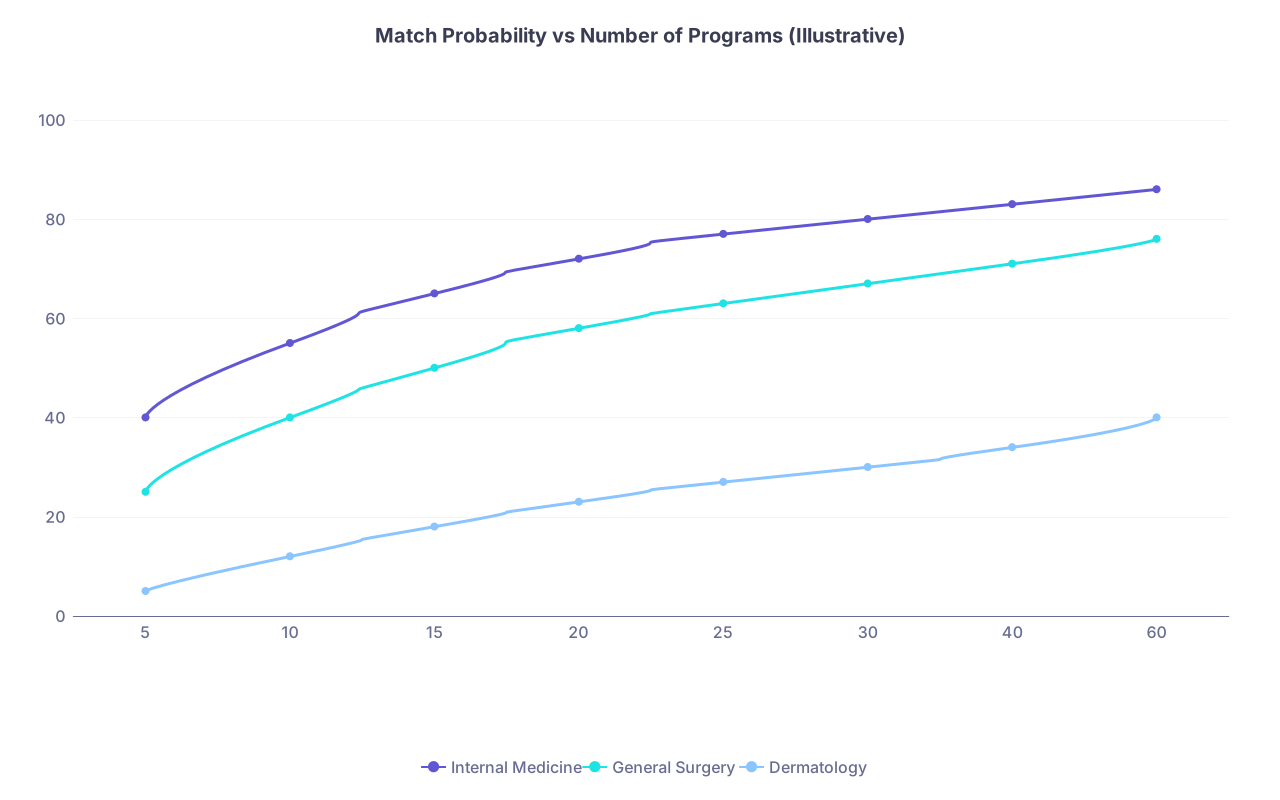
There are diminishing returns:
- Going from 5 to 15 applications usually makes a big difference.
- Going from 30 to 60 often adds less benefit and significantly more cost and workload.
- Extremely large lists can hurt the quality of your applications and interview performance.
Focus on smart targeting—programs where your profile is a good fit and where you’d genuinely consider training—rather than sheer volume.
Q4: What factors should I prioritize when deciding which programs make the cut?
When refining your list, prioritize:
- Fit with your career goals (academic vs community, fellowship interests, research).
- Program culture and resident satisfaction (from websites, social media, word of mouth).
- Geography and lifestyle needs (family, partner, cost of living).
- Clinical and educational quality (case mix, patient population, didactics).
- Your competitiveness relative to current residents (use NRMP and ResidencyExplorer data where available).
Remove programs where you would not realistically rank them, even if they offered an interview—this keeps your list focused and ethical.
Q5: How can I keep application costs manageable while still applying broadly enough?
To control costs without compromising safety:
- Set a maximum budget for ERAS fees and potential travel.
- Prioritize programs with strong fit and reasonable chances rather than “just in case” choices.
- Take advantage of free or low‑cost resources (FREIDA, program websites, alumni connections) to avoid random applications.
- If your school or organization offers fee assistance programs or scholarships for application costs, explore those early.
- Consider focusing on regions or clusters of programs to streamline interview scheduling and reduce logistical strain, if in‑person interviews apply to your specialty.
By combining an honest self‑assessment, an understanding of specialty competitiveness, and a thoughtful, data‑driven Application Strategy, you can choose a number of residency programs that balances risk and practicality. Ultimately, the goal is not just to match somewhere—it’s to match at a Residency Program that aligns with your values, supports your growth, and sets you up for long‑term success in Specialty Matching and Career Development as a physician.