Understanding the Transitional Year (TY) and Why Program Selection Matters
For an MD graduate pursuing a Transitional Year, your program selection strategy is more than “filling time” before advanced training. A strong TY program can:
- Strengthen your candidacy for advanced residencies (e.g., radiology, anesthesiology, derm, ophthalmology, PM&R)
- Build foundational clinical skills and autonomy
- Provide robust mentorship and networking
- Offer schedule flexibility for research, away rotations, or Step 3
Unlike categorical residencies, Transitional Year residency programs vary widely in structure and culture. Some are medicine-heavy and rigorous; others are cushioned with electives and lifestyle advantages. Your program selection strategy should be intentional and tailored to your long‑term goals.
In this guide, we’ll build a step-by-step framework for MD graduates to choose and rank Transitional Year programs, including:
- Clarifying goals and constraints
- Analyzing program types and structures
- Deciding how many programs to apply to
- Building and narrowing your list
- Crafting a ranking and backup strategy for the allopathic medical school match
Step 1: Define Your Goals, Risk Tolerance, and Constraints
Before you start asking “how many programs to apply to,” you need to be clear about what you want from a TY and what you absolutely need to avoid.
A. Clarify Your Long-Term Specialty Goal
Most applicants to a Transitional Year already know (or strongly suspect) their advanced specialty. Your specialty influences the best TY fit:
- Radiology / Radiation Oncology / Dermatology / Ophthalmology
- Often prefer lighter inpatient loads, strong didactics, ample elective time.
- TY that allow radiology/derm/ophtho electives and research are ideal.
- Anesthesiology
- Balanced mix of medicine, ICU, and perioperative exposure is valuable.
- Programs affiliated with strong anesthesia departments or large ORs may help.
- PM&R / Neurology
- TY with neurology, rehab, or MSK electives can be beneficial.
- Exposure to neuro, stroke, and MSK cases is a plus.
- Preliminary back-up for Internal Medicine or Surgery
- If applying advanced and categorical in parallel, you might want a TY that looks good to IM/surgery in case you pivot.
Action: Write three priorities you want from your TY year (e.g., “more elective time,” “strong ICU,” “geographically close to partner,” “research heavy,” “ultimate lifestyle”).
B. Assess Your Risk Tolerance and Match Profile
Your program selection strategy depends heavily on how competitive you are for TY programs and your willingness to take risk in the allopathic medical school match.
Key factors:
- USMLE Step 1 (P/F) and Step 2 CK score
- Class rank / AOA status
- Quality/reputation of your MD program
- Research output and specialty-specific experiences
- Presence of red flags (gaps, USMLE failures, professionalism concerns)
- Whether you already have an advanced position (e.g., Radiology PGY-2) secured
General competitiveness tiers (approximate, not absolute):
- Highly competitive
- Top quartile, high Step 2 CK, strong letters, often from well-known MD schools
- Applying in competitive advanced specialties (e.g., Derm, Rad Onc) with strong applications
- Moderately competitive
- Solid scores, no red flags, decent research and clinical performance
- At-risk / vulnerable
- Lower scores, attempts on USMLE, gaps, limited letters, or below-average evaluations
Your risk profile affects:
- How many TY and categorical prelim programs you should apply to
- How geographically concentrated your list can be
- Whether you should have IM preliminary programs as safety options
Step 2: Understand Types of TY Programs and Their Structures
Transitional Year residency programs are not one-size-fits-all. Understanding the common patterns helps you create a smarter program selection strategy.
A. “Lifestyle” TY Programs
Characteristics:
- Higher proportion of electives (up to 6–8 months in some programs)
- Limited night float and ICU time
- Often associated with advanced programs that want a “gentle” intern year for their residents
- Popular with radiology, rad onc, and dermatology-bound residents
Pros:
- Time for research, Step 3, and early advanced specialty exposure
- Better work-life balance
- Often strong camaraderie and supportive culture
Cons:
- Can be highly competitive
- Some may offer less robust general medicine training and procedural exposure
B. Medicine-Heavy or ICU-Heavy TY Programs
Characteristics:
- Larger blocks of inpatient medicine, ICU, and night float
- Call schedule similar to categorical internal medicine interns
- Often at community hospitals or academic centers with high patient volume
Pros:
- Strong preparation for any clinical specialty
- Can impress advanced program directors with robust training
- Build confidence and autonomy
Cons:
- Less elective time
- More fatigue and higher burnout risk if not well-supported
C. Hybrid or Balanced TY Programs
Characteristics:
- Mix of inpatient, outpatient, ICU, and electives in roughly equal proportions
- Reasonable work hours but still rigorous enough to build skills
Pros:
- Good compromise for most candidates
- Flexibility to tailor rotations while still getting solid core training
Cons:
- Not as many electives as “lifestyle” TYs
- Not as intense clinically as some medicine or surgery prelim years (which may matter for some advanced fields)

Step 3: Researching Programs: What Really Matters for MD Graduates
When you start building your list, it’s easy to get overwhelmed. Instead of scrolling endlessly, use a structured checklist.
A. Core Selection Criteria
Program Type and Affiliation
- Pure TY vs. TY attached to a specific advanced specialty (e.g., radiology TY track)
- University vs. community vs. hybrid
- Presence of the advanced specialty at the same institution (e.g., TY + Radiology in same hospital)
Curriculum and Rotation Mix
- Number of months:
- Inpatient medicine
- ICU
- Emergency medicine
- Night float
- Electives
- Are there dedicated blocks for your intended specialty (e.g., radiology, PM&R)?
- Number of months:
Elective Flexibility
- Can you create away rotations?
- Are research electives allowed?
- How many “self-designed” blocks can you have?
Call Structure and Workload
- Typical hours per week
- Night float vs. 24-hour call
- Weekend frequency
- Presence of physician extenders or strong ancillary support
Program Culture and Resident Support
- Word-of-mouth from alumni/upperclassmen
- Resident testimonials on program website or social media
- Wellness initiatives, mentoring structure, support for struggling residents
Advancement and Outcomes
- Where do TY alumni match for advanced positions?
- If the program is attached to advanced residencies, do they express satisfaction with their TY interns?
Geography and Lifestyle
- Proximity to family/partner
- Cost of living
- City size and climate preferences
B. Reading Between the Lines on Program Websites
A program website is marketing material, but you can still extract useful signals:
- Curriculum pages:
- Count total elective months.
- Note whether ICU is required and how many blocks of inpatient medicine.
- Resident roster:
- Where did they come from? (MD vs DO mix, US vs international, which schools?)
- Does the resident background look like yours?
- Advanced program alignment:
- Do they list integrated TY+advanced positions? If so, spots may be reserved for those matched into the advanced programs at that institution.
If information is incomplete, sending a short, professional email to the coordinator with specific questions (e.g., “How many elective months are typically allowed, and are research electives possible?”) is appropriate.
Step 4: How Many Programs to Apply to for a Transitional Year
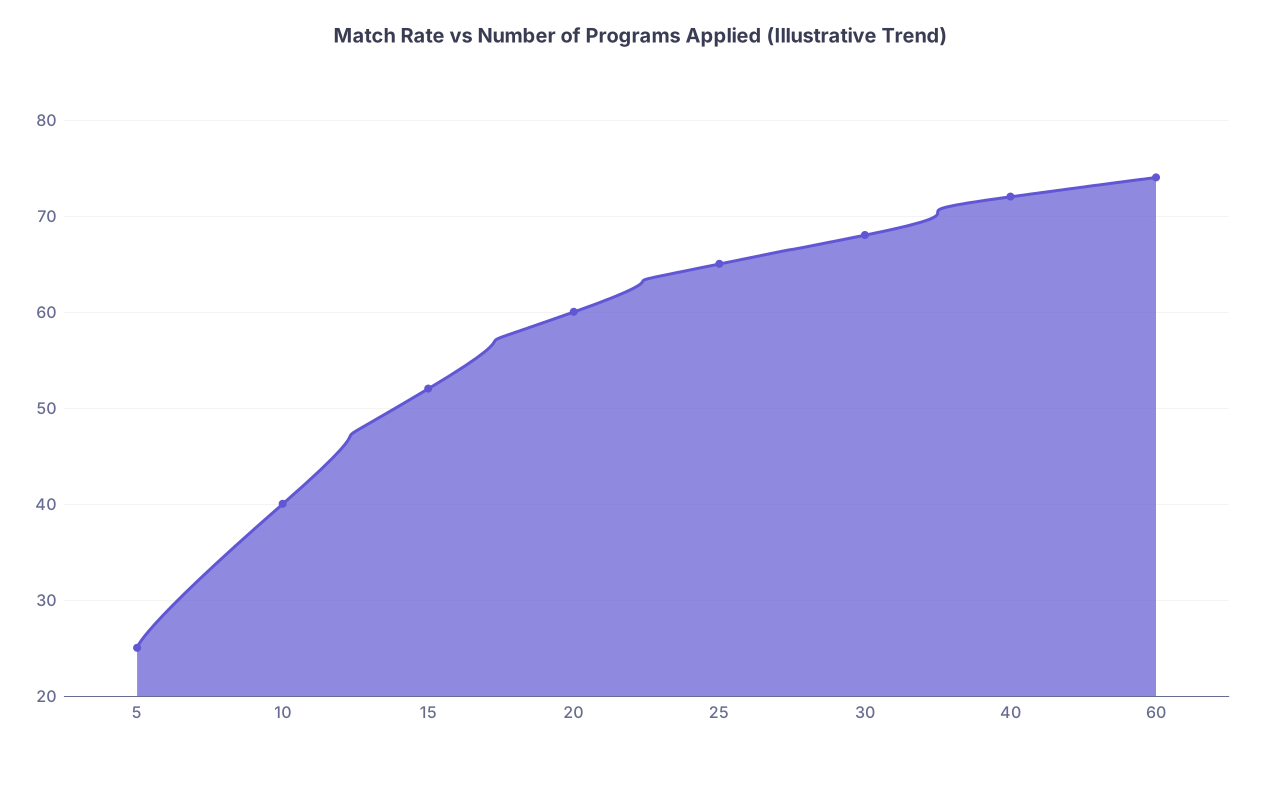
A central question for MD graduates is how many programs to apply to for the TY portion of the match. While there’s no universal number, we can outline a data-informed approach.
A. General Benchmarks (MD Graduate, TY Focus)
These are typical ranges for MD graduates targeting Transitional Year residency positions, assuming they are also applying to advanced positions:
Highly competitive applicants
- Advanced specialty applications: 25–40 programs (depending on field)
- TY programs: 10–20 Transitional Year programs
- 5–10 preliminary internal medicine programs as backup (optional but recommended if risk-averse)
Moderately competitive applicants
- Advanced specialty applications: 40–60 programs (or per specialty norms)
- TY programs: 20–30 Transitional Year programs
- 10–15 preliminary IM programs as safety
At-risk / vulnerable applicants
- Advanced specialty: broad strategy, often 60+ where feasible (depending on specialty)
- TY programs: 25–40 Transitional Year programs
- 15–25 preliminary IM programs
- Strongly consider also applying to a less-competitive categorical backup (e.g., categorical Internal Medicine at some programs).
B. Factors That Increase the Number of Programs Needed
You should lean toward the higher end of those ranges if:
- You have:
- Step 2 CK significantly below national mean for your specialty
- One or more exam failures
- Limited or no home-rotation/specialty exposure
- Your medical school is less well-known to many programs
- You’re geographically constrained (e.g., must be in one or two regions)
- You’re applying to highly sought-after “lifestyle” TY programs almost exclusively
Conversely, you may cautiously reduce the number of TY applications (but still keep a healthy margin) if:
- You already matched into an advanced program at a highly reputable institution that also has its own TY or prelim slots
- You have top-tier metrics and multiple strong letters from known faculty
- You’re flexible on geography and are open to community-based programs
C. Balancing Cost, Time, and Risk
Every added program application costs money and time in ERAS and potentially more interviews. Your program selection strategy should be:
- Broad enough to give you a comfortable match probability
- Focused enough that each program is somewhere you could realistically live and work for a year
A practical approach:
- Start with a long list (40–60 TY and prelim programs).
- Remove clear misfits (wrong geography, no elective flexibility, extremely heavy call if you dislike that).
- Aim for your target number based on competitiveness (e.g., 25 TY + 10 prelim IM).
If you are unsure, it is safer—especially as a first-time applicant—to lean toward slightly too many than too few, within your financial limits.
Step 5: Building a Tiered Program List and Selection Strategy
Now that you have a sense of how many programs to apply to, you can use a tiered strategy for your list.
A. Categorize Programs into Tiers
Create a spreadsheet and divide programs into three broad tiers based on competitiveness and desirability.
Tier 1: Reach / Dream TY Programs
- Highly desirable geography, strong affiliation with top advanced specialties, lots of electives or ideal lifestyle
- Historically competitive
- Your profile may be average or slightly below their typical matched profile
Tier 2: Target TY Programs
- Good fit for your goals
- Your stats and experiences closely match or exceed current residents’
- Reasonable workload, acceptable geography, solid reputation
Tier 3: Safety TY and Prelim IM Programs
- You are likely to be above their typical matched profile
- Often community-based or in less popular locations
- Still accredited, with acceptable training environment, but may be less flexible or glamorous
Aim for a distribution something like:
Competitive MD with solid advanced applications:
- ~20–30% Tier 1
- ~40–50% Tier 2
- ~20–30% Tier 3 (including prelim IM)
At-risk applicant:
- ~10–20% Tier 1
- ~40–50% Tier 2
- ~30–40% Tier 3 (robust prelim IM and possibly categorical options)
B. Aligning TY Programs with Advanced Applications
A powerful program selection strategy is to pair your TY applications with advanced program applications:
- If you apply to an advanced program (e.g., Diagnostic Radiology) at Institution X:
- Also apply to their TY and/or prelim IM programs if allowed.
- This increases your chances of staying in one system for PGY-1 and PGY-2+.
Benefits:
- Better continuity of training
- Less stress relocating between PGY-1 and PGY-2
- Stronger institutional support, potentially better mentorship
However, do not solely rely on paired programs. Always include independent TYs and prelims.

Step 6: Evaluating Interviews and Refining Your Ranking Strategy
Program selection doesn’t stop once interviews start. Your rank list is the final expression of your strategy for the allopathic medical school match.
A. During Interviews: What to Ask and Observe
When you interview at a Transitional Year residency, focus on:
Day-to-Day Life
- Ask residents:
- “What does a typical week look like on your busiest rotation?”
- “How many nights per month are you on call?”
- “Are duty hour violations common?”
- Ask residents:
Electives and Flexibility
- “How easy is it to arrange away rotations?”
- “Have residents taken research electives or Step 3 study time?”
- “Are schedule changes possible if someone matches late into an advanced spot?”
Culture and Support
- “How approachable are attendings?”
- “How does the program support residents who are struggling clinically or personally?”
- “How is feedback delivered?”
Outcomes and Advanced Placement
- “Where have recent graduates gone for their advanced positions?”
- “Do residents in competitive specialties feel supported?”
Use concrete examples from resident responses to update your perception of each program.
B. After Interviews: Updating Your Tiers
Post-interview, many applicants realize:
- Some “dream” programs feel toxic or overworked.
- Some modest-looking community programs have excellent culture and reasonable workloads.
Recalculate your tiers based on:
- Resident happiness and culture
- Honest assessment of workload vs. benefits
- Fit with your long-term specialty (e.g., radiology exposure)
- Geography and personal life factors (partner’s job, family support, etc.)
C. Ranking Strategy for TY vs. Prelim IM
For MD graduates targeting a Transitional Year:
- Rank all TY programs you genuinely would attend, in your true preference order.
- Then rank preliminary internal medicine or other prelim options you would accept if TY doesn’t work out.
- If you are also ranking categorical programs as a backup specialty, consult your dean’s office or advisor to structure your rank list intelligently (because there are nuances when mixing categorical and advanced+prelim choices).
Key principle of the NRMP match:
Always rank programs in the exact order you would want to attend them, not based on perceived likelihood. The algorithm works in your favor when you rank by true preference.
Step 7: Examples of Program Selection Strategy Scenarios
Scenario 1: Strong MD Applicant Going into Radiology
- Top quartile of class, solid Step 2 CK, strong radiology research.
- Wants a lifestyle-friendly Transitional Year near a major city.
Strategy:
- 35–45 DR programs nationwide, focusing on academic centers.
- 15–20 Transitional Year programs, mostly in urban or suburban areas with high elective time.
- 5–10 prelim IM programs at institutions where they also applied for DR.
- Program mix:
- Tier 1: Prestigious urban TYs with many electives
- Tier 2: Balanced TYs in acceptable cities
- Tier 3: Community-based TY and prelim IM in less-desired areas (safety)
Scenario 2: Moderate Applicant Entering Anesthesiology with Mild Geographic Limits
- Middle of the class, Step 2 CK slightly below the anesthesiology average.
- Needs to stay in the Midwest for family reasons.
Strategy:
- 45–60 anesthesia programs, mostly Midwest + some nearby regions.
- 20–25 TY programs in the Midwest, balanced or moderate-medicine heavy.
- 10–15 prelim IM programs in the same region.
- Slightly heavier emphasis on safety: several community-based prelim IM and some less popular geographic locations within the region.
Scenario 3: At-Risk Applicant Applying PM&R, Unsure of Competitiveness
- Pass on Step 2 CK but modest score, minor academic gap, limited research.
- Wants PM&R but is flexible on location.
Strategy:
- Broad PM&R applications (60+ programs if feasible).
- 25–35 Transitional Year programs with good PM&R/neurology electives.
- 15–20 prelim IM programs in a wide range of states.
- Also apply to a subset of categorical Internal Medicine programs as a safety net if PM&R doesn’t work out.
- Accept that a community-based or less-lifestyle-friendly program might be the realistic outcome, and prioritize accreditation, support, and safety over prestige.
Common Pitfalls to Avoid in TY Program Selection
Over-focusing on Prestige Alone
- For a one-year TY, culture, schedule, and fit can matter more than name recognition.
Underestimating Workload
- Some TYs function essentially like full medicine intern years. If you want a lighter year, don’t ignore call structure and elective months.
Applying to Too Few Safety Options
- Even strong MD graduates can unexpectedly go unmatched if the list is too narrow geographically or too “top-heavy.”
Ignoring Personal Life Factors
- Your support system, partner’s needs, and financial realities matter. A “dream” TY in a city where you’re miserable or financially strained may not be ideal.
Not Seeking Advice Early
- Talk to:
- Specialty advisors
- Recent graduates from your school who did a Transitional Year
- Residents at target programs (if possible)
- Talk to:
FAQ: Transitional Year Program Selection for MD Graduates
1. How many programs should I apply to specifically for Transitional Year?
For most MD graduates, a reasonable range is:
- Competitive applicants: ~10–20 TY programs
- Moderately competitive: ~20–30 TY programs
- At-risk: ~25–40 TY programs
In addition, most applicants benefit from 5–25 preliminary internal medicine applications, depending on risk tolerance. Always consider your advanced specialty competitiveness, geography limits, and financial resources.
2. Do Transitional Year programs care about Step 1/Step 2 as much as advanced programs?
Yes, but often slightly less intensely than some advanced specialties. TY programs still review your:
- Step 2 CK score (especially now that Step 1 is pass/fail)
- Overall academic performance
- Letters and professionalism
Competitive “lifestyle” TYs at prestigious institutions may have high academic expectations similar to their advanced programs. Community and mid-tier TYs may be more flexible but still require a solid, passing record without major red flags.
3. Is it better to do a Transitional Year or a Preliminary Internal Medicine year?
It depends on your goals:
Transitional Year is better if:
- You want broad exposure and more electives.
- You’re entering fields like radiology, rad onc, derm, ophtho, or PM&R.
- You value flexibility and, often, a more favorable lifestyle.
Preliminary IM may be better if:
- You want very strong medicine and ICU training.
- You foresee possibly switching into Internal Medicine or another medicine-heavy specialty.
- TY options in your desired area are limited.
Many applicants apply to both TY and prelim IM to maximize match safety.
4. Should I only apply to programs connected to my desired advanced specialty?
No. While applying to paired TY + advanced programs is smart, limiting yourself only to those is risky. You should:
- Apply to:
- Paired TY/prelim programs where you’re also applying in the advanced field.
- Independent TYs and prelim IM programs at other institutions.
This diversification protects you in case you don’t match at your dream institution while improving your chances of securing some accredited PGY-1 position, which is essential for completing residency in your field.
A thoughtful, data-driven program selection strategy—grounded in your goals, honest self-assessment, and a realistic sense of how many programs to apply to—will position you well for the Transitional Year portion of the allopathic medical school match. Use the tools and frameworks above, seek mentorship, and build a list that balances ambition with safety so that your TY year becomes a strong launchpad for your career.