Understanding the Urology Match Landscape as an MD Graduate
For an MD graduate from an allopathic medical school, urology residency is one of the most competitive and nuanced matches to navigate. Unlike many other specialties, the urology match is an early, specialty-specific process administered through the American Urological Association (AUA), not the main NRMP Match. This affects your entire program selection strategy, from timeline to how many programs to apply to.
Key differences that shape your strategy:
- Earlier timeline: Applications, interviews, and rank lists happen sooner than the NRMP cycle. You have less time to “fix” gaps, so careful planning is critical.
- Smaller specialty: Fewer total programs and positions. This magnifies the impact of each application and interview.
- High applicant quality: Most urology applicants have strong academic profiles, making differentiation and smart targeting of programs essential.
If you are an MD graduate residency applicant from an allopathic medical school, you already benefit from some structural advantages—such as better access to home institution urology departments and often more robust advising. But those advantages only translate into a successful urology match if you deploy a deliberate, data-driven program selection strategy.
This article will walk you through:
- How to estimate your competitiveness
- How many urology programs to apply to
- How to choose residency programs and build a balanced list
- Specific strategies for MD graduates (US allopathic) in urology
- Common pitfalls and FAQs
Step 1: Assess Your Competitiveness Objectively
Before you can design a program selection strategy, you need an honest evaluation of your profile. Your competitiveness determines how many programs to apply to and which types of programs belong on your list.
Core Competitiveness Factors in Urology
USMLE scores / board performance
- Step 1: Now pass/fail, but programs still review underlying performance via transcripts and context. A failure is a red flag but not always fatal if the rest of the application is strong.
- Step 2 CK: Critical numeric filter in the urology match. Competitive applicants often score in the upper quartiles, but thresholds vary by program.
- Ask your dean’s office and urology advisors how your Step 2 CK compares to prior matched urology applicants from your school.
Medical school performance
- Clinical clerkship grades, especially in surgery and medicine
- Class rank or quartile, when provided
- AOA or Gold Humanism Honor Society membership (when available)
- Narrative comments in MSPE, showing work ethic, teamwork, and professionalism
Urology-specific experiences
- Away rotations (sub-internships) in urology are especially influential. Strong performance with excellent evaluations and letters can outweigh minor weaknesses elsewhere.
- Home urology rotation and your department’s support.
Letters of recommendation
- 2–3 strong letters from urologists, ideally:
- At least one from your home institution urology faculty
- One from an away rotation where you excelled
- Optionally, a strong letter from a surgery or research mentor if particularly compelling
- 2–3 strong letters from urologists, ideally:
Research and scholarly activity
- Urology-related publications, posters, and presentations are helpful—not mandatory, but increasingly common.
- Quality and continuity of involvement matter more than sheer volume.
Non-cognitive factors
- Evidence of teamwork, professionalism, leadership, and resilience.
- Any red flags (disciplinary actions, professionalism issues, repeated exams) require a specific strategy and clear explanation.
Categorizing Yourself: High, Moderate, or Developing Competitiveness
To design a realistic program selection strategy, place yourself into one of three broad categories:
Highly Competitive
- Step 2 CK: well above national urology averages
- Strong clinical performance with honors in surgery and medicine
- Urology research (possibly multiple projects or publications)
- Strong urology letters (home + away)
- No academic or professionalism red flags
Moderately Competitive
- Step 2 CK: around or slightly below typical matched urology applicants
- Mostly solid clerkship grades, with a mix of high passes and some honors
- Some research and urology exposure, though not extensive
- Good but not extraordinary letters
- No major red flags
Developing/At-Risk
- Step 2 CK: significantly below typical matched urology applicants, or a prior exam failure
- Several mid-tier clinical grades or concerns about class rank
- Limited urology exposure or research
- Letters that may be generic or from non-urology faculty only
- Any significant professionalism or academic issues
This categorization isn’t about labeling yourself; it’s a planning tool. Your program selection strategy, including how many programs to apply to, should vary based on where you realistically fall.
Step 2: How Many Urology Programs Should an MD Graduate Apply To?
Choosing how many programs to apply to is one of the most common and anxiety-provoking decisions urology applicants face.
While there is no single “correct” number, we can outline data-informed ranges and then adapt them to your competitiveness category and circumstances.
General Ranges for Urology Applicants
Respected advisors and AUA data trends generally support the following guidelines for MD graduates from allopathic medical schools:
Highly Competitive MD applicant
Typical range: 25–40 urology programs- You can be selective and emphasize genuine fit.
- Save space in your schedule and budget for interviews rather than blanket applying.
Moderately Competitive MD applicant
Typical range: 35–60 urology programs- Wider net to offset variability in interview offers.
- Critical to include a broad mix of program types and geographic regions.
Developing/At-Risk MD applicant
Typical range: 60+ urology programs (realistically up to most/all programs in the NRMP list, minus clear misfits such as visa-incompatible programs)- You are leveraging volume plus thoughtful fit to increase your chances of enough interview invites.
- Strong backup plan (e.g., categorical general surgery or another specialty) and advising are crucial.
Factors That May Push You Toward the Higher or Lower End
Move toward the higher end of your range if you:
- Have a Step 2 CK closer to specialty cutoffs or below your peers
- Attend a medical school without a home urology program or with a weaker track record in the urology match
- Have limited research or only one urology letter
- Face geographic limitations (e.g., partner, family responsibilities) and therefore need to target specific regions
- Are applying after a gap year or with prior unmatched status
You may cautiously consider the lower end of your range if you:
- Have very strong metrics and strong support from your home urology department
- Have significant urology research, national presentations, or leadership positions
- Are flexible geographically and open to a broad spectrum of program types
- Have already built strong relationships through multiple away rotations
Balancing Cost, Time, and Diminishing Returns
Each additional application has:
- Direct cost (ERAS fees)
- Indirect cost (time customizing personal statements, researching programs, tracking communications)
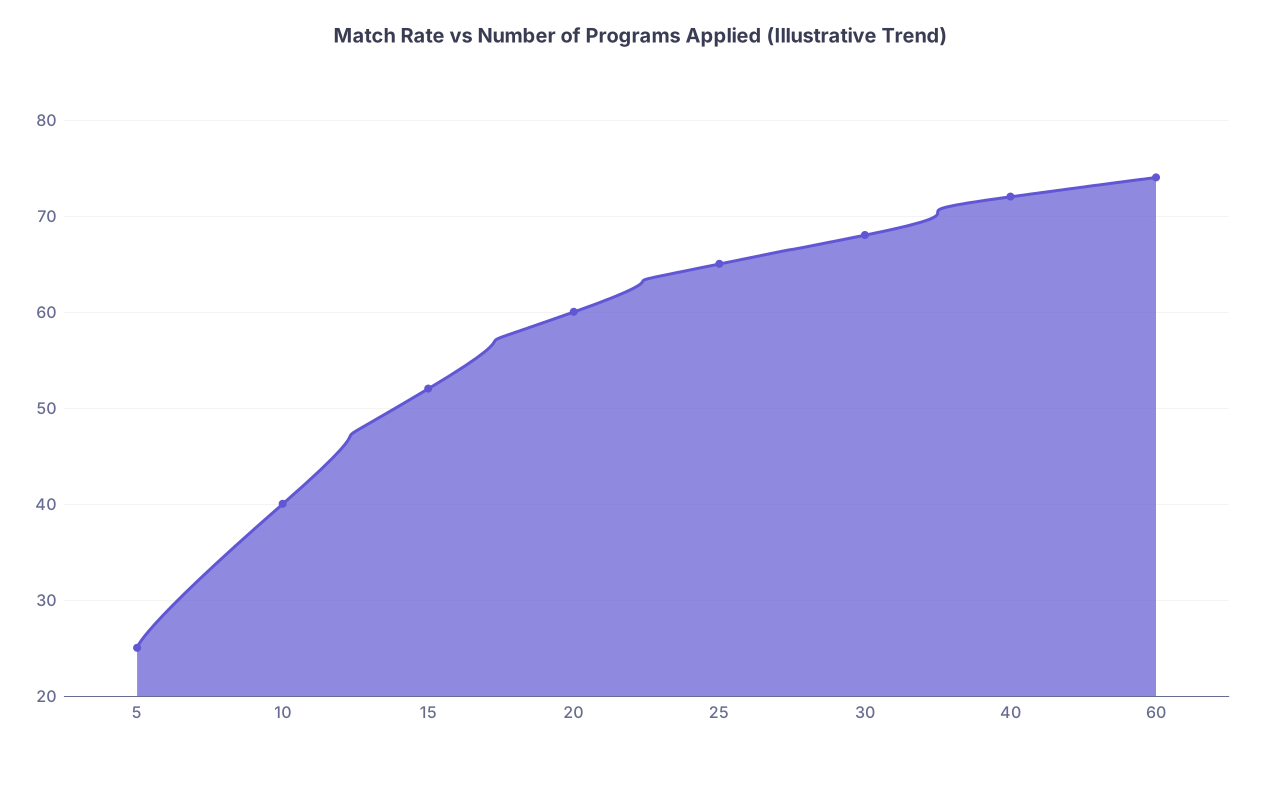
- Diminishing returns: After a certain point, adding many more programs may only minimally increase your odds, especially if the additional programs are poor fits.
As an MD graduate, you typically have robust institutional advising. Use that advantage: bring your Step 2 CK score, transcript, CV, and draft program list to a dedicated meeting with a urology advisor who knows the urology match well. Ask them:
- “Given my profile, what range of program numbers is realistic?”
- “Where do recent matched urology graduates from our school with similar profiles typically match, and how many programs did they apply to?”
Step 3: How to Choose Residency Programs—Core Selection Criteria
Once you have a target range of how many programs to apply to, the next question is how to choose residency programs effectively. Randomly applying to 40–60 urology programs is inefficient; you want a deliberate program selection strategy.

1. Program Type: Academic, Hybrid, or Community-Based
Academic programs
- Typically university-affiliated; heavy emphasis on research, sub-specialty exposure, and fellowship placement.
- Best if you’re interested in academic medicine, research, or highly specialized practice.
- Often more competitive, but not always—“big-name” isn’t synonymous with “best fit.”
Hybrid programs
- Mix of academic and community sites.
- Broad clinical exposure and procedural volume, with some research opportunities.
- Good for candidates considering diverse career paths.
Community-based programs
- Often strong in clinical volume and hands-on surgical experience.
- May have fewer research requirements but still excellent training.
- Ideal for those drawn to community practice or smaller health systems.
Actionable tip:
Categorize each program on your initial list into one of these buckets. Aim for a balanced mix: you might target, for example, 40% academic, 40% hybrid, 20% community-based, adjusting for your interests and competitiveness.
2. Geographic Considerations
Geography often drives both satisfaction and match probability in the urology match.
Questions to ask:
- Do you have geographic ties (family, prior schooling, partner’s job) to specific regions?
- Are you open to training in less saturated areas (Midwest, South) where some programs might receive fewer applications than coastal counterparts?
- Are you comfortable with urban vs. suburban vs. rural settings?
Program selection strategy:
- Include multiple regions unless you have strong, unavoidable constraints.
- If you prefer a highly competitive coastal city, balance your list with solid programs in less over-subscribed locations.
- Highlight your geographic ties in your personal statement or secondary communications, where appropriate.
3. Program Size and Case Volume
Program size and surgical volume shape the day-to-day training environment:
Larger programs may offer:
- More residents (larger cohort, more peer learning)
- Broader subspecialty exposure
- More complex academic structures
Smaller programs may offer:
- Tighter-knit teams
- More autonomy for individual residents
- Potentially higher per-resident case volume in certain areas
Look for:
- Case logs and ACGME data (if available)
- Program websites and interview-day presentations discussing case numbers in:
- Endourology / stone disease
- Oncology
- Reconstructive surgery
- Pediatrics
- Female pelvic medicine
- Robotics and laparoscopy
Align these with your future interests. If you strongly suspect an interest in oncology or robotics, a program with robust exposure in those areas is key.
4. Research and Scholarly Expectations
Urology programs span a wide spectrum in research intensity:
Research-heavy programs:
- Often academic centers with NIH-funded labs.
- May involve 6–12 months of dedicated research time.
- Strong pipeline to academic fellowships.
Clinically focused programs:
- Emphasize surgical training and clinical productivity.
- Research may be encouraged but less protected.
Your program selection strategy should reflect:
- Your genuine interest in research or academic careers
- Your prior research track record (to avoid mismatch)
- Your need for publications if you’re considering subspecialty fellowships in highly competitive niches
Include a mix unless you are absolutely certain you want (or do not want) a research-intensive environment.
5. Culture, Mentorship, and Resident Support
This may be the single most important and hardest-to-measure factor.
Indicators of healthy program culture:
- Residents appear genuinely collegial and honest on interview day.
- Graduates stay in touch and speak positively about their experience.
- Reasonable call structure and night float systems; duty hours are respected.
- Faculty known for being accessible, supportive, and invested in teaching.
Red flags:
- High resident attrition or transfers
- Recurrent mentions of burnout or unmanageable call
- Residents unable or hesitant to answer questions about wellness or support
- Consistent negative word-of-mouth from trusted mentors or recent graduates
Your strategy:
Track this qualitatively. After each interview or information session, write a brief note rating:
- Resident happiness (1–5)
- Faculty approachability (1–5)
- Perceived support and wellness infrastructure (1–5)
Over time, these notes will be invaluable when building your rank list.
6. Match Outcomes and Alumni Trajectories
For each program, consider:
- Where do graduates go after residency?
- Academic vs. community practice
- Types of fellowships (oncology, endourology, peds, female pelvic, etc.)
- Geographic distribution of alumni jobs
- What is the program’s overall reputation in the urology community?
- Not just “prestige,” but consistency in producing well-trained, independent surgeons.
This information can often be found on:
- Program websites (alumni pages)
- Faculty or resident presentations
- Conversations with alumni from your own allopathic medical school who have matched into urology
Step 4: Building a Balanced Urology Program List
Once you’ve defined your criteria, it’s time to assemble a concrete list that aligns with your allopathic medical school match goals.

Step-by-Step Approach
Start broad
- Generate a long list of all accredited urology residency programs.
- Remove any immediate mismatches (e.g., programs that categorically do not accept applicants without certain visa status if that applies to you).
Tag each program For each program, use a simple spreadsheet and tag:
- Type: academic / hybrid / community
- Region: Northeast / Midwest / South / West / etc.
- Research: heavy / moderate / light
- Perceived competitiveness: high / moderate / lower (based on reputation, location, and your advisor’s guidance)
- Any ties: geographic, alumni, prior rotations
Cross-check against your competitiveness category
- Highly competitive applicants: you can afford to include more “reach” programs but should still incorporate some “solid” fits.
- Moderately competitive applicants: emphasize a core of “solid” programs with some reaches and some likely “safety” options.
- Developing applicants: still include a few aspirational programs, but most of your list should be moderate and less-competitive programs, including those in less sought-after regions.
Aim for a 3-tier structure
As a rough guideline (for a 45-program list, adjust proportionally):
Tier 1 (Reach / Highly Competitive) – 10–15 programs
- Well-known academic centers
- Highly popular geographic locations
Tier 2 (Core / Target) – 20–25 programs
- Strong programs where your profile is reasonably aligned with recent matched applicants
- Mixture of academic and hybrid settings
Tier 3 (Safety / Less Competitive) – 8–12 programs
- Solid training, perhaps in less saturated markets
- Community or hybrid programs with a good track record of training
Labeling something as a “safety” in urology does not mean it’s easy to match there; it simply reflects relative competitiveness and your alignment with their usual applicant pool.
Example for a Moderately Competitive MD Applicant
Profile:
- Step 2 CK around national mean for matched urology applicants
- Strong clinical evals; a few honors, mostly high passes
- One home urology rotation, one away rotation
- Two urology letters, one surgery letter
- Limited but decent research exposure
Possible distribution (around 45 programs):
- 12 high-profile academic programs (big names, top cities)
- 20 mixed academic/hybrid programs in varied regions
- 13 community or smaller academic programs in less saturated locations
In parallel, plan a backup strategy in case of a urology non-match:
- A separate application to categorical general surgery or another specialty through the NRMP
- Or a structured research year plan with clear support from a urology department
Step 5: MD-Specific Strategic Considerations in the Urology Match
As a US MD graduate from an allopathic medical school, you should leverage structural advantages while addressing any unique vulnerabilities.
Leverage Your Home Institution
- Meet early with:
- Urology program director
- Department chair (if appropriate)
- Urology clerkship director
- Request candid feedback: “Where would you place me among recent urology applicants from our school?”
- Ask how your home program historically supports students in the urology match:
- Faculty outreach and phone calls
- Advocacy letters
- Advice on which programs tend to look favorably on your school’s graduates
Home advocacy can significantly influence interviews and match odds.
Optimize Your Away Rotations
Away rotations are a core part of the urology match culture and your program selection strategy:
- Choose 1–2 away rotations at programs that:
- You are genuinely interested in
- Match your competitiveness level (not exclusively hyper-elite)
- Have reputations for valuing their rotators in interviews and rank lists
- Use these rotations to:
- Demonstrate work ethic, teachability, and collegiality
- Secure strong letters of recommendation
- Gather first-hand intelligence about program culture and training
Be Strategic with Your Personal Statement and Communication
- Tailor regional interests (without dishonesty) when you have real ties to an area.
- If you have a particular interest in urology residency research or specific subspecialties, highlight that in ways that align with the programs you are targeting.
- Consider short, professional emails to programs where:
- You have genuine, specific interest
- You have a geographic or personal tie
- You rotated previously and want to reinforce your enthusiasm
Avoid generic mass emails; they rarely help and can be counterproductive.
Plan for Contingencies Early
Despite thoughtful planning, the urology match remains competitive. As an MD graduate, you will often have robust alternate pathways:
- A dedicated research year with a strong urology mentor
- A planned simultaneous application to another specialty in the NRMP (often general surgery)
- Post-match SOAP or opportunities in preliminary surgery if you decide to reapply
Discuss these contingencies before applications go out. This allows you to design a coherent plan rather than scrambling under time pressure.
FAQs: Program Selection Strategy for MD Graduates in Urology
1. How many urology programs should I apply to as an MD graduate?
Most MD graduates applying to urology should consider:
- Highly competitive: ~25–40 programs
- Moderately competitive: ~35–60 programs
- Developing/at-risk: 60+ programs, often nearly all that are reasonably compatible
Your exact number should be refined with your urology advisor, taking into account Step 2 CK, clinical performance, research, letters, and any red flags. Remember that more is not always better; a thoughtful, balanced list is more effective than blind volume.
2. Does going to an allopathic medical school improve my chances in the urology match?
Being an MD graduate from an allopathic medical school often helps with:
- Access to a home urology residency and mentors
- Institutional familiarity in many programs’ applicant pools
- Stronger advising infrastructures
However, success in the allopathic medical school match for urology still depends heavily on your individual performance: exam scores, clinical evaluations, urology rotations, letters, and professionalism. MD status is an advantage but not a guarantee.
3. Should I only apply to “top-tier” urology programs if I am highly competitive?
Even if you are a highly competitive MD applicant, limiting yourself to only the perceived “top-tier” programs is risky. The urology match is small and unpredictable. Include:
- A core of high-profile academic programs you are truly interested in
- A substantial group of mid-tier academic and hybrid programs
- A smaller set of community or less geographically sought-after programs that still provide excellent training
A balanced list increases both your chances of matching and your odds of ending up in a program that fits your personality and career goals.
4. What if I’m not sure about my long-term career goals (academic vs. community practice)?
Uncertainty is common at this stage. If you’re unsure:
- Favor programs that offer:
- Strong clinical training
- Some research exposure
- Diverse subspecialty experiences
- Avoid overcommitting exclusively to either extreme (ultra-research-heavy or ultra-clinical) unless you’re confident.
- Ask residents at each program:
- “What proportion of your graduates go into academic vs. community practice?”
- “How easy is it to get involved in research if I decide I want that?”
Building flexibility into your program selection strategy keeps doors open while you clarify your preferences during residency.
A thoughtful, data-driven program selection strategy is one of the most powerful tools you have as an MD graduate in the urology match. Start early, seek candid advising, construct a balanced list, and align your applications with your true interests and strengths. This deliberate approach will not only improve your odds of matching in urology residency, it will increase the likelihood of finding a program where you can thrive for five demanding, formative years.