Understanding the Urology Match Landscape
Urology is one of the most competitive specialties, and its match process has historically been separate from the main NRMP Match (though structures continue to evolve). Regardless of administrative changes, the fundamentals of program selection strategy remain the same: you must apply smartly, not just widely.
Unlike larger specialties, urology has:
- A relatively small number of residency positions nationally
- Many highly competitive academic programs clustered in large cities
- Significant variability in case volume, subspecialty exposure, and research expectations
Because of this, program selection strategy in urology residency is not just about “how many programs to apply” but also which programs and why. Your goal is to build a balanced, realistic list that maximizes your chance of matching while aligning with your long‑term career and lifestyle priorities.
This guide will walk you through:
- How to evaluate your competitiveness honestly
- How to categorize programs and build a balanced list
- How to choose residency programs that fit your goals and values
- Concrete numbers and ranges for “how many programs to apply” in urology
- Practical tactics, examples, and a FAQ to support your decision‑making
Step 1: Honestly Assess Your Competitiveness
Before you can design a thoughtful program selection strategy, you need a clear picture of where you stand. In urology, program directors often look first at:
- Academic performance
- Letters of recommendation (especially from urologists)
- Sub‑internship (sub‑I) or away rotation performance
- Research and scholarly work
- Personal qualities demonstrated in the MSPE, personal statement, and interviews
Key Factors to Review
Board Scores / Exams
- USMLE Step 1 is now Pass/Fail, so Step 2 CK (or COMLEX‑Level 2) is more heavily weighted.
- Strong Step 2 CK scores can help offset a less‑robust research portfolio or mid‑tier school background.
- Below‑average scores do not eliminate you from the urology match, but they should guide how broad you apply.
Clerkship and Preclinical Performance
- Honors in surgery and strong clinical evaluations support your case.
- Narrative comments in your MSPE are reviewed carefully in a small specialty like urology.
Sub‑internships and Away Rotations
- Performance on urology sub‑Is is often the single most important clinical metric.
- Strong evaluations can directly lead to interview offers—or at least to high‑yield letters and advocacy.
Letters of Recommendation
- At least 2–3 letters from urologists are standard, ideally including one from away rotations.
- Nationally known letter writers or program directors who will vouch for you carry significant weight.
Research and Scholarly Work
- Urology values curiosity and academic potential, particularly at research‑heavy programs.
- Publications, abstracts, posters, and QI projects in urology or surgery are helpful.
- Highly academic programs will often expect at least some urology‑related work.
Non‑cognitive Factors
- Maturity, professionalism, teamwork, and communication skills are crucial in a small, close‑knit field.
- Red flags (e.g., professionalism concerns, repeated failures) must be deliberately addressed and may warrant a broader application strategy.
Categorizing Yourself: A Practical Framework
You don’t need perfect data, but you do need an honest category to guide your urology match strategy. One practical framework:
Highly Competitive Applicant
- Strong Step 2 CK (often > national mean), honors in surgery, excellent clinical comments
- Multiple urology research experiences, abstracts, or publications
- Strong letters from well‑known urologists
- Strong performance at home and away sub‑Is
Solid / Typical Applicant
- Step 2 CK around national mean or slightly above
- Mainly high pass/honors in core clerkships
- Some research or QI, not necessarily all in urology
- Good but not widely known letter writers
- Competent and reliable performance on sub‑Is
Underdog / Risk‑Adjusted Applicant
- Step 2 CK below mean or prior exam failure (now passed)
- Limited or no urology research
- Coming from a school without a home urology program
- Significant gap(s) in the application (LOA, remediation, less‑than‑ideal clinical comments)
Once you place yourself—ideally with input from your home urology faculty or advisor—you can move on to designing a program selection strategy that fits your risk profile.
Step 2: Understanding Program Types and Priorities
Urology residency programs are not interchangeable. When thinking about how to choose residency programs, start by learning the major variables that differentiate them.
1. Academic vs. Community vs. Hybrid Programs
Academic Programs
- Typically at large university hospitals
- Strong subspecialty exposure (peds, oncology, female pelvic medicine, reconstruction, etc.)
- Higher research expectations, more protected time, more fellows
- Often more competitive; may prefer applicants with robust academic backgrounds
Community Programs
- Often smaller, with fewer residents per year
- High operative volume and early hands‑on exposure
- Less research pressure but potentially fewer subspecialty niches in‑house (though often via affiliations)
- Great for applicants prioritizing surgical skill and clinical independence
Hybrid Programs
- Mix of university and community sites
- Balanced exposure to complex tertiary care and bread‑and‑butter community practice
- Variable research infrastructure depending on the primary institution
2. Size and Structure
Key questions:
- How many residents per year (1 vs. 2 vs. 3+)?
- Integrated 5–6 years vs. research year vs. preliminary surgical year?
- How many hospitals/sites will you rotate through?
- Call structure (home vs. in‑house) and workload expectations?
Smaller programs can mean closer mentorship and more OR time per resident, but also more call and fewer co‑residents to share the workload. Larger programs can offer more peer support and subspecialty breadth but potentially more competition for complex cases.
3. Operative Volume and Case Mix
Case logs and resident testimonials are crucial:
- Do graduating residents meet or exceed ACGME minimums?
- Is there meaningful exposure to:
- Endourology and stone disease
- Robotic and laparoscopic surgery
- Reconstruction
- Urologic oncology
- Pediatric urology
- Female pelvic medicine and incontinence
Look for a balance that aligns with your interests. If you’re leaning toward oncology or reconstruction fellowships, robust exposure to those cases and mentors matters.
4. Research and Academic Development
Ask:
- Is there protected research time?
- Is funding or infrastructure available (biostats support, databases, mentors)?
- Do residents regularly present at national meetings (AUA, SUO, etc.)?
- What proportion of graduates pursue fellowship vs. community practice?
If you’re interested in an academic career, prioritize programs with a clear track record of resident scholarly success.
5. Culture, Wellness, and Fit
Culture is difficult to quantify but incredibly important:
- Resident camaraderie and support
- Faculty approachability and respect for residents
- Attitudes toward diversity, equity, and inclusion
- Transparency around hours, call, and expectations
- Mentorship and career advising
Collect this information from:
- Current and former residents
- Away rotation experiences
- Interview day dynamics
- Alumni who matched there from your school

Step 3: Building a Balanced Application List
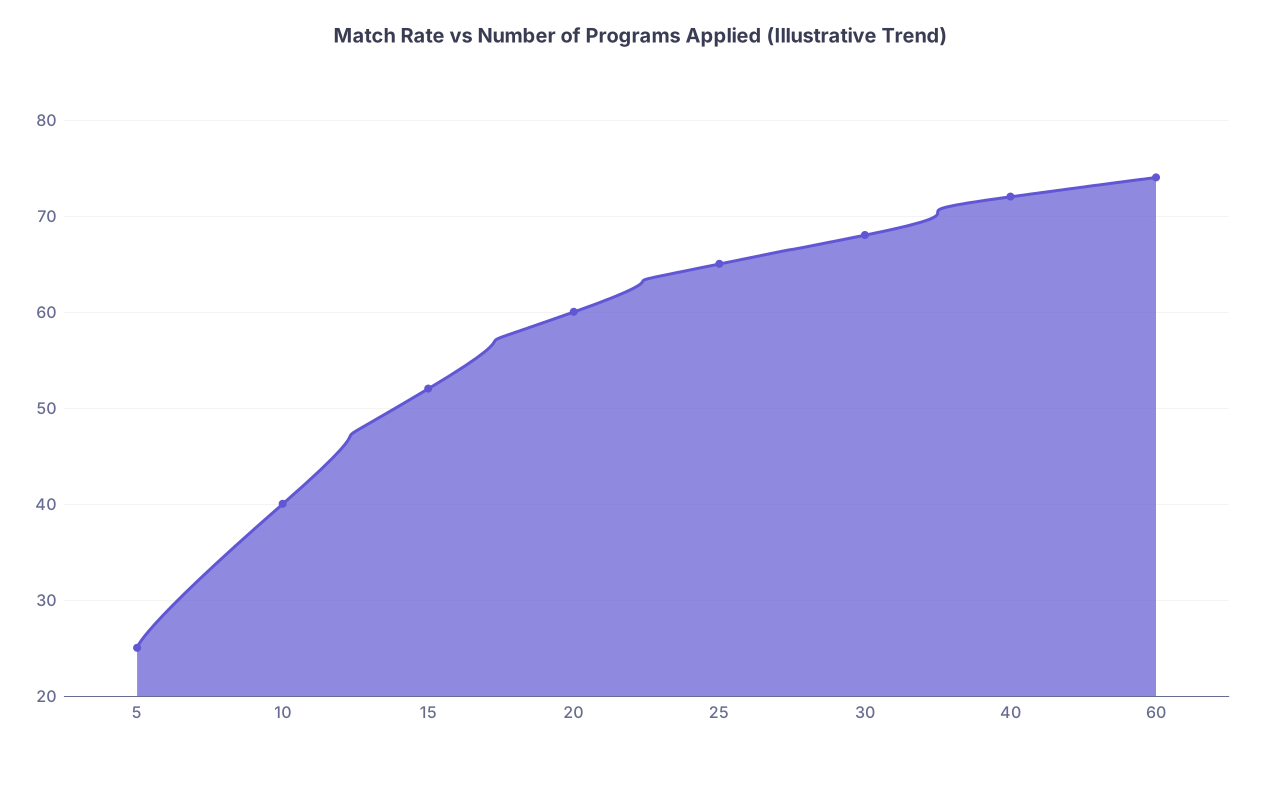
The central question in any program selection strategy article is: how many programs to apply and how to spread them across competitiveness tiers.
Approximate Ranges: How Many Urology Programs to Apply To?
Exact numbers vary year to year and by applicant profile, but as general guidance:
Highly Competitive Applicant
- Apply to ~35–45 programs
- You may selectively avoid programs that clearly don’t fit your goals (e.g., limited research if you want heavy academics), but be careful not to over‑narrow.
Solid / Typical Applicant
- Apply to ~45–60 programs
- Include a mix of highly competitive academic centers, solid mid‑tier programs, and well‑regarded community or hybrid programs.
Underdog / Higher‑Risk Applicant
- Apply to ~60–75+ programs if feasible
- Cast a wide net geographically and by program type; include more community and hybrid programs and some newer or smaller residencies.
These ranges are not rigid rules, but they give you a starting point for how many programs to apply in urology. Most applicants underestimate how competitive urology is and are better served by erring on the side of applying broadly.
Tiering Programs: A Practical Method
Once you’ve generated a long list (often 70–90 programs), categorize them into three broad tiers based on your self‑assessment and the program characteristics:
Reach Programs
- Historically match many applicants with top metrics and substantial research.
- High national or regional reputation, many fellowship‑bound graduates.
- You would be excited but not surprised to not receive an interview.
Target Programs
- Your metrics and experiences are aligned with or slightly above their typical matched residents.
- Good fit in terms of case volume, training style, and goals.
- You should expect to receive at least some interviews from this group.
Safety Programs (Realistic, Not “Throwaways”)
- Programs that historically interview and match applicants with a profile like yours or below.
- Often community or hybrid programs, sometimes in less sought‑after geographic regions.
- You would genuinely be willing to train there.
A healthy distribution might look like:
Highly Competitive Applicant:
- 30–40% reach, 40–50% target, 20–30% safety
Solid Applicant:
- 20–30% reach, 40–50% target, 30–40% safety
Underdog Applicant:
- 10–20% reach, 30–40% target, 40–60% safety
Example: Building a List for a “Solid” Applicant
Imagine you’re a solid candidate:
- Step 2 CK slightly above mean
- Honors in surgery and strong sub‑I comments
- One urology abstract + one general surgery QI project
- Letters from your home PD and two urologists (one from an away)
Your program selection strategy might be:
- Total applications: 55
- Program type mix: 20 academic, 25 hybrid, 10 community
- Tier distribution:
- 12–15 reach (top academic centers, highly research‑heavy programs)
- 25–30 target (solid academic and hybrid programs where your metrics are on‑par)
- 10–15 safety (smaller, newer, or more community‑focused programs; wider geographic spread)
You can fine‑tune this with your advisor based on your school’s historical match data.
Step 4: Strategic Filters – How to Choose Residency Programs That Fit You
Raw numbers don’t replace thoughtful program selection. Once you understand how many programs to apply, refine your list using filters that matter to you.
1. Geographic Preferences (and Flexibility)
Ask yourself:
- Are there locations I absolutely cannot live in (for family, financial, or health reasons)?
- Are there regions where I have significant ties (grew up, went to college, have family)?
- Am I willing to train anywhere for a strong program?
In urology, geographic openness is a major advantage. However:
- Avoid applying to a huge number of programs in regions where you’d never realistically go; that wastes time and money.
- Do apply more broadly in regions where you have strong ties, as programs often favor applicants who are likely to stay or return to the area.
2. Home Program and Away Rotations
Your home program and away sites should anchor your list:
- If you have a home urology residency, it’s often one of your best chances to match. Learn how “home‑friendly” they historically are.
- Away rotations double as long interviews:
- You should almost always apply to the programs where you did aways, unless the fit was clearly poor.
- Programs often significantly increase interview chances for rotators, especially if performance was strong.
3. Career Goals and Fellowship Aspirations
If you’re leaning toward:
Academics or subspecialty fellowship (oncology, pediatrics, reconstruction, FPMRS, endourology):
- Prioritize programs with robust research, strong faculty in your area of interest, and a track record of sending residents to top fellowships.
Community practice or private practice:
- Emphasize programs with high operative volume, broad general urology experience, and strong mentorship in practice management and real‑world skills.
4. Lifestyle and Culture
Residency will shape your life for 5–6 years:
- Consider call schedules, night float, and overall workload.
- Look for programs that openly discuss resident wellness, mental health resources, and schedule fairness.
- Pay attention to how residents talk about each other and the faculty during interview day and open houses.
5. “Red Flag” Considerations
Be cautious with:
- Programs with very low or inconsistent case volumes
- Places with high resident attrition or repeated unfilled spots (ask why)
- Environments where residents seem anxious to speak or guarded
- Programs that significantly over‑rely on residents for service with little teaching
While some new programs can be excellent and just need time to establish a reputation, you should evaluate them critically: leadership experience, hospital support, and operative opportunity.

Step 5: Practical Tactics for a Smart Program Selection Strategy
Use Data, But Don’t Be Paralyzed by It
Useful data sources include:
- AUA / specialty match statistics
- Residency program websites (case logs, fellowship placements)
- Your school’s match list and historical outcomes in urology
- Word of mouth from residents and recent graduates
However, keep in mind:
- Program culture and mentorship quality are not fully captured in numbers.
- Individual outcomes vary widely; you’re not a statistic.
Coordinate with Your Mentors Early
By late third year:
- Meet with your urology advisor or a trusted faculty member.
- Bring: draft CV, exam scores, research summary, and geographic preferences.
- Ask them directly:
- How competitive am I in this cycle?
- How many programs would you recommend for someone with my profile?
- Are there specific programs I should strongly consider—or avoid?
Advisors often know nuanced program details and informal reputations that you will not find online.
Leverage Away Rotations Strategically
When choosing away rotations, consider:
- Programs where you are realistically competitive and genuinely interested
- Geographic areas where you would be happy to live
- Institutions with strong reputations in your tentative subspecialty of interest
After your rotation:
- Ask for feedback and, if appropriate, a letter of recommendation.
- Clarify if they see you as a strong fit; this can inform how heavily you weight them on your list.
Monitor and Adjust During Application Season
As interviews roll in:
- Keep track of the ratio of invites to applications across tiers.
- If you receive few or no interviews from target programs, consider:
- Expanding your list if there’s still time in the cycle
- Realistically elevating the importance of your safety programs
Your final rank list should still prioritize genuine fit and happiness, but your application strategy may need mid‑course adjustments.
Common Pitfalls to Avoid
Over‑focusing on “name brand” prestige
A household name doesn’t always equal better training for your goals. Strong community and hybrid programs can produce excellent surgeons and happy graduates.Ignoring safety programs
In a competitive field like urology, lacking a sufficient number of realistic options is one of the biggest mistakes applicants make.Applying too narrowly geographically without a compelling reason
Unless you have non‑negotiable constraints, keeping your geographic options open substantially improves your odds.Relying solely on online reputation or anonymous forums
Forums and rumor mills are famously noisy and biased. Prioritize direct conversations with real residents and faculty.Underestimating the importance of fit
Even the most prestigious program won’t serve you well if you are miserable. The best program for you is the one where you will be supported, trained well, and able to thrive.
FAQs: Program Selection Strategy in Urology
1. How many urology residency programs should I apply to?
There’s no perfect number, but common ranges:
- Highly competitive applicants: ~35–45 programs
- Solid / typical applicants: ~45–60 programs
- Underdog applicants or those with red flags: ~60–75+ programs
Your specific number should be refined with your advisor based on your scores, research, letters, and your school’s historical match outcomes.
2. How do I decide which programs are “reach,” “target,” or “safety”?
Consider:
- Average metrics of recent matched residents (if available)
- Program reputation and how many graduates pursue top fellowships
- Research expectations and your own scholarly record
- Feedback from mentors who know the field
If your metrics, experience, and letters are significantly below what a program typically matches, it’s a reach. If they’re similar, it’s a target. If you’re above, or the program historically matches a wide range of applicants, it’s more of a safety.
3. Should I prioritize programs where I’ve done an away rotation?
Generally, yes—if the fit felt good and your performance was well received. Away rotations function as a prolonged audition. Programs often interview (and frequently rank highly) their strong rotators. However:
- Do not rank an away site highly if you felt the culture was unhealthy or misaligned with your values.
- If feedback from the rotation suggests they don’t see you as a strong fit, treat them more like a reach.
4. How important is research when choosing urology programs?
It depends on your career goals:
- If you’re aiming for academic medicine or a competitive fellowship, prioritize programs with robust research infrastructure, protected time, and consistent scholarly output.
- If you’re focused on community practice, research is less critical; instead, look more heavily at operative volume, breadth of general urology training, and mentorship in practice management.
That said, even community‑focused programs value residents who can interpret literature and participate in quality improvement, so some exposure to scholarly work is beneficial.
Designing a successful program selection strategy in urology means combining honest self‑assessment, thoughtful prioritization, and data‑informed flexibility. Applying broadly, choosing programs that truly fit your goals, and seeking guidance from trusted mentors will give you the best chance of a successful—and satisfying—urology match.