Understanding the Unique Challenges for Non‑US Citizen IMGs in Urology
Urology is one of the most competitive specialties in the US, and the bar is even higher for a non‑US citizen IMG or foreign national medical graduate. Before you can build a strong program selection strategy, you need a realistic understanding of:
- How competitive urology is
- How being a non‑US citizen IMG affects your chances
- What program directors look for when deciding whom to interview
Why Urology Is Especially Competitive
Compared with many other specialties, urology has:
- Fewer residency positions overall
- A smaller number of programs
- A strong emphasis on academic performance and research
- Early match timing (through the AUA/SAU system, not the NRMP Main Match)
For non‑US citizen IMGs, each of these factors narrows the funnel further. Many programs:
- Take few or no IMGs at all
- Do not sponsor visas
- Prioritize students from US allopathic (MD) schools
Your program selection strategy must recognize these realities and focus on:
- Targeting programs that actually consider and interview IMGs
- Ensuring visa sponsorship is possible
- Aligning your profile with where you are most likely to be competitive
IMG and Visa Status: Why It Matters
As a non‑US citizen IMG, you face two main layers of screening:
- IMG status (US vs non‑US medical school)
- Citizenship/visa status (US citizen, permanent resident, or needing J‑1/H‑1B)
Some programs are IMG-friendly but only if you are a US citizen/green card holder. Others may be open to foreign graduates but only sponsor a J‑1 visa. A smaller number consider H‑1B.
Your program selection strategy must therefore explicitly account for:
- Programs that historically have accepted IMGs
- Programs that clearly state visa sponsorship options (J‑1, H‑1B, both, or none)
- The intersection of those two factors with your own academic and research record
This is the core of an effective urology residency program selection strategy for a foreign national medical graduate.
Step 1: Profile Self‑Assessment – Know Where You Stand
Before you ask “how many programs to apply to,” you must understand how competitive your application is for urology as a non‑US citizen IMG. This will guide both how many and which programs you target.
Key Components of Your Competitiveness
- USMLE Scores (or Step 1 Pass + Step 2 CK score)
- Clinical Experience in the US (especially urology rotations)
- Letters of Recommendation from US urologists
- Research productivity and academic involvement
- Communication skills and English proficiency
- Visa status flexibility (e.g., able to accept J‑1 vs needing H‑1B)
USMLE Scores
In urology, programs often screen heavily by Step 2 CK score (and previously Step 1). As a non‑US citizen IMG:
- A strong Step 2 CK score is often necessary to overcome skepticism about your school’s grading system and training.
- Higher scores help compensate for unfamiliar medical school names and lack of home institution advocacy.
Benchmarks (approximate, not absolute):
- Very competitive for an IMG: Step 2 CK ≥ 255
- Competitive but more dependent on other strengths: 245–254
- Possible but needs compelling US experience, strong network, and realistic list: <245
These are not hard cutoffs, but they should influence your program selection strategy and how wide your net needs to be.
US Clinical Experience and Rotations in Urology
For urology, in‑person clinical exposure in US urology departments is extremely valuable:
- Away rotations (sub‑internships) in urology
- Observerships or research rotations in urology departments
- Strong faculty support from US urologists who know you well
If you have no US urology exposure at all, your program list must be particularly realistic and skewed to programs with a history of giving international graduates a chance—often those with significant research components.
Research Productivity
Because urology is academic and research‑oriented, your research record can dramatically impact your program options:
- PubMed‑indexed publications in urology or related fields
- Abstracts and presentations at urology or surgery conferences (AUA, SUO, etc.)
- A sustained research position in a US urology department
A powerful program selection strategy for a foreign national medical graduate often involves:
- Spending 1–2 years in a US‑based urology research position
- Building deep mentorship relationships
- Targeting programs where your mentors can advocate for you
English Proficiency and Communication
Programs worry about communication challenges, especially in a surgical subspecialty that requires nuanced patient counseling. Ensure that:
- Your personal statement and application materials are polished and error‑free
- You demonstrate clear, confident communication during rotations and in any emails to faculty
- You are prepared to perform well in virtual or in‑person interviews
Step 2: Clarify Your Constraints – Visa, Geography, and Career Goals
Your program selection strategy must integrate your personal and logistical constraints before you even open a program list.
Visa Considerations
As a non‑US citizen IMG, you should ask:
Which visa can I realistically obtain?
- J‑1 is the most common visa supported by GME offices.
- H‑1B is less common, especially in surgical specialties; many urology programs do not sponsor it.
Am I open to J‑1 with a later waiver service obligation?
- If yes, your pool is larger (more programs support J‑1).
- If you must have H‑1B, your pool will be much smaller, and you will need a very strong profile to be competitive at the few programs offering it.
What does each program actually say about visas?
- Some state clearly “J‑1 only.”
- Some say “no visa sponsorship.”
- Some are vague—this may require emailing the program coordinator diplomatically.
Your program selection strategy should include a tracking sheet with fields for:
- J‑1 sponsorship: Yes/No
- H‑1B sponsorship: Yes/No
- Unclear – follow up needed
Geographic Flexibility
If you restrict yourself to major coastal cities or high‑prestige academic centers, your chances drop. For a non‑US citizen IMG in urology, casting a wide geographic net usually improves your odds:
- Be open to midwestern and southern programs
- Consider smaller cities or less famous academic centers
- Avoid over‑concentration on top‑tier research institutions unless your profile is particularly strong
Career Goals: Academic vs Community Urology
Your long‑term goals affect which programs fit best:
If you want an academic career, emphasize programs with:
- Strong research infrastructure
- Fellowships and subspecialty exposure
- NIH funding or ongoing trials
If you are open to community or hybrid practice, consider:
- Community programs affiliated with academic centers
- Programs focused on high‑volume clinical training
For most non‑US citizen IMGs, it is wise to include both academic and community‑affiliated programs on the list, unless your mentors strongly advise otherwise.

Step 3: Building Your Initial Program List
Now you can begin the structured part of your program selection strategy: generating an initial universe of possible programs, then systematically narrowing it down.
Sources of Program Information
Use multiple sources to answer the question “how to choose residency programs?” for urology:
- AUA/SAU Urology Match Program Listings
- Official program list with basic information and links
- Program Websites
- Visa policies, IMG requirements, research focus
- Faculty interests and recent publications
- FREIDA (AMA Residency and Fellowship Database)
- Basic stats, program size, visa information (not always updated)
- NRMP/AUA Match Data and past statistics
- To understand competitiveness trends
- Personal Networks
- IMGs who matched in urology
- Research mentors, attendings, residents
- Alumni from your medical school
Identifying IMG‑Friendly Urology Programs
Because you are a non‑US citizen IMG, you must prioritize:
- Programs that have historically matched IMGs (especially non‑US citizens)
- Places where your mentors or contacts have influence
- Hospitals that traditionally rely on IMGs in other surgical specialties (orthopedics, general surgery) even if they rarely take IMGs in urology—could still be more open-minded
Look for:
- Past residents’ lists posted on department websites
- Do you see non‑US medical schools? Any foreign national medical graduate among recent residents?
- Research fellows turned residents
- Some programs “grow their own” by promoting successful research fellows into residency
- Signals on websites such as “We welcome applications from international medical graduates” (rare but valuable)
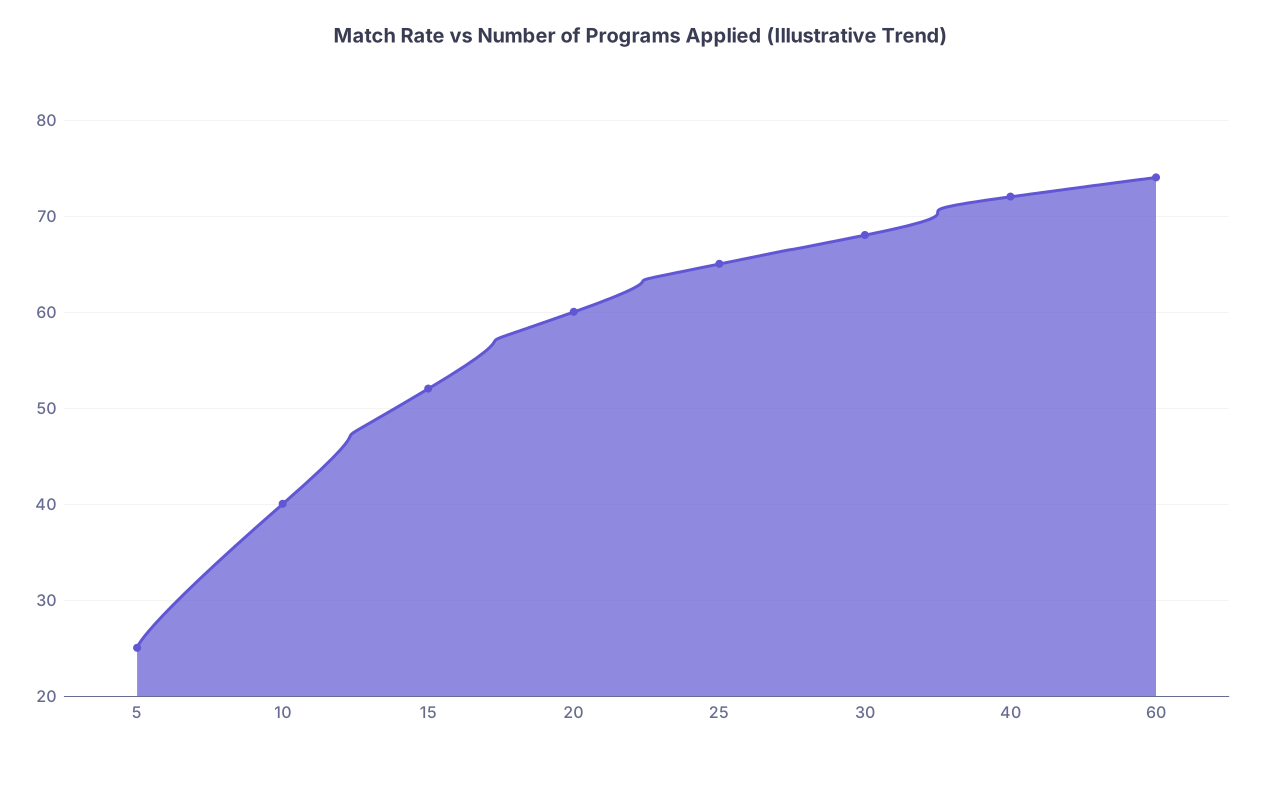
Step 4: How Many Programs Should You Apply to in Urology?
This is one of the most critical questions for your program selection strategy as a foreign national medical graduate: how many programs to apply to in the urology match?
Urology has a limited number of programs and positions compared with large specialties like internal medicine. However, for a non‑US citizen IMG, a broad application strategy is usually necessary.
General Ranges (Approximate, for Non‑US Citizen IMGs)
These are not rules, but starting points for planning:
Very Strong Profile
- Step 2 CK: ≥ 255
- Multiple US rotations in urology
- 2–3 strong letters from US urologists
- Significant research, possibly 1–2 years in US urology research
- Strategy:
- Apply to most urology programs that accept IMGs and sponsor your visa type
- Expected application range: 45–60 programs
Moderately Strong Profile
- Step 2 CK: ~245–254
- Some US experience in surgery/urology and at least one US urology letter
- Some research (ideally urology‑related)
- Strategy:
- Apply broadly to almost all plausible programs, including less famous academic centers and community‑affiliated programs
- Be realistic and avoid programs that explicitly state they do not accept IMGs
- Application range: 60–80+ programs
Weaker or Unbalanced Profile
- Step 2 CK: <245
- Limited or no US urology exposure
- Minimal research
- Strategy:
- Consider dedicating a year to US‑based research in urology before applying
- If applying this cycle, you must cast an extremely wide net but also have a parallel plan (e.g., research position, another specialty)
- Application range: as many viable programs as possible, understanding odds may still be low
In all scenarios:
- Your program selection strategy should assume you will need to apply broadly.
- Budget realistically for application fees and possibly traveling for interviews (if in‑person).
Avoiding Common Mistakes in Deciding How Many Programs to Apply To
Over‑focusing on prestige
- Targeting only big‑name institutions is risky for a non‑US citizen IMG in a surgical subspecialty. Mix “reach,” “target,” and more realistic “safety” programs.
Ignoring visa information
- Submitting applications to programs that never sponsor visas wastes money and effort.
Applying too narrowly by geography
- Limiting yourself to 1–2 states or only major cities drastically lowers your odds.
Failing to budget for broad applications
- You must plan your finances early (application fees, potential travel, USMLE exams, document translation if needed).
Step 5: Prioritizing and Tiering Your Program List
Once you have a list of programs that:
- Accept IMGs (ideally with a record of doing so)
- Offer your visa type (J‑1 and/or H‑1B)
- Fit your basic geographic and academic preferences
You should categorize programs into tiers to guide your efforts.
Tier 1: High Priority / Strong Match
Programs that are a good fit and where you may have a realistic shot:
- Have recent non‑US IMG residents
- Have faculty mentors who know you or where you have done rotations or research
- Offer your preferred visa type
- Align well with your Step 2 CK score and academic record
Actions:
- Spend extra time on personalized emails to faculty/PDs when appropriate
- Highlight direct connections in your personal statement or supplemental materials
- Consider visiting (if possible) for observerships or virtual information sessions
Tier 2: Moderate Fit
Programs where you are competitive on paper, but:
- They may not have a strong history with IMGs
- They are more selective or academic
- They have limited spots and no personal connection
Actions:
- Apply, but don’t rely heavily on these; consider them “targets.”
- Still research them well and tailor your applications where possible.
Tier 3: Reach Programs
Highly prestigious or historically IMG‑averse programs where your chances are lower, but not zero:
- Top‑tier academic centers with intense competition
- Programs with no recent non‑US IMG residents but strong faculty in your research area
- Programs where your mentor has strong personal ties
Actions:
- Apply selectively, based on strategic reasons (mentor connections, perfect research fit).
- Do not let this tier dominate your list.

Step 6: Practical Tactics to Strengthen Your Program Selection Strategy
Beyond choosing where and how many programs to apply to, you can actively signal interest and strengthen your candidacy for specific urology programs.
Use Your Network Strategically
For a non‑US citizen IMG, networking is often as important as metrics:
Ask your research mentor or US urology attendings:
- “Based on your knowledge of my profile, which programs do you think are realistic for me?”
- “Are there any programs where you would feel comfortable sending an email or calling on my behalf?”
Reach out to current residents (especially IMGs) at programs you’re interested in:
- Ask about the culture, openness to IMGs, and whether they know of non‑US citizen IMGs in the program.
Tailor Your Application Materials
When possible:
Customize parts of your personal statement to mention:
- Specific aspects of a program’s training or research
- Faculty whose work you admire and have read
Highlight why your international background is an asset:
- Diverse patient experience
- Adaptability and resilience
- Commitment to underserved communities
Parallel Planning
Given the competitiveness of urology for non‑US citizen IMGs, a realistic program selection strategy often includes a contingency plan:
- A research year in urology or a related field if you do not match
- Applying to another less competitive specialty in a subsequent cycle, if needed
- Maintaining strong professional relationships so you can reapply with a stronger profile
Putting It All Together: Example Program Selection Strategy
Imagine a non‑US citizen IMG with:
- Step 2 CK: 250
- 1‑year US urology research fellowship with 3 urology abstracts and 1 pending manuscript
- 1 US urology away rotation
- 3 letters from US urologists
- Okay with J‑1 visa
A realistic urology residency program selection strategy might look like:
Build a program spreadsheet with:
- All urology programs
- Visa types supported
- History of IMGs (especially non‑US)
- Geography, program size, research focus
Filter out programs that:
- Explicitly do not accept IMGs
- Do not sponsor any visas
Further categorize into tiers:
- Tier 1 (about 15–25 programs):
- Programs with IMGs in recent years, J‑1 sponsorship, faculty connections via research, or programs where you rotated
- Tier 2 (30–40 programs):
- Reasonably IMG‑open, J‑1 friendly, no direct connection but appropriate academic level
- Tier 3 (10–20 programs):
- Higher‑tier academic centers where your mentor has some connection or where your research is highly relevant
- Tier 1 (about 15–25 programs):
Total applications: ~60–80 programs.
Parallel plan:
- If not matched, continue urology research, aim for more publications, and possibly pursue a second‑cycle match with a strengthened profile.
This structured approach addresses the core question of how many programs to apply to while using a deliberate program selection strategy tailored to a non‑US citizen IMG in the urology match.
FAQs: Program Selection Strategy for Non‑US Citizen IMGs in Urology
1. As a non‑US citizen IMG, is it realistic to match into urology?
It is possible but difficult. Urology is highly competitive, and many programs rarely take IMGs, especially non‑US citizens. Your odds improve significantly if you:
- Achieve a strong Step 2 CK score
- Obtain substantial US‑based urology research experience
- Build relationships with US urologists who can advocate for you
- Apply broadly to programs that accept IMGs and sponsor your visa type
You should approach the process with ambition but also realism and consider parallel plans (e.g., research years).
2. How important is visa type (J‑1 vs H‑1B) for my program list?
Visa type is critical for your program selection strategy. Many urology programs sponsor only J‑1 visas. A smaller subset may offer H‑1B, and some sponsor no visas at all. If you can accept a J‑1, your program pool is much larger. If you require H‑1B, you must:
- Identify the relatively few programs that offer it
- Recognize that competition for those spots is intense
- Have a very strong profile (scores, research, US experience)
Always verify visa information directly from the program website or coordinator, as databases can be outdated.
3. How many urology programs should I apply to if my profile is average for an IMG?
For a foreign national medical graduate with a mid‑range Step 2 CK (around 245–255), some US urology exposure, and modest research, you should plan to:
- Apply to 60–80 or more urology programs that:
- Accept IMGs
- Sponsor your visa type
- Are not clearly out of reach based on their track record
- Diversify across academic and community‑affiliated programs
- Use mentors’ advice to refine the list
Given the competitive nature of the urology match, applying broadly is often essential.
4. Should I take a research position before applying to urology?
For many non‑US citizen IMGs, a US‑based urology research position is one of the most effective ways to:
- Strengthen your CV with publications and presentations
- Develop relationships with US urologists
- Gain credible US letters of recommendation
- Demonstrate long‑term commitment to urology
If your current profile is not strong (lower Step 2 CK, no US urology exposure, minimal research), spending 1–2 years in research before applying can substantially improve your competitiveness and allow for a more focused, realistic program selection strategy in the urology match.
By combining a clear assessment of your profile, realistic understanding of visa and IMG constraints, and a structured approach to how to choose residency programs, you can create a program selection strategy that maximizes your chances as a non‑US citizen IMG aspiring to match into urology.