Understanding the Unique Challenge: Caribbean IMG in the Urology Match
Urology is one of the most competitive residency specialties in the United States. For a Caribbean IMG—whether from SGU, Ross, AUC, Saba, or another Caribbean medical school—developing a deliberate program selection strategy is absolutely critical.
Several realities shape your approach:
- Urology is an early match through the AUA (not the main NRMP Match for most positions).
- Caribbean medical school residency placement in urology is less common than in primary care fields; each application choice matters more.
- Many programs rarely or never interview IMGs, while others are more open if your profile is strong.
- As a Caribbean IMG, you must be extra strategic about where and how many programs to apply.
This article walks you step-by-step through a data-driven, realistic, and high-yield program selection strategy tailored specifically to Caribbean IMGs targeting urology residency.
We’ll address:
- How to evaluate your competitiveness honestly
- How many urology programs to apply to as a Caribbean IMG
- How to build a balanced list (reach/target/safety)
- How to identify IMG-friendly urology programs
- How to prioritize programs given time, money, and rotation constraints
- Where SGU residency match data and similar resources fit into your strategy
Step 1: Analyze Your Competitiveness Objectively
Before deciding how many programs to apply to or which ones, you must honestly evaluate your profile in the context of the urology match.
Key Components of Competitiveness in Urology
USMLE Scores (or STEP scores if pass/fail context)
- Historically, urology applicants who match tend to have above-average Step scores.
- With Step 1 pass/fail, Step 2 CK has become more critical.
- As a Caribbean IMG, a strong Step 2 CK (ideally 245+ and higher is better for urology) significantly improves your odds.
- If your Step 2 is <235, you may still apply, but your program selection strategy should be more conservative and focused on genuinely IMG-friendly programs.
Clinical Performance and MSPE/Dean’s Letter
- Honors in core rotations—especially surgery and medicine—are valuable.
- Strong comments in your evaluations that highlight work ethic, technical skills, and teamwork matter a lot in surgical specialties like urology.
Urology-Specific Exposure
- Formal urology rotations or electives in the U.S.
- Strong letters of recommendation (LORs) from urologists, preferably at U.S. academic centers.
- Any urology research (case reports, QI projects, retrospective chart reviews, or bench research) helps.
Research & Scholarly Activity
- Urology is increasingly research-focused.
- Publications, abstracts, and posters in urology or surgical fields can significantly boost your application.
- Caribbean IMGs from schools like SGU often succeed by demonstrating sustained research work, sometimes with mentors at U.S. institutions.
Visa Status
- If you need a visa (J-1 or H-1B), that will further narrow your realistic program list.
- Some programs clearly state “No visas sponsored”; don’t waste applications there.
Self-Stratify: Where Do You Stand?
Use your profile to categorize yourself:
Tier 1 (Very Competitive Caribbean IMG)
- Step 2 CK ≥ 250
- Strong urology LORs from U.S. faculty
- At least a few urology research outputs
- Honors in surgery/medicine
- No red flags, solid clinical narratives
Tier 2 (Moderately Competitive)
- Step 2 CK ~238–249
- At least one strong urology LOR
- Some research or strong clinical performance
- Possibly one minor red flag (single fail on an exam now passed, etc.)
Tier 3 (High-Risk but Still Applying)
- Step 2 CK <238
- Minimal or no urology research
- Limited U.S. urology exposure
- Visa requirement and/or academic red flags
The lower your tier, the more programs you should apply to and the more carefully you must target IMG-friendly institutions.

Step 2: How Many Urology Programs Should a Caribbean IMG Apply To?
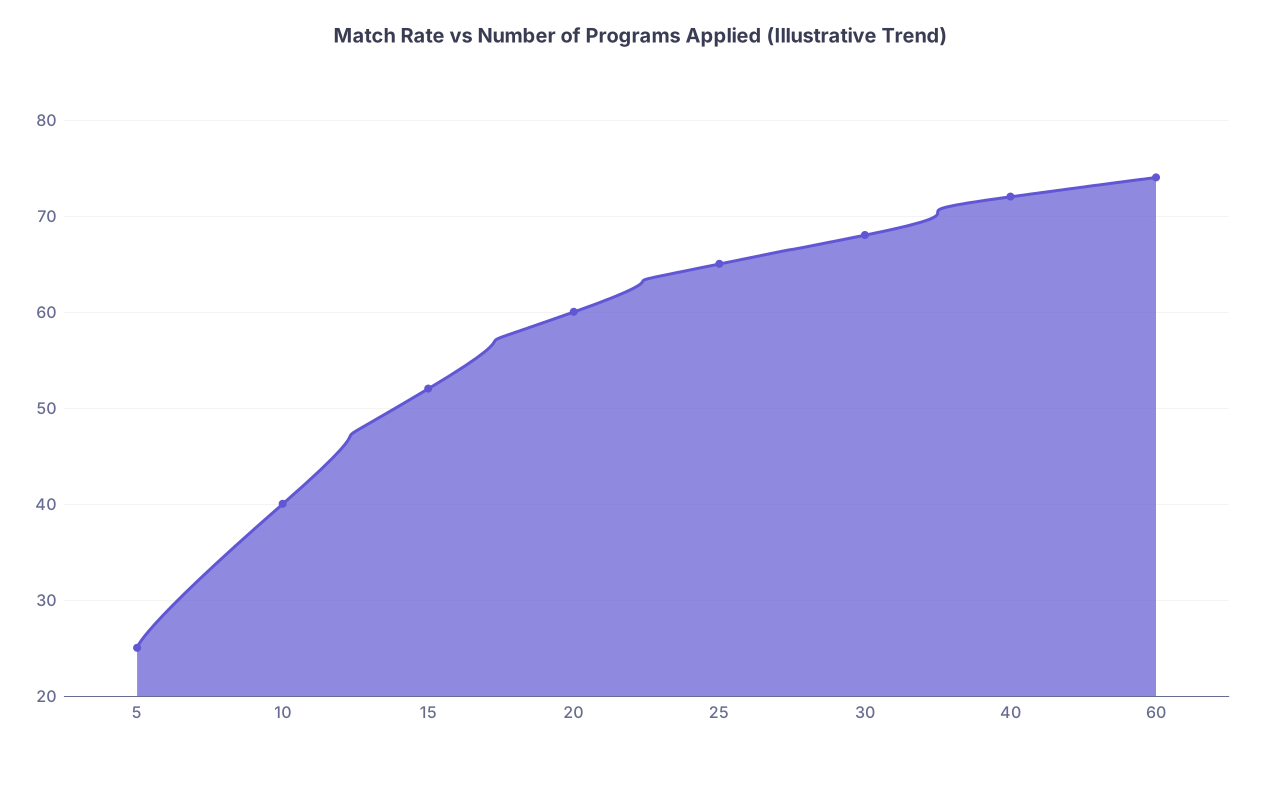
There is no universal number, but for Caribbean IMG applicants in urology, a broad application strategy is usually necessary.
General Ranges by Tier
These estimates assume you are applying through the AUA Urology Match, plus possibly a parallel backup specialty (e.g., general surgery, prelim surgery, internal medicine via NRMP):
Tier 1 Caribbean IMG (strong profile)
- Urology: 45–65 programs
- Backup specialty (if desired): 10–20 programs
- Rationale: You’re competitive enough for a solid number of interviews but still face IMG bias and specialty competitiveness.
Tier 2 Caribbean IMG
- Urology: 60–80+ programs
- Backup specialty: 20–30 programs
- Rationale: You need to offset the lower probability of interview invitations with volume and careful program selection.
Tier 3 Caribbean IMG
- Urology: 70–90+ programs (if strongly committed)
- Backup specialty (highly recommended): 25–40+ programs
- Rationale: Matching in urology will be challenging; you must be very realistic. Many in this tier choose to strongly prioritize backup plans or delay a cycle to strengthen their application.
Factors That Modify the Number
Budget
- Application fees accumulate quickly.
- Consider total cost: AUA application + ERAS (if using for prelim or backup) + travel for interviews (in-person) or tech/logistics for virtual interviews.
- If funds are limited, narrow by evidence-based criteria instead of just cutting random programs.
Time and Bandwidth
- Interviews—especially if both AUA and NRMP—can be time-consuming.
- Still, urology interviews are not as numerous per applicant as larger specialties, so broad application is generally manageable.
Backup Strategy
- If you’re simultaneously applying to general surgery, prelim surgery, or internal medicine, you can afford to be ambitious in urology, but you must still apply widely enough to get a fair chance at interviews.
Step 3: Build a Targeted, Tiered Program List
Numbers alone are not enough. Your program selection strategy should focus on where you have a realistic chance as a Caribbean IMG pursuing urology.
Think in three categories: reach, target, and safety (though in urology, “safety” is always relative).
1. Reach Programs
These are top-tier academic centers, highly competitive locations (Northeast urban hubs, West Coast academic giants), or historically top-ranked urology departments.
- Examples: Big-name university hospitals, institutions with large NIH funding or strong urologic oncology programs.
- As a Caribbean IMG, you should still apply to some of these if your profile supports it (especially Tier 1 candidates), but keep them to perhaps:
- 15–25% of your list, depending on your competitiveness.
2. Target Programs
Programs where:
- There is at least some history of interviewing or matching IMGs (not necessarily Caribbean, but IMGs generally).
- Their website does not explicitly discourage IMGs.
- Your metrics (scores, research, clinical performance) are near or above the program’s reported or estimated averages.
- They are mid-tier academic or strong community-based training programs.
These should make up the bulk of your list:
- 50–65% of your applications.
3. Relative “Safety” Programs
In urology, there are few true safeties, but relative safeguards include:
- Programs with documented Caribbean IMG or other IMG residents in recent classes.
- Programs in less geographically competitive locations (smaller cities, Midwest, South, some non-coastal areas).
- Institutions explicitly stating they are open to IMGs and willing to sponsor visas.
- Strong community or hybrid academic-community programs not viewed as top “name-brand” destinations.
Aim for 20–30% in this category, with the understanding that no urology position is ever genuinely easy to get.
Step 4: Identify Urology Programs That Are Realistic for Caribbean IMGs
Use Actual Match Outcomes and IMG Data
SGU Residency Match and Similar Data
- If you’re from SGU or another major Caribbean medical school, use your school’s residency match lists:
- Search for “urology” and see which institutions have previously accepted Caribbean grads.
- These programs are more likely to:
- Recognize the school’s curriculum.
- Have familiarity with Caribbean IMGs.
- Be open to considering your application.
- If you’re from SGU or another major Caribbean medical school, use your school’s residency match lists:
Public Databases & Forums
- AUA Residency Program listings.
- FREIDA (for general program information, though urology may not show all details).
- Specialty forums where applicants share urology match experiences (e.g., Student Doctor Network, Reddit—use these cautiously and focus on confirmed data).
- Look for patterns: which programs have current or recent IMGs?
Program Websites
- Review program pages carefully:
- Current residents: Do they include Caribbean or other IMGs?
- FAQ sections: Do they state whether they accept IMGs or sponsor visas?
- Research and faculty pages: Opportunities that align with your background.
- Review program pages carefully:
Practical Filter Criteria
When building your list, use the following filters systematically:
Geography
- More open: Midwest, South, some interior states.
- More competitive and IMG-skeptical: Some Northeast and West Coast academic powerhouses.
Visa Policy
- If you require a visa, exclude:
- Programs stating they do not sponsor visas.
- Programs that require U.S. citizenship or permanent residency.
- Prioritize:
- Programs that explicitly note J-1 sponsorship.
- Programs currently training residents on visas.
- If you require a visa, exclude:
Historical IMG Presence
- Any program with multiple past or current IMGs is highly valuable for a Caribbean IMG applicant.
- This is one of the strongest markers of being worth an application.
Size and Newness
- Larger programs may be more flexible and occasionally more open to non-traditional profiles.
- Newer programs might have fewer entrenched selection habits but may also be more cautious early on; evaluate case by case.

Step 5: Program Selection Strategy: Balancing Fit, Risk, and Personal Priorities
Once you’ve filtered for feasibility, refine your list based on fit and priorities.
Factors to Consider When Choosing Residency Programs
Clinical Training Breadth
- Variety of subspecialties: oncology, endourology, female pelvic medicine, pediatrics, reconstructive, andrology, etc.
- Surgical volume and autonomy.
- Robotics exposure and access to minimally invasive technology.
Academic vs. Community Emphasis
- Academic: Strong for those who want fellowship, research careers, or academic positions.
- Community: Often high operative volume and close-knit teams.
- Hybrid programs may provide the best of both worlds for many Caribbean IMGs.
Research Environment
- If you’re building a research-heavy profile:
- Look for structured research time and mentors.
- Review recent urology publications from the department.
- If you’re building a research-heavy profile:
Culture and Mentorship
- Harder to assess but critical for well-being.
- Read resident bios, watch program videos, attend virtual open houses.
- Seek out alumni from Caribbean schools in urology; ask about program culture and support.
Geographic and Personal Considerations
- Family, partner, or spouse location.
- Cost of living and support networks.
- While you should be flexible as a Caribbean IMG in a competitive specialty, your personal life still matters.
Creating a Prioritized List
Once you have a longlist (perhaps 80–100 programs), sort them into:
- A List (Top Priority): Programs where feasibility is high, IMG openness is clear, and you genuinely like the training environment and geography.
- B List (Moderate Priority): Reasonable options where either feasibility or personal fit is slightly less ideal but still acceptable.
- C List (Long Shots or Lower Fit): Reach programs or those with less known IMG history but where you would still be happy to train.
Trim only if budget or logistics require. In urology, over-trimming is more dangerous than over-applying, especially as a Caribbean IMG.
Step 6: Integrating Backup Plans and Parallel Strategies
Because urology is highly competitive, every Caribbean IMG applicant should at least consider a backup plan.
Common Backup Paths
General Surgery Categorical
- Strong overlap in skillset, OR exposure, and potential later entry into urology via complex routes (though not guaranteed).
- Can still lead to a satisfying surgical career even if urology is not ultimately attainable.
Preliminary Surgery
- One-year positions.
- Not a guaranteed pathway to urology, but can:
- Strengthen your clinical credibility.
- Create opportunities for networking and potential PGY-2 openings.
- Must be approached cautiously and with clear eyes about the uncertainty.
Other Specialties
- Internal medicine, radiology, or other fields where you also have genuine interest.
- Important if you value matching into any residency more than waiting for urology specifically.
Strategic Application Timing
Remember:
- The AUA Urology Match results are released before the main NRMP Match (for most cycles).
- If you do not match in urology:
- You still have time to participate in NRMP (for backup specialties) and SOAP if necessary.
- Coordinate:
- Urology AUA applications (main focus).
- NRMP applications (backup specialty) with well-chosen program lists rather than an unfocused scatter.
Step 7: Practical Example – Building a Sample Program List
Example Profile: Caribbean IMG from SGU
- Step 2 CK: 245
- Honors in surgery, high pass in internal medicine
- 1 urology rotation in the U.S. with strong LOR
- 1 urology case report and 1 poster at a regional meeting
- Requires J-1 visa
Tier: Solid Tier 2
Target Application Strategy:
Total urology programs: ~70
- 15 reach (top academic centers where IMGs are rare but not impossible)
- 40 target (mid-tier academic and community programs with some IMG history)
- 15 relative safety (known IMG acceptance, Midwest/South, visa-friendly)
Backup: 20–25 general surgery categorical + 10 prelim surgery via NRMP
Selection Tactics:
- Start with:
- All programs that have previously accepted SGU or other Caribbean IMGs (via SGU residency match lists or equivalent).
- Additional programs in less competitive geographic regions that do not exclude IMGs.
- Remove:
- Programs explicitly refusing visas.
- Programs with no IMGs ever and high-profile reputations where you are significantly below their likely average metrics.
- Refine:
- Rank programs according to academic interest, geography, and culture.
- Attend virtual open houses for your top 20–30 to refine your true “A List.”
Final Thoughts: Key Takeaways for Caribbean IMGs Targeting Urology
- Urology is highly competitive; as a Caribbean IMG, your program selection strategy must be systematic and realistic.
- Apply broadly:
- Typically 45–90 urology programs, depending on your competitiveness and risk tolerance.
- Focus where you have evidence of openness to IMGs, especially from Caribbean schools:
- Use SGU residency match data and similar match lists from your school.
- Structure your list with reach, target, and relative safety programs:
- With a majority in the target category.
- Don’t neglect backup plans through NRMP in related specialties.
- Data, realism, and persistence—not just hope—should guide where and how many programs you apply to.
Frequently Asked Questions (FAQ)
1. As a Caribbean IMG, is it even realistic to match into urology?
Yes, but it is challenging. Urology is among the most competitive specialties, and many programs prefer U.S. MD seniors. However, Caribbean medical school residency outcomes do include some urology matches each year, especially from schools like SGU, Ross, and AUC. Success requires:
- Strong exam scores (especially Step 2 CK).
- Urology exposure and research.
- Strategic program selection emphasizing IMG-friendly institutions.
- Often, a broader application and a well-planned backup strategy.
2. How can I tell if a urology residency program is IMG-friendly?
Look for:
- Current or recent IMGs listed among residents or alumni.
- Program FAQs stating they consider IMGs and/or sponsor J-1 visas.
- Lists from your own school (e.g., SGU residency match lists) showing prior matches at that institution.
- Reassuring information from residents or coordinators when you attend virtual open houses or reach out respectfully with specific questions.
If a program explicitly rejects IMGs or refuses visas, don’t apply.
3. If my Step 2 CK score is below 240, should I still apply to urology?
You can, but expectations must be realistic. You should:
- Apply even more broadly (70–90+ programs).
- Focus strongly on IMG-friendly and less geographically competitive programs.
- Strengthen every other part of your application: urology letters, research, away rotations (if possible).
- Develop a solid backup plan (e.g., general surgery or another specialty you’d be happy in) with an adequate number of programs.
Some Caribbean IMGs choose to delay applying one cycle to improve their profile via research or additional clinical work, depending on circumstances.
4. How important are away rotations for a Caribbean IMG in the urology match?
Away rotations (audition rotations) are extremely valuable in urology, especially for Caribbean IMGs:
- They provide face time with faculty and residents.
- They allow you to earn strong letters of recommendation from U.S. urologists.
- They can convert a “cold” program into one where you are a known, trusted applicant.
However, away rotations are not always feasible for everyone due to time, funding, and visa issues. If you cannot do multiple away rotations, at least try to secure one strong rotation in urology at a U.S. site and maximize your performance and networking there.
By combining honest self-assessment, a carefully designed program selection strategy, and a realistic approach to how many programs to apply to, Caribbean IMGs can significantly improve their chances in the competitive urology match.