Understanding Your Unique Position as a US Citizen IMG in Urology
As a US citizen IMG (international medical graduate) aiming for urology residency, you occupy a very specific—and often misunderstood—position in the urology match. You share some challenges with non‑US IMGs, but you also have advantages that you must learn to leverage when building a program selection strategy.
Before you decide how to choose residency programs, how many programs to apply, or how to rank them, you need a realistic understanding of where you stand.
Why Urology Is Different
Urology is:
- A small specialty with relatively few residency positions nationwide
- Historically competitive, with high board scores and strong clinical metrics among matched applicants
- A specialty that places major emphasis on:
- Academic performance (especially in core surgical and clinical rotations)
- USMLE scores
- Letters of recommendation from urologists
- Research productivity (often urology-specific)
- Performance on urology away rotations (sub‑internships)
In addition, urology uses its own match system (run by the AUA/SAU) that takes place earlier than the NRMP Match. That timing affects your planning and how aggressively you apply.
What Being a US Citizen IMG Means in the Urology Match
Compared with US MD seniors, a US citizen IMG is more likely to face:
- Fewer interviews per application
- Less familiarity from program directors with your medical school
- Heightened scrutiny of clinical evaluations and letters
- A perception risk: not all programs are IMG‑friendly
Compared with non‑US IMGs, you typically:
- Do not need visa sponsorship, removing a logistical barrier
- May have stronger cultural familiarity with US healthcare and communication norms
- May have some US undergraduate education or prior US experience that helps your profile
When you develop a program selection strategy in urology, the goal is to:
- Maximize the number of programs likely to consider and interview you
- Balance reach, target, and safety programs realistically
- Avoid over‑concentration on ultra‑competitive or IMG‑averse programs
- Keep your list large enough to be safe, but not so large that your application quality drops
The rest of this article will take you step‑by‑step through how to do that.
Step 1: Honestly Assess Your Competitiveness
You cannot decide how many programs to apply or which ones to target until you perform a clear, honest assessment of your own application. As an American studying abroad, this is crucial—urology is unforgiving if your self‑assessment is off.
Core Components to Evaluate
USMLE Performance
- Step 1: Now Pass/Fail, but still relevant. Failure attempts will significantly limit options.
- Step 2 CK:
- 250+ → Strong for US citizen IMG in urology
- 240–249 → Competitive but will need strengths elsewhere
- 230–239 → Possible with strategic program choice, strong letters, and urology exposure
- <230 or any failed attempt → Very challenging; may need research year or additional strengthening before application
Clinical Performance
- Honors or high passes in core rotations, especially:
- Surgery
- Internal medicine
- Strong sub‑internship (sub‑I) or away rotation evaluations in urology
- Honors or high passes in core rotations, especially:
Letters of Recommendation
- Preferably 3 letters, with:
- At least 2 from US urologists
- 1 from a department chair or program director in urology if possible
- Letters should be detailed, personalized, and enthusiastic—these matter more for IMGs who need advocacy.
- Preferably 3 letters, with:
Urology‑Specific Exposure
- US clinical experience in urology (electives or sub‑Is)
- Participation in urology clinics, OR, call, and conferences
- Evidence you fully understand what a urology career entails
Research and Academic Productivity
- Urology‑related research is a plus:
- Abstracts, posters, publications, QI projects
- A dedicated research year at a US institution is very helpful, especially if:
- You have weaker exam scores
- You lack urology exposure or letters
- Urology‑related research is a plus:
Red Flags
- USMLE failures or multiple exam attempts
- Extended gaps without clear explanation
- Professionalism concerns or academic probation
- Very limited US clinical experience
Creating a Self‑Profile Tier
Using the factors above, roughly place yourself in one of three “tiers” for urology as a US citizen IMG:
Tier 1 (Highly Competitive US Citizen IMG)
- Step 2 CK ≥ 250
- Strong clinical evaluations, honors in surgery
- Multiple strong US urology letters
- Urology research (preferably with output)
- No major red flags
Tier 2 (Competitive but Not Elite)
- Step 2 CK 240–249
- Solid clinical performance
- Some US urology exposure and at least 1–2 good urology letters
- Maybe limited or non‑urology research
Tier 3 (At Risk / Needs Strengthening)
- Step 2 CK < 240 or multiple attempts
- Minimal US urology experience
- Lightweight letters or primarily non‑urology letters
- Limited research, no advocacy from US urologists
- Any red flags
This self‑profiling will drive your program selection strategy, including how many programs to apply and what types of programs to emphasize.

Step 2: Understand the Urology Program Landscape for US Citizen IMGs
Once you know your approximate tier, you need to understand the landscape of urology programs to target those most likely to consider an American studying abroad.
Key Dimensions of Program Variation
IMG‑Friendliness
- Some programs regularly interview and match IMGs, including US citizen IMGs.
- Others rarely, if ever, rank IMGs high enough to match.
- Look specifically for:
- Current or recent residents with IMG backgrounds
- Program websites that explicitly mention diversity in training backgrounds
- Conversations at open houses/virtual Q&As where faculty acknowledge having IMGs
Program Size and Structure
- Larger programs (2–4 residents/year) may have:
- More interview slots
- Some openness to strong non‑traditional or IMG applicants
- Smaller programs (1 resident/year) are often:
- Very selective
- Tight-knit with strong preferences for known students or home/away rotators
- Larger programs (2–4 residents/year) may have:
Academic vs. Community Orientation
- Highly academic programs with big-name reputations tend to:
- Prefer US MD seniors from top schools
- Heavily weigh research
- Be less IMG‑friendly overall
- Mid‑tier academic or academic‑community hybrid programs:
- Often the best targets for US citizen IMGs
- Value clinical work ethic and genuine interest over prestige alone
- Community-based programs with academic affiliations may:
- Have fewer research expectations
- Be more open to strong IMGs with good clinical skills
- Highly academic programs with big-name reputations tend to:
Geographic Factors
- Some regions are more competitive (e.g., Northeast, West Coast, major metropolitan areas).
- Programs in less saturated regions or smaller cities may be relatively more receptive to well-qualified IMGs.
Home Institution and Away Rotations
- Programs are much more likely to interview and rank high the students who:
- Rotated there for a urology sub‑I
- Have strong advocacy from their faculty
- As a US citizen IMG, away rotations are one of your most powerful tools—they essentially convert you into a “known quantity.”
- Programs are much more likely to interview and rank high the students who:
Where to Find Data and Signals
As you refine your program selection strategy, use:
- AUA/SAU official lists of accredited urology programs
- Program websites and resident rosters (look for IMG or Caribbean backgrounds)
- Social media (Twitter/X, Instagram) where programs showcase residents and highlight diversity
- Word of mouth:
- Mentors at your school
- Urology faculty where you rotate
- Alumni from your medical school who matched into urology
Keep a spreadsheet of all programs with columns like:
- Current IMG residents? (Y/N, details)
- Program type: academic / hybrid / community
- Region and city size
- Reputation (major, mid, lesser-known)
- Visa policy (even if not needed, may reflect openness to IMGs)
- Notes from virtual open houses or away rotations
This database becomes your backbone for how to choose residency programs strategically.
Step 3: Determining How Many Urology Programs to Apply To
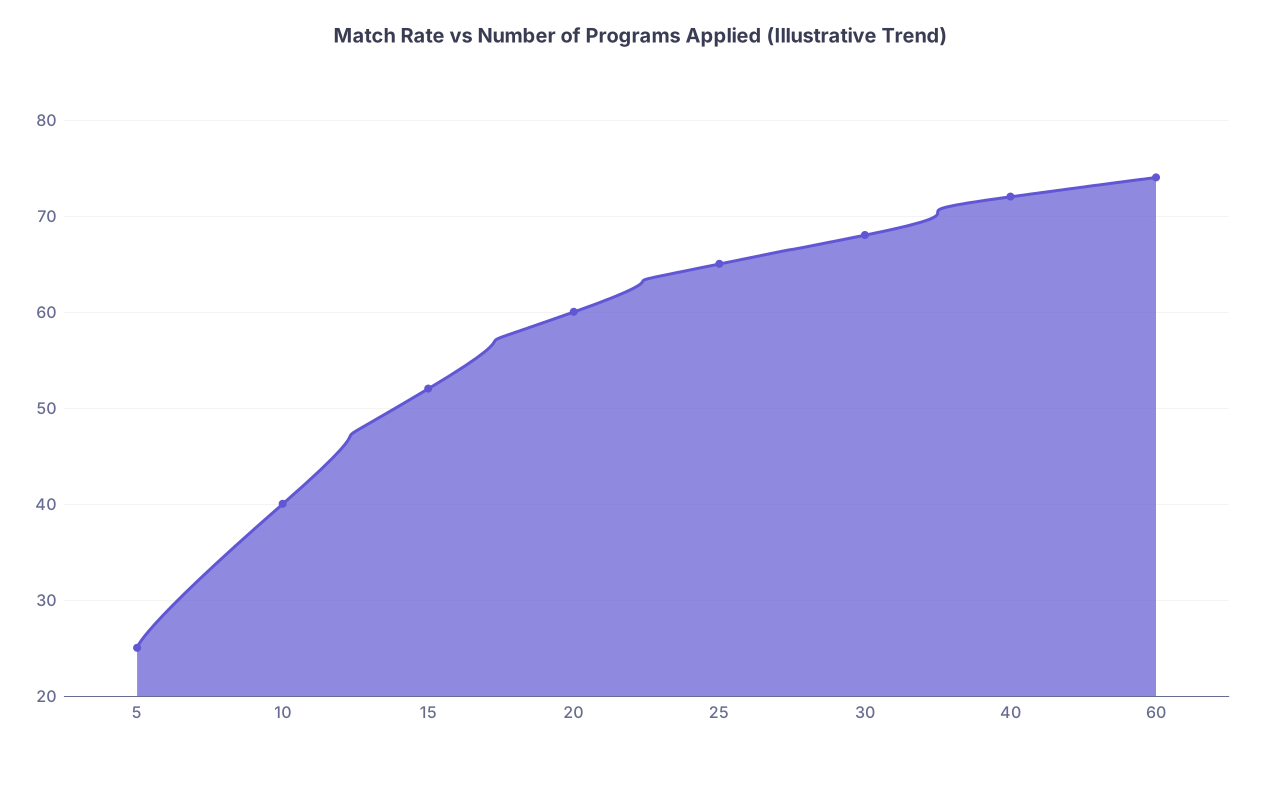
Because urology is small and competitive, especially for a US citizen IMG, the default advice is: apply widely. But “widely” needs numbers attached.
These ranges are estimates based on typical US citizen IMG experiences and variability in competitiveness.
Suggested Application Volume by Tier
Tier 1 – Highly Competitive US Citizen IMG
- Recommended: 45–60 urology programs
- Rationale:
- You may receive a higher interview yield per application, but urology spots are limited.
- A broad list protects you from randomness in interview offers.
Tier 2 – Competitive but Not Elite
- Recommended: 60–75 urology programs
- Rationale:
- Your scores and profile are good but not top of the pool.
- You must counterbalance lower interview yield with more applications.
Tier 3 – At Risk / Needs Strengthening
- Recommended:
- If you are applying this cycle anyway: 75–95+ urology programs
- Strongly consider first:
- A dedicated urology research year
- Strengthening US clinical experience and letters before applying
- Rationale:
- Interview yield for IMG applicants with red flags is low.
- Massive breadth is required to have a reasonable chance—but it’s often more rational to delay and improve.
Factors That May Push You to the Higher End
Increase the number of applications if you have:
- Any USMLE attempt failures or low Step 2 score
- Minimal US urology experience or no away rotations
- Limited research or no urology‑related output
- Few or generic letters (especially no US urology letters)
- Very regionally restricted preferences (e.g., only wanting one area of the country)
Cost vs. Benefit
Yes, applying to 60–80+ programs is expensive and time‑consuming, but:
- Urology has fewer total programs than many specialties.
- As a US citizen IMG, under‑applying is a common, preventable reason for going unmatched.
- If needed, adjust your budget by:
- Cutting back slightly on NRMP applications (if planning a backup specialty)
- Allocating funds specifically for the urology match season
When in doubt, especially as a non‑top‑tier applicant, lean toward more programs rather than fewer, as long as you can maintain quality in your application submissions.

Step 4: Building a Smart, Tiered Program List
Raw application volume alone isn’t enough. You need a targeted distribution of programs: some reaches, some realistic targets, and some relative safeties.
1. Start With IMG‑Friendly and Historically Receptive Programs
Identify programs where:
- Current or recent residents are IMGs, especially US citizen IMGs
- Program leadership or website explicitly welcomes diverse training backgrounds
- Colleagues or mentors say “they’ve taken IMGs before”
For a typical US citizen IMG:
- Aim for at least 40–60% of your list to be IMG‑friendly or IMG‑neutral programs.
2. Categorize Programs by Difficulty
Break your list into three buckets:
Reach Programs
- Prestigious academic centers, top‑ranked or research‑heavy
- Highly competitive cities (e.g., NYC, Boston, San Francisco)
- Little or no history of taking IMGs
- These can still be worth applying to if:
- You have strong research
- You excelled at an away rotation there
- You have powerful advocates in their department
Target Programs
- Mid‑tier academic or strong hybrid programs
- Some history of interviewing or matching IMGs
- Locations that are desirable but not hyper‑competitive
- Reasonable fit for your metrics and experiences
Safety‑Leaning Programs
- Lesser-known programs or geographically remote locations
- Strong clinical training but less emphasis on prestige
- Documented history of IMGs or openness to non‑traditional candidates
A reasonable distribution for many US citizen IMGs might be:
- 20–30% Reach
- 40–50% Target
- 20–30% Safety‑leaning
If you are a lower‑tier applicant (Tier 3), shift more weight toward target and safety programs.
3. Consider Away Rotations as Anchors
Where you complete away rotations should heavily influence your program selection strategy:
- Always apply to your away rotation sites unless there was a clear mutual disconnect.
- If you performed well and received strong evaluations:
- Treat these as enhanced “target+” programs, since they know you.
- Ask faculty directly:
- “How competitive am I for this program?”
- “Would you recommend I apply here, and could I expect to be seriously considered?”
Their answers can guide both how high to prioritize those programs and which similar programs may be good fits.
4. Geographic and Personal Considerations
You are more likely to match where you are:
- Willing to live for 5–6 years
- Genuinely prepared to commit fully (especially in less popular regions)
But as an American studying abroad, try not to overly restrict geography. Very narrow geographic preferences can be dangerous in a small specialty like urology.
Balance:
- Personal needs (family support, partner, health considerations)
- Match probability (wider geographic spread increases your odds)
Step 5: Application Quality, Signaling, and Backup Planning
Once you’ve constructed your list and decided how many programs to apply, the next stage is ensuring that your individual applications are strong and that you protect yourself with backup plans.
Tailoring and Consistency
For urology, especially as a US citizen IMG:
- Personal statements should be:
- Clearly urology‑focused
- Specific about your exposure and what attracts you to the field
- Honest about your journey as an IMG without being defensive
- Ensure consistency across:
- CV and ERAS (if participating in NRMP backup)
- AUA/SAU application fields
- Experiences and dates (no unexplained gaps)
Highlighting Your US Citizen IMG Strengths
Use your application to show:
- You are a US citizen with no visa constraints (if true)
- You understand US healthcare from:
- Undergrad
- Previous work
- US clinical experiences
- Your education abroad was a deliberate choice, not a fallback
- You’ve done the work to obtain:
- US letters from respected urologists
- Urology‑specific research or projects
- Solid performance on USMLE
Away Rotations as De Facto Signals
Because urology historically hasn’t used the same “preference signaling” system as other specialties (though policies can evolve), your strongest “signal” is:
- Where you rotate
- How you interact during those rotations
- Who is willing to advocate for you afterward
Make sure faculty know:
- You are serious about urology
- You plan to apply broadly but have particular interest in their program
- You would be a committed resident if matched there
Backup Specialties and NRMP Strategy
Most US citizen IMGs applying to urology should also think carefully about:
- Backup specialty options (e.g., general surgery, preliminary surgery, internal medicine)
- Whether to:
- Apply simultaneously to a backup in the main NRMP match, or
- Go “all‑in” on urology one year and use a backup only if unmatched
Your choice depends on:
- Risk tolerance
- Financial ability to potentially apply more than once
- Strength of your profile for urology versus other fields
Even your backup specialty list should be built using the same principles:
- Wide application spread
- Focus on IMG‑friendly programs
- Realistic mix of reach, target, and safety programs
Putting It All Together: A Practical Example
Imagine two US citizen IMGs, both passionate about urology.
Applicant A: Strong Profile (Tier 1)
- Step 2 CK: 253
- No exam failures
- Honors in surgery, strong evals
- Two US urology away rotations, both highly positive
- 3 letters from US urologists (one from a program director)
- 1 publication and 2 abstracts in urology
Program Selection Strategy:
- Applies to 55 urology programs
- Distribution:
- 15 reach (big academic centers, top cities)
- 25 target (mid‑tier programs, IMG‑neutral or some IMG history)
- 15 safety‑leaning (lesser-known, more remote)
- Includes:
- Every site where they did an away rotation
- Programs with faculty connections who know them by name
- Also submits a modest backup list in general surgery (25–30 programs) through NRMP, focusing on IMG‑friendly options, but mentally prioritizes urology.
Applicant B: Developing Profile (Tier 2–3 Borderline)
- Step 2 CK: 238
- Pass on first attempt
- Good but not exceptional clinical evaluations
- One US urology elective, no sub‑I
- 1 US urology letter, 2 non‑urology letters
- Minimal research, none in urology
Program Selection Strategy:
- Honestly assesses that urology is possible but challenging
- Decides to:
- Take one additional year to do urology research at a US institution
- Gain more US letters and consider another away rotation
- After strengthening, applies to 80+ urology programs:
- 10 reach
- 40–45 target
- 25–30 safety‑leaning / IMG‑friendly
- Also builds a robust backup plan:
- 40–60 general surgery or categorical prelim programs via NRMP, focusing heavily on IMG‑friendly programs
- Keeps geography wide open except for a few places where personal reasons make relocation impossible.
Both applicants use similar principles—from self‑assessment to spread—but adjust how many programs to apply and where to focus based on their profiles.
Frequently Asked Questions (FAQ)
1. As a US citizen IMG, how many urology programs should I apply to?
Most US citizen IMGs should apply to at least 60 programs, often more:
- Stronger applicants (Tier 1) may be comfortable with 45–60 programs.
- Competitive but not elite applicants (Tier 2) should target 60–75.
- Applicants with weaker profiles or red flags (Tier 3) often need 75–95+, or should strongly consider delaying to strengthen their application before applying.
Because urology is small and competitive, under‑applying is a significant risk.
2. How can I tell if a urology residency is IMG‑friendly?
Signs a program may be open to US citizen IMGs include:
- Current or recent residents who are IMGs (especially US citizens from Caribbean or international schools)
- Website language emphasizing diverse training backgrounds
- Statements in open houses or social media highlighting previous IMG residents
- Positive comments from faculty or alumni about IMGs being welcomed
If you’re unsure, politely ask during virtual events:
“Does your program consider applications from US citizen IMGs, and have you had IMG residents in recent years?”
3. Should I only apply to programs where I did away rotations?
No. Away rotations are powerful but limited to a few programs. A strong program selection strategy for urology requires broad applications:
- Always apply to your away sites (unless there was clear misalignment).
- In addition, build a wide list of IMG‑friendly and mid‑tier programs you did not rotate at.
- Use away rotations as anchors, not as exclusive targets.
4. Do I need a backup specialty if I apply in urology as a US citizen IMG?
It’s strongly recommended for most US citizen IMGs to have a backup specialty, because:
- Urology positions are limited.
- IMGs, even US citizens, tend to receive fewer interviews.
- A backup (e.g., general surgery, preliminary surgery, or another field) via NRMP gives you a parallel path if you do not match in urology.
The exact backup plan depends on your risk tolerance, finances, and how willing you are to reapply in a future cycle. Discuss your options with an advisor or urology mentor who understands your full application.
By honestly evaluating your competitiveness, understanding which programs are realistic, and applying widely with a purposeful mix of reach, target, and safety programs, you can build an effective program selection strategy as a US citizen IMG in the urology match. Thoughtful planning now significantly improves your chances of turning your passion for urology into a residency position in the United States.