Understanding Your Unique Position as a US Citizen IMG Interested in Global Health
If you are an American studying abroad and planning a career in global health, you occupy a very specific—and increasingly valuable—niche in residency recruitment. You’re a US citizen IMG with lived experience in international settings, likely comfortable navigating different cultures and health systems. For programs with a global health residency track or emphasis on international medicine, that is an asset, not a liability.
However, your status as an IMG still affects how to choose residency programs, how many programs to apply to, and what a realistic program selection strategy looks like. The margins for error are slimmer than for many US MD graduates, but with deliberate planning, you can target programs that value your background and maximize your chances of matching.
This article will walk you step-by-step through building a data-driven, realistic, and mission-aligned program list specifically for US citizen IMGs pursuing global health.
Step 1: Clarify Your Global Health Career Vision
Before you open a single residency website, you need clarity on what “global health” means in your career.
A. Different Flavors of “Global Health” in Residency
Programs use “global health” in very different ways. Distinguish among:
True Global Health Tracks / Pathways
- Formal curriculum (didactics, seminars)
- Structured international rotations (often 4–8 weeks per year)
- Defined mentorship and scholarly project expectations
- Example titles: Global Health Equity Track, International Health Pathway, Health Equity & Global Health Scholars Program
International Electives Only
- Program allows or supports occasional abroad electives (often PGY-2 or PGY-3)
- Less structured; may depend on your own initiative and faculty support
Domestic Health Equity / Underserved Focus
- Strong emphasis on care of migrants, refugees, limited English proficiency patients, or under-resourced communities
- Urban safety-net hospitals or rural training tracks
- Often excellent preparation for international medicine, even if labeled differently
Academic Global Health Powerhouses vs. Quietly Strong Community Programs
- Some large academic centers advertise robust international medicine programs, while smaller or community-based residencies have long-standing but low-profile partnerships abroad.
- Don’t filter only by branding; read between the lines.
B. Define Your Global Health Goals in Concrete Terms
Ask yourself:
- Do I want short-term service trips or long-term partnership-based work?
- Am I more interested in:
- Direct clinical care abroad?
- Health systems strengthening?
- Research and implementation science?
- Policy and advocacy?
- Is my priority:
- Tropical medicine?
- Refugee and migrant health?
- Maternal-child health?
- Non-communicable diseases in low-resource settings?
Write down 2–3 clear career goals. Examples:
- “I want to be an academic internist with a focus on health systems in sub-Saharan Africa, doing both clinical care and implementation research.”
- “I see myself working in Latin America part of each year and in a US safety-net clinic the rest of the time.”
- “I want to lead TB and HIV programs in low-resource settings through NGOs or international agencies.”
Your goals will later help you prioritize programs that genuinely fit, rather than those with “global health” as a marketing label.
Step 2: Understand the Match Reality for US Citizen IMGs
Your program selection strategy must be grounded in realistic odds.
A. Why Your IMG Status Matters (Even as a US Citizen)
As a US citizen IMG, you sidestep visa sponsorship issues, which is a major plus. But programs may still:
- Prefer US MD/DO applicants due to familiarity with training standards
- Worry about:
- Clinical readiness (different health systems)
- Documentation and ECFMG timelines
- US clinical experience
However, for global health residency track positions, your international training can become a strong differentiator—if your application is well constructed and you target the right programs.
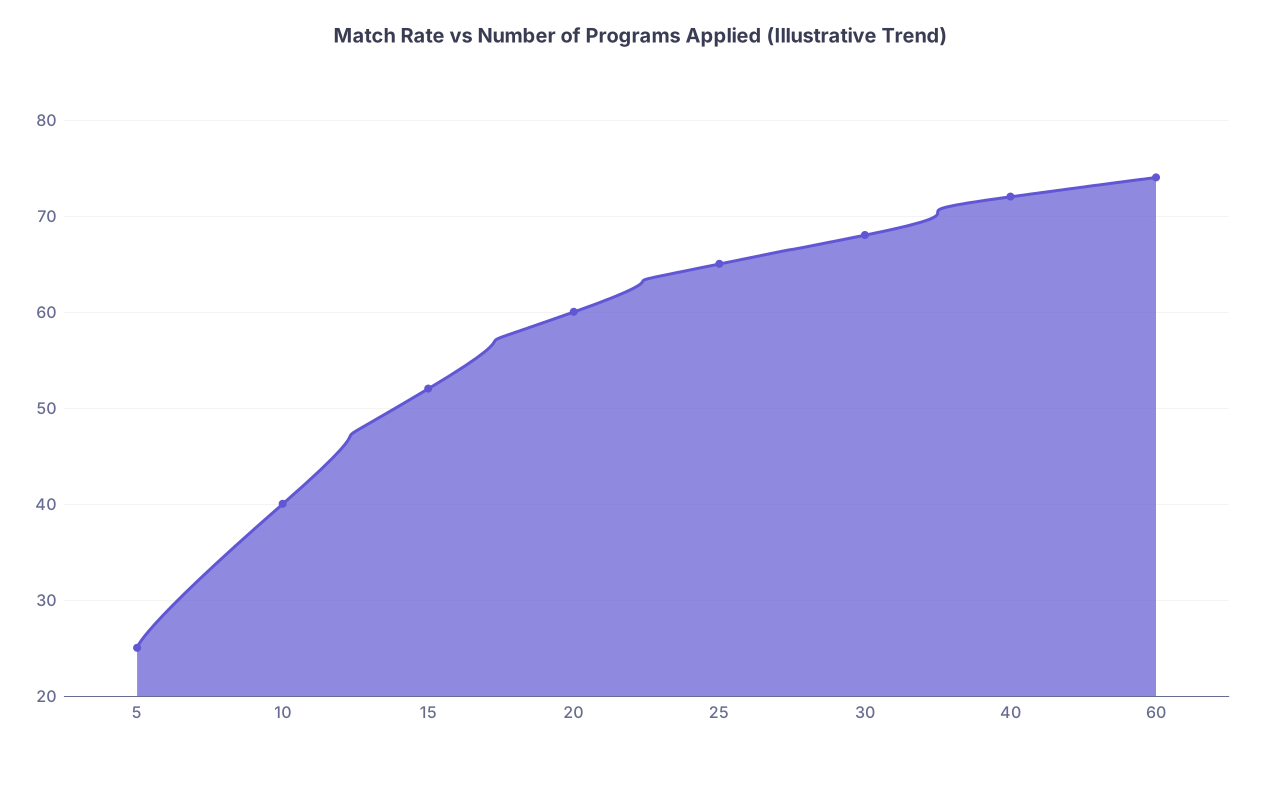
B. Data-Driven Realism: How Many Programs to Apply To?
There is no universal number, but for a US citizen IMG interested in global health, typical guidelines:
- Highly competitive specialties (e.g., EM, some surgical fields):
- Often 70–120+ applications for IMGs; global health niche does not replace core competitiveness
- Internal Medicine / Family Medicine / Pediatrics with global health focus:
- IMGs often target 40–80 programs depending on:
- USMLE/COMLEX scores
- Gaps in training
- US clinical experience
- Research output
- IMGs often target 40–80 programs depending on:
A useful starting point:
- Strong profile (few red flags, solid scores, US clinical experience, research, robust global health activities):
→ 40–60 programs - Moderately competitive profile (average scores, some gaps, or limited US experience):
→ 60–80 programs - Significant challenges (low scores, attempts, large gaps):
→ 80+ programs
The answer to how many programs to apply is not just “as many as possible.” It’s “enough to offset IMG status and any weaknesses, but targeted to programs that are IMG-friendly and global health-aligned.”

Step 3: Build Your Long List – Identifying Global Health–Oriented, IMG-Friendly Programs
Now translate your goals into a concrete list. This is your long list—bigger than your final application list.
A. Start with Specialty and Geography
Choose your core specialty:
- Most common for global health: Internal Medicine, Family Medicine, Pediatrics, Emergency Medicine, OB/GYN
- Other specialties (Surgery, Psychiatry, Anesthesiology) also have international opportunities but fewer formal tracks.
Decide on basic geographic preferences: Consider:
- Regions where you have personal or professional connections
- Proximity to global health institutions (e.g., universities with strong global health centers)
- States historically more accepting of IMGs (often Northeast, Midwest, some Southern states)
B. Use Targeted Search Methods
FREIDA (AMA) and ACGME Public Information
- Filter by specialty and state.
- Pay attention to:
- Program size
- University vs. community-based
- Fellowship opportunities (for IM, consider ID, global health, or health equity fellowships at the same institution)
Program Websites – Look for Global Health Signals On each site, scan for:
- Global Health Track / International Health Pathway pages
- Research or partnerships in:
- HIV/TB/Malaria
- Maternal-child health
- Refugee and migrant health
- Affiliations with:
- Schools of public health
- Global health centers or institutes
- Evidence of:
- Long-term partnerships with specific countries or institutions
- Resident scholarly projects abroad
- Faculty with international medicine expertise
Global Health Organizations and University Centers
- Many universities have global health centers that list affiliated residency tracks.
- Search “[University Name] global health residency” or “[Specialty] global health pathway.”
- Check if those residencies have historically welcomed US citizen IMGs.
Networking and Word-of-Mouth
- Reach out to:
- Upperclassmen from your international school who matched into global health or international medicine-related residencies.
- Faculty at your medical school involved in global health or public health.
- Ask:
- Which programs are genuinely supportive of residents’ international interests?
- Which are known to be friendly to US citizen IMGs?
- Reach out to:
C. Identify IMG-Friendliness
You’re not just looking for global health; you need global health + IMG-friendliness.
Evaluate programs by:
Past Match Lists
- Look for:
- US citizen IMGs among current or recent residents
- Graduates from Caribbean schools or other international schools
- Look for:
Program FAQs / Websites
- Some explicitly say:
- “We welcome international medical graduates”
- “We require X months of US clinical experience”
- “We do/do not sponsor visas” (not relevant for you but signals past IMG involvement)
- Some explicitly say:
Residency Program Social Media
- Photos of resident groups often show diverse backgrounds.
- Posts about residents’ prior training or home countries can be revealing.
Add each promising program to a spreadsheet with columns for:
- Program name and specialty
- State and city
- Global health track? (Yes/No)
- International rotations? (Yes/No / Limited / Unknown)
- Has IMGs? (Yes/No/Unsure)
- US citizen IMG in current class? (if known)
- Required US clinical experience
- Minimum score cutoffs (if published)
- Notes (e.g., “strong Latin America focus, HIV research”)
Aim to build an initial long list of 80–120 programs, understanding you will narrow it down.
Step 4: Prioritize and Tier Your Programs Strategically
Once you have your long list, you must decide how to choose residency programs that are worth the application fee and your emotional investment.
A. Academic Fit, Mission Fit, and Safety Level
Rate each program on three axes:
Academic Fit
- Are your test scores, clinical experiences, and research roughly at or above the program’s usual level?
- Consider:
- Average board scores (if known)
- Rigor of program (university vs. community)
- Your IMG status relative to their historic patterns
Mission / Global Health Fit
- Does the program have:
- A structured global health residency track or international medicine emphasis?
- Faculty actively engaged in global health?
- Opportunities that align with your specific interests (e.g., maternal-child vs. HIV programs)?
- Does the program have:
Personal and Practical Fit
- Location preferences and support system
- Cost of living
- Call schedule and program culture
- Family needs, if applicable
Then bucket programs into tiers:
- Reach Programs
- Strong global health reputation, academically competitive
- Limited IMG history or higher board score expectations
- Target Programs
- Solid or emerging global health opportunities
- Documented acceptance of IMGs, including US citizens
- Your metrics are aligned with current residents
- Safety Programs
- Very IMG-friendly
- Maybe less formal global health branding but open to residents developing international or health equity projects
- Geographic or community programs with high IMG representation
As a US citizen IMG, a reasonable distribution might be:
- 15–25% Reach
- 40–60% Target
- 25–35% Safety
B. Balancing Global Health Focus with Match Security
You must balance ideal global health exposure with realistic match odds.
Strategy:
Core Global Health Programs (Non-Negotiables)
- Identify 10–20 programs that are a near-perfect match for your global health interests.
- These may include some Reach and Target programs.
- You will put extra effort into tailoring your application to these.
Global Health–Friendly but Less Branded Programs
- Programs that:
- Serve immigrant, refugee, or underserved populations
- Have faculty with international experience, even if not formal tracks
- These can be your most realistic Target and Safety choices.
- Programs that:
“Bread and Butter” IMG-Friendly Programs
- Programs known to reliably interview and match IMGs.
- May not have strong branding in global health but may support:
- Electives abroad
- Research in international medicine
- These ensure your chance of matching safely while you create your own global health pathway during residency.

Step 5: Tailor Your Application to Global Health Programs as a US Citizen IMG
Your program selection strategy only works if programs recognize your value. As an American studying abroad, your global exposure can become a major asset.
A. Presenting Your Global Health Story
Your personal statement and experiences should:
- Clearly explain:
- Why you chose to study medicine abroad as a US citizen
- How this experience broadened your understanding of health systems and cultures
- Highlight:
- Clinical or community work in resource-limited settings
- Language skills
- Cross-cultural communication experience
- Emphasize:
- Your commitment to ethical, sustainable global health, not just travel or medical tourism
- Long-term partnerships and continuity where possible
Programs in global health and international medicine want residents who:
- Understand power dynamics and equity issues
- Value local leadership and capacity building
- Think beyond “short-term missions” toward systems-level improvement
B. Aligning Your Experiences with Program Priorities
For each of your top global health residency track programs:
- Reference specific aspects of their program:
- Longitudinal tracks
- Partnerships with specific countries or communities
- Scholarly requirements
- Show how your experiences match their mission:
- If they have a refugee health clinic, discuss your work with displaced populations.
- If they focus on Latin America, and you trained or volunteered in that region, highlight that connection.
As a US citizen IMG, you must also show:
- Robust US clinical experience (ideally 2–3 months of hands-on experience in your desired specialty)
- Comfort navigating the US health system
- Strong letters of recommendation from US-trained physicians
C. Making Your Own Track at Less-Resourced Programs
Many safety and target programs may not have formal tracks but could still support your ambitions if you are proactive. During interviews (and in emails if appropriate), ask:
- “What opportunities exist for residents interested in global health or international rotations?”
- “How have prior residents engaged with global or immigrant/refugee health?”
- “Is there mentorship available for building global health scholarly projects?”
You’re looking for a signal that:
- Faculty is supportive, not dismissive
- There have been prior residents with similar interests
- The program leadership is open to reasonable flexibility around electives and projects
Step 6: Decide How Many Programs to Apply To (Final Calibration)
Now that you have:
- A clear vision for your global health career
- A long list of potential programs
- A tiered classification (Reach/Target/Safety)
- A sense of your competitiveness as a US citizen IMG
You can finalize how many programs to apply.
A. Factors That Increase the Number You Should Apply To
You should lean toward the higher end of your range (e.g., 70–90+) if:
- Your USMLE/COMLEX scores are below the median for matched applicants in your specialty.
- You have:
- Attempted exams more than once
- A significant gap in training
- Limited US clinical experience
- Your specialty is more competitive (e.g., EM, OB/GYN, some Pediatrics programs).
B. Factors That Allow a Slightly Lower Number (But Still Robust)
You might safely be in the 40–60 program range if:
- You have strong scores and passed on the first attempt.
- You have substantial US clinical experience with excellent letters.
- You have:
- Research or publications in global or international medicine
- Leadership roles in global health organizations
- Your specialty is relatively IMG-friendly (e.g., many Internal Medicine or Family Medicine programs).
C. Sample Program Distribution for a US Citizen IMG in Global Health
Example: US citizen IMG applying to Internal Medicine with a strong interest in global health, solid scores, and 3 months of US rotations.
- Total applications: 60 programs
- 10 Reach (strong academic, formal global health tracks, IMG-possible but not common)
- 30 Target (global or immigrant/refugee health focus, demonstrated IMG acceptance)
- 20 Safety (very IMG-friendly, supportive of international or underserved work even without formal tracks)
Another example: US citizen IMG in Family Medicine interested in international medicine with average scores and limited US rotations:
- Total applications: 75–80 programs
- 12–15 Reach (FM academic programs with prestigious global health residencies)
- 35–40 Target (FM residencies with global health or underserved tracks that regularly take IMGs)
- 25–30 Safety (IMG-heavy community FM programs with some flexibility for international electives)
Step 7: Practical Tips and Common Pitfalls for US Citizen IMGs
A. Practical Tips
Start Early (12–18 Months Before ERAS Opens)
- Research programs and global health tracks.
- Build relationships with mentors in global and international medicine.
- Seek US clinical electives in institutions that value global health.
Leverage Your International Training
- Frame your non-US medical education as:
- Experience working in diverse systems
- Comfort with resource limitations
- Cross-cultural adaptability
- Frame your non-US medical education as:
Be Honest With Yourself
- Don’t build a list exclusively of elite academic global health programs.
- Ensure a solid core of IMG-friendly, realistic options where you can still build a global health-focused career.
Stay Flexible in How Global Health Fits In
- Remember: The path to a global health career is not limited to “formal global health tracks.”
- Many successful global health physicians trained in standard residency programs and developed their international portfolio later.
B. Common Pitfalls to Avoid
Over-focusing on Branding
- A big-name institution may have a great global health reputation but minimal IMG acceptance.
- Some smaller programs with no flashy website may offer more real opportunities for you.
Applying Too Narrowly
- Only applying to a handful of “dream” global health residency tracks is risky as an IMG.
- Always include a wide range of program types.
Neglecting US Clinical Experience
- Strong global experiences do not substitute for US-based clinical evaluations and letters.
Not Demonstrating Long-Term Commitment
- Short-term “medical mission trips” without deeper engagement can appear superficial.
- Highlight continuity, partnerships, and learning from local partners.
FAQs: Program Selection Strategy for US Citizen IMGs in Global Health
1. As a US citizen IMG, should I prioritize programs with formal global health tracks over IMG-friendliness?
You need both, but IMG-friendliness comes first for match security. Ideally, you select a mix:
- A subset of programs with formal global health residency tracks that do occasionally accept IMGs (even if less frequently).
- A larger set of IMG-friendly programs where:
- You can “build your own” global health path through electives, projects, and mentorship.
- The program serves diverse and underserved communities, including migrants and refugees.
If a prestigious global health program has never taken an IMG and your profile is average, don’t make it the backbone of your list—keep it in the Reach category.
2. How can I know if a program is truly supportive of international medicine or just uses global health as a buzzword?
Look for evidence, not just language:
- Consistent, long-term partnerships with specific sites abroad
- Structured curricula with clear objectives and evaluation methods
- Faculty with ongoing international work and publications
- Resident scholarly projects documented on the website
- Protected time for global health work, not just “you can go if you use vacation days”
During interviews, ask detailed questions about supervision, funding, and continuity of partnerships.
3. If I match into a program without a formal global health track, can I still build a global health career?
Yes. Many leaders in global health trained at programs without branded tracks. You can:
- Seek mentors with international or health equity experience at your institution.
- Develop scholarly projects on global or immigrant/refugee health topics.
- Use elective time to:
- Rotate abroad with reputable, partnership-based programs.
- Work in domestic clinics that serve global populations (e.g., refugee, migrant worker, or border clinics).
- Pursue fellowships later in:
- Global health
- Infectious diseases
- Health equity or public health
Your residency is one stage of a longer pathway into international medicine.
4. How many programs should I apply to if I want global health but have a limited budget?
If finances are tight:
- Prioritize quality and fit over raw numbers.
- Focus on:
- Programs that are both IMG-friendly and genuinely aligned with your global health goals.
- Consider:
- 40–50 well-chosen programs instead of 70–80 generic ones.
- Intensively tailor your application for your top 20–25 programs.
Discuss your profile with mentors to calibrate if reducing application volume still leaves you with a reasonable chance of matching.
As a US citizen IMG passionate about global health, your path may be less linear, but it is absolutely achievable. A thoughtful, data-informed program selection strategy, grounded in both international medicine goals and realistic assessment of your competitiveness, will allow you to build a list of programs where you can both match successfully and grow into the global health physician you aim to become.