Understanding Your Unique Position as a US Citizen IMG in Med-Peds
As a US citizen IMG (international medical graduate) applying to Medicine-Pediatrics (Med-Peds), you occupy a very specific niche in the residency match. You are:
- A US passport holder or permanent resident
- An American studying abroad (e.g., Caribbean, Ireland, Eastern Europe, etc.) or a US citizen who completed medical school outside the US/Canada
- Interested in a relatively small, combined specialty: Internal Medicine + Pediatrics
This combination creates both opportunities and constraints:
Pros:
- No visa sponsorship needed, which removes one common barrier for IMGs
- Many Med-Peds programs value broad, diverse experiences and non-traditional paths
- Your US cultural familiarity and likely clinical exposure in the States can be advantages
Cons:
- You are still classified as an IMG, and many combined Med-Peds programs are small and competitive
- Fewer total Med-Peds positions compared to categorical Internal Medicine or Pediatrics
- Limited number of programs makes program selection strategy crucial
When you ask “How many programs to apply?” or “How to choose residency programs?” as a US citizen IMG in Med-Peds, the answer requires a tailored, strategic approach. You’re not just competing in any specialty—you’re targeting a niche field with a concentrated program list.
This article will walk you through a structured, stepwise method to build a smart, realistic Medicine-Pediatrics match strategy: how to assess your profile, categorize programs, decide how many to apply to, and prioritize where to send your best efforts.
Step 1: Honestly Assess Your Competitiveness as a US Citizen IMG
Before you can design an effective program selection strategy, you need a clear-eyed assessment of your profile. This will drive both how many programs to apply to and which kinds of programs to prioritize.
1. Academic Metrics: USMLE/COMLEX and Transcript
Key factors:
- USMLE Step 2 CK (and Step 1 if taken before pass/fail)
- Any attempts/failures on Step exams
- Clerkship grades and class rank (if provided)
- Performance on core Medicine and Pediatrics rotations
A rough (not absolute) competitiveness framework for US citizen IMGs in Med-Peds:
Strong profile
- Step 2 CK ≥ 245–250
- No exam failures
- Strong clinical grades, especially in Medicine and Pediatrics
- Honors/Awards, strong letters from US faculty
Moderate profile
- Step 2 CK ~ 230–245
- No more than one low score or borderline grade
- Solid but not stellar transcript
- At least a couple of strong US letters
At-risk profile
- Step 2 CK < 230 or any exam failure
- Noticeable academic concerns (repeated years, multiple low grades)
- Limited US clinical evaluation data
- Limited Med-Peds-relevant experiences
You don’t need to fit perfectly into one bucket, but this framework helps determine how aggressive your application strategy should be.
2. Clinical Experience: Especially in the US
As an American studying abroad, US clinical exposure is crucial. Residency programs want to know you can function effectively in the US healthcare system.
Important elements:
- US clinical electives/sub-internships in Internal Medicine, Pediatrics, or ideally Med-Peds
- Letters of recommendation from US faculty (especially core IM, Peds, or Med-Peds attendings)
- Continuity or longitudinal experiences showing commitment and reliability
If you have multiple strong US rotations and letters from US-based mentors, you can safely stretch a bit higher in your program list. If your US exposure is limited, your list should be broader and more inclusive of less competitive programs.
3. Med-Peds-Specific Commitment
Because Med-Peds is small and unique, programs care deeply about your why:
Examples of strong Med-Peds commitment:
- Med-Peds rotations or shadowing with Med-Peds faculty
- Long-term work with populations that benefit from dual-trained physicians (e.g., complex care, transition-of-care clinics, underserved communities, youth with chronic disease)
- Leadership or research involving both adult and pediatric populations
- A personal statement and letters that speak specifically to Medicine-Pediatrics rather than just “I like both medicine and pediatrics”
The clearer and more convincing your Med-Peds story, the more likely programs are to invest in you—even if some metrics are less ideal.

Step 2: Understanding the Med-Peds Landscape and Program Types
Unlike large specialties, Medicine-Pediatrics has:
- Fewer total programs (compared to categorical IM or Peds)
- Smaller individual class sizes (often 4–10 residents per year)
- Strong culture and identity—programs actively seek “true Med-Peds people”
This means program selection strategy is less about finding hundreds of options and more about smartly stratifying a limited universe of programs.
Program Categories to Recognize
You can conceptually place Med-Peds programs into several overlapping categories. This helps when you’re asking “Where do I realistically fit?” and “How many programs should I target in each tier?”
1. Highly Competitive / Academic Powerhouses
Characteristics:
- Located at major academic centers or highly desirable urban areas
- Strong, nationally visible faculty and subspecialty opportunities
- Heavy focus on research, fellowships, and academic careers
- Often attract top US MD applicants and couples matching with other competitive specialties
For a US citizen IMG, these programs may be reach schools unless your profile is very strong (excellent scores, robust US-based research, strong Med-Peds mentorship and advocacy).
2. Mid-Level Academic / Strong Hybrid Programs
Characteristics:
- University-affiliated or large teaching hospitals
- Solid subspecialty exposure and research, but not hyper-competitive
- Balanced focus on education, clinical care, and fellowship preparation
- Often located in mid-sized cities or less saturated markets
These are realistic targets for many US citizen IMGs with decent metrics, good letters, and clear Med-Peds interest.
3. Community-Focused / Regionally Oriented Programs
Characteristics:
- Strong emphasis on primary care, continuity, and community medicine
- May serve under-resourced populations or specific regions (rural or semi-rural)
- Often smaller, tight-knit resident cohorts
- Variable academic emphasis; some still have robust fellowship pathways
These can be excellent “anchor” programs in your strategy if your metrics are modest or if you strongly value primary care and underserved work.
4. Programs With IMG-Friendly History
Beyond academic strength alone, you should examine:
- Do they have current or recent US citizen IMG residents?
- Do they mention welcoming IMGs or have a track record of interviewing them?
- Are there alumni with pathways similar to yours (American studying abroad, Caribbean-trained, etc.)?
Programs that have previously matched US citizen IMGs are likely to seriously consider your application, especially if your story and metrics are in line with their current residents.
Step 3: How Many Med-Peds Programs Should a US Citizen IMG Apply To?
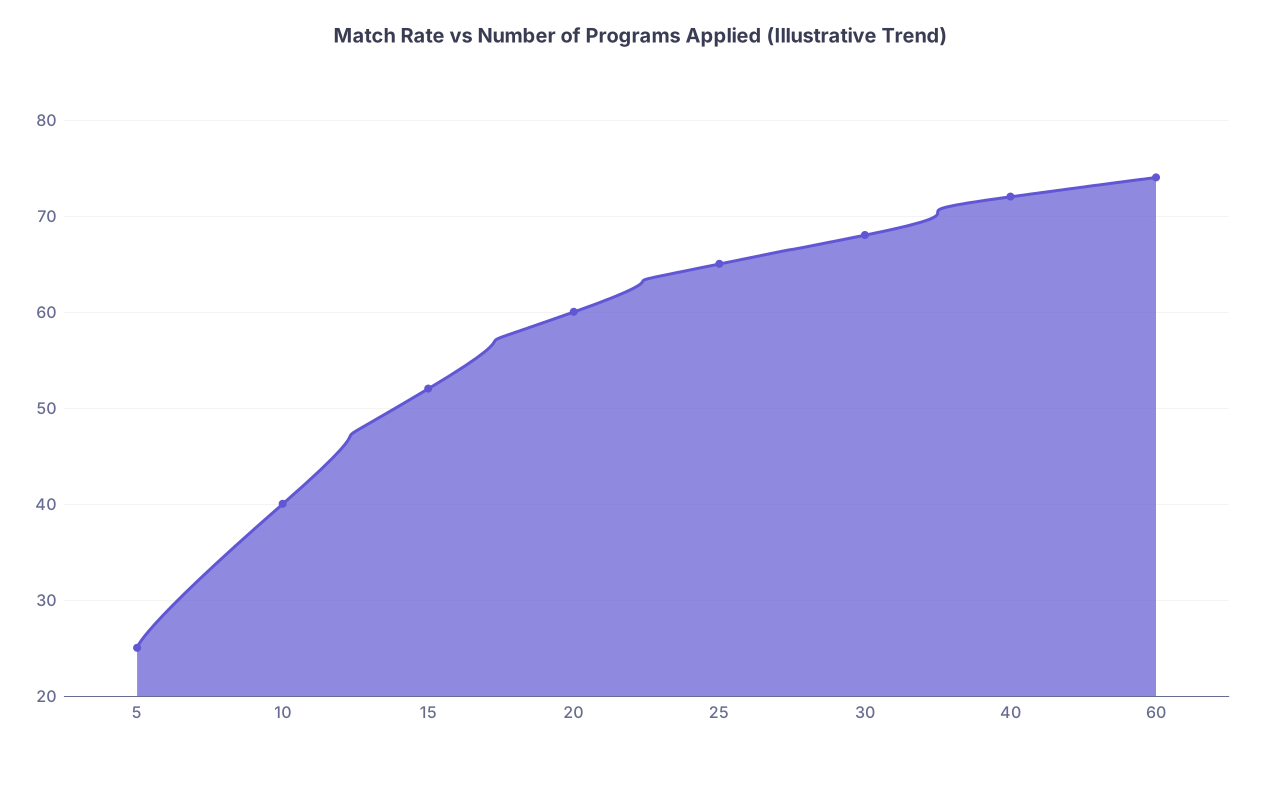
Because of the limited number of Med-Peds programs, the classic “apply to 80–100 programs” advice from large specialties doesn’t directly apply. Instead, you need a Med-Peds–specific answer to how many programs to apply to.
General Ranges (Not Rigid Rules)
For a US citizen IMG applying primarily to Med-Peds:
Strong profile:
- 20–30 Med-Peds programs (nearly the full list if feasible)
- Optionally add 5–10 categorical Internal Medicine and/or Pediatrics programs as a safety net, depending on risk tolerance and career flexibility
Moderate profile:
- 25–35 Med-Peds programs (as close to all as makes sense geographically and financially)
- Strongly consider 10–20 categorical IM and/or Peds programs—specifically those that have historically interviewed or matched IMGs
At-risk profile:
- 20–30 Med-Peds programs if your commitment is strong (still apply broadly), but do not rely solely on Med-Peds
- 20–40 categorical programs (mix of IM and Peds) with conscious selection of IMG-friendly sites
Because the number of Med-Peds programs is limited, many US citizen IMGs planning a Med-Peds career will:
- Apply to most, if not all, Med-Peds programs where they’d realistically train, and
- Build a parallel list of categorical IM and/or Peds programs as a backup.
Balancing Breadth, Cost, and Burnout
Applying to residency is expensive and time-consuming:
- Application fees increase in tiers as you apply to more programs in a specialty
- Each additional program means more potential interviews, travel/lodging (if in-person), and time
To manage this:
- Prioritize quality of application over sheer volume: a thoughtful, personalized application to 30 programs often beats a rushed application to 60.
- Start ERAS early so you can tailor segments (experiences, personal statement, program-specific communication) for Med-Peds.
- Use spreadsheets to track where you’ve applied, interview offers, and program characteristics so you can respond quickly.
Step 4: Building a Tiered Program Selection Strategy
A practical way to answer “How to choose residency programs?” is to create a tiered list based on both your competitiveness and your preferences.
1. Define Your Tiers
For each Med-Peds program, assign one of three internal labels:
Reach (Tier 1)
- Programs whose average matched resident profile is stronger than yours
- Highly competitive locations or institutions
- You’d be thrilled but not surprised if you don’t get an interview
Target (Tier 2)
- Programs where your metrics and experiences are similar to their current residents
- Reasonable geographic and cultural fit
- You can imagine realistically training there and being valued
Safety (Tier 3)
- Programs more likely to be IMG-friendly or historically match candidates with metrics equal or slightly weaker than yours
- May be in less popular locations or smaller institutions
- You would still be willing to rank and attend if matched
You don’t share these tiers with programs—they’re for your strategic planning only.
2. Example Distribution for a Moderate US Citizen IMG
Let’s say you plan to apply to 30 Med-Peds programs:
- Reach (Tier 1): 5–7 programs
- Target (Tier 2): 15–18 programs
- Safety (Tier 3): 7–10 programs
Overlay this with your categorical backup plan, for instance:
- 8–10 Internal Medicine programs
- 8–10 Pediatrics programs
Chosen for being IMG-friendly, in locations you’d accept, and aligned somewhat with your long-term goals.
3. Using Data to Inform Tiers
Gather information for each Med-Peds program:
- Program website: Mission, clinical sites, fellowship outcomes, faculty interests
- Current residents page: Training background, IMG presence, diversity of schools
- FREIDA and program directories: Program size, visa policies (even if you don’t need one, visa openness often correlates with IMG openness), call structure
- NRMP and Charting Outcomes data: General IMG competitiveness trends (for combined specialties and categorical IM/Peds as needed)
Ask:
- Do they have recent US citizen IMGs?
- Are most residents from highly ranked US schools, or is there a mix?
- Does the program highlight community care, underserved populations, or global health (which might align with your background as an American studying abroad)?
- Is there any explicit mention of IMGs being welcome?
Use these elements to calibrate whether a program is more likely to be a reach, target, or safety for you.

Step 5: Aligning Program Selection With Your Med-Peds Career Goals
A successful program selection strategy is not only about matching but about matching where you will thrive as a Med-Peds physician.
1. Clarify What You Want From Med-Peds
Consider your long-term goals:
- Do you hope to work in primary care for all ages, including continuity from childhood to adulthood?
- Are you leaning toward adult or pediatric subspecialty fellowship (e.g., cardiology, endocrinology, hospitalist roles)?
- Are you passionate about underserved populations, complex care, or global health?
- Do you envision mostly academic or community practice?
Write down 3–5 top career priorities. Use this list when evaluating programs.
2. Program Features to Evaluate
When comparing Med-Peds programs, ask:
Training balance:
- Is the curriculum truly integrated, or is it just separate IM and Peds blocks?
- Are there Med-Peds–specific clinics, conferences, or faculty leadership?
Mentorship and support:
- Are there multiple core Med-Peds faculty, or a single program director?
- Do residents report strong mentorship for fellowship or career planning?
Fellowship and career outcomes:
- Do graduates regularly match into adult and pediatric fellowships, or mostly go into primary care?
- Does this align with what you want?
Location and lifestyle:
- Will you realistically be content living there for 4 years?
- Is support available for significant others or family if relevant?
For example, if you are particularly interested in transition-of-care clinics (youth with chronic conditions moving into adult care), prioritize programs that mention:
- Complex care clinics
- Combined Medicine-Pediatrics continuity practices
- Collaboration between adult and pediatric subspecialists
3. Geographic Strategy for a US Citizen IMG
Because you don’t have visa limitations, you can consider any region. But geography still matters:
- Urban academic centers may be more competitive but offer robust academic resources
- Midwestern or Southern programs may be more open to IMGs and have strong Med-Peds cultures
- Some programs in less “popular” locations (weather, distance from coasts, etc.) can be excellent matches and slightly more attainable
Ask yourself:
- Where would I genuinely be willing to live and train?
- Are there family or support system locations that are essential?
- Am I willing to consider “hidden gem” programs away from major coastal cities?
Don’t apply to places you absolutely know you would never rank; this wastes resources and mental energy.
Step 6: Practical Application Tactics to Strengthen Your Odds
Once your program selection strategy is set, enhance your application so it resonates with Med-Peds programs.
1. Tailor Your Personal Statement for Med-Peds
Have at least:
- One primary Med-Peds personal statement that clearly describes:
- Why combined Medicine-Pediatrics (not just “I like both”)
- Specific experiences that prepared you for dual training
- Long-term goals that logically require Med-Peds
Optionally, you can create minorly tailored versions for certain programs or regions if you have a strong connection (e.g., “I grew up in the Midwest and want to serve similar communities”).
2. Curate Your Letters of Recommendation
Ideal letter mix for a Med-Peds application:
- At least one letter from Internal Medicine (preferably from a US rotation)
- At least one letter from Pediatrics (preferably from a US rotation)
- If possible, one letter from a Med-Peds physician or faculty member who knows you well
- One additional letter from a mentor, research supervisor, or attending who can speak to your professionalism, clinical reasoning, and reliability
Tell your letter writers specifically that you are applying to Medicine-Pediatrics and remind them of experiences that highlight your suitability for dual training.
3. Highlight IMG-Relevant Strengths
As an American studying abroad, you should emphasize:
- Adaptability and cultural competence—you successfully moved to another country for training and navigated a different system
- Resilience and independence—you handled logistics, licensing exams, and transitions with less institutional guidance than US MD peers
- US clinical experience—showing that you’ve already transferred those skills back into the US healthcare context
Program directors know that a strong US citizen IMG often has a high level of maturity, initiative, and life experience.
4. Communicate Interest Thoughtfully (But Not Excessively)
For programs that are particularly important on your list:
- Attend virtual open houses or information sessions
- Ask focused, intelligent questions (not ones easily answered on the website)
- If allowed, send a concise post-interview letter expressing genuine interest (avoiding overpromising to multiple programs)
Stay professional and avoid excessive or pushy communication. Quality of contact matters more than quantity.
Frequently Asked Questions (FAQ)
1. As a US citizen IMG, should I apply only to Med-Peds or also to categorical programs?
For almost all US citizen IMGs, it is safer not to put all your eggs in the Med-Peds basket. Because the number of Med-Peds positions is limited, it is usually wise to:
- Apply broadly to Med-Peds programs that fit your goals
- Also apply to categorical Internal Medicine and/or Pediatrics programs as a parallel path, especially if your metrics are moderate or lower
- Rank lists in a way that prioritizes Med-Peds while maintaining a realistic backup
Your personal risk tolerance and how strongly you feel about Med-Peds versus categorical pathways should guide the exact balance.
2. How can I tell if a Med-Peds program is IMG-friendly?
Look for:
- Current or recent residents who are IMGs, particularly US citizen IMGs
- Program websites or presentations that explicitly mention welcoming IMGs
- Evidence of visa sponsorship (J-1/H-1B)—even if you don’t need a visa, this often signals openness to IMGs in general
- Conversations at open houses or with residents indicating a supportive environment for diverse training backgrounds
Keep notes in a spreadsheet so you can systematically factor IMG-friendliness into your program selection strategy.
3. Is it realistic for an American studying abroad to match into Med-Peds?
Yes, it is realistic—with a strategic approach. Many US citizen IMGs have successfully matched into Med-Peds by:
- Achieving solid USMLE scores and strong US clinical evaluations
- Showcasing clear, authentic commitment to Med-Peds
- Obtaining strong US-based letters of recommendation
- Applying broadly and wisely, including some categorical backups
Your status as a US citizen is a genuine advantage (no visa barriers), but it does not eliminate the need for a strong application and well-planned program list.
4. How early should I start planning my Med-Peds program selection strategy?
Ideally, begin at least 6–12 months before ERAS opens:
- In the pre-application phase, target elective rotations in IM, Peds, and Med-Peds
- Identify mentors and potential letter writers
- Start mapping potential program lists and learning about Med-Peds culture and training options
By the time ERAS opens, you should already have:
- A draft med-peds personal statement
- A working tiered list of programs (reach, target, safety)
- A plan for categorical backups if needed
Early planning turns a stressful scramble into a deliberate, data-informed program selection strategy that maximizes your chances of a successful Medicine-Pediatrics match.