Understanding Your Unique Position as a US Citizen IMG in OB GYN
As a US citizen IMG (often an American studying abroad at a Caribbean or international medical school), your program selection strategy in Obstetrics & Gynecology must be deliberate, data‑informed, and realistic. OB GYN is now a solidly competitive specialty. You cannot afford a “spray and pray” approach, but you also cannot undershoot and risk going unmatched.
Before you decide how many programs to apply to and which ones to target, you need a clear grasp of:
- How OB GYN programs view US citizen IMGs
- Your own competitiveness profile
- The realities of the obstetrics match in recent years
How Programs View US Citizen IMGs in OB GYN
Most OB GYN residencies are moderately IMG‑friendly at best. A subset is explicitly non‑IMG or almost never ranks IMGs. Others accept a small but consistent number of US citizen IMGs every year. A smaller group is genuinely IMG‑friendly.
Important distinctions:
US citizen IMG vs. non‑US IMG:
Programs often prefer US citizen IMGs over non‑US IMGs because:- No visa sponsorship is required
- Fewer administrative complexities
- Perceived smoother integration into the US healthcare and cultural environment
Caribbean vs. other international schools:
Some PDs have more experience with graduates from certain Caribbean schools and may consider them more familiar. Others may favor graduates from established schools in Ireland, Israel, UK, etc. However, performance and scores still matter more than school name for most programs.OB GYN’s risk profile:
OB GYN involves high malpractice risk, intense call, and strong advocacy expectations. Programs want residents who:- Handle stress and acuity
- Communicate effectively with vulnerable patients
- Work well in interprofessional teams
This makes strong letters, US clinical experience, and evidence of reliability especially important.
The Big Picture: Competitiveness in the Obstetrics Match
Recent NRMP data show:
- OB GYN fills nearly all spots in the Match each year
- US MD seniors have strong match rates into OB GYN
- US citizen IMGs match into OB GYN at lower but still meaningful rates—particularly if:
- They have solid USMLE scores
- Apply broadly and strategically
- Have US OB GYN letters and meaningful women’s health experiences
Your strategy must assume:
- You are competing with US MDs and DOs for a limited number of relatively IMG‑friendly positions.
- Program selection is as important as your application content. Even a strong application can fail if targeted at programs that almost never rank IMGs.
Step 1: Objectively Assess Your Competitiveness
Before answering “how many programs to apply to” or “how to choose residency programs,” you must categorize yourself realistically. This step drives your program list size and composition.
Core Metrics to Analyze
Use these main buckets:
Exam performance
- USMLE Step 1: Pass/Fail
- USMLE Step 2 CK: Core numerical metric now
245–250: Very competitive for many OB GYN programs
- 235–245: Competitive for a significant share of IMG‑friendly programs
- 220–235: Possible but requires broad, strategic program selection
- <220: Higher risk; must be extremely broad and realistic
Clinical performance
- Strong OB GYN and surgery clerkship grades
- Honors in women’s health–related rotations
- Quality of evaluations from US rotations
US clinical experience in OB GYN
- At least one US OB GYN rotation (core or elective) is extremely helpful
- Two or more is even better, especially if they yield strong letters
Letters of recommendation
- Aim for 3 OB GYN letters, at least 2 from US faculty
- Ideally, at least one from:
- Program Director
- Clerkship Director
- Well‑known academic OB GYN faculty
Red flags
- Failed Step 1 or Step 2 CK
- Multiple attempts at exams
- Extended gaps in training without clear explanation
- Unprofessionalism documented in evaluations
Value‑added elements
- Prior US healthcare experience (nurse, midwife, MA)
- OB GYN or women’s health research
- Leadership in student organizations or women’s health advocacy
- Volunteer work with underserved or high‑risk perinatal populations
Self‑Categorization: Strong, Middle, High‑Risk Applicant
1. Strong US Citizen IMG OB GYN Applicant
Typical profile:
- Step 2 CK ≥ 245
- No exam failures
- Honors or high passes in OB GYN and core rotations
- 2–3 strong US OB GYN letters
- Some OB GYN research or meaningful women’s health activities
- No major red flags
2. Middle‑of‑the‑Road Applicant
Typical profile:
- Step 2 CK 230–244
- Solid but not standout clerkship performance
- US OB GYN rotation(s) with decent letters
- Limited research
- No major red flags
3. Higher‑Risk Applicant
Typical profile:
- Step 2 CK <230 or failed attempt
- Limited or no US OB GYN rotations
- Mixed evaluations or professionalism concerns
- Noticeable gaps in training
You don’t need to be perfect; you need to be accurate about where you stand. That realism will prevent two common—and damaging—mistakes:
- Applying almost only to highly competitive university programs
- Applying to far too few total programs “to save money”
Step 2: Determining How Many OB GYN Programs to Apply To
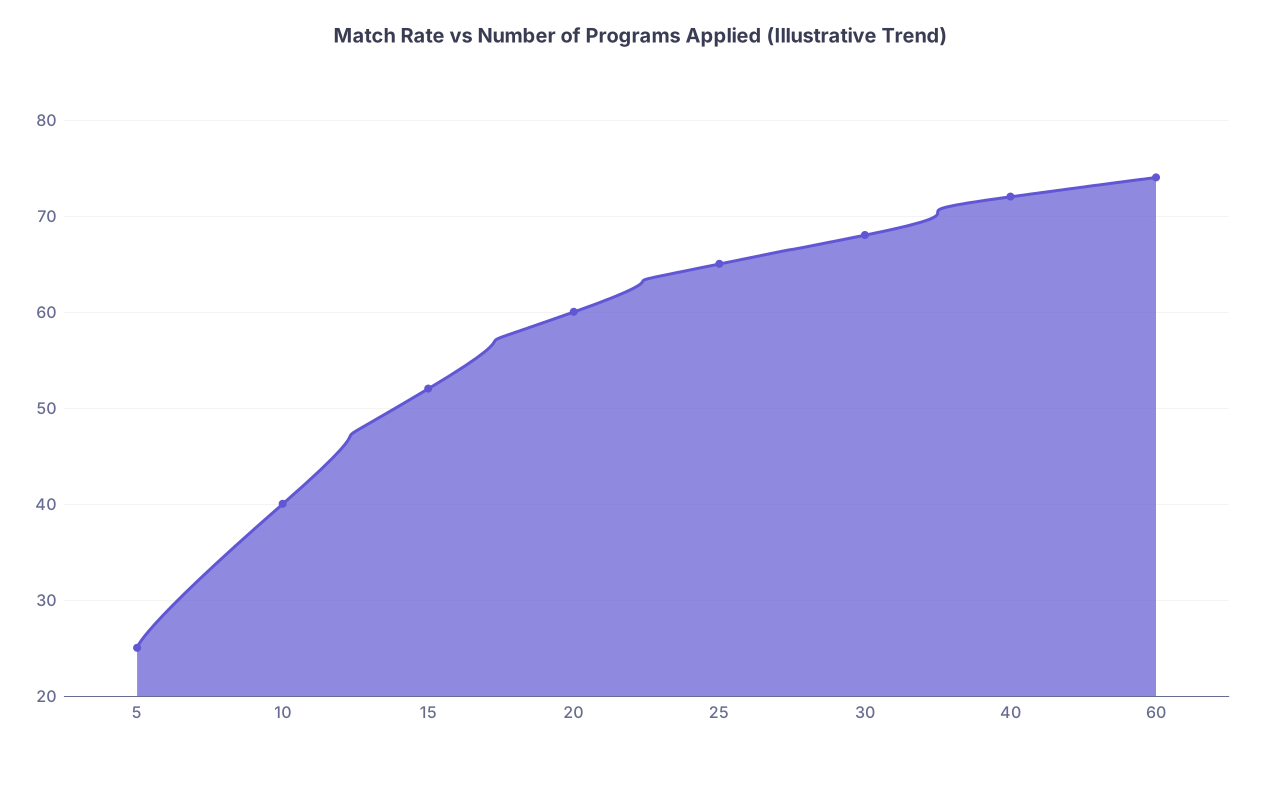
For a US citizen IMG in OB GYN, “how many programs to apply” is not a trivial budgeting question—it’s a key part of your match strategy.
General Numerical Guidelines
These are broad ranges; adjust based on your profile and budget.
Strong US citizen IMG (Step 2 ~245+, strong letters, no red flags):
- Target range: 45–60 programs
- Strategy: Wide but not excessive; focus on IMG‑friendly academic and community programs.
Middle‑of‑the‑road US citizen IMG (Step 2 ~230–244, average profile):
- Target range: 60–80 programs
- Strategy: Broad application, heavy emphasis on IMG‑friendly programs, mix of community and some smaller academic centers.
Higher‑risk applicant (Step 2 <230, exam attempt, or red flags):
- Target range: 80–120+ programs
- Strategy: Very broad, focusing on programs with documented prior IMGs, newer programs, and smaller community sites.
These numbers might sound high, but OB GYN is competitive and IMG‑friendly seats are relatively limited. As a US citizen IMG, underapplying is one of the most common causes of going unmatched.
Balancing Cost, Bandwidth, and Probability
When deciding how many programs to apply to, consider:
- ERAS fees: Costs rise with each additional program. But the cost of going unmatched (time, income delay, morale) is far higher than a few hundred dollars in additional fees.
- Application quality: Do not submit rushed, generic personal statements or incomplete applications just to hit impressive numbers.
- Interview season bandwidth: For OB GYN, aim to attend at least 10–12 interviews as an IMG if possible (more is better). Historically, US citizen IMGs who match often have:
- 10+ interviews in moderately competitive specialties
- In OB GYN, 12–15 interviews gives a safer cushion
Think of your number of applications as a lever to secure enough interviews, not an end in itself.
Step 3: Building a Targeted OB GYN Program List
Once you know your approximate application volume, you need a structured program selection strategy.

Step 3A: Identify IMG‑Friendly OB GYN Programs
Start with programs that demonstrably consider IMGs:
Use data sources:
- FREIDA (AMA): Check “International Medical Graduates Accepted” and current residents
- Residency Explorer Tool (NRMP/AAMC): Look at applicant characteristics and program history
- Program websites: Review current resident bios and alumni lists
- Online forums and spreadsheets: Cross‑check “IMG‑friendly OB GYN residency” lists, but verify with primary sources
Look for patterns:
- Programs that have:
- 1–2 IMGs per class
- US citizen IMGs in recent years
- Community‑based and university‑affiliated community programs are more likely to have IMGs than top‑tier academic universities.
- Programs that have:
Flag explicitly non‑IMG programs:
- Some programs state: “We only consider graduates of US LCME or AOA accredited medical schools”
- Others repeatedly have 0 IMGs over many years
As a US citizen IMG, allocate only a small fraction (if any) of your applications here unless you have a unique connection.
Step 3B: Classify Programs by Tier and Fit
Create a spreadsheet and categorize each program into:
Reach Programs
- Historically few or no IMGs
- Very competitive academic centers
- Very desirable geographic areas (e.g., Boston, San Francisco, Manhattan)
- Your Step 2 CK at or below their usual range
Target Programs
- Regularly accept US citizen IMGs or at least a few IMGs
- Your Step 2 CK and profile align with their typical residents
- Mix of academic and community‑based programs
Safety‑Leaning Programs
- Historically more IMG‑friendly, including Caribbean grads
- Smaller community or newly accredited OB GYN residencies
- Locations that are less popular (rural, mid‑sized cities, colder/warmer extremes)
A rough composition for a middle‑tier US citizen IMG with 70 programs:
- 10–15% Reach (7–10 programs)
- 55–65% Target (40–45 programs)
- 25–35% Safety‑leaning (18–25 programs)
For higher‑risk applicants, shift more heavily toward safety‑leaning programs.
Step 3C: Consider Geographic and Personal Factors
As an American studying abroad, you may have ties to specific US regions. Many OB GYN programs care deeply about regional commitment.
Factors to weigh:
- Home state or region:
Programs in your home state or adjacent states often view you more favorably. - Previous US education:
Undergrad, post‑bacc, or prior healthcare work in a region can be used to demonstrate ties. - Family and support system:
OB GYN residency is intense; having nearby support is a genuine advantage. - Future career goals:
If you want academic subspecialty training (MFMs, REI, Gyn Onc), you should include:- Some programs with strong fellowship connections
- But you still must prioritize IMG‑friendliness and realistic competitiveness.
Do not restrict your list to one or two popular states. As a US citizen IMG, be open to less saturated locations; they’re often your best pathway into OB GYN.
Step 4: Deep‑Dive Criteria for Choosing OB GYN Programs
Beyond IMG‑friendliness, you need a structured lens to evaluate how to choose residency programs specifically for OB GYN.

A. Training Environment and Case Volume
OB GYN is hands‑on. Look for:
- Delivery numbers per resident:
Check if graduates meet or exceed case minimums comfortably. - Surgical exposure:
- Variety of cesarean sections
- Hysterectomies (abdominal, vaginal, laparoscopic)
- Basic urogynecology and gynecologic oncology exposure
- Continuity clinic structure:
Quality longitudinal prenatal and gynecology care experience.
Action tip:
If websites do not list numbers, look for clues in:
- Resident testimonials
- ACGME case logs on program overview
- Fellowship placement (indirect marker of strong training)
B. Program Culture and Support for IMGs
As a US citizen IMG, you must ensure the environment is inclusive and supportive:
- Resident diversity:
Are there IMGs, DOs, or non‑traditional students currently in the program? - Mentoring:
Is there structured mentorship? Are junior residents assigned faculty mentors? - Wellness and duty hours:
OB GYN is high‑stress—programs that prioritize wellness are less likely to burn you out.
When you interview, ask:
- “How does the program support new residents transitioning from international schools?”
- “What mentorship structures exist for residents interested in fellowships or academic careers?”
C. Academic vs. Community Focus
Consider your goals:
- If you’re interested in academics, teaching, or fellowship:
- Look for university‑based or university‑affiliated programs
- Ask about research infrastructure and protected time
- If you’re more focused on broad, hands‑on working OB GYN practice:
- Community‑based programs may provide higher autonomy and volume
Many US citizen IMGs thrive in university‑affiliated community programs that balance both worlds and are more IMG‑accessible.
D. Subspecialty Exposure and Fellowship Pathways
Even if you’re unsure about fellowship, strong subspecialty exposure benefits your training:
- Does the program have in‑house:
- MFM
- Gyn Onc
- REI
- Urogynecology
- If not, do they have strong referral or rotation relationships?
Check graduates’ outcomes:
- Have prior residents matched into fellowships?
- Are graduates employed in the types of settings you envision for yourself?
E. Lifestyle, Location, and Safety
OB GYN residents work hard. Life outside the hospital still matters:
- Cost of living:
High rent in big cities can increase stress. - Commute and safety:
Late‑night call and post‑call travel must be safe and manageable. - Partner/family considerations:
Schools, job markets, and community resources if you have dependents.
Your first priority is to match into OB GYN, but your 3–4 years there must also be livable.
Step 5: Refining Your List and Maximizing Your Chances
Once you’ve built a preliminary list:
A. Reality Check with Mentors
As an American studying abroad, you should intentionally build a mentor network that includes:
- OB GYN faculty from your US rotations
- Your school’s US residency advising team
- Recent alumni who matched into OB GYN
Ask them to review:
- Your CV and scores
- Your preliminary program list
- Whether your reach/target/safety distribution is appropriate
Encourage blunt feedback—you need honest, not just encouraging, input.
B. Crafting Application Materials to Match Your Strategy
Your program selection strategy and application content must align.
Personal statement:
- Emphasize your commitment to women’s health and OB GYN specifically
- Highlight any longitudinal or meaningful women’s health experiences
- Address, if needed, briefly and professionally any red flags
- Mention regional or institutional ties when appropriate
Program‑specific signals (if available):
If the specialty or ERAS cycle introduces signaling for OB GYN:- Prioritize signaling programs that:
- Are IMG‑friendly
- Fit your geographic and training priorities
- Are realistic for your profile (not just famous names)
- Prioritize signaling programs that:
Letters of recommendation:
- Ensure at least 2 letters are from OB GYN attendings who know you well
- If you rotated at a program where you’re applying, ensure one letter is from there
C. During Interview Season: Prioritize Wisely
If you are fortunate to receive many interviews:
- Attend all IMG‑friendly and safety‑leaning program interviews.
Do not cancel “less prestigious” interviews early—those may become your highest‑ranked realistic options. - For borderline or reach interviews:
- Prepare thoroughly; sometimes an excellent interview can offset borderline scores.
- Track impressions:
- After each interview, record notes: culture, volume, location, “gut feel.”
Remember: The match algorithm favors the applicant’s true preferences. Rank programs in genuine order of where you’d most want to train—not where you think you “should” rank them.
Putting It All Together: A Sample Strategy
Imagine you are:
- US citizen IMG from a Caribbean school
- Step 2 CK: 236
- No exam failures
- 2 US OB GYN rotations, 3 OB GYN letters
- Solid but not stellar research
- Strong ties to the Midwest and Northeast US
A reasonable strategy:
- Number of Programs: Apply to ~70 OB GYN programs.
- Composition:
- 8–10 reach programs (large academic centers in NY, Boston, Chicago with some history of US citizen IMGs)
- 40–45 target programs (university‑affiliated and community programs in Midwest, Northeast, and South that regularly take IMGs)
- 15–20 safety‑leaning programs (smaller community or newer programs in less competitive cities/states)
- Geographic mix:
- 40–50% in Midwest and Northeast (regions of strong personal ties)
- 50–60% across South, Midwest, and interior West (more IMG‑friendly)
- Preparation:
- Strong, OB GYN‑focused personal statement
- Ask letter writers to comment on work ethic, adaptability to US system, and potential as a future OB GYN
- Practice interviews emphasizing teamwork, communication with vulnerable patients, and dedication to women’s health
This approach maximizes your likelihood of obtaining 10–15 interviews, enough to be in a reasonable position to match as a US citizen IMG in the obstetrics match.
FAQs: Program Selection Strategy for US Citizen IMGs in OB GYN
1. As a US citizen IMG, is OB GYN a realistic specialty choice?
Yes—if you are strategic. OB GYN is competitive, but US citizen IMGs match into OB GYN every year. Realistic success usually requires:
- Solid Step 2 CK (ideally ≥230, higher is better)
- At least one or two strong US OB GYN rotations with supportive letters
- Broad and targeted applications (often 60+ programs)
- Willingness to consider less saturated geographic areas and more IMG‑friendly programs
2. How many OB GYN programs should I apply to if my Step 2 CK is below 230?
If your Step 2 CK is below 230, you are in a higher‑risk category for OB GYN as a US citizen IMG. A typical strategy would be:
- Apply to 80–120+ programs, focusing heavily on:
- Programs with a track record of taking IMGs
- Community‑based and newer residencies
- Less competitive geographic regions
- Strengthen all other elements: US clinical experience, letters, personal statement, and any evidence of improvement after your exam.
3. Should I still apply to top academic programs if they rarely take IMGs?
It’s reasonable to include a small number of reach programs if:
- Your application is relatively strong (Step 2 CK ≥240–245, no red flags)
- You have a meaningful connection (US rotation there, faculty mentor, regional ties)
However, as a US citizen IMG, limit these to perhaps 5–10 programs. Don’t let prestigious but low‑yield applications crowd out more realistic, IMG‑friendly options.
4. What’s more important for OB GYN: location or program reputation?
For a US citizen IMG in the obstetrics match, the first priority is matching into OB GYN at all. Once that is secured, both location and reputation matter, but consider:
- For most applicants:
A supportive, hands‑on training environment in a “less famous” location is better than no OB GYN position at all. - If you have strong academic/fellowship aspirations:
A program with good case volume, mentorship, and some research/fellowship connections is helpful—but it does not need to be a “top‑10 name” for you to succeed.
In practice, choose the best training environment and culture that will rank you—even if the city is not your first choice.
By combining a realistic self‑assessment with a structured program selection strategy, a well‑researched mix of IMG‑friendly programs, and broad enough applications, you significantly improve your odds of successfully matching into OB GYN as a US citizen IMG.