Understanding the Landscape: What Makes Program Selection Different for US Citizen IMGs in Pediatrics?
For a US citizen IMG (an American studying abroad), designing a smart program selection strategy for pediatrics residency is one of the most important parts of the peds match. Unlike US MD seniors, you must be more deliberate and data-driven about where you apply, how many programs to apply to, and what mix of programs is realistic.
Several factors shape your program selection strategy:
- IMG-friendliness: Some pediatric residencies rarely interview or rank IMGs; others have a proven track record of taking US citizen IMG graduates.
- Competitiveness of your profile: Exam scores, clinical performance, US clinical experience (USCE), research, and visa status (if applicable) all matter.
- Geographic and personal constraints: Family, partner’s job, childcare, or financial constraints may limit your available locations.
- Pediatrics as a specialty: Pediatrics is generally more IMG-friendly than highly competitive fields like dermatology or orthopedic surgery, but there is still a wide range in how receptive individual programs are to IMGs.
Your goal is to be strategic rather than reactive: to understand how to choose residency programs that fit you, while also giving yourself enough breadth to maximize your chances of matching.
In this article, we’ll walk through a step-by-step program selection strategy tailored specifically to US citizen IMGs applying to pediatrics, with concrete guidance on:
- Evaluating your competitiveness
- Building a balanced list of programs
- Estimating how many programs to apply to
- Prioritizing US citizen IMG–friendly pediatrics residencies
- Combining data, networking, and personal needs into one coherent plan
Step 1: Assess Your Competitiveness as a US Citizen IMG in Pediatrics
Before you can decide how many programs to apply to or which ones to target, you need a realistic picture of your own profile. This will drive your program selection strategy.
1. Key Components of Competitiveness
For American students studying abroad, these elements are crucial:
USMLE/COMLEX Scores and Pass Status
- USMLE Step 1: Pass/Fail, but a first-attempt pass matters.
- USMLE Step 2 CK: Now the main numerical screening tool.
- Any Step failures or exam gaps are red flags to many programs.
Clinical Experience
- US Clinical Experience (USCE) is essential: ideally pediatrics sub-internships, electives, or acting internships in US teaching hospitals.
- Community outpatient pediatrics experience is useful but less powerful than inpatient or academic sub-I’s.
- Strong, detailed Letters of Recommendation (LoRs) from US pediatricians (especially academic faculty) significantly elevate your profile.
Academic Record
- Performance in pediatrics, internal medicine, and core clerkships.
- Any honors, distinctions, or dean’s list.
- Class rank or quartile, if available.
Research and Scholarly Work
- Pediatrics-related projects, case reports, posters, or publications.
- Quality and relevance matter more than sheer quantity, especially if you’re considering academic programs.
Visa Status
- As a US citizen IMG, you do not need a visa, which is a major advantage.
- Programs that say “US citizenship or permanent residency required” are open to you—but might exclude non–US citizen IMGs.
Non-Cognitive Factors
- Communication skills, professionalism, empathy, and teamwork.
- Evidence of commitment to children (volunteering, advocacy, school outreach).
2. Self-Categorize Your Profile
Based on those components, loosely place yourself into one of three groups. This is not official, but it will inform your program selection strategy.
Group A – Strong Applicant
- Step 2 CK comfortably above recent national pediatric match averages (for example, ≥ 235–240, depending on the year’s trends).
- No exam failures.
- Solid USCE in pediatrics with strong LoRs from US faculty.
- A few research projects or strong school ranking/honors.
- No major red flags (gaps, professionalism concerns).
Group B – Moderate Applicant
- Step 2 CK around the national average or slightly below (e.g., 220–235).
- Possibly one contextualized red flag (e.g., a leave of absence, explained in personal statement).
- Some USCE in pediatrics, but maybe less extensive or fewer letters.
- Limited but still present extracurriculars or research.
Group C – At-Risk Applicant
- Step 2 CK clearly below average or with one or more exam failures.
- Minimal or no meaningful USCE in pediatrics.
- Significant red flags (multiple attempts, long time since graduation).
- Few strong LoRs, especially from US pediatricians.
Your self-categorization affects how aggressively you should apply and how broad your program list should be.

Step 2: Researching Pediatrics Programs with an IMG-Friendly Lens
Once you understand your profile, the next step in your program selection strategy is to identify pediatrics residency programs that realistically align with it. As an American studying abroad, you need a structured way to assess IMG-friendliness, training quality, and fit.
1. Start with Official Data Sources
Use these core resources:
ERAS / FREIDA (AMA Residency & Fellowship Database)
- Filter by specialty: Pediatrics.
- Filter for program type (categorical).
- Check:
- Whether they accept IMGs.
- Whether USMLE is required.
- Whether there is a time-since-graduation cutoff.
- Any mention of US citizen/permanent resident preference.
Program Websites
- Look at current residents:
- How many are IMGs?
- Are there US citizen IMGs from Caribbean or other international schools?
- Check eligibility criteria:
- “We sponsor J-1 visas only” is less relevant to you as a US citizen but might tell you whether they are open to IMGs generally.
- Some explicitly say “We consider international graduates; US clinical experience is strongly preferred.”
- Look at current residents:
NRMP “Charting Outcomes” and “Program Director Survey” (when updated)
- Review match statistics for pediatrics.
- See how often programs interview/rank IMGs vs. US MD seniors.
2. Identify Truly IMG-Friendly Pediatrics Programs
Signs a pediatrics residency is US citizen IMG–friendly:
- A visible proportion of international graduates among current or recent residents.
- Website language that explicitly welcomes applications from IMGs.
- No excessively restrictive criteria (e.g., “Graduated within 1–3 years” might be challenging if you’re older, though not always exclusionary).
- Reasonable minimum exam thresholds, or no hard cutoffs listed.
- History of matching US citizen IMG applicants from similar schools to yours.
Make a list or spreadsheet with columns such as:
- Program name and location
- University vs. community program
- USMLE requirements
- Mention of US citizen/permanent resident requirement
- Your interest level (1–5)
- Estimated competitiveness (reach/target/safety)
3. Understand Program “Tiers” Without Over-Fixating on Prestige
For pediatrics, think less about “Top 10” rankings and more about:
- University vs. community vs. hybrid programs
- University programs: More research, subspecialty exposure, academic environment.
- Community programs: Often smaller, potentially more hands-on early responsibility, sometimes more IMG-friendly.
- Location:
- Large coastal cities and highly desirable metro areas are more competitive.
- Midwest, South, and some smaller cities may be more accommodating to US citizen IMGs.
- Subspecialty strength:
- If you have a clear interest (e.g., pediatric cardiology), note programs with strong fellowships—but don’t limit yourself only to those.
As a US citizen IMG, applying to a healthy mix of university-affiliated community programs, medium-sized university programs, and some IMG-friendly smaller programs will usually be more effective than aiming solely for the most prestigious children’s hospitals.
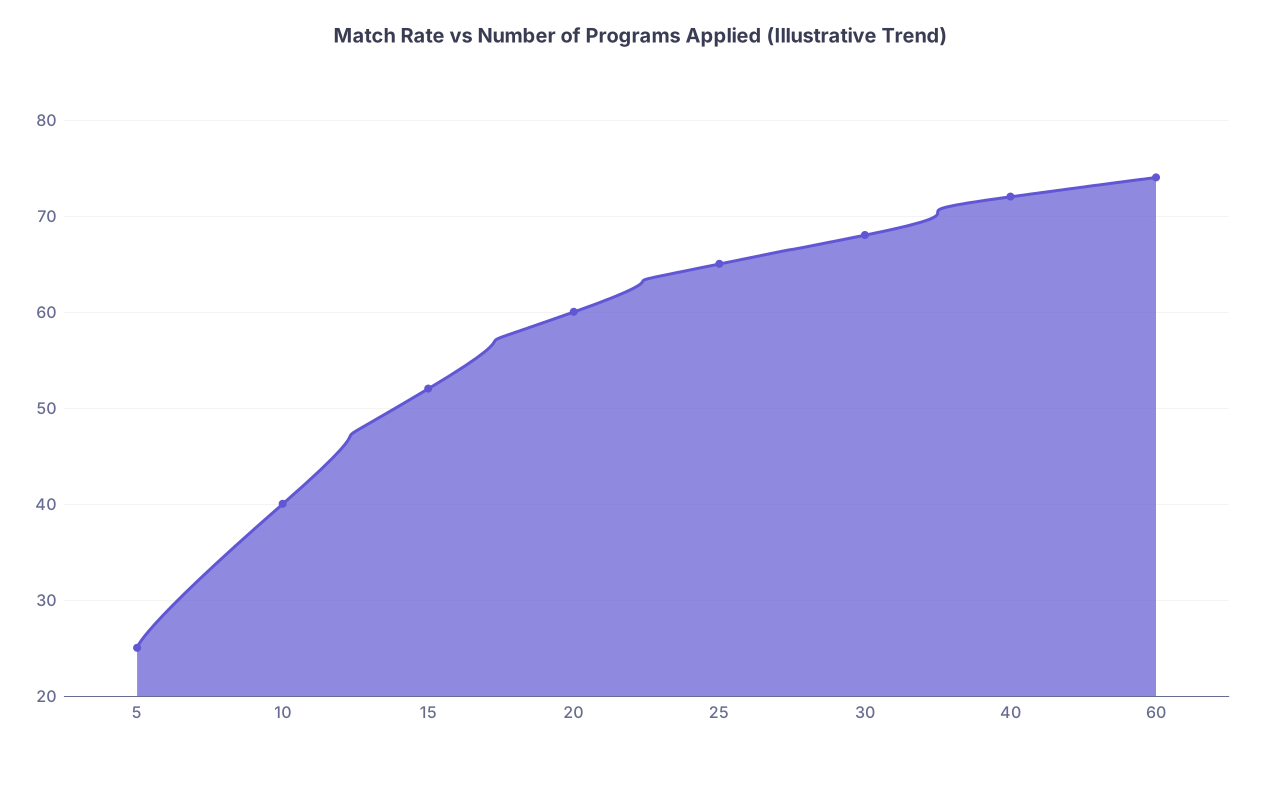
Step 3: How Many Pediatrics Programs Should a US Citizen IMG Apply To?
The central question for many IMGs is: how many programs to apply to for pediatrics?
The right number varies based on your competitiveness, but US citizen IMGs typically need to apply more broadly than US MD seniors to achieve a similar match probability.
1. General Ranges for Pediatrics (US Citizen IMG)
These are ballpark figures and should be tailored to your situation and the most recent NRMP data:
Group A (Strong Applicant)
- Consider 35–60 pediatrics programs.
- You may lean more toward quality over sheer quantity, but still keep a broad geographic spread.
- You might safely reduce the number if you have exceptional USCE and strong networking connections—but do so cautiously.
Group B (Moderate Applicant)
- Aim for 60–90 programs.
- This range balances cost and coverage.
- You should include a good mix of target and safety programs, across regions and program types.
Group C (At-Risk Applicant)
- You may need 90–120+ programs to stay competitive.
- Particularly if you have failed exams, older graduation year, or minimal USCE, wide net coverage is your friend.
- Focus on IMG-friendly community and hybrid programs first, then include selected university-affiliated sites where your profile still plausibly fits.
These ranges assume pediatrics specifically, not ultra-competitive specialties. Adjust slightly depending on:
- How late your application is (late = apply to more).
- Whether you’re dual applying (e.g., pediatrics + family medicine).
- How many away rotations and strong US LoRs you have.
2. Balancing Cost and Benefit
ERAS application fees can add up quickly. To be strategic:
- Prioritize programs:
- Tier 1: High interest + realistic chance (apply no matter what).
- Tier 2: Moderate interest OR moderate chance.
- Tier 3: Lower interest but still acceptable if needed (safety net).
If fees are a concern, you might:
- Start with Tier 1 and Tier 2 (e.g., 60–80 programs).
- Add Tier 3 programs later if interview volume is low, as long as deadlines haven’t passed.
3. Don’t Ignore Interview Numbers
Ultimately, you match based on interviews, not applications. For pediatrics, a US citizen IMG will generally want:
- At least 10–12 interviews to feel reasonably comfortable.
- More if you have red flags (15+ interviews gives a stronger safety margin).
Your application volume and program mix should be designed to get you to those interview numbers.

Step 4: Building a Balanced List: Reach, Target, and Safety Programs
Now that you have a sense of how many pediatrics programs to apply to, the next step is designing a balanced portfolio that optimizes both fit and match chances.
1. Define Your Program Categories
Use your self-assessment plus program data to classify:
Reach Programs
- Historically match mostly US MD/DO grads.
- Few IMGs in recent resident rosters.
- Higher average Step 2 CK scores and often located in very desirable areas (big coastal cities, famous children’s hospitals).
- You still meet minimum criteria, but you’re less competitive than the typical resident there.
Target Programs
- Regularly accept US citizen IMGs and non–US citizen IMGs.
- Your scores, USCE, and experiences are comparable to their current residents.
- Located in moderately competitive or mixed-desirability locations (suburbs, mid-sized cities, certain parts of the Midwest/South).
Safety Programs
- Clear history of matching IMGs, with multiple international grads in each class.
- Less geographically competitive (smaller cities, more rural regions).
- You exceed their minimum requirements, and your profile is at or above the apparent average.
A reasonable distribution (for a moderate applicant) might be:
- 20–30% Reach
- 40–50% Target
- 30–40% Safety
For an at-risk applicant:
- 10–20% Reach
- 30–40% Target
- 40–60% Safety
2. Geographic Considerations for US Citizen IMGs
As an American studying abroad, you may have:
- Family ties to specific states
- A partner following a separate career path
- A preference for certain climates or communities
Use those, but don’t let them trap you into only applying to 1–2 regions, especially if those are highly competitive.
- If you have strong regional ties (e.g., grew up in the Midwest, went to undergrad there), highlight that in your personal statement and ERAS geographic preferences and prioritize programs there.
- But still apply to at least 3–4 different regions if possible:
- Example: Midwest, Northeast (non-top-tier cities), South, and selected West programs.
Programs sometimes prioritize applicants who are likely to stay long-term; being able to explain a genuine reason for your interest in a region is an advantage.
3. Additional Fit Factors for Pediatrics
Beyond competitiveness and location, consider:
- Program Size: Larger programs may have more peers and subspecialties, smaller programs may offer closer mentorship.
- Children’s Hospital vs. Mixed Setting: Some programs are anchored at large standalone children’s hospitals; others rely on community hospitals with pediatric units.
- Patient Population: If you’re passionate about underserved, immigrant, or rural communities, look for programs explicitly serving those groups.
- Educational Structure: Availability of simulation, protected didactics, research time, and subspecialty electives.
Use these as secondary filters after you’ve ensured the program is logistically and statistically reasonable for you.
Step 5: Advanced Program Selection Tactics for the Peds Match
Once you have a preliminary list, refine it using more nuanced strategies.
1. Leverage Networking and USCE Sites
Your US clinical experience sites are invaluable:
- Prioritize pediatrics programs at hospitals where you:
- Completed sub-internships or electives.
- Worked closely with faculty who are willing to advocate for you.
- Ask attendings or residents:
- “Are there particular pediatrics residencies that tend to be more open to US citizen IMG applicants?”
- “How does this program and others you know view international graduates?”
Sometimes a single strong advocate at a program can transform it from a “reach” to a realistic target.
2. Align Your Application Messaging with Your Target Programs
As you decide how to choose residency programs, remember you can subtly tailor ERAS content:
- Personal Statement:
- Emphasize pediatrics-specific experiences.
- Highlight any geographic or population-focused interests (e.g., urban underserved, immigrant health, rural pediatrics).
- Program-Specific Paragraphs:
- When allowed, add short sections explaining why that program’s mission, patient population, and training environment match your goals.
- LoRs:
- Ask letter writers to reference qualities relevant to pediatrics (compassion with children and families, communication with parents, resilience in emotionally intense scenarios).
This alignment doesn’t change your raw score, but it helps convert interviews once you’re through the basic filters.
3. Monitor and Adjust in Real Time
Residency application strategy isn’t static. After you submit:
Track interview invitations:
- If you receive very few invites after 3–4 weeks, consider expanding your program list (if deadlines allow).
- If you’re flooded with invites and overwhelmed, you can cancel lower-priority interviews strategically—though most US citizen IMGs in pediatrics won’t have this problem.
Stay attentive to signals from programs:
- Some may communicate strong interest explicitly.
- Others may be less responsive; don’t overinterpret silence, but use patterns to refine your expectations.
4. Planning for Worst-Case and Best-Case Scenarios
Your program selection strategy should also account for contingencies:
- If you don’t match:
- Keep a record of all the programs you applied to and why.
- Identify whether you need to improve exam scores, gain more USCE, or broaden your geographic scope for the next cycle.
- If you match into a safety program:
- You still have the full training to pursue subspecialties, leadership roles, or academic pathways later.
- Focus on excelling where you are; many pediatric fellows and faculty trained at community or mid-tier programs.
Frequently Asked Questions (FAQ)
1. As a US citizen IMG, is pediatrics a realistic specialty for me?
Yes. Pediatrics is generally more welcoming to IMGs than many other specialties, and being a US citizen IMG gives you a significant advantage over non–US citizen IMGs because you do not need visa sponsorship. With sound exam performance, solid USCE, and a well-planned program selection strategy, peds is a realistic and attainable specialty.
2. How many pediatrics programs should I apply to if I have an average Step 2 score and some USCE?
If you’re a moderate applicant (mid-220s Step 2 CK, some USCE, no major red flags), a reasonable range is 60–90 pediatrics programs. Within that, aim for a mix of reach, target, and safety programs, and ensure many are clearly IMG-friendly and in a variety of geographic regions.
3. How do I identify which pediatrics programs are IMG-friendly?
Use a multi-step approach:
- Check FREIDA and program websites for explicit statements about considering IMGs.
- Look at current residents’ profiles for evidence of US citizen IMGs or other international grads.
- Pay attention to requirements such as USMLE attempts, time since graduation, and USCE preferences.
- Ask mentors, attendings, or IMGs who recently matched which programs were responsive and welcoming.
Programs with several IMGs in recent classes and inclusive eligibility language are generally more IMG-friendly.
4. Should I limit my applications to regions where I have family or personal ties?
It’s beneficial to apply where you have genuine ties, as programs may view that as a sign you’re likely to stay. However, limiting yourself only to a small number of competitive cities or one region can significantly reduce your chances of matching. A better approach is to emphasize your ties in your application while still applying broadly—to at least 3–4 regions—especially if your profile is moderate or at-risk.
Designing a thoughtful program selection strategy as a US citizen IMG in pediatrics requires honest self-assessment, data-driven research, and a careful balance between ambition and realism. By understanding your strengths, targeting IMG-friendly pediatrics residency programs, and applying widely enough to secure ample interviews, you can greatly increase your chances of a successful peds match and start the career in child health you’ve been working toward.