Understanding Your Unique Position as a US Citizen IMG in Peds-Psych
As a US citizen IMG (international medical graduate) and an American studying abroad, you occupy a very specific—and strategic—niche in the residency landscape. When it comes to pediatrics-psychiatry (often shortened to peds-psych) and the triple board pathway (pediatrics–general psychiatry–child & adolescent psychiatry), this niche can actually work to your advantage if you plan deliberately.
Why Your Status Matters
As an American studying abroad, you:
- Do not require visa sponsorship (usually a major concern for non–US citizen IMGs)
- Are often more familiar with US healthcare and culture
- May have family or geographic ties that programs value (for retention and stability)
- Still face some IMG-related challenges:
- Less direct access to US clinical training during medical school
- Potential bias toward US MD/DO graduates
- Less familiarity with how to choose residency programs and how many programs to apply to
In a niche field like combined pediatrics-psychiatry or triple board, your strategy matters even more because:
- There are very few programs nationwide.
- Positions per program are limited (often 1–3 spots per year).
- Combined and triple board pathways attract highly motivated, niche-focused applicants.
The goal of a smart program selection strategy is to turn a small number of opportunities into a high probability of matching, while aligning with your career goals in peds-psych or triple board.
Step 1: Clarify Your Path – Peds-Psych vs Triple Board vs Categorical
Before you decide how many programs to apply to or build a program list, you need a clear sense of what you’re actually targeting.
The Main Pathways
Combined Pediatrics-Psychiatry-Child & Adolescent Psychiatry (Peds-Psych-CAP)
- Typically a 5-year integrated program.
- Leads to board eligibility in:
- Pediatrics
- General Psychiatry
- Child & Adolescent Psychiatry
- Training is woven together with rotations in all three disciplines throughout.
Triple Board (Pediatrics–Psychiatry–Child & Adolescent Psychiatry)
- Also 5 years, but with a somewhat different structure or emphasis depending on the program.
- Often branded specifically as “Triple Board Residency.”
- Outcomes are similar—board eligibility in pediatrics, general psychiatry, and child & adolescent psychiatry.
Categorical Programs with a Peds-Psych Focus
- Categorical Pediatrics with strong behavioral/developmental pediatrics, child psychiatry exposure, or integrated mental health services.
- Categorical Psychiatry with:
- Strong child & adolescent psychiatry fellowships
- Pediatric consultation-liaison services
- Close relationships with children’s hospitals.
- Option to complete a separate Child & Adolescent Psychiatry fellowship later.
Why This Choice Affects Program Selection
Your program selection strategy should reflect your risk tolerance and priorities:
If your dream is truly integrated dual/tri-board training, then peds-psych or triple board should be your priority list, but:
- Combined/triple board spots are limited.
- You need a robust safety net of categorical pediatrics and/or psychiatry programs.
If you’re flexible and the key goal is to be involved with kids’ mental health, you might:
- Apply broadly to categorical psychiatry and pediatrics programs with strong child-focused features.
- Add combined/triple board programs as “reach” or “ideal-fit” options.
A common strategy for a US citizen IMG interested in peds-psych:
Tier 1 (Dream): All viable combined pediatrics-psychiatry/ triple board programs
Tier 2 (Strong Fit): Categorical psychiatry programs with robust child & adolescent focus, plus a CAP fellowship on-site
Tier 3 (Safety/Flexible): Categorical pediatrics programs with strong behavioral/developmental or integrated mental health exposure
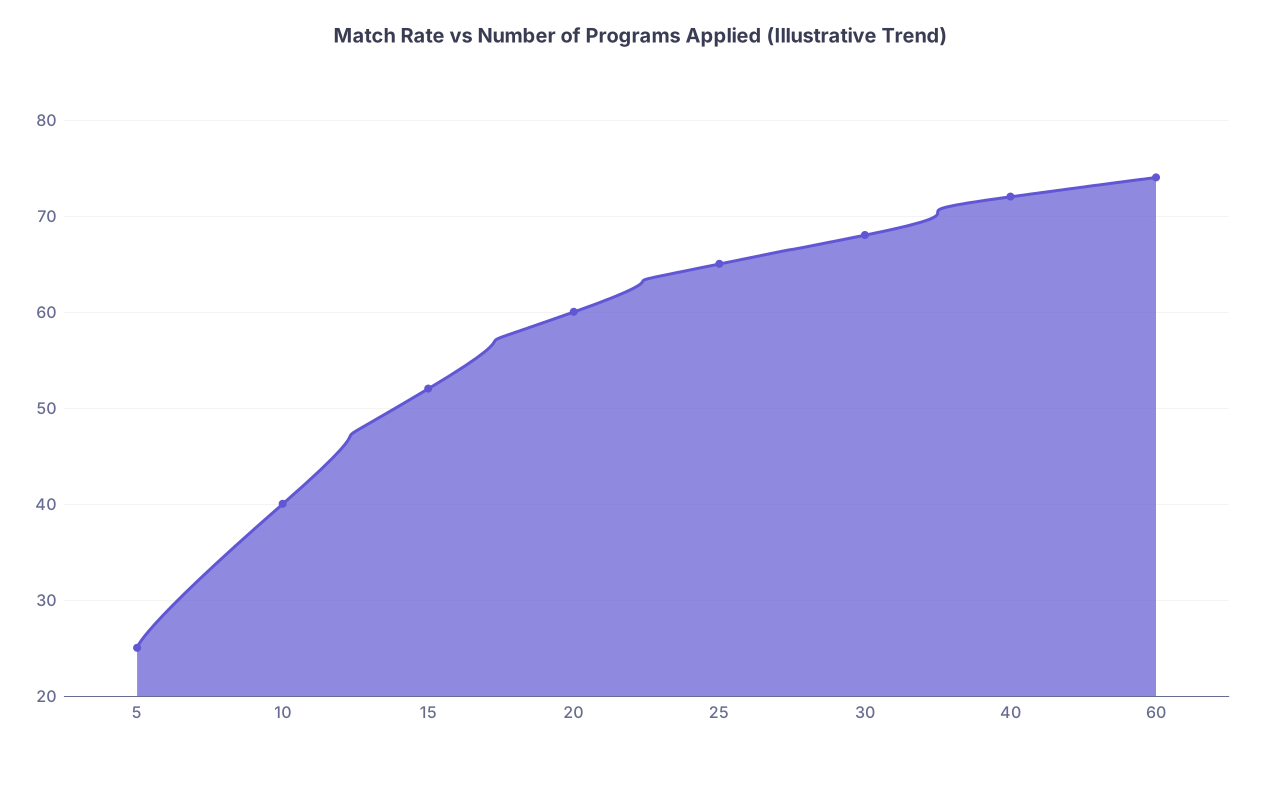
Step 2: How Many Programs Should You Apply To?
This is the core “how many programs to apply” question—and it’s different for a niche field like peds-psych.
General Benchmarks (Not Specialty-Specific)
For context (not as rigid rules):
- US MD/DO in core specialties often aim for:
- ~25–40 programs in a single specialty.
- US citizen IMG usually apply more broadly:
- 40–60+ programs in a single specialty, depending on competitiveness.
But peds-psych and triple board are tiny in comparison to categorical pediatrics or psychiatry. There are only a handful of such programs nationally, and many only offer 1–2 positions per year. That means:
- You cannot rely on these combined programs alone for match security.
- Your total application volume must include categorical programs.
A Practical Numeric Strategy for US Citizen IMG in Peds-Psych
Assuming you’re an American studying abroad with average to slightly above average credentials (Step scores or pass/fail performance, decent clinical grades, some USCE, and solid letters), a practical distribution could look like:
Combined Peds-Psych / Triple Board
- Apply to every program you reasonably qualify for.
- This will likely be 5–15 programs, depending on the year and offerings.
- As a US citizen IMG, you should almost never “self-screen out” of these unless:
- You clearly do not meet specific criteria (e.g., program requires US med school graduation).
- You have substantial red flags and the program is extremely competitive.
Categorical Psychiatry Programs
- 25–40 programs as a US citizen IMG is often reasonable, especially:
- If you have a strong peds-psych narrative.
- If programs are IMG-friendly.
- Consider more (40–50) if:
- Scores are borderline or you had a fail/remediation.
- You have minimal USCE or weaker letters.
- 25–40 programs as a US citizen IMG is often reasonable, especially:
Categorical Pediatrics Programs
- Another 20–30 programs, focusing on:
- IMG-friendly institutions.
- Children’s hospitals with integrated behavioral health or complex care clinics.
- If psychiatry is your first love, you could reduce pediatrics to 15–20—but make sure there are at least some pediatrics options on your list if you’re open to both routes.
- Another 20–30 programs, focusing on:
Total Application Count Example
- 10 combined/triple board
- 35 psychiatry categorical
- 25 pediatrics categorical
= 70 total applications
This sounds high, but for a US citizen IMG in a niche pathway, this can be a rational strategy, especially if finances allow. You can adjust upward or downward based on your competitiveness:
Stronger profile (high scores, significant USCE, strong peds+psych research):
- 5–10 combined/triple board
- 25–30 psychiatry
- 15–20 pediatrics
- Total: ~45–60
Weaker profile (borderline scores, limited USCE, gaps):
- All possible combined/triple board
- 40–50 psychiatry
- 25–30 pediatrics
- Total: ~70–90
The key: combined and triple board are your aspirational target, but categorical programs provide match security.

Step 3: Building a Smart Program List – Criteria that Matter
Once you know your targets and rough numbers, the next step is developing a program selection strategy that goes beyond prestige or name recognition.
1. IMG-Friendliness and US Citizen Bias
As a US citizen IMG, you’re navigating two overlapping realities:
- IMG status can be a hurdle.
- No need for visa sponsorship is a major plus.
Your questions when evaluating programs:
- Have they historically matched IMGs, especially US citizens?
- Do they list IMG requirements clearly (USMLE minimums, graduation year cut-offs, USCE expectations)?
- For psychiatry and pediatrics:
- Many community and some university-affiliated programs are very IMG-friendly.
- Some elite university programs are IMG-neutral but still accept strong US citizen IMGs.
Actionable tactics:
- Use NRMP Charting Outcomes and program websites to identify:
- % of IMGs in recent classes.
- Language like “we accept international graduates” vs “we prefer US grads.”
- Email coordinators if unclear:
- Ask directly whether IMGs (especially US citizens) have matched in recent years.
2. Alignment with Peds-Psych or Triple Board Interests
You should prioritize programs where your peds-psych narrative makes sense:
For combined/triple board programs:
- They explicitly want applicants with:
- Clear, long-term commitment to child mental health.
- Experience with both pediatrics and psychiatry (even if limited abroad, supplemented with USCE).
For categorical psychiatry:
- Look for:
- On-site Child & Adolescent Psychiatry fellowship.
- Pediatric consultation-liaison services.
- Rotations at a children’s hospital.
- Faculty with peds-psych research or integrated care projects.
For categorical pediatrics:
- Look for:
- Integrated behavioral health clinics.
- Developmental-behavioral pediatrics.
- Child abuse, foster care, complex care, or psychosocially heavy services.
- Opportunities to collaborate with psychiatry or psychology departments.
3. Geographic Strategy
As an American studying abroad, geography can help or hurt you:
- Programs often favor applicants with ties to their region:
- Family, undergrad, prior work, or personal history in that area.
- For peds-psych or triple board, there may be only one or two programs in an entire region, so:
- Be flexible with location, but emphasize any tie you have to where you apply.
Geographic tactics:
- Prioritize:
- States/regions where you have support systems, or realistic long-term plans.
- Areas known to be more IMG-welcoming (e.g., some Midwest, South, and community-heavy regions).
- Spread risk:
- Don’t cluster your entire list in the most competitive urban hubs (NYC, Boston, San Francisco) unless your profile is very strong.
- Include a mix of urban, suburban, and smaller-city programs.
4. Competitiveness Alignment
To decide how to choose residency programs in line with your profile, consider:
USMLE/COMLEX performance (or school’s internal exam record if pass/fail):
- If you’re below national averages, lean toward community or mid-tier university programs and apply broadly.
- If you’re at or above averages, you can add more academic/children’s hospital–based programs.
Gaps or red flags:
- Attempted or failed exams.
- Leaves of absence.
- Significant time since graduation.
- For each red flag, increase the volume of applications and emphasize programs with a known history of evaluating applicants holistically.
Strength of narrative:
- Peds-psych is a narrative-driven field.
- Strong, consistent interest demonstrated in your personal statement, experiences, and letters can offset modest scores.
Step 4: Organizing and Prioritizing Your List
A thoughtful program selection strategy isn’t just about how many; it’s about how you rank and prioritize programs for applications and eventual interviews.
Step 4A: Use a Structured Spreadsheet
Create a spreadsheet with columns such as:
- Program name
- Type:
- Combined/triple board
- Categorical psych
- Categorical peds
- Location (city, state, region)
- Academic vs community
- IMG-friendliness (e.g., high/medium/low)
- Child mental health exposure:
- CAP fellowship?
- Children’s hospital?
- Integrated behavioral health?
- Requirements:
- Step cut-offs
- Year of graduation limit
- Required USCE
- Personal fit notes:
- Geographic/family ties
- Faculty of interest
- Specific rotations you like
- Priority tier:
- A (must apply)
- B (likely apply)
- C (apply if budget allows)
This lets you visualize how many programs you actually have per tier and adjust accordingly.
Step 4B: Define Priority Tiers
As a US citizen IMG targeting peds-psych, a reasonable structure:
Tier A (High priority)
- All combined and triple board programs where you meet basic criteria.
- Categorical psych/peds at institutions with:
- Strong CAP or developmental-behavioral focus
- Demonstrated IMG acceptance
- Geographic ties or clear personal fit
Tier B (Moderate priority)
- Solid categorical psych and peds programs that are IMG-friendly, but with less obvious peds-psych emphasis.
- Programs in regions where you’re neutral about long-term living.
Tier C (Backup/fallback)
- Programs that are less aligned with your ideal path, but still acceptable for training and board eligibility.
- Heavily IMG-friendly programs in locations that are less desirable but realistic.
Action Step:
Fill Tier A first and ensure:
- Every combined/triple board program you qualify for is in Tier A.
- Tier A alone will not be enough numerically; you still need robust Tier B and C for security.
Step 5: Strategically Present Yourself to Programs
Program selection isn’t just about where you apply; it’s about how you tailor your application and communication to align with their mission.
Tailored Personal Statements
For a peds-psych–focused applicant, consider:
One primary personal statement emphasizing:
- Longstanding interest in child mental health
- Experiences with children, families, schools, or behavioral health
- Your motivation for integrated care
Variations for:
- Combined/Triple Board:
- Emphasize the equal passion for pediatrics and psychiatry.
- Include specific reasons you want integrated training rather than sequential.
- Categorical Psychiatry:
- Highlight your interest in child & adolescent psychiatry and intention to pursue CAP fellowship.
- Categorical Pediatrics:
- Emphasize your desire to care for children with complex psychosocial or behavioral needs and collaborate closely with mental health professionals.
- Combined/Triple Board:
Letters of Recommendation (LORs)
For a US citizen IMG aiming at peds-psych/triple board:
- Ideal LOR mix might include:
- 1–2 letters from psychiatry faculty (preferably child & adolescent, if available).
- 1–2 from pediatrics faculty or pediatric subspecialists.
- If limited options abroad, prioritize any US clinical experience letters.
When sending to specific program types:
- For combined/triple board:
- Include both pediatrics and psychiatry letters.
- For categorical psychiatry:
- Minimum 2 psych letters, plus 1 pediatric or primary care letter if allowed.
- For categorical pediatrics:
- 2 peds letters, plus 1 psych letter if it helps highlight your behavioral child health interest.
Communicating as a US Citizen IMG
In your CV and interviews, subtly highlight the advantages of being an American studying abroad:
- Familiarity with US culture and language.
- Clear commitment to returning and practicing in the US.
- Adaptability demonstrated by successfully training abroad.
- No visa sponsorship burden.
Be prepared to explain:
- Why you chose to study abroad.
- How your training environment has prepared you for US residency.
- What steps you’ve taken (USCE, observerships, electives) to understand US clinical systems.
Step 6: Adjusting Your Strategy in Real Time
A good program selection strategy stays flexible as you receive feedback during the season.
Monitor Interview Offers and Respond
Track:
- How many interview invitations you receive from:
- Combined/triple board programs
- Categorical psychiatry programs
- Categorical pediatrics programs
If you see:
Early strong response from categorical psychiatry but few combined/triple board invites:
- Double down on psych programs that value CAP and peds exposure.
- Consider signaling clear commitment to child psychiatry in interviews.
Fewer interviews across the board than expected (e.g., <8 total invites by late November):
- Consider:
- Emailing programs with thoughtful updates (new experiences, improved scores, additional USCE).
- Accepting more interviews from safety programs than you might have originally preferred.
- Being realistic about ranking strategy later (e.g., prioritizing any acceptable psych/peds categorical positions).
- Consider:
Rank List Strategy (Briefly)
Your eventual rank list should reflect both aspiration and realism:
- Rank all combined/triple board programs you would genuinely attend at the top.
- Follow with:
- Categorical psychiatry programs with strong CAP/child focus.
- Then pediatric programs aligned with your secondary path.
- Avoid ranking any program you truly would not attend, but be honest about how much you value simply matching versus waiting another year.
FAQs: Program Selection Strategy for US Citizen IMG in Pediatrics-Psychiatry
1. As a US citizen IMG, can I realistically match into a peds-psych or triple board program?
Yes, it is realistic but competitive. Success is more likely if you:
- Apply to every combined/triple board program you qualify for.
- Build a strong, consistent narrative around child mental health and integrated care.
- Back up your application with robust categorical psychiatry and pediatrics applications.
- Demonstrate US clinical experience and strong letters where possible.
Your US citizenship helps (no visa issues), but IMG status still means you should apply broadly.
2. If I’m passionate about peds-psych, is it a mistake to apply to categorical programs?
No. Applying to categorical pediatrics and psychiatry is a smart safety and flexibility strategy, not a compromise:
- Categorical psychiatry + a Child & Adolescent Psychiatry fellowship can closely approximate your ideal peds-psych career.
- Categorical pediatrics with strong behavioral/developmental focus also lets you work intensively with mental health in children.
- Combined/triple board is a preferred path, not the only path to a peds-psych career.
3. How should my program list differ if my scores are below average?
If your exam performance is below average:
- Increase the total number of programs:
- More categorical psychiatry and pediatrics (e.g., 40–50 psych, 25–30 peds).
- Emphasize IMG-friendly and community-based programs.
- Still apply to all combined/triple board programs, but treat them as “reach” options.
- Strengthen all other aspects: compelling peds-psych narrative, solid letters, USCE if possible.
4. How many combined or triple board peds-psych programs should I apply to?
In this niche area, the answer is almost always:
Apply to every single combined pediatrics-psychiatry or triple board program where:
- You meet the basic eligibility criteria, and
- You would genuinely consider attending.
Because there are so few programs and spots, limiting yourself further only hurts your chances. The key is to surround those applications with a broad, well-chosen set of categorical psychiatry and pediatrics programs so that you maintain a high overall chance of matching.
By approaching your application season with a deliberate program selection strategy—one that integrates your status as a US citizen IMG, your passion for peds-psych, and a realistic understanding of how many programs to apply to—you position yourself not just to match, but to land in a training environment aligned with your long-term vision in child mental health.