Understanding the Unique Position of a US Citizen IMG in Med-Psych
As a US citizen IMG (American studying abroad in medical school), you occupy a very specific niche in the residency landscape—especially when targeting a medicine-psychiatry combined residency. You share some challenges with non‑US IMGs (visa issues, perceived training differences), but you also have meaningful advantages:
- No visa requirement – a major barrier removed.
- Cultural familiarity with US healthcare and patient expectations.
- Often greater geographic or family ties to certain states or regions.
For a small and highly specialized field like medicine-psychiatry combined (often called “med psych residency”), a clear, deliberate program selection strategy is critical. Because there are relatively few programs nationwide and each accepts only a handful of residents per year, you cannot rely on a random or overly narrow approach.
Instead, you need a structured plan that answers:
- Which programs should I target—and why?
- How many programs should I apply to?
- How do I balance reach, realistic, and safety programs as a US citizen IMG?
- How do I integrate categorical internal medicine and psychiatry programs into my strategy?
This article will walk you through a step‑by‑step framework tailored specifically for US citizen IMGs applying to medicine-psychiatry combined programs, with practical examples and actionable advice.
Step 1: Clarify Your Profile and Competitiveness
Before you can build a sound program selection strategy, you must know where you stand. For a US citizen IMG American studying abroad, this means being brutally honest about your metrics, experiences, and potential red flags.
Academic Metrics
Key academic elements for med‑psych programs:
- USMLE Step 1 (Pass/Fail): Most programs will require a pass on first attempt.
- USMLE Step 2 CK score: Now the main standardized numeric marker.
- Any failed attempts (Step 1, Step 2 CK, or CS earlier): These must be accounted for.
Broad (approximate) competitiveness tiers for Step 2 CK (for context, not rigid cutoffs):
- Strong: ≥ 245–250
- Moderate: 230–244
- At risk: < 230 or with exam failures
Med‑psych is niche but often attracts very motivated applicants; some programs may have averages similar to competitive internal medicine or psychiatry programs. However, as a US citizen IMG, your lack of visa needs can partially offset slightly lower scores in some places.
Action item:
Create a simple one-page profile with:
- Step 1 status (pass/fail, attempts)
- Step 2 CK score and attempts
- Medical school type and country
- Month and year of graduation
- Any gaps or delays in training
Clinical Experience and Fit for Medicine-Psychiatry
Med‑psych PDs want residents with genuine interest in both internal medicine and psychiatry. They often value:
- US clinical experience (USCE) in:
- Internal medicine (ward and/or ambulatory)
- Psychiatry (especially CL psychiatry, inpatient, or emergency)
- Evidence of:
- Enjoying complex, comorbid patients
- Longitudinal thinking about whole‑person care
- Comfort with interdisciplinary teams and behavioral health
Strong signals of fit might include:
- Rotations in consultation-liaison psychiatry or integrated care clinics
- Projects on primary care–behavioral health integration
- Quality improvement work around chronic disease and mental health
- Case reports involving complex medical-psychiatric comorbidity
Action item:
List your med‑psych‑relevant experiences under three headings:
- Internal medicine
- Psychiatry
- Integrated / systems / CL / community mental health / chronic disease + mental health
This will help you identify programs that align with your demonstrated interest.
Letters of Recommendation
For medicine-psychiatry, an ideal LOR set often includes:
- At least one strong internal medicine letter from a US faculty member.
- At least one strong psychiatry letter from a US faculty member.
- Additional letters could include:
- A CL psychiatry attending
- A medicine subspecialist who worked with you on complex comorbid patients
- A research mentor in a relevant integrated care area
You will appear more competitive at programs where your letter profile fits their clinical emphasis (e.g., strong CL psych letter for programs heavy in CL).
Step 2: Understand the Med-Psych Landscape and Program Types
Medicine-psychiatry is a small field. Each year, there are only a limited number of ACGME-accredited combined med‑psych programs, and many have between 2–5 positions per year.
As a US citizen IMG, your program selection strategy should be built around:
- Core med‑psych combined programs
- Categorical internal medicine and psychiatry programs (as parallel paths)
- Geographic and institutional tiers
Core Medicine-Psychiatry Combined Programs
These programs:
- Are 5-year combined training tracks leading to dual board eligibility in Internal Medicine and Psychiatry.
- Often have strong ties to:
- Academic centers
- Safety-net hospitals
- VA systems
- Emphasize:
- Consultation-liaison psychiatry
- Integrated primary care-behavioral health
- Chronic disease and serious mental illness
Because the total number of med‑psych programs is relatively small, many serious applicants apply to nearly all of them—then stratify by interest, geography, and competitiveness.
Categorical Internal Medicine and Psychiatry: Strategic Backups, Not Afterthoughts
One of the most common mistakes among US citizen IMGs who are passionate about med‑psych is applying only to combined programs. This dramatically increases the risk of not matching at all.
Instead, consider:
- Applying to categorical internal medicine programs that:
- Are IMG‑friendly
- Have strong CL psych or integrated behavioral health
- Have a culture supportive of dual interests
- Applying to categorical psychiatry programs that:
- Are IMG‑friendly
- Have rich medical-psychiatric exposure (e.g., CL, inpatient medical units with psych comorbidity)
- Might appreciate your strong internal medicine orientation
Over time, you may still build a career in medicine-psychiatry through:
- Fellowship in consultation-liaison psychiatry
- Work in integrated primary care or collaborative care settings
- Dual-appointment roles in IM and psychiatry departments
- Hospitalist roles with strong psychiatric interface or med-psych units
Action item:
Commit now to treating categorical IM and psych as integral parts of your strategy, not a backup you decide on at the last minute.

Step 3: How Many Programs to Apply to as a US Citizen IMG Targeting Med-Psych
The question “how many programs to apply” is central to any program selection strategy. For a US citizen IMG in medicine-psychiatry, the answer requires nuance.
3.1 Med-Psych Combined Programs
Because there are relatively few medicine-psychiatry combined residencies, the decision is often:
- Apply to nearly all med‑psych programs unless you have a strong reason not to.
Reasons to exclude a program might include:
- Strict policies against IMGs (rare but possible)
- Very strong stated preference for MD/DO from US schools only
- Geographic location where you absolutely would not live
- Program mission that clearly does not fit your goals
Typical range for med‑psych combined:
- Many serious applicants apply to 80–100% of the available combined programs.
- If there are, for example, 15–20 programs in a given year, it is common to apply to 12–20 combined programs, depending on your profile and budget.
3.2 Categorical Internal Medicine and Psychiatry Programs
This is where US citizen IMG program selection strategy becomes more individualized.
Variables to consider:
- Step 2 CK score and failures
- Graduation year (and any gap years)
- Amount of US clinical experience
- Strength and number of US letters
- Geography preferences and ties
Approximate application volume recommendations (combined IM-Psych + categorical IM + categorical Psych):
Stronger US citizen IMG profile (Step 2 ≥ 245, no fails, recent grad, strong USCE):
- Med‑Psych combined: 12–20 programs (nearly all available)
- Categorical Internal Medicine: 25–40 programs
- Categorical Psychiatry: 20–35 programs
- Total: ~60–90 applications
Moderate profile (Step 2: 230–244, no fails OR minor issues, some USCE):
- Med‑Psych combined: 12–20 programs
- Categorical Internal Medicine: 35–60 programs
- Categorical Psychiatry: 25–45 programs
- Total: ~75–120 applications
More challenging profile (Step 2 < 230 and/or exam failures, older grad, limited USCE):
- Med‑Psych combined: 10–18 programs (still most of them, but be realistic about interviews)
- Categorical Internal Medicine: 60–80+ programs
- Categorical Psychiatry: 35–60 programs
- Total: ~100–150+ applications
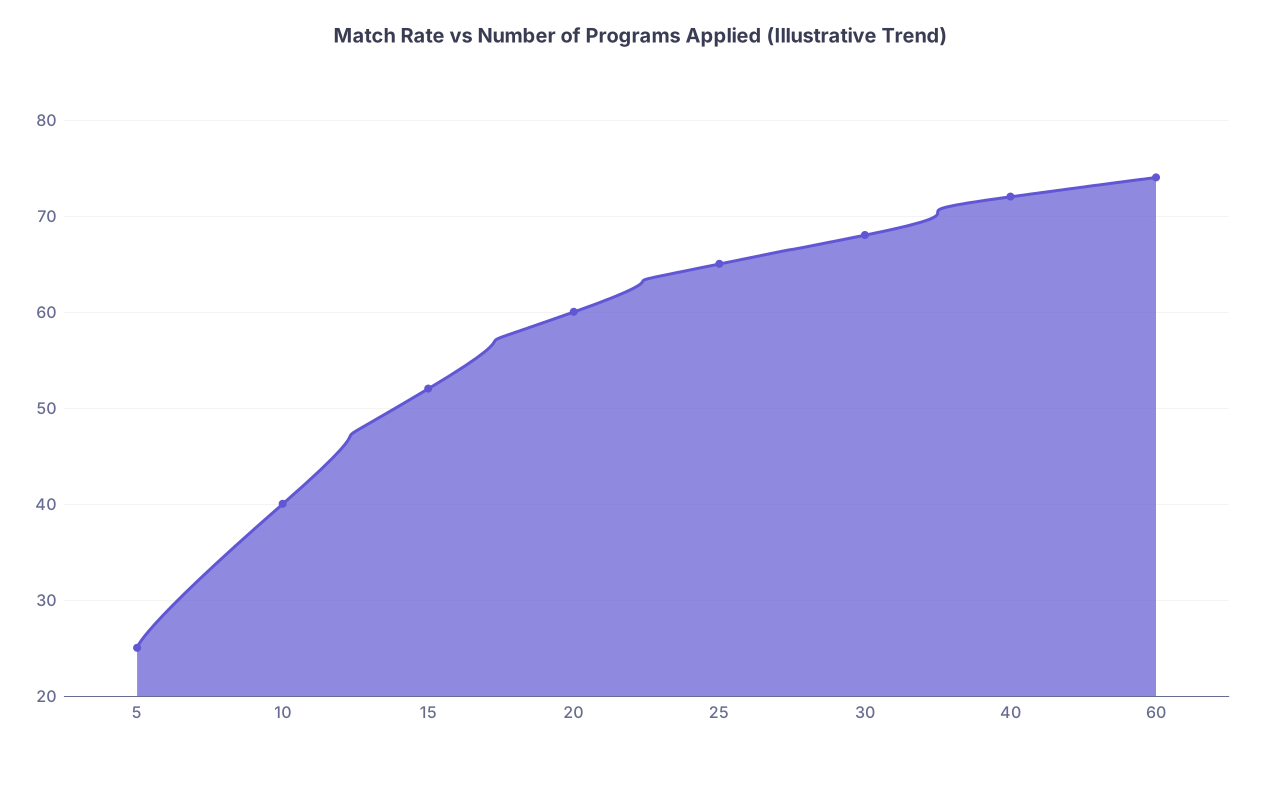
These numbers may seem high, but for a US citizen IMG, especially one targeting a niche field, widening your net in categorical IM and psych is often critical for matching safely.
Key principle:
Do not sacrifice broad categorical coverage in hopes of forcing a med‑psych outcome. You can still build a med‑psych career through categorical training.
3.3 Balancing Financial Reality and Match Probability
Every application costs money. To reconcile how many programs to apply with your budget:
- Prioritize combined med‑psych programs first (this is your dream track).
- Next, identify IMG‑friendly categorical internal medicine programs with:
- Documented history of accepting IMGs.
- Reasonable USMLE expectations matching your score.
- Locations where you would realistically live.
- Then, add IMG‑friendly categorical psychiatry programs with:
- Openness to IMGs.
- Strong CL psych or integrated care components.
If your budget is limited:
- Consider scaling back slightly in categorical psych or IM, but avoid dropping below ~40–50 total programs unless you are exceptionally strong.
- Speak with mentors or advisors to prioritize quality and fit (not just quantity).
Step 4: Build a Targeted, Tiered List of Programs
Once you have a rough sense of how many programs to apply to, you need to decide which specific programs belong on your list.
A structured program selection strategy uses a tiered approach:
4.1 Define Your Tiers
For each category (med‑psych, categorical IM, categorical psych), classify programs as:
- Reach:
Programs where:- Average scores are clearly higher than yours
- They have limited or no IMG history
- They are highly competitive academic centers
- Realistic/Core:
Programs where:- Your scores and profile are near or slightly below their typical range
- They regularly take US citizen IMGs or international grads
- Safety:
Programs where:- Many IMGs match each year
- Score expectations are clearly within your range or lower
- They are community-focused or less competitive geographies
Aim for a healthy mix in each category:
- Med‑Psych:
- Some reach (if you are passionate about them)
- Many realistic/core
- Some somewhat “safer” among the combined programs (if any)
- Categorical IM & Psych:
- The bulk of your list should be realistic/core and safe, with a smaller number of reach programs.
4.2 Analyze Programs Through the Lens of a US Citizen IMG
For each program, look at:
IMG Friendliness
- Check program websites and match lists.
- Use forums and unofficial spreadsheets (with caution) to see IMG history.
- As a US citizen IMG, prioritize programs that:
- Explicitly say they consider IMGs
- List current or recent IMG residents
- Absence of IMG residents in a small program may be a warning sign, but not absolute.
Visa Policies
- While you do not need a visa, programs that sponsor J‑1 or H‑1B are often accustomed to IMGs and may be more open to non‑US grads in general.
USMLE and Application Requirements
- Minimum Step 2 CK score if listed.
- Policies on attempts/failures.
- Maximum years since graduation.
Clinical Emphasis and Training Style
- For med‑psych combined:
- How is time split between IM and psych?
- Is there strong consultation-liaison training?
- Are there integrated care clinics, VA, or safety-net sites?
- For categorical IM:
- Is there a robust psychiatry consultation team?
- Do they have med‑psych units or integrated care tracks?
- For categorical psych:
- Strength of CL psychiatry and medically complex populations.
- Any med‑psych elective rotations or dual interests among faculty.
- For med‑psych combined:
Geography and Ties
- Highlight states where you have:
- Family
- Previous education or work
- Long-term plans to live
- Programs often prefer residents with some geographic commitment.
- Highlight states where you have:
Action item:
Build a spreadsheet with columns such as:
- Program name
- Combined / IM / Psych
- City, state
- IMG‑friendly? (Y/N/Unknown)
- US citizen IMG or IMG residents currently listed?
- Step requirements
- Your tier: Reach / Realistic / Safety
- Geographic ties (Yes/No; specify)
- Notes on med‑psych relevance

Step 5: Practical Tactics to Strengthen Your Program Selection Strategy
Beyond deciding where and how many programs to apply to, you can actively improve how programs perceive your fit, which in turn influences your interview yield and rank list strength.
5.1 Tailor Your Personal Statement Strategy
For medicine-psychiatry combined programs, consider:
- A primary med‑psych personal statement emphasizing:
- Why you are drawn to the intersection of medicine and psychiatry.
- Specific experiences treating medically and psychiatrically complex patients.
- Your long-term vision (e.g., CL psychiatry, integrated care, academic med‑psych).
For categorical IM and psych:
- You may write:
- A more internal-medicine-focused statement emphasizing psychosomatic/behavioral health interest.
- A psychiatry-focused statement emphasizing your comfort with medical comorbidities and CL exposure.
Use ERAS settings to assign the appropriate statement to each program type.
5.2 Communicate Geographical and Program-Specific Interest
When reasonable, consider:
- Brief, professional emails to programs where:
- You have strong geographic ties.
- You have a particularly good fit with their model (e.g., strong CL psych, integrated primary care).
In such emails:
- Reaffirm that as a US citizen IMG, you do not require visa sponsorship.
- Note specific aspects of the program that align with your background and goals.
- Be concise, respectful, and avoid repeated follow‑ups.
5.3 Leverage Mentors and Networks
As an American studying abroad, your med school may have:
- Alumni who matched into:
- Medicine-psychiatry
- Internal medicine
- Psychiatry
- US faculty who completed training in the US.
Ask mentors to:
- Review your program list for realism.
- Suggest IMG-friendly programs within your target regions.
- Write personalized, detail-rich letters of recommendation where appropriate.
5.4 Adjusting Your Strategy In-Season
As interviews roll in (or don’t):
- Track:
- Number of med‑psych interviews
- Number of IM interviews
- Number of psych interviews
- If by mid-late October you have very few interviews, consider:
- Improving your application (e.g., update letter, new experience).
- Reaching out to additional “safety” categorical programs if they are still reviewing applications.
- If you have more interviews than you can handle:
- Prioritize combined med‑psych interviews.
- Among categorical programs, prefer those with stronger med‑psych or CL alignment.
Step 6: Ranking Strategy with a Med-Psych Focus
Once interviews are done, your match outcome will depend heavily on how you rank programs, not just where you applied.
Key principles for a US citizen IMG passionate about medicine-psychiatry:
Rank all med‑psych combined programs you would truly be willing to attend above your categorical options.
- If your life goal is dual training and you can genuinely see yourself at all those combined programs, let the algorithm work in your favor.
Rank categorical IM and psych programs where you felt most supported and aligned with med‑psych goals higher in their respective lists.
Do not “overthink” gaming the algorithm.
- Rank programs in your true order of preference.
- The NRMP algorithm already favors the applicant’s preferences.
Be realistic about match safety.
- Include a sufficient number of categorical programs on your rank lists.
- Even if you don’t match into med‑psych, a strong categorical IM or psych match can still support a med‑psych career trajectory.
Putting It All Together: Example Strategy for a US Citizen IMG Applicant
Imagine a US citizen IMG who:
- Finished medical school 1 year ago at an overseas English-language school.
- Step 1: Pass on first attempt (pre-pass/fail scoring was modest).
- Step 2 CK: 238.
- 2 months of USCE in internal medicine, 1 month in psychiatry.
- Strong LORs from a US IM attending and a US psychiatrist.
- Significant interest and experiences in CL psychiatry and chronic disease management.
A reasonable program selection strategy might look like:
- Med‑Psych combined: Apply to all 15–18 ACGME-accredited programs (if that is the number in that cycle).
- Categorical Internal Medicine:
- Apply to 40–55 programs, focusing on:
- Mid‑tier academic and community programs in IMG-friendly states.
- Programs with robust CL psych or integrated care.
- Apply to 40–55 programs, focusing on:
- Categorical Psychiatry:
- Apply to 25–40 programs with:
- CL psychiatry strength
- Openness to IMGs
- Reasonable expectations for Step 2 in the 230–240 range.
- Apply to 25–40 programs with:
Total applications: Approximately 80–110.
They would:
- Use a med‑psych-focused personal statement for combined programs.
- Write slightly tailored PSs for IM and psych categorical applications, highlighting the med‑psych angle.
- Build a tiered list with visual markers of:
- IMG-friendliness
- Geographical ties
- Med‑psych and CL strengths.
Result: A balanced approach, maximizing chances to match somewhere while still giving med‑psych the best possible shot.
FAQs: Program Selection Strategy for US Citizen IMG in Medicine-Psychiatry
1. As a US citizen IMG, do I still need to worry about IMG-friendly programs if I don’t need a visa?
Yes. Visa issues are only one barrier. Many programs still prefer US MD/DO graduates because of familiarity with training systems, perceived exam reliability, and prior experience. Being a US citizen helps, but you should still prioritize programs with a track record of taking IMGs.
2. Should I only apply to medicine-psychiatry combined programs if that’s my dream?
No. Even if your dream is medicine-psychiatry combined, you should apply to categorical internal medicine and psychiatry programs as well. These provide safer options and still allow you to pursue a med‑psych-style career (e.g., CL psychiatry, integrated care). Limiting yourself only to combined programs greatly increases your risk of going unmatched.
3. How do I decide how many med-psych vs. categorical programs to apply to?
Start by planning to apply to nearly all med‑psych combined programs that are not clearly off-limits. Then, based on your Step 2 CK score, graduation year, and USCE, build a robust categorical list:
- Stronger profiles: ~60–90 total programs (combined + categorical).
- Moderate profiles: ~75–120 total programs.
- More challenging profiles: ~100–150+ total programs.
Adjust based on your budget and advisor input, but avoid cutting too deeply into categorical applications.
4. Can I still build a medicine-psychiatry focused career if I match only into internal medicine or only psychiatry?
Yes. Many physicians effectively practice “med‑psych” through:
- Consultation-liaison psychiatry fellowship after general psychiatry.
- Working in integrated primary care, collaborative care, or behavioral health integration.
- Becoming an internal medicine hospitalist or outpatient physician with a focus on serious mental illness and comorbid medical conditions.
- Joining VA or safety-net systems where med‑psych complexity is high.
A combined medicine-psychiatry residency is a direct route to dual board eligibility, but not the only path to a med‑psych career identity.
By approaching your applications with a deliberate program selection strategy—grounded in honest self-assessment, realistic understanding of the medicine-psychiatry combined landscape, and a smart balance of combined and categorical options—you significantly improve your chances of both matching and building the med‑psych career you envision as a US citizen IMG.