Understanding the Unique Landscape of Vascular Surgery Residency
Vascular surgery is a small, highly specialized field with a limited number of training spots, a relatively small faculty pool, and high expectations for technical skill and academic potential. For an MD graduate residency applicant from an allopathic medical school, getting the program selection strategy right is critical—not only for matching, but for shaping your long‑term career.
Before you decide how many programs to apply to or which ones to prioritize, you need to understand the structure of vascular training pathways and how they differ.
Integrated vs. Traditional Pathways
There are two broad paths to becoming a vascular surgeon in the United States:
Integrated Vascular Surgery Residency (0+5 Program)
- Match directly from medical school into a five-year integrated vascular program.
- Includes core surgical training and advanced vascular training in a single continuous curriculum.
- You finish eligible for vascular surgery boards without doing a separate general surgery residency.
- Typically very competitive, with small program sizes (often 1–3 residents per year).
Independent Vascular Fellowship (5+2 Pathway)
- Complete a five-year general surgery residency, then apply for a two-year vascular surgery fellowship.
- Traditional route; still very common but shrinking relative to integrated spots.
- Offers broader general surgery exposure; some applicants prefer this for flexibility.
This article focuses on program selection strategy for MD graduates seeking an integrated vascular surgery residency, but many of the principles apply to future fellowship selection as well.
Why Program Selection Strategy Matters So Much in Vascular Surgery
- Small applicant and program pool: Fewer programs mean each choice matters more. You can’t simply “spray and pray” like in large specialties.
- Narrowed career trajectory: Once you commit to vascular surgery, your path is fairly defined. Program characteristics (e.g., open vs. endovascular volume, research focus) heavily shape your skillset and opportunities.
- High level of mentorship dependency: With small divisions, your attendings will have outsized influence on your training, letters, and future job prospects.
- Geographic and lifestyle implications: Vascular call and case load can be intense; fit with the local system, support staff, and culture is critical for your well‑being.
Your program selection strategy should therefore be deliberate, data-informed, and aligned with your clinical, academic, and personal priorities.
Step 1: Clarify Your Career Goals and Applicant Profile
Before you can decide how to choose residency programs, you must first understand who you are as an applicant and where you want your career to go. This is especially important in a specialized field like vascular surgery.
Define Your Long-Term Career Vision
Ask yourself:
- Do you see yourself in academic vascular surgery (major university hospital, research, teaching)?
- Are you more drawn to community practice with high procedural volume and less research?
- Do you want to focus on:
- Complex open aortic and peripheral surgery?
- Predominantly endovascular and catheter-based interventions?
- A mix, with an emphasis on hybrid skills?
- Are you interested in:
- Clinical research?
- Outcomes or health services research?
- Translational or device-based research?
- How important are:
- Geographic region?
- Proximity to family or partner?
- Lifestyle considerations (call structure, clinic vs. OR balance)?
This reflection determines whether you should prioritize:
- Tertiary academic centers vs. robust community-based academic hybrids
- Programs known for high aneurysm and complex open volume vs. “endovascular-heavy” sites
- Programs with track records of NIH funding, publications, or fellowships for graduates
Honestly Assess Your Competitiveness
As an MD graduate residency applicant from an allopathic medical school, you have some advantages (access to home vascular faculty, likely robust letters), but competitiveness varies widely.
Consider these components:
- USMLE Step 1 (if numeric) and Step 2 CK
- Clerkship grades, especially surgery and sub-internships
- Subspecialty vascular surgery rotations
- Letters of recommendation—particularly from vascular surgeons
- Research productivity:
- Vascular or surgical research?
- Abstracts, presentations, publications?
- Away rotations (sub-Is) in vascular surgery
- Any red flags:
- Leave of absence
- Failed step or shelf exam
- Professionalism concerns
Create a realistic self-categorization:
- Highly competitive:
- Strong Step 2 CK, honors in surgery, multiple vascular publications or presentations, glowing letters from known vascular faculty.
- Solid/average:
- Reasonable Step 2, good clinical performance, some research or strong clinical letters, but not nationally known.
- At-risk/less competitive:
- Lower scores, limited exposure to vascular, minimal research, or geographic/visa constraints.
Your profile, combined with your goals, will drive both the caliber and number of programs you should target.
Step 2: Understand the Numbers – How Many Programs to Apply To?
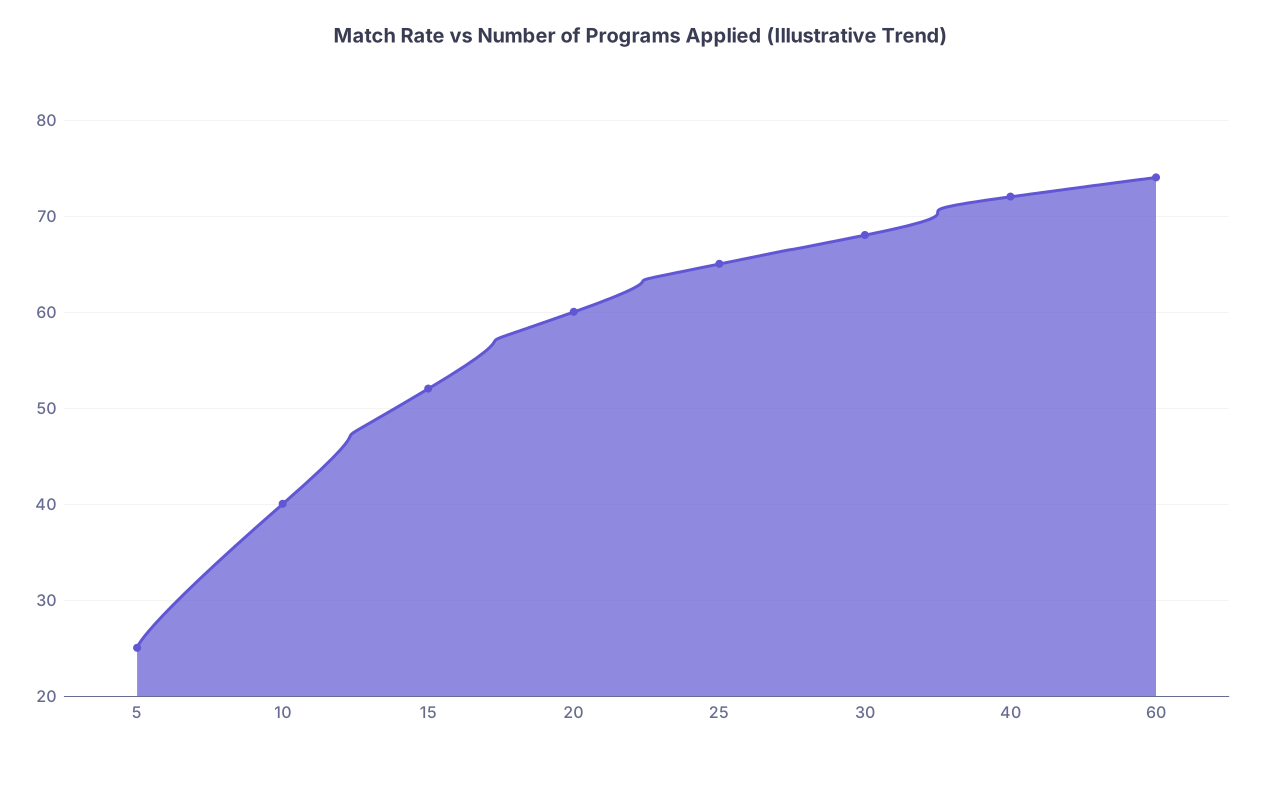
In vascular surgery, “how many programs to apply” to is not a one-size-fits-all answer. But there are patterns and benchmarks derived from NRMP and specialty-specific data.
General Ranges for Integrated Vascular Applicants
For a typical MD graduate from an allopathic medical school applying to an integrated vascular program, approximate ranges often look like:
- Highly Competitive Applicant (top-tier metrics, strong vascular background):
- ~15–20 programs
- Solid/Typical Applicant (no major red flags, average scores, some vascular exposure):
- ~20–30 programs
- At-Risk Applicant (borderline scores, late decision, limited vascular exposure, visa constraints):
- ~30–40+ programs
These are approximations, not rigid rules. You must balance:
- Financial cost (ERAS fees, interview travel/lodging if in-person)
- Time cost (virtual or in-person interviews, time off rotations)
- Diminishing returns (beyond a certain number, extra applications add little value)
Factors That Might Push You Toward a Higher Number
You should lean to the higher end of the range if:
- You have below-average scores or academic concerns.
- You decided on vascular late in medical school, with fewer vascular-specific experiences.
- You don’t have a strong home vascular surgery program.
- You’re restricted to specific geographic regions that have relatively few programs.
- You need visa sponsorship or have other eligibility constraints.
- You’re not dual-applying (e.g., only relying on vascular, not also applying in general surgery).
When You Can Safely Apply to Fewer Programs
You may be comfortable with fewer applications (e.g., 15–20) if most of the following apply:
- Strong application metrics (high Step 2 CK, honors, strong letters).
- Well-known vascular mentors who advocate for you.
- Multiple strong away rotations with anticipated letters.
- Geographic flexibility.
- Demonstrated dedicated interest in vascular surgery (research, society involvement, early exposure).
Dual Application Considerations
Some MD graduates choose to dual-apply (e.g., integrated vascular and categorical general surgery). This changes your program selection strategy:
- You can apply to fewer integrated vascular programs if you have a strong general surgery backup.
- But if vascular is your clear goal, you should still apply widely enough to allopathic medical school match programs in vascular to maximize your chance of at least a few interviews.

Step 3: Building Your Program List – A Structured Approach
Once you have a target range for how many programs to apply to, the next step is deciding which programs deserve a spot on your list. This is where a systematic program selection strategy helps you avoid emotional or anecdotal decisions.
1. Start Broad: Compile a Master List
Use sources such as:
- FREIDA (AMA) for integrated vascular surgery residency listings.
- VSIG and SVS (Society for Vascular Surgery) websites for program directories.
- Your home vascular faculty and recent graduates for informal rankings and impressions.
- Residency Explorer and NRMP data (if available) for competitiveness and outcomes.
Capture for each program:
- Location and region
- Program type: University, hybrid academic-community, standalone community
- Number of residents per year
- Vascular faculty size
- Affiliated hospitals (VA, county, private)
2. Categorize Programs: Reach, Target, and Safety
Use your self-assessment to assign each program into tiers:
- Reach Programs:
- Historically very competitive institutions, top academic centers, or places with extremely small intake (1 resident/year) where the bar is very high.
- Target Programs:
- Programs where your metrics and experiences align with their typical match profiles.
- Safety Programs (as much as this exists in a small specialty):
- Slightly less competitive or more community/regional programs where your application stands out.
Aim for a rough distribution:
- ~25–35% Reach
- ~40–50% Target
- ~20–30% Safety
Example for a solid applicant applying to 25 programs:
- 7–8 Reach
- 11–12 Target
- 5–6 Safety
3. Evaluate Core Training Elements
When deciding how to choose residency programs, prioritize factors that will directly impact your training quality:
Case Volume and Diversity
- Total annual vascular case volume.
- Balance between open and endovascular cases.
- Exposure to:
- Aortic disease (open and EVAR/TEVAR)
- Peripheral arterial disease (bypass, endovascular interventions)
- Carotid disease
- Dialysis access
- Venous disease
- Trauma and emergent cases
- Ask: “Will I be a competent independent vascular surgeon with balanced skills on graduation?”
Early Hands-On Experience
- Do interns and junior residents get meaningful vascular exposure, or is it back-loaded?
- Is there early access to the endovascular suite?
- How much autonomy is granted at senior levels?
Faculty Composition and Mentorship
- Number of vascular surgeons and their specialties.
- Stability of faculty (high turnover is a red flag).
- Reputation of program leadership.
- Accessibility of mentors for research and career planning.
Infrastructure and Technology
- Dedicated hybrid ORs.
- Modern endovascular equipment and device variety.
- Access to advanced imaging, intravascular ultrasound, robotics (if applicable).
4. Consider Academic and Career Development
If you aim for an academic career or advanced subspecialization, weigh:
- Research Opportunities
- Dedicated research time (protected vs. integrated with clinical schedule).
- Types of research: clinical outcomes, device trials, translational, health policy.
- Availability of MPH/MSc/PhD options.
- Track Record of Graduates
- Where do alumni work?
- Academic centers vs. community practices.
- Do graduates secure competitive fellowships (if integrated residents pursue extras like complex aortic or endovascular fellowships)?
- Where do alumni work?
- Society Involvement
- Does the program encourage presentations at SVS, regional vascular meetings?
- Are faculty leaders in the field (guideline committees, editorial boards)?
5. Integrate Personal and Lifestyle Factors
Even for an intensely demanding specialty like vascular surgery, your personal life matters:
- Geography
- Proximity to family or partner’s job prospects.
- Preference for urban vs. suburban vs. smaller city settings.
- Climate considerations (may affect well-being).
- Call Structure and Workload
- Frequency of in-house vs. home call.
- Support staff (advanced practice providers, night coverage).
- Volume of emergencies (ruptured aneurysms, acute limb ischemia) that may affect sleep and burnout.
- Program Culture
- Collegiality among residents.
- Relationship between vascular and other surgical services.
- Support for wellness and mental health.
Use these criteria to rank and filter your master list into a realistic, targeted set of programs to which you will actually apply.
Step 4: Refining Your Strategy with Data and Mentorship
An effective program selection strategy integrates objective data, your preferences, and the wisdom of those who know the field well.
Use Objective Tools—and Know Their Limits
- FREIDA and Program Websites: Helpful for baseline information, but may be outdated.
- Residency Explorer: When available, helps you compare your metrics to matched cohorts.
- NRMP and SVS Data:
- Integrated vascular match statistics.
- Average number of applications, interviews, and programs ranked for successful matches.
- Scutwork, Reddit, and Forums:
- Can provide insider perspectives but are highly anecdotal.
- Use to generate questions, not to make final decisions.
Leverage Mentors Strategically
Your vascular surgery mentors are among your most powerful assets:
Schedule deliberate conversations:
- Ask where graduates with similar profiles successfully matched.
- Ask which programs they consider “hidden gems” or overrated.
- Ask whether they can personally contact program directors on your behalf at select places.
Share your:
- USMLE scores
- Class rank and clerkship grades
- CV and research output
- Geographic preferences
Then ask directly:
- “Given my profile, how many integrated vascular programs do you think I should apply to?”
- “Which 5–10 programs would you personally recommend as high-priority targets for me?”
Incorporate Feedback from Away Rotations
If you complete vascular surgery sub-internships (away rotations):
- Honest self-evaluation:
- Did you receive strong informal feedback?
- Did residents and attendings seem excited to work with you?
- Signals from faculty:
- Explicit comments like, “We’d love to see you apply here” are meaningful.
- Ask, respectfully, whether they’d be willing to write a strong letter and potentially advocate for you.
Programs where you’ve rotated and thrived should be high-priority on your application list and eventual rank list.

Step 5: Finalizing Your Application Portfolio and Adapting in Real Time
Once you have a curated program list and a clear sense of how many programs to apply to, you need to think about execution and flexibility.
Structuring Your ERAS Application Strategy
Core Application Quality First
- Strong personal statement tailored to vascular surgery.
- CV that clearly highlights vascular-relevant experiences.
- Polished, error-free application.
Thoughtful Program-Specific Signaling (If Available)
- Some application cycles provide formal signaling tokens; otherwise, use:
- Targeted emails expressing genuine interest.
- Consistent connections through mentors or interest groups.
- Reserve your strongest expressions of interest for:
- Programs that best fit your career goals.
- Programs where your mentors have influence.
- Some application cycles provide formal signaling tokens; otherwise, use:
Align with Personal Constraints
- If you have strict geographic limitations (e.g., family obligations, partner match), apply to a greater number of programs within that region to compensate for the smaller pool.
Adapting Based on Interview Offers
Your initial program selection strategy is only the starting point. You must be prepared to adjust as the season unfolds.
If you receive many interview offers early:
- You may cancel interviews at programs that are clear poor fits (politely, and with adequate notice).
- Focus on programs where you could realistically see yourself thriving.
If you receive fewer interview offers than expected:
- Communicate with your mentors immediately.
- Consider:
- Reaching out to specific programs to express interest.
- Strengthening ongoing research, seeking extra letters, or highlighting recent achievements.
- In rare cases, consider adding a small number of additional applications (if the timeline allows and ERAS is still open).
Ranking Strategy Preview
Although ranking is a separate step, your program selection strategy should anticipate the future:
- You want to interview at enough programs to confidently rank 10–12 or more programs, if possible, to maximize your match probability.
- The main driver of your rank list should be:
- Quality and breadth of training
- Culture and mentorship fit
- Personal and geographic fit
- Reputation matters, but no “big name” is worth six years of poor training fit or toxic culture.
Practical Examples: Applying Strategy to Different Applicant Profiles
To make this more concrete, here are examples of how MD graduates might implement a program selection strategy for an integrated vascular program.
Example 1: Strong Academic Applicant with Geographic Flexibility
- Top 15% of class, Step 2 CK well above national average.
- 3 vascular-related publications, 2 national presentations.
- Excellent letters from home vascular division and one away rotation.
- Open to training anywhere in the country.
Strategy:
- Apply to ~20 programs:
- 7–8 high-powered academic centers (reach).
- 8–10 strong university-based programs (target).
- 3–5 regional or smaller programs (safety).
- Prioritize programs with:
- Dedicated research time.
- High caseload and strong alumni academic placement.
- Use mentors to signal interest to top 3–5 programs.
Example 2: Solid Applicant with Strong Geographic Constraint
- Average Step 2 CK, good clinical performance.
- Limited vascular research but strong interest and exposure.
- Needs to stay in the Midwest due to family.
Strategy:
- Identify all integrated vascular programs in the Midwest and neighboring regions.
- Apply to ~25–30 programs:
- All programs within desired region, plus some in adjacent areas as a buffer.
- Include a mixture of:
- Academic centers.
- Combined general/vascular programs or hybrid settings.
- Consider dual-applying to general surgery in the same region as a safety net.
Example 3: At-Risk Applicant with Late Decision
- Step 2 slightly below average, no early vascular exposure.
- Realized interest in vascular during late MS3; one away rotation planned.
- From an allopathic medical school without a strong home vascular program.
Strategy:
- Apply to ~30–40 programs, leaning toward:
- Mid-tier and community-affiliated programs.
- Regions with more programs (e.g., Northeast, Southeast).
- Prioritize:
- Strong clinical fit and supportive culture over brand-name prestige.
- Meet early with faculty at home institution and away rotation for candid feedback and targeted advocacy.
- Strongly consider dual-applying in general surgery.
Frequently Asked Questions (FAQ)
1. As an MD graduate from an allopathic medical school, do I have an advantage in the integrated vascular match?
Generally, yes. Allopathic MD graduates tend to have:
- Greater access to home vascular surgery divisions.
- More opportunities for vascular-specific research and mentorship.
- Familiarity among program directors with your curriculum and evaluation system.
However, vascular surgery remains highly competitive, and your individual metrics, letters, and experiences still matter more than degree type alone.
2. How early should I start planning my program selection strategy for vascular surgery?
Ideally, start in your third year, when you complete your core surgery rotation:
- Identify your interest in vascular surgery.
- Seek vascular mentors and research projects.
- Schedule vascular electives and potential away rotations for late MS3 or early MS4.
- By early MS4, you should have:
- A preliminary program list.
- A sense of how many programs to apply to.
- At least one strong vascular letter in progress.
3. Should I prioritize program reputation or case volume when choosing vascular surgery residencies?
Both matter, but case volume and quality of training should generally come first. A highly reputable program with low case volume or limited autonomy may not prepare you as well as a slightly lesser-known institution with:
- High open and endovascular volume,
- Strong hands-on experience,
- Supportive mentorship.
Reputation can aid academic job searches, but your technical competence, references, and overall training experience are more important in the long run.
4. Is it risky to apply only to integrated vascular programs without a backup specialty?
Yes, it carries risk, especially if you have:
- Below-average exam scores or academic concerns,
- Limited vascular exposure or research,
- Narrow geographic restrictions.
If your application is not clearly strong for integrated vascular surgery, many advisors recommend dual-applying (e.g., to categorical general surgery) to protect your ability to eventually pursue vascular—either through fellowship or a later transition.
By carefully aligning your program selection strategy with your goals, honest self-assessment, objective data, and mentor guidance, you can construct a smart, targeted application portfolio for vascular surgery. For MD graduate residency applicants in this small but demanding specialty, deliberate planning about which programs to choose and how many programs to apply to can make the difference between an uncertain cycle and a successful match into a program that truly fits your vision of a vascular surgery career.