The biggest myth about residency is that your first specialty choice is permanent. It is not. Especially as an IMG, you must treat your first match as a step, not a life sentence.
If you are an international medical graduate stuck in the wrong specialty or seriously thinking about switching, you are not alone and you are not doomed. I have watched IMGs move from prelim surgery to anesthesia, from family medicine to radiology, from pathology to internal medicine. The transitions were not easy, but they were absolutely possible—and predictable once you know the patterns.
This is the playbook: how to think about changing specialties as an IMG, and how to find programs that are flexible, humane, and actually willing to help you pivot instead of trap you.
1. The Hard Truth: What You Are Up Against
Let me be blunt for a moment.
Program directors are not sitting around thinking, “How can we help IMGs change specialties?” They are thinking:
- Will this person stay and finish our program?
- Are they going to leave us with an unfilled spot?
- Are they going to be a problem resident?
That is the default suspicion, especially toward someone saying, “I matched into X, but I actually want Y.”
So you have two jobs:
- Do excellent work where you are right now so you look reliable.
- Target programs and pathways that are known to be flexible instead of trying to force a switch in a rigid environment.
There is a reason some programs have multiple residents who came in as transfers, or who started in one thing and ended up in another. They have a culture for it and leadership that does not panic when residents change direction.
Your leverage is not your dream. Your leverage is:
- Your performance
- Your letters
- Your timing
- Your ability to find and approach the right programs
You fix this by being strategic, not desperate.
2. Know Which Specialties and Tracks Are Actually Flexible
Not all specialties treat switchers equally. Some fields are much more open to residents changing into them, especially if you bring strong performance from another program.
More flexible targets (realistic for IMG switchers)
Internal Medicine (Categorical)
The workhorse pathway for a lot of IMG transitions.
Programs often:- Need upper-levels due to attrition
- Respect prior clinical experience (even from another specialty)
- Are used to onboarding transfers
Family Medicine Often IMG-friendly to begin with, with PDs who are more used to atypical paths:
- More forgiving of non-linear careers
- Frequently fill late-cycle spots
- Value continuity and communication skills over “perfect” CVs
Psychiatry Increasingly friendly to IMGs, especially at community programs:
- Will sometimes accept residents who started in IM or FM
- Appreciate maturity and life experience
- More willing to look beyond raw board scores once you are a resident
Pathology Underfilled in some regions:
- Academic and community programs sometimes have mid-year empty PGY-2 spots
- Prior clinical training can help but is not mandatory
Neurology (especially categorical IM+Neuro setups) Often will consider residents with some IM training:
- Many PGY-2 spots
- Open to transfers from IM or prelims
Less flexible (not impossible, but harder as an IMG switcher)
- Dermatology
- Ophthalmology
- Neurosurgery
- Plastic surgery
- Orthopedic surgery
- ENT
These fields are brutally competitive for fresh US grads. Switching into them as an IMG is possible but extremely rare, usually requiring:
- Elite research
- Strong US connections
- A PD going to bat for you aggressively
If you are an IMG trying to leave these for something else? That is far more realistic.
3. The Programs You Actually Want: What “Flexible and Supportive” Really Looks Like
Do not waste your time on programs that barely tolerate IMGs in the first place. You are looking for specific traits.
Core features of IMG-friendly, flexible programs
Documented history of accepting transfers
You want actual evidence:- Web pages mentioning “we consider transfer applicants”
- Resident bios like “completed a preliminary year in surgery at X”
- Alumni who transitioned from one specialty to another
Size and redundancy
- Mid-to-large programs (≥ 6 residents per year) handle attrition better
- Multi-hospital systems often have more slack and more opportunities
High IMG proportion If half the residents sound like they are from Caribbean schools, India, Pakistan, Eastern Europe, the Middle East, etc., that is not an accident. It usually means:
- PD is comfortable with visas and non-traditional paths
- Administration has already bought into IMGs
Non-toxic culture You want:
- Reasonable duty hours actually enforced
- Leadership that meets residents regularly and listens
- Minimal gossip about “that resident who tried to leave…”
Visa experience For non-US citizens, this is non-negotiable:
- Programs that routinely sponsor J-1 or H-1B
- GME office that actually understands transfer and visa timing
Where to find the data
Use these tools:
- FREIDA (AMA) – Filter by:
- IMG percentage
- Visa sponsorship
- Program size
- NRMP “Charting Outcomes in the Match” / Program director surveys – To see where IMGs match
- Program websites – Look at:
- Current residents
- Alumni paths
- Any mention of transfers or off-cycle positions
| Signal Type | Strong Positive Sign |
|---|---|
| Website content | States “we accept transfer residents” |
| Resident roster | Multiple IMGs, some with prior training |
| Program size | 6+ residents per PGY level |
| Visa experience | Explicitly lists J-1 and/or H-1B supported |
| Culture signals | Emphasis on wellness, mentoring, remediation |
If a program:
- Has one IMG buried in a sea of US MD graduates
- Never mentions visas
- Has rigid academic reputation with zero transfer history
You can still apply, but do not count on them as your primary lifeboat.
4. Timing: When To Move and When To Keep Your Head Down
You cannot just wake up in April of PGY-1 and decide to jump ship without consequences. Timing is everything.
Common transition windows
Early PGY-1 (first 3–4 months)
This is the “Oh no, I made a huge mistake” window.
Risk: PDs may see you as unstable.
Use this window only if:- The environment is abusive or unsafe
- The specialty mismatch is severe and obvious
- You already have strong contacts in the target field
Late PGY-1 to early PGY-2
This is the most common and most defensible time to switch:- You have:
- Evaluations
- Real letters
- Some credibility
- Programs often have attrition around PGY-2 that creates openings
- You have:
After finishing an entire program (e.g., IM → fellowship or second residency)
This is the “complete one thing, pivot to another” strategy:- Finish internal medicine
- Then:
- Apply to another residency (e.g., radiology)
- Or fellowship that changes your practice (e.g., cardiology, critical care)
A simple decision flow

| Step | Description |
|---|---|
| Step 1 | Unhappy in current specialty |
| Step 2 | Prioritize exiting program safely |
| Step 3 | Research target fields and programs |
| Step 4 | Seek transfer within same specialty |
| Step 5 | Stay, build record, avoid conflict |
| Step 6 | Quietly contact target PDs about off cycle spots |
| Step 7 | Apply with PD/mentor support |
| Step 8 | Is it abuse or unsafe? |
| Step 9 | Is change specialty or change program? |
| Step 10 | Have 6-12 months of strong evaluations? |
If your situation is toxic or unsafe, your priority is survival and documentation, not perfect strategy. Different conversation. But for most residents, the smarter play is: stay functional, work hard, collect proof you are excellent, then move.
5. Concrete Steps: How To Plan and Execute a Specialty Change
Let us walk this as a protocol.
Step 1: Get brutally clear on your “why”
Vague dissatisfaction is not enough. You must be able to explain your switch in 2–3 clean sentences.
Bad:
- “I realized I do not like surgery that much and the hours are too hard.”
Better:
- “During my preliminary surgery year, I found that I was consistently more engaged with the perioperative medical management, ICU decision-making, and complex medical optimization than with the operative portions. After discussing with multiple mentors, I recognized that my strengths and long-term career goals align better with internal medicine and critical care than with a purely procedural surgical path.”
That is a story a PD can work with.
Step 2: Quietly stabilize your current performance
Before you start sending emails to other programs:
- Fix your evaluations
- Avoid conflict with your current PD
- Do not:
- Complain constantly
- Announce widely that you are leaving
- Burn bridges with nursing or co-residents
You want:
- “Hard worker, reliable, gets along with the team, strong knowledge base”
Not: - “Always talking about leaving. Distracting. Uncommitted.”
Step 3: Build targeted relationships in your desired field
You cannot switch specialties in a vacuum. You need people in the target field who can say:
- “This person would be an asset in IM/psych/FM/etc.”
Ways to do this:
- Elective rotations in the target specialty:
- As early as possible: schedule IM or psych electives if you are thinking of those
- Find a faculty mentor in the target specialty:
- Ask for:
- Career advice
- Reading lists
- QI or research projects
- Ask for:
- Volunteer for:
- Case presentations
- Teaching sessions
- Small QI tasks on those services
You are trying to create at least one strong letter writer in the new specialty.
Step 4: Identify realistic target programs
Target programs with:
- History of transfers
- High IMG percentage
- Open stance on visas (if needed)
- Not top 10–20 elite brand names (you are stacking odds, not chasing prestige)
Use three tiers:
- “Probable” programs:
- Community or university-affiliated IM/FM/psych with many IMGs
- “Reach but plausible”:
- University programs with IMG history, moderate competitiveness
- “Long shot”:
- Better-known university programs with some IMGs and occasional transfers
Build a spreadsheet. Track:
- Program
- Specialty
- IMG %
- Visa type
- Residents with prior training
- Contact dates and responses
6. Contacting Programs Without Torching Your Current Position
The actual outreach is where a lot of IMGs blow it.
They either send desperate mass emails or they tell their PD they are leaving before they have any real options. Both are mistakes.
How to write the first email to a target PD or coordinator
Key points:
- Keep it short
- Be specific
- Signal that you are stable and performing well
- Do not trash your current program
Sample structure:
Who you are:
- Current PGY level
- Current specialty and institution
- Visa status
What you want:
- A categorical PGY-1 or PGY-2 spot in X specialty
- Off-cycle or next-match cycle
Why you are switching:
- Brief, professional explanation (no drama)
Why their program:
- One or two specific reasons
Attach:
- CV
- USMLE/COMLEX scores
- Brief statement that letters can be provided upon request
Example (trim this to your own style, but keep the bones):
Subject: Inquiry about potential PGY-2 opening in Internal Medicine
Dear Dr. [PD Last Name],
I am a current PGY-1 preliminary general surgery resident at [Hospital/Program], on a J-1 visa, and I am writing to inquire whether your program anticipates any off-cycle PGY-2 internal medicine openings for the upcoming year.
Over the past several months, my clinical interests and strengths have clearly aligned with internal medicine and critical care rather than with an operative career. I have consistently enjoyed and excelled in the perioperative medical management, ICU rotations, and complex inpatient care aspects of my training. With guidance from mentors in both surgery and medicine, I am seeking a transfer into a categorical internal medicine position.
I am in good standing at my current program with strong evaluations and would be happy to provide letters of recommendation from my current PD and from internal medicine faculty. My CV and score report are attached for your reference.
If your program has or expects any openings, I would be very grateful for the opportunity to speak with you or your coordinator about whether I might be a fit.
Sincerely,
[Name], MD
Current PGY-1 Preliminary Surgery
[Institution]
[Contact info]
That is it. Clean, calm, no drama.
When to involve your current PD
You involve them:
- When a program expresses serious interest
- Or when your letter becomes necessary
Not when:
- You are just thinking about it
- You are cold-emailing programs with no responses
Once there is a real possibility:
- Schedule a meeting
- Be respectful and direct:
- “I am grateful for the opportunity here. Over this year, I have realized my long-term fit is in X for [reasons]. A program in X has encouraged me to apply for a categorical position. I intend to complete the current year with full commitment, but I wanted to be transparent and request your honest support with a letter, if you feel you can provide one.”
Some PDs will help. Some will not. Document everything, stay professional.
7. Data Reality: Where IMGs Actually Have Flexibility
Let us ground this in realistic patterns rather than fantasy.
Most IMG specialty switches I have seen succeed fell into a few buckets:
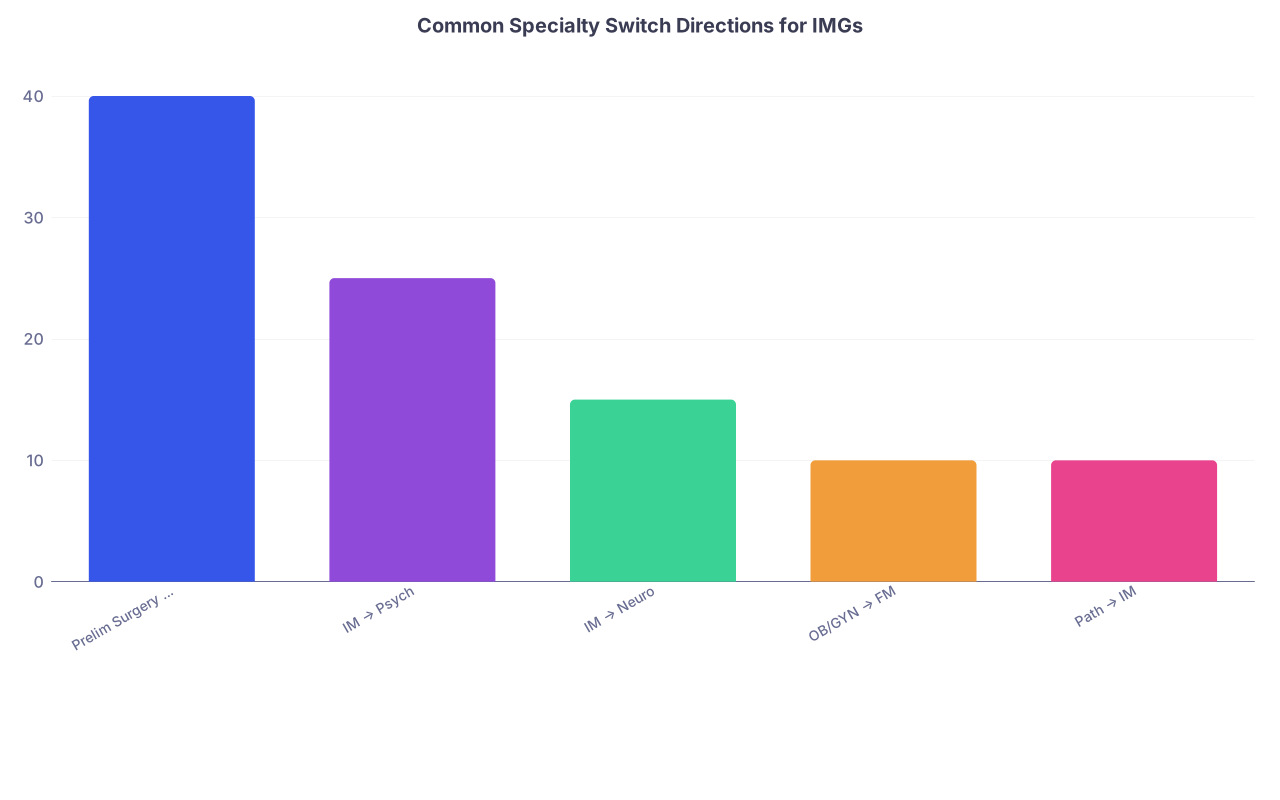
| Category | Value |
|---|---|
| Prelim Surgery → IM | 40 |
| IM → Psych | 25 |
| IM → Neuro | 15 |
| OB/GYN → FM | 10 |
| Path → IM | 10 |
Interpretation:
Prelim Surgery → IM is by far the classic switch:
- Prelim programs are often understood as “audition” or “holding” years
- IM programs like the work ethic and procedural exposure
IM → Psych/Neuro:
- Residents discover they are more interested in CNS/behavior than multi-system management
- Psych and neuro PDs respect IM-based reasoning
OB/GYN → FM and Path → IM are less common but very real:
- Lifestyle and personality fit drives most of these
Do IMGs change from FM to radiology? Rarely. From IM to derm? Almost never. Focus on the lanes where precedent exists.
8. Special Case: Visa-Holding IMGs Changing Specialties
This is where it gets complicated.
J-1 or H-1B does not make it impossible, but it shrinks your options and requires more planning.
J-1 visa (ECFMG sponsored)
- You must:
- Stay in ACGME-accredited training
- Not violate the terms (full-time training, etc.)
- Transfers:
- Require:
- Release from current program
- Acceptance by new program
- Coordination through ECFMG / GME offices
- Require:
You need:
- A receiving program that:
- Knows how to handle J-1 transfers
- Is willing to do the paperwork
- Clear timing:
- Ideally aligning your PGY levels so there is no large gap
H-1B visa
More restrictive:
- Specialty and site specific
- New residency = new H-1B petition
- Some programs:
- Flat out refuse to deal with H-1B transfers for mid-residency switches
This is where IMG-friendly programs with strong GME infrastructure matter. You want:
- Larger institutions with:
- Dedicated visa offices
- Prior experience with such moves
9. Red Flags: Programs That Will Fight Your Switch
You are not only choosing where to go. You are managing where you are.
Some programs will make your life miserable if they sense you are leaving.
Warning signs:
- PD frequently says things like:
- “No one leaves this program unless I say so.”
- “If someone is not committed, we will make sure other programs know.”
- Multiple residents quietly warn you:
- “Be careful what you say in PD meetings.”
- High attrition with:
- Ugly stories
- Litigation
- People “disappearing” from the website mid-year
In these environments:
- Document everything
- Keep communication factual and minimal
- Build your network outside the program
- When you do move, stay professional but do not overshare your future plans within the program
10. A Simple, Realistic Game Plan
You do not need a 20-page strategy document. You need a clear sequence.

| Step | Description |
|---|---|
| Step 1 | Decide new specialty |
| Step 2 | Clarify 2-3 sentence reason |
| Step 3 | Optimize performance in current program |
| Step 4 | Find mentors in target specialty |
| Step 5 | Collect at least one strong letter in target field |
| Step 6 | Build list of IMG friendly flexible programs |
| Step 7 | Send targeted inquiry emails to PDs |
| Step 8 | Interview or informal calls |
| Step 9 | When real interest appears, inform current PD |
| Step 10 | Complete current year professionally |
| Step 11 | Start new specialty with clean narrative |
11. One Last Reality Check: Sometimes You Stay And Change From Within
Not every problem is a specialty problem. Some are:
- Toxic attending
- Bad rotation
- Misalignment with one service, not the entire field
Before you blow everything up:
- Talk to:
- A trusted senior resident
- A sane attending
- Someone in your target specialty
Ask directly:
- “Does this sound like the wrong specialty, or just the wrong environment?”
Sometimes the best move is:
- Finish your current residency in a field that is “good enough”
- Shape your career with:
- Fellowships
- Niche practice
- Job choice
I have seen IMGs who hated IM residency but loved palliative care or addiction medicine once they got there. They did not need to start all over.
12. Key Takeaways
- Changing specialties as an IMG is possible, but only if you treat it like a strategic operation, not an emotional reaction.
- Your best allies are: strong current performance, targeted relationships in the new field, and programs with a real track record of supporting IMGs and transfer residents.
- Protect yourself: maintain professionalism where you are, choose your timing carefully, and aim for specialties and programs where the data—and the culture—actually support flexibility.