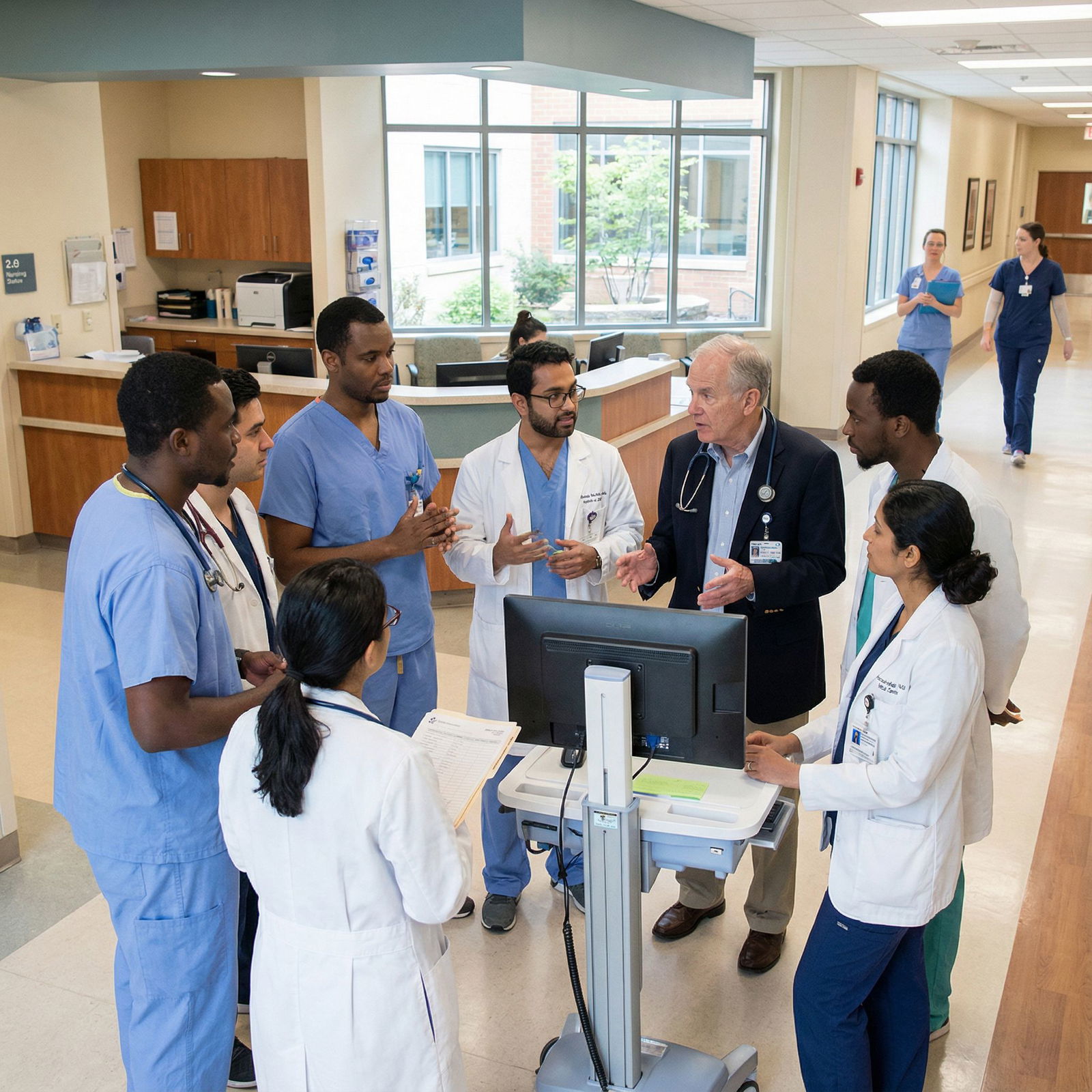
You’re an IMG, looking at residency program lists, and you keep seeing the same labels: “university-based,” “community,” “university-affiliated community.” Your seniors say, “Go academic if you can.” Some attending told you, “Community is better for real-world practice.” You’ve got 30 tabs open and one big question:
Is an academic or community setting actually better for you long-term as an IMG?
Let’s answer that directly, then break it down.
For most IMGs who want solid jobs, a visa, and a stable career, a strong community or hybrid university-affiliated community program is often the best long-term move. Pure academic powerhouses can be great, but they’re not automatically “better” for IMGs—and in some cases, they’re worse for what you actually need.
Now let’s go through the reasoning like an adult, not like a brochure.
1. First: What Do You Actually Want Long-Term?
Before you argue “academic vs community,” you need to be clear on your endgame. The “best” setting depends heavily on this.
Common IMG long-term goals:
- Stay in the US, get a stable job, support family.
- Secure/extend a visa (J-1 waiver / H-1B / later green card).
- Possibly do a fellowship (cards, GI, heme/onc, crit care, etc.).
- Build a career with reasonable pay and manageable hours.
- Maybe some teaching and light research—but not necessarily NIH grants.
Now be honest with yourself:
- If your absolute priority is getting a job and visa quickly and securely → community-heavy path is usually more IMG-friendly.
- If your absolute priority is competitive academic fellowship at a big-name center → you’ll need at least a strong academic component somewhere in your training (residency or fellowship).
But for most IMGs? They want:
- A job
- A visa
- Decent pay
- Some teaching
- Reasonable life
So let’s compare the settings with those realities.
2. Academic vs Community: What Actually Changes for an IMG?
Forget the marketing language. Here’s what usually differs in real life.
| Factor | Academic Program | Community Program |
|---|---|---|
| IMG Friendliness | Often lower | Often higher |
| Visa Sponsorship | Variable, sometimes limited | Often more flexible |
| Research Opportunities | More structured | Limited but possible |
| Fellowship Pipeline | Strong for some specialties | Variable, can be good locally |
| Autonomy & Procedures | Sometimes slower, more layered | Often higher, earlier autonomy |
| Workload | Heavy, complex patients, admin load | Heavy, more service but simpler structure |
Academic programs (university-based)
Pros:
- Better access to formal research, publications, and “name” recognition.
- Home fellowships (cards, GI, heme/onc, pulm/crit, etc.).
- More subspecialty exposure.
- Strong letters from well-known faculty (this can matter a lot).
Cons:
- Often less IMG-friendly. Many top academic IM programs flat-out don’t take IMGs or take 1–2 per class.
- More competition for every opportunity—research, chief positions, fellowships.
- Heavy bureaucracy, endless committees, and sometimes you’re just service labor for the machine.
- Visa policies can be arbitrary and change with leadership.
Community programs
Pros:
- Many are built on IMG labor. They know you, they rely on you, they fight for your visas.
- More autonomy, earlier. You actually manage your patients, not just present them.
- Often excellent procedural experience.
- Very strong for hospitalist/nocturnist careers and local job networks.
- Attendings often know local hospital admins and private groups who hire.
Cons:
- Research is often weak/optional, sometimes almost nonexistent.
- Less “brand name” on your CV.
- May not have in-house fellowships, or only 1–2 (like cards + GI).
- Letters may be less powerful outside the region or outside community settings.
3. Long-Term Career Outcomes: Who Wins?
This is where people get it wrong. They think:
“Academic program = automatic better career.”
Not really. Let’s break it by goal.
3.1 If your main goal is a good job + visa
Community or hybrid is usually better.
You want:
- A program that consistently sponsors J-1 and/or H-1B for IMGs.
- A region with lots of community hospitals or multi-hospital systems that hire IMGs.
- Attendings who already did waivers or H-1B and can connect you.
Community-heavy areas (Midwest, South, some Northeast suburbs) are often gold for this. I’ve seen IMGs from “no-name” community programs land:
- $280–$350k hospitalist jobs
- J-1 waiver positions in the same health system
- Employer-supported green cards within a few years
That’s not rare. That’s the usual.
3.2 If your main goal is a competitive fellowship (cards, GI, heme/onc, pulm/crit)
Here it gets more nuanced.
Best positioning as an IMG:
- A university-affiliated community program with strong fellowship match (especially with a linked academic partner)
- Or a mid-tier academic program that reliably takes IMGs (don’t chase Harvard if they’ve matched one IMG in 10 years)
Key signal is not “academic” on paper. It’s actual IMG fellowship outcomes.
You want to see:
- Recent grads (IMGs) in the last 3–5 years matching:
- Cardiology
- GI
- Heme/Onc
- Critical Care
- At universities or solid community fellowships
If a community program sends 2–3 IMGs per year into those fellowships, that program is better for you than a shiny academic name that almost never promotes IMGs to fellowship.
3.3 If you want long-term academic career (faculty, research, leadership)
Now pure academic starts to matter more.
If you see yourself:
- Writing grants
- Doing clinical trials
- Becoming program director / division chief
- Building a name in a subspecialty
You should try (eventually) to land in:
- Academic residency, or
- Community residency → academic fellowship → academic job
For this path:
- Research output matters.
- Mentors with national reputations matter.
- Academic culture matters.
But again, it doesn’t all have to happen in residency. Many IMGs do:
- Strong community IM residency → research years or academic-style fellowship → academic attending job.
Not the easiest path, but it’s real.
4. Specific IMG Realities People Don’t Tell You
Here’s where being an IMG actually changes the math.
4.1 Visas: community often fights harder
Plenty of academic places say:
- “We only sponsor J-1.”
- Or “We don’t do H-1B for IM, only for some specialties.”
- Or they quietly stop doing visas one year and leave candidates hanging.
Community-heavy systems that rely on IMGs? They often:
- Are used to ECFMG, J-1, H-1B processes.
- Have lawyers on retainer.
- Understand waivers and underserved designations.
- Sometimes even recruit you for waiver jobs inside their own system.
That’s long-term leverage.
4.2 Being “the IMG” in an academic environment
In some top academic IM programs, you’re:
- The only IMG in the class.
- Constantly subtly judged against US grads.
- Competing with people whose parents are attendings at the same hospital.
You can still thrive. People do. But you’re not starting on equal ground.
In a strong community or hybrid program that’s 60–80% IMGs:
- You’re normal.
- The structure, teaching, and mentoring are built with IMGs in mind.
- The chief residents often are IMGs who know exactly what you need.
I’d pick being well-supported in a slightly “less fancy” place over being isolated in a big-name center any day—unless you’re truly gunning for hardcore academics and willing to absorb the pain.
5. How to Choose: A Simple Decision Framework
Let’s make this practical. Don’t just ask “academic or community?” Ask these:
Question 1: What’s my top 1–2 priorities?
Example outcomes:
- “I must stay in the US and support family → job + visa.”
- “I want cards/GI and I’m okay to work a bit more for academics.”
- “I’m open, but I want options and decent lifestyle.”
Question 2: What does the program’s track record show for IMGs?
Not US grads. IMGs specifically.
Look for:
- % of current residents who are IMGs.
- Fellowship matches for IMGs (last 5 years).
- Where their IMGs work post-residency (hospitalist? fellowship? which states?).
If a program can’t show you recent IMG success stories, be skeptical.
Question 3: What’s their actual visa policy?
Ask directly:
- “Which visas do you sponsor for IMGs?”
- “Have there been any recent changes in visa sponsorship?”
- “How many current residents are on visas, and which types?”
Answers like “case-by-case” or “we’ll see” are red flags.
Question 4: What’s the clinical experience like?
You want:
- Enough volume to feel comfortable as an attending.
- Actual responsibility, not just “scribe for the fellow.”
- Procedural access if your career needs it (ICU, lines, paracentesis, etc.).
Community often wins on hands-on experience. Academic may win on complexity and specialty exposure.
6. Hybrid / University-Affiliated Community: The Sweet Spot for Many IMGs
The best kept secret: university-affiliated community programs.
Typically:
- Main training is in a community hospital.
- Official affiliation with a university (e.g., “X Hospital / Y University Program”).
- Rotations or conferences at the university site.
- Some access to research and academic faculty.
- But culture and visa policies closer to community.
For IMGs, this can be ideal:
- IMG-friendly environment.
- Solid clinical experience.
- Fellowship pipeline either in-house or via the university connection.
- A brand name on your CV that opens some doors, without insane competition.
If your goal is:
- Fellowship + strong job + visa → this category is often your best long-term bet.
7. Typical Long-Term Paths for IMGs by Setting
Here’s how this usually plays out over 8–10 years.
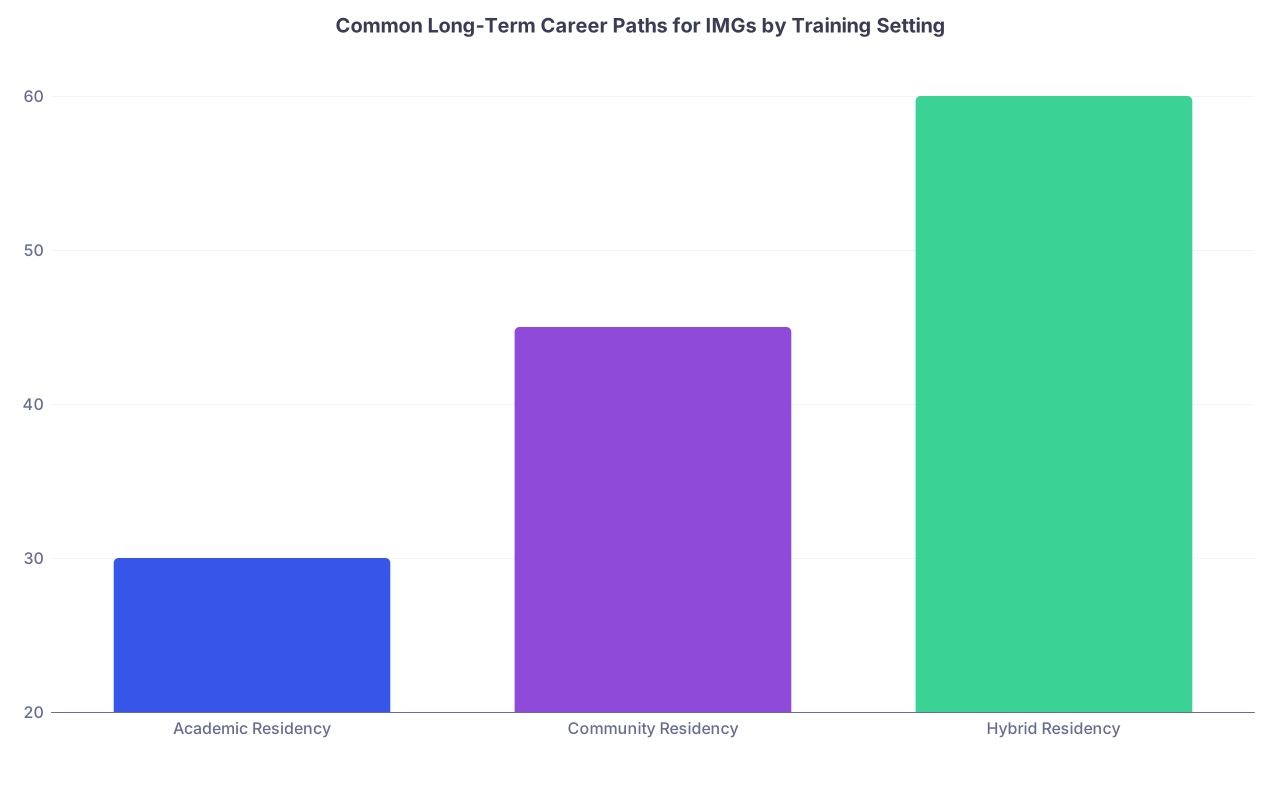
| Category | Value |
|---|---|
| Academic Residency | 30 |
| Community Residency | 45 |
| Hybrid Residency | 60 |
(Interpretation: not exact numbers—more to illustrate relative typical strength for flexible long-term options. Hybrid tends to open the most balanced doors.)
Academic residency (IMG-friendly)
Common IMG trajectory:
- IM residency → competitive fellowship (often within same or similar tier system) → academic or hybrid job.
- Or residency → hospitalist in academic center → later move to community/hybrid.
High upside if you get in. But fewer IMGs get those spots.
Community residency
Common IMG trajectory:
- IM residency → hospitalist/nocturnist job → J-1 waiver → green card → stable long-term job.
- Or residency → local fellowship (cards/GI/crit care) at affiliated or nearby program → regional subspecialty practice.
Less glitter, more stability. Very good outcome for most real humans.
Hybrid / university-affiliated community
Common IMG trajectory:
- IM residency → strong fellowship (either community or academic) → you can choose:
- Academic job
- Hybrid job
- High-paying community job
That flexibility is exactly why I keep saying: this is often the best long-term setting for IMGs.
8. What I’d Actually Advise an IMG Ranking Programs
If you were my friend and you showed me a rank list, here’s how I’d think:
- Eliminate places with shaky or unclear visa practices. I don’t care how shiny they are.
- Among remaining:
- Put IMG-friendly hybrid/university-affiliated community programs with strong fellowship history near the top.
- Next, solid community programs in regions with lots of IMG jobs and waiver options.
- Then, academic programs that are truly IMG-supportive with a track record to prove it.
- Ignore prestige unless it’s backed by actual IMG outcomes.
And if you’re stuck between:
- A big-name academic program that’s lukewarm toward IMGs, and
- A community/hybrid program that clearly invests in IMGs, sponsors visas, and has grads where you want to be,
I’d tell you to seriously consider the community/hybrid option. Safety, support, and real career outcomes beat branding.
FAQ (Exactly 7 Questions)
1. Is an academic residency always better for IMGs?
No. For many IMGs, especially those focused on stable jobs and visas, a strong community or hybrid program is actually better long-term. Academic only wins if you’re truly committed to a competitive fellowship or long-term academic career and the program is genuinely IMG-friendly.
2. Can I still get a competitive fellowship (cards, GI, heme/onc) from a community program?
Yes, if the program has a proven track record of sending IMGs into those fellowships. Many community and hybrid programs regularly place residents into good fellowships, especially within their region. You need to look at actual match lists, not assumptions.
3. Will a community program hurt my chances of ever working in academia?
Not necessarily. Plenty of IMGs do community IM residency → academic-style fellowship → academic attending job. It’s harder than starting academic from day one, but it’s absolutely possible if you build research, strong letters, and mentors during fellowship.
4. Which setting is better for visa sponsorship: academic or community?
Community and hybrid programs are often more reliable for visas, simply because they’ve historically relied more on IMGs. Many academic centers limit H-1B or change policies frequently. Always ask programs directly what visas they sponsor and how many current residents are on visas.
5. If I want to be a hospitalist, does academic vs community matter?
Not much for the job itself. Both paths can land you good hospitalist roles. Community programs may give more hands-on autonomy and local job networks. Academic or hybrid programs may help if you want a hospitalist role with teaching or research responsibilities.
6. Are university-affiliated community programs really different from pure community programs?
Yes. These “hybrid” programs often combine:
- Community-style hands-on training and IMG friendliness
- University connections, some research, and a bit of brand name They’re often a sweet spot for IMGs who want both job security and fellowship options.
7. Bottom line: which is better for IMGs long-term—academic or community?
For most IMGs, the best long-term option isn’t pure academic vs pure community. It’s:
- A hybrid/university-affiliated community program with IMG-friendly policies, strong clinical training, clear visa support, and a real track record of IMG fellowship and job placement. If that’s not available, a solid IMG-heavy community program with strong visa and job outcomes usually beats a prestige academic name with weak IMG support.
Key points to keep in your head:
- Don’t chase labels. Chase IMG outcomes: visas, jobs, fellowships.
- Hybrid / university-affiliated community programs are often the best long-term bet for IMGs.
- The “best” program for you is the one that reliably gets people like you the life you actually want—not the biggest name on paper.