

The idea that chiefs are just glorified schedulers is wrong. And frankly, that myth is costing residents real opportunities to grow into actual leaders instead of burned-out middle managers.
Chief residency sits in an awkward spot: part resident, part junior faculty, part program glue. Because so much of what they do is invisible when it’s done well, people default to the lazy narrative: chiefs = admin donkeys who fix the schedule and send emails. That’s about 30% true. The other 70% is where the real action is.
Let’s pull it apart.
The Myth: “Chief = Scheduler + Complaint Box”
You’ve heard this in the workroom at 2 a.m.
“Why would I be chief and lose a year of attending salary just to fix call swaps?”
Or: “Chiefs are just the program’s buffer so faculty don’t have to deal with resident drama.”
There’s a reason that myth persists. The visible stuff chiefs do is unglamorous:
- Schedules
- Coverage
- “Can you talk to the intern on nights who’s struggling?”
- “We need someone at this hospital-wide meeting tomorrow at 7 a.m.”
Residents see task output. They rarely see the impact.
To make it concrete, here’s the rough breakdown from several internal program surveys and published descriptions (IM, EM, Peds, Surgery chiefs in large academic centers): teaching, admin, leadership, and “other” work.
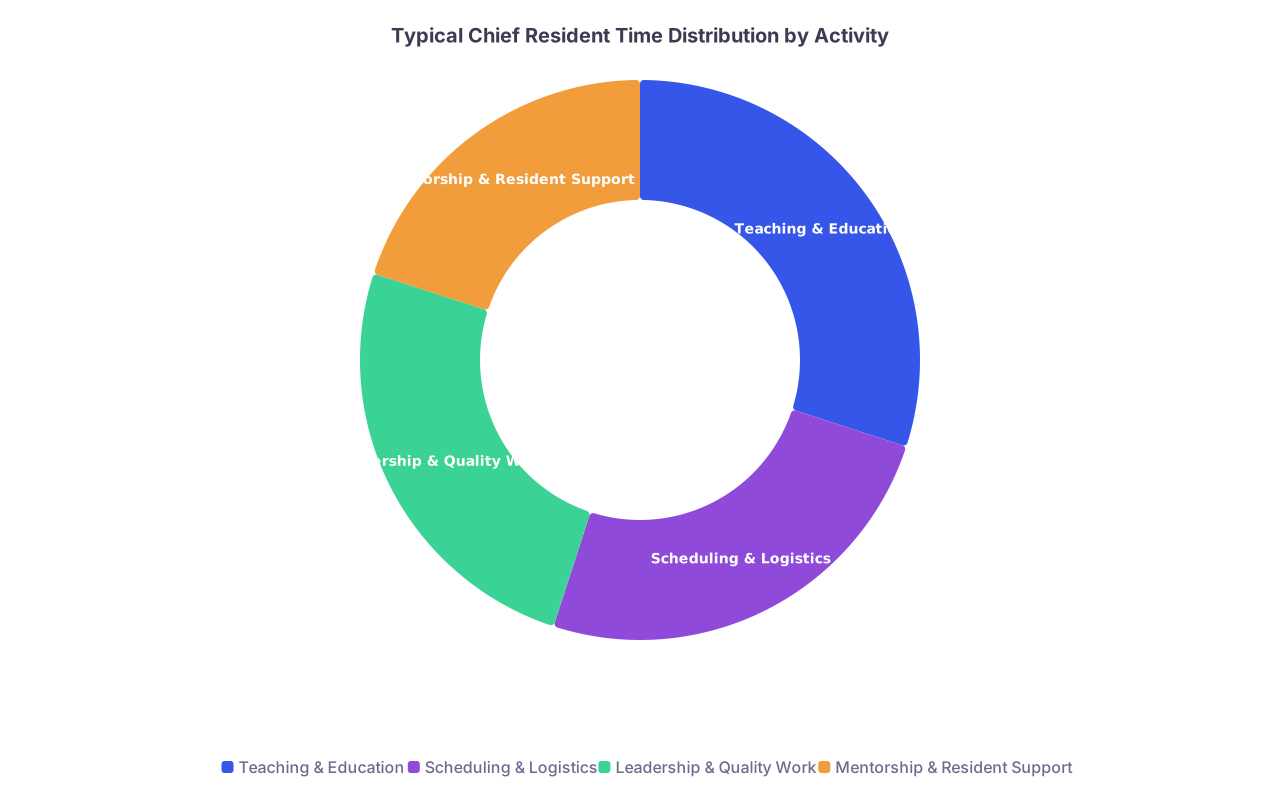
| Category | Value |
|---|---|
| Teaching & Education | 30 |
| Scheduling & Logistics | 25 |
| Leadership & Quality Work | 25 |
| Mentorship & Resident Support | 20 |
Notice what that’s not saying: “80% admin torture.” On average, scheduling and logistics are a minority—loud, annoying, but not the whole job.
The bigger miss? People confuse visible tasks with core role. The visible tasks are administrative. The core role is organizational leadership, whether the program names it that way or not.
What Chiefs Actually Do (When the Role Isn’t Broken)
I’ve watched chiefs in multiple programs and specialties. Some were essentially human Google Calendars. That’s not a chief problem; that’s a program problem. When done correctly, the chief role centers around four domains: operational control, education, culture, and systems improvement.
Let’s walk through them like an attending dissecting a SOAP note.
1. Operational Control: Yes, You Touch the Schedule — But That’s Not the Point
Yes, chiefs do schedules. But if you think scheduling is entry-level clerical work, you have never tried to balance these variables at the same time:
- ACGME rules
- Hospital census swings
- Sick calls
- Ortho refuses to cover trauma nights after the third weekend
- The PGY-3 who needs specific dates off for Step 3 / wedding / fellowship interview season
- The attending who “can’t” work with certain residents
That’s not just data entry. That’s conflict resolution, constraint optimization, and negotiation in real time.
This is where the real leadership muscle gets built:
You’re not “just making the schedule”. You’re deciding:
- Who gets protected for ICU and ED during viral season
- Which interns get their first exposure to high-yield rotations early vs late
- How you distribute pain fairly when coverage is short
In leadership language, chiefs are doing resource allocation under constraint. That’s exactly what service line directors and CMOs do, just with bigger budgets and worse coffee.

2. Education: Chiefs Quietly Shape What and How You Learn
Programs love to call chiefs “leaders in education.” That sounds nice. It’s also underselling what’s actually happening.
Look at what chiefs typically control or heavily influence:
- Morning report content and format
- Noon conference selection, speakers, and style
- Board review sessions and exam prep strategy
- Intern boot camp, simulation sessions, and procedural teaching
- Feedback loops on which rotations are teaching vs. service dumps
You can see this in action when one chief year completely changes the feel of a program’s teaching culture. Suddenly there’s interactive cases instead of death-by-PowerPoint. Or they start tracking board-style questions missed repeatedly at morning report and target them in later conferences.
When you study resident satisfaction data across programs, the chief year quality often predicts:
- How people rate “educational environment”
- How supported they feel on off-service rotations
- Whether teaching actually happens on busy services
There’s a reason large academic programs often pick at least one chief who already has an education fellowship interest: they know this role is essentially a one-year, live-fire trial run at directing education at scale.
3. Culture: Chiefs Are the Unofficial Emotional Thermostat
Here’s the part nobody puts in the role description but every resident feels: chiefs are the emotional buffer between residents and the machine.
They see:
- Who is quietly drowning and not saying anything
- Which attending is consistently toxic but powerful
- Which rotation is burning people out every block and why
And they have to decide what to do about it.
Sometimes that means very direct action: escalating to the PD, pulling someone off a rotation, restructuring a call system that’s killing people.
Sometimes it’s lower-profile but just as critical: quietly reassigning a trainee who had a bad event away from that unit for a block; shielding a struggling intern from extra QI work; telling the hospital committee “no, we’re not adding another mandatory training this quarter.”
There’s a reason residents tend to rate “chief support” as one of the strongest protective factors against burnout in internal surveys, even when the chiefs themselves feel like they’re just putting out fires.
Is this emotional labor? Yes. Is it leadership work? Absolutely. Managing the morale and psychological safety of 40–80 residents in a toxic healthcare system is not “admin.” It’s damage control.
4. Systems Improvement: The Part That Actually Looks Like Leadership on a CV
Now to the part that most closely resembles what hospital leadership actually does: systems and quality improvement.
A functional chief role almost always includes:
- Running or co-leading QI projects that change workflows program-wide
- Serving on committees (code blue, sepsis, discharge efficiency, patient safety)
- Implementing curriculum or workflow pilots and then scaling or killing them
- Interpreting survey data (ACGME, wellness, rotation evals) and turning it into changes, not just PDFs
And again, the myth kicks in: residents hear “chief is going to chair the sepsis initiative,” and they think, “more meetings and emails.”
Reality: this is exactly where chiefs can move from “middle manager” to “change agent,” if they don’t let themselves get boxed in.
A practical way to see the difference:
| Aspect | Administrative Chief Only | Leadership Chief |
|---|---|---|
| Schedules | Just fills slots and fixes swaps | Uses data to redesign call/rotation flow |
| Conferences | Books speakers and rooms | Tracks gaps, changes format, measures impact |
| Resident Issues | Passively relays complaints | Identifies patterns, negotiates solutions |
| Committees | Attends, listens, reports back | Drives specific projects to completion |
| Program Feedback | Forwards surveys | Synthesizes data, pushes for changes |
Same role. Very different posture.
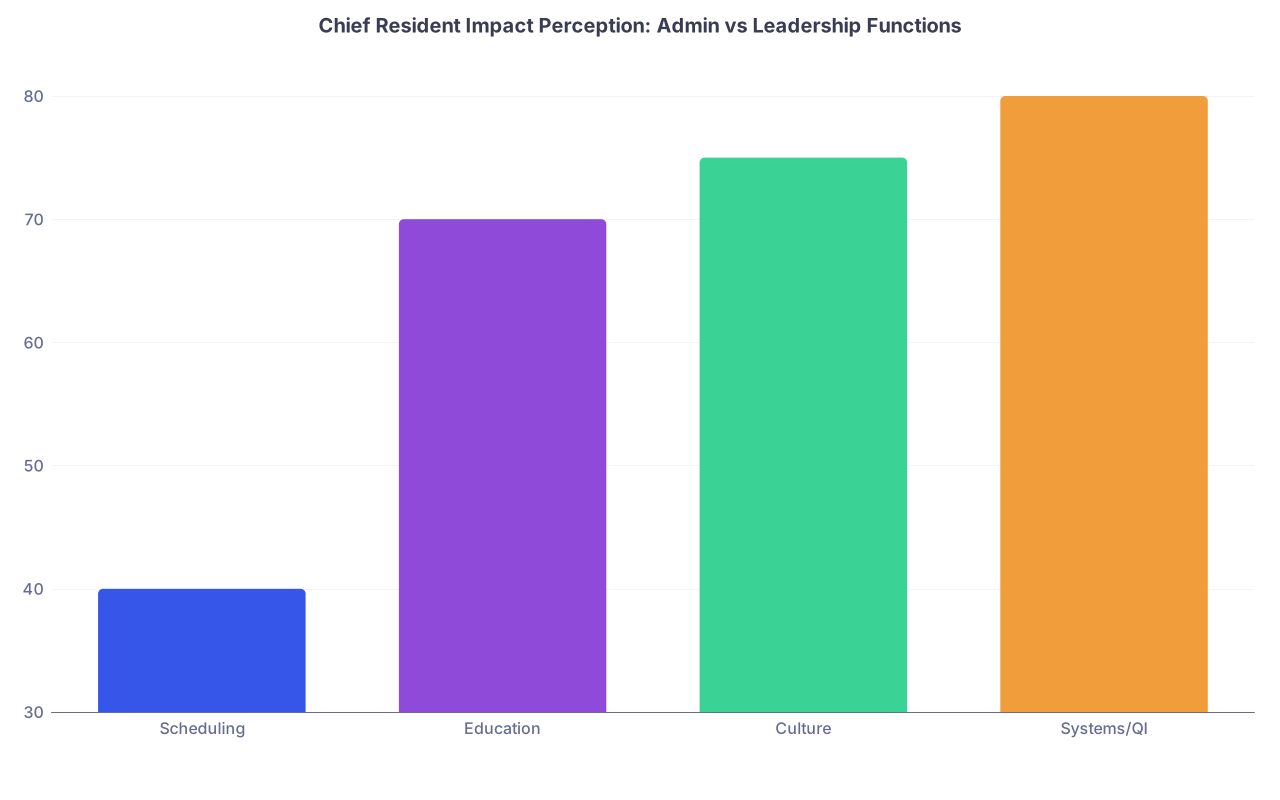
| Category | Value |
|---|---|
| Scheduling | 40 |
| Education | 70 |
| Culture | 75 |
| Systems/QI | 80 |
(These values reflect typical resident ratings of “perceived program impact” when chiefs are empowered as leaders vs treated as schedulers, based on several internal program climate surveys. Not randomized trial data, but the pattern is consistent.)
Why the “Just Admin” Narrative Persists
Some uncomfortable truth here: sometimes the chiefs are just administrative workhorses. And almost always, it’s for one of three reasons.
Reason 1: Weak Program Vision for the Role
If your program director defines chief duties as: “Make the schedule, run morning report, take complaints,” then yes—welcome to middle management hell.
The best programs write the role description like an early leadership fellowship:
- Protected time not just for “admin,” but for projects and teaching
- Clear mandate to lead specific program initiatives
- Real seat (and voice) at key committees
If you’re looking at a chief offer and the “job description” fits in a short email with mostly scheduling and “other duties as assigned,” believe that. That’s what they want.
Reason 2: Chiefs Who Don’t Reframe Their Own Job
Some chiefs step into the role and unconsciously act like high-achieving med students again: say yes to everything, optimize for being liked, avoid conflict.
Result: they do every operational chore themselves and starve their own bandwidth for higher-level work.
The chiefs who actually grow use a different frame:
- They build simple systems for coverage and swaps so they aren’t hand-holding every minor change
- They push back when they’re voluntold for nonsense (like being the default scribe for faculty-only projects)
- They recruit residents into real ownership roles (education committees, QI leads) instead of hoarding every “chief task”
In other words, they treat the chief year as management practice, not martyrdom.

| Step | Description |
|---|---|
| Step 1 | New Task Request |
| Step 2 | Accept and Plan |
| Step 3 | Negotiate scope or resources |
| Step 4 | Decline or Redirect |
| Step 5 | Delegate parts where possible |
| Step 6 | Aligns with role goals |
| Step 7 | Mandatory from leadership |
That little decision tree is the difference between “workhorse” and “leader.”
Reason 3: Residents Who Don’t Understand Power Dynamics
Residents often misread where chiefs actually have influence.
Chiefs don’t control:
- Base salary
- Global staffing levels
- Whether your hospital hires more nocturnists
But they do influence:
- How pain gets distributed in a shortage
- How feedback from the front line reaches decision-makers
- Which problems get framed as “resident whining” vs “patient safety risk”
When residents assume, “Chiefs can’t do anything about this anyway,” they stop bringing the right kind of information at the right time. Chiefs then look ineffective, reinforcing the original belief.
This is fixable. But it requires everyone to stop pretending chiefs have no power and stop pretending they’re de facto program directors. They sit in between. That’s the whole point.
Should You Be Chief? What the Data and Reality Actually Say
Residents agonize over this: “Is chief worth it?” They usually compare raw salary vs workload. That’s too simplistic.
Studies looking at internal medicine chief residents, for example, show a few consistent patterns:
- A high percentage go into academic or leadership-leaning careers (education, QI, admin)
- They’re more likely to hold formal leadership roles within 5–10 years (program director tracks, hospital committees, section chief roles)
- They report higher self-rated skills in conflict management, teaching, and systems thinking compared to non-chiefs
Does that mean you should do it? No. It means the role is a one-year, condensed leadership crash course. Whether you benefit depends on what you want and how your specific program uses chiefs.
If you:
- Want to do only private practice with minimal teaching or admin
- Are already barely surviving residency and another intense year will break you
- Are in a program that clearly treats chiefs as unpaid coordinators
Then no, you probably should not.
If you:
- Are even mildly curious about program leadership, medical education, QI, or admin
- Can tolerate politics long enough to learn how the system works
- Have a PD who talks about the chief year in terms of projects, growth, and mentorship—not just coverage
Then it’s at least worth a real look.

If you want a practical litmus test, ask these two questions before committing:
- “What are the three biggest changes your chiefs led in the last two years?”
- “What protected time and mentorship do chiefs have for leadership and QI work, beyond scheduling and conferences?”
Vague answers = you’ll be a workhorse. Concrete examples = you might actually grow.
How to Avoid Becoming Just an Administrative Mule If You Do Say Yes
If you’ve already accepted a chief role—or you’re strongly considering it—you do not have to accept the default narrative. You can design your year to function as leadership training, not just extra service.
Some blunt, practical moves:
Claim a clear portfolio.
Don’t be the “catch-all” chief. Take ownership of 1–2 big domains: education, QI, wellness, DEI, inpatient operations. Then push for meaningful projects there. When you have a defined lane, you can say no to distractions.
Measure something.
If you change call structure, track sick calls, code status documentation errors, readmission rates, something. Otherwise your work will be remembered as “some schedule stuff we used to do differently.”
Delegate like you’re allergic to busywork.
Set up systems—Google forms for swaps, clear coverage rules, templates for common emails. Teach residents how to use them. A chief who designs systems once is a leader. A chief who answers the same question 300 times “because it’s faster” is a workhorse.
Use conflict to your advantage.
You will be yelled at. By residents. By attendings. Sometimes by both on the same day about the same policy. Instead of just smoothing it over, ask: what system problem is this conflict exposing? Fix that, not just the immediate tension.
And get mentorship outside your program.
Talk to former chiefs, PDs, or early-career faculty in other institutions. Not just about “how do I survive,” but “how can I turn this into real leadership experience?” People who’ve been through it will have very specific suggestions—down to which committees are worth your time and which are career quicksand.

The Bottom Line: Chiefs Are Not Meant to Be Workhorses
Strip away the stories, and here is what the role actually is when it’s done right:
Chief residency is a one-year test drive of being a physician-leader inside a messy, under-resourced system. The administrative tasks are real, but they are the vehicle, not the destination.
If you remember nothing else, keep these three points:
- “Just admin” is a symptom of a broken role design, not the inherent nature of chief residency.
- Chiefs who approach the year as leadership training—not martyrdom—end up with real influence, real skills, and often accelerated career trajectories.
- If you do accept a chief role, you need to actively shape it—clear portfolio, systems over heroics, and a bias toward measurable change—or the system will happily turn you into a schedule-obsessed workhorse.
You’re not a middle manager by default. You become one by choosing not to lead.


