
Leadership in residency is one of the most misunderstood concepts in medical training.
The obsession with titles—chief resident, committee chair, “founder” of some half-dead initiative—is wildly overrated. Programs, and frankly residents themselves, keep pretending that leadership is a checklist of positions. The data and real-world behavior of strong physicians say otherwise.
You do not become a leader because someone put your name on a slide. You become a leader because people actually follow you when things are hard, chaotic, or unclear.
Let’s dismantle the mythology.
The Myth of the Magic Leadership Title
I keep seeing the same pattern: PGY-1s and PGY-2s scrambling to stack their CV with “leadership roles” the way premeds hoard club presidencies. Chief resident. Wellness committee co-chair. QI project lead. Some “task force” that meets twice a year and accomplishes nothing.
Here’s the uncomfortable truth:
Most so-called “leadership positions” in residency are, by themselves, weak predictors of real leadership ability or future success.
Program directors already know this. The ACGME has hammered “systems-based practice,” “interpersonal and communication skills,” and “professionalism” into the milestones—not “did they have a fancy title?” When you read program director surveys from NRMP and AAMC, what keeps showing up at the top is reputation, performance on rotations, and how the person functions in a team. Not whether they were PGY-3 Treasurer of the Noon Conference Snack Committee.
Does chief residency matter? Sometimes, yes. But not because of the title. It matters only if it reflects real behaviors: managing conflict, influencing culture, improving systems, advocating for residents. I’ve seen chiefs everyone feared and avoided. That’s technically a “leadership role” too. Just not in the way you want.
Strip away the gloss and you’re left with this: titles are cheap. Day-to-day behavior is not.
What Leadership in Residency Actually Looks Like on the Ground
Forget the LinkedIn version of leadership for a second. Let’s talk about what it looks like in a real hospital at 3 a.m.
Leadership in residency is mostly:
- How you behave when you are tired and someone weaker than you screws up.
- How you respond when a nurse is worried and everyone else is brushing her off.
- Whether students and interns feel safer or more anxious when you walk onto the unit.
Let’s break that down into something more concrete.
1. Reliability is the real “core competency”
Residents who are viewed as leaders aren’t necessarily the smartest. They’re the ones people know they can rely on. Consistently.
This is the resident:
- Whose notes you do not have to double-check every time.
- Who shows up to handoff on time, every time, even post-call.
- Who does not disappear when there’s a crashing patient.
Look at any ICU or busy medicine team. There’s almost always a PGY-2 or PGY-3 who doesn’t have a formal role but is the de facto “go-to” person. Night nurses call them first. Interns say things like, “If she’s on, I’m not worried.” That reputation is leadership. With or without any title.
And there’s evidence behind this. Studies on “informal leadership” in clinical teams consistently show that perceived reliability and competence drive who people follow in emergencies more than organizational position. When things go sideways, the most trusted person—not the highest-ranking one—runs the show.
2. Communication under pressure
You don’t need an MBA to lead a code. You do need to communicate clearly when everyone else is spinning.
Real leadership in residency looks like:
- Stating out loud what the plan is: “Okay, let’s walk through the assessment. Here’s what we know…”
- Closing the loop: “You’re calling RT. You’re grabbing the ultrasound. You’re drawing labs. Say back what you’re doing.”
- Updating the team when things change, instead of quietly altering orders at the computer and hoping everyone notices.
There’s data on this too. Closed-loop communication, explicit task assignments, and speaking up are tied to better resuscitation performance. Programs preach “crew resource management” and “teamSTEPPS” for a reason. Those aren’t just checkboxes. They describe actual, learnable leadership behaviors.
But here’s the twist. You don’t need to be “team leader” in the code note to behave like this. Interns can do components of it. So can medical students. The idea that leadership is something you “unlock” as a senior resident is nonsense. You grow into it by practicing actual skills long before your name is at the top of the call schedule.
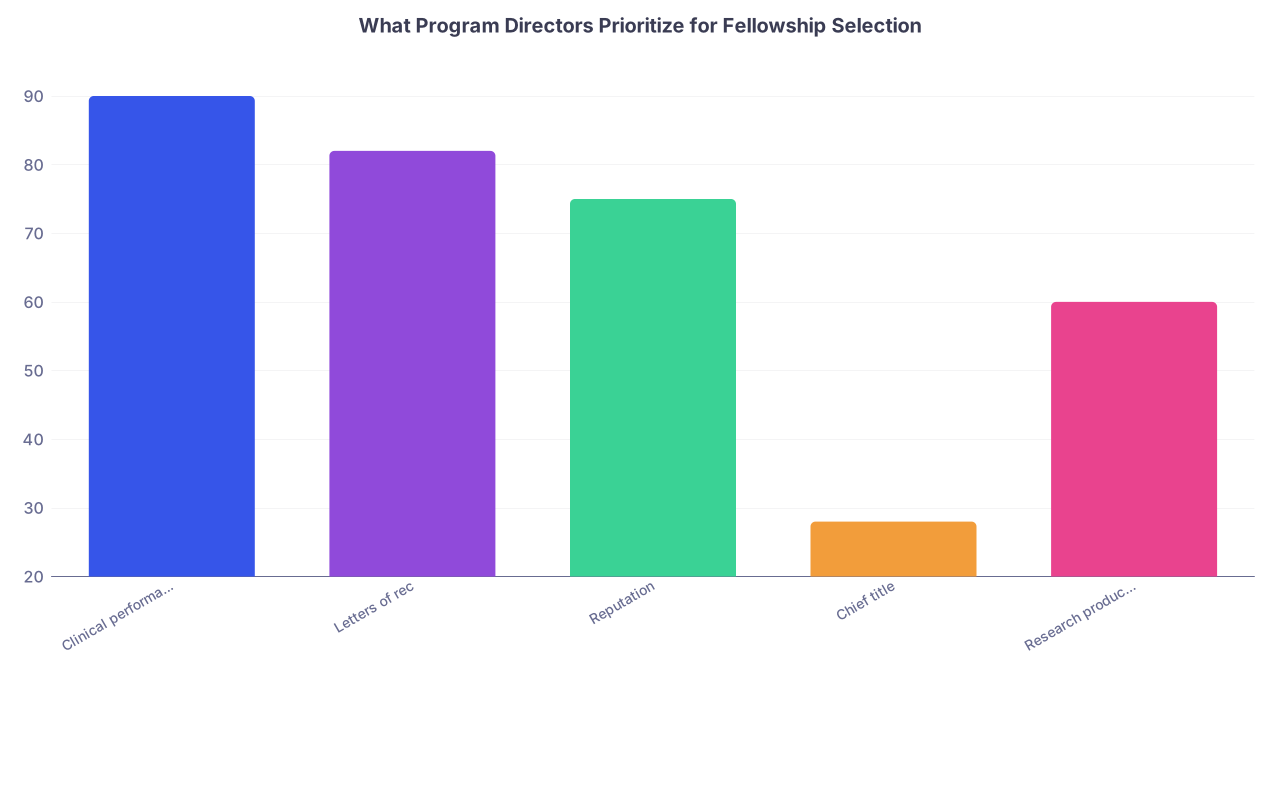
| Category | Value |
|---|---|
| Clinical performance | 90 |
| Letters of rec | 82 |
| Reputation | 75 |
| Chief title | 28 |
| Research productivity | 60 |
Informal vs Formal Leadership: The Stuff That Actually Moves the Needle
We need to separate two things that get conflated all the time: formal power and actual influence.
Formal power is: “You are the chief resident.”
Actual influence is: “People change what they do because of how you think, speak, and act.”
Plenty of residents have the first and almost none of the second.
Informal leaders run the culture
If you’ve trained anywhere halfway decent, you know exactly who the informal leaders are. They’re not always the chiefs. In fact, frequently they’re not.
- The PGY-2 who quietly tells the new interns, “If you’re overwhelmed, text me before you drown.”
- The resident who steps into a tense intern–consult confrontation and reframes without humiliating anyone: “Let’s back up. Here’s what we’re actually worried about.”
- The senior who tells the students, “I don’t care if attendings intimidate you—if you’re worried about a patient, you page me, period.”
Those people shift norms. They make “asking for help” part of the culture instead of a sign of weakness. They model admitting uncertainty without collapsing into self-doubt. That is leadership.
And programs notice. Maybe not in a formal evaluation box, but in every behind-the-scenes conversation: “Who would you trust on nights?” “Who would you want as a co-fellow?” “Who makes the team better just by being on it?”
Titles can amplify—or expose—you
Now, titles are not useless. They act like a magnifying glass. Whatever you already are becomes more visible.
If you’re respected before you’re chief, the role gives you more reach to fix things: scheduling issues, workflow problems, toxic behavior that needs to be called out. But if you’re disorganized, conflict-avoidant, or all about optics, chief will simply showcase that to more people.
Residents often assume they need the title to prove they’re a leader. Backwards. Programs trust residents with titles because they’ve already demonstrated leadership informally.
I’ve seen residents not selected as chief who still ended up in phenomenal fellowships or as junior faculty leaders because everyone knew who they really were on the wards. Conversely, I’ve seen chiefs who burned bridges so badly that no one wanted to vouch for them later.
The Actual Skills That Matter (And How To Build Them Without a Title)
You don’t need a committee letterhead to build real leadership capacity. You need reps. Repetitions of situations that demand better thinking, better communication, better judgment. Residency gives you plenty of those if you stop waiting for permission.
Let’s talk concrete skills.
1. Situational awareness and prioritization
This sounds abstract but isn’t. It’s the mental habit of scanning your patients, your team, and the system regularly and asking: “What’s likely to break next?”
Leaders:
- Know which patients are “sick but stable” vs “fine until they’re not.”
- Anticipate bottlenecks: CT scanner down, only one anesthesiologist for three urgent cases, lab backups.
- Adjust team workflow early instead of reacting late.
You can build this today:
- On rounds, force yourself to identify the top 2 risk patients on your list and why.
- Before sign-out, ask: “If something’s going to go wrong this evening, who is it likely to be and what can I pre-empt now?”
- Watch attendings who seem unruffled; listen to how they think out loud. They’re narrating their situational awareness, even if they don’t use the term.
2. Giving and receiving feedback like an adult
Leadership is impossible if you can’t handle feedback. Or worse, if you weaponize it.
Effective resident leaders:
- Ask for specific feedback: “On that family meeting, what’s one thing I should’ve done differently?”
- Deliver feedback privately, concretely, and early: “I noticed handoff has been running late this week. Let’s talk about what’s getting in the way.”
- Don’t wait for evaluations; they have normal human conversations.
There’s good evidence that cultures with normalized, bidirectional feedback perform better and retain people longer. Healthcare is bad at this because everyone is pretending not to have feelings. Strong resident leaders break that pattern and somehow the sky doesn’t fall.
You don’t need a position to start. You just need to stop treating feedback as an act of violence.
3. Advocacy with teeth, not just slogans
Let’s be blunt: “Wellness” committees love posters and yoga emails. Residents do not feel led by that.
Real advocacy leadership looks like:
- Pushing for cross-coverage staffing when call schedules are abusive, and backing it with data: page logs, hours, patient outcomes.
- Escalating safety issues even when they’re politically uncomfortable: the attending who bullies nurses, the unsafe sign-out patterns that keep causing near misses.
- Saying, “No, that’s not acceptable,” when admin wants another “initiative” without dropping anything else.
The key difference: leaders don’t just complain; they propose, negotiate, and persist. They do it repeatedly, not once at a town hall and then vanish.
And again—you do not need to be chief for this. You need a spine, allies, and some basic understanding of how your hospital’s power structure actually works.

| Step | Description |
|---|---|
| Step 1 | Show up reliable |
| Step 2 | Earn trust of peers |
| Step 3 | Take initiative on hard tasks |
| Step 4 | Become go-to person |
| Step 5 | Informal leadership reputation |
| Step 6 | Formal roles if offered |
| Step 7 | Influence culture without title |
How Programs and Future Employers Actually Judge Your “Leadership”
Fellowship directors and hiring committees don’t sit there calculating how many executive-sounding words are in your CV. They use proxies. Very human ones.
Here’s what usually matters far more than your titles:
- Letters of recommendation that say, “This resident is the person we trust with the sickest patients and toughest situations.”
- Stories during your interview about times you handled conflict, led through uncertainty, or fixed a broken process.
- The informal backchannel: “Would you take this person as a co-fellow?” “Would you rehire them as faculty?” “Do nurses like working with them?”
And yes, they absolutely ask nurses and staff. I’ve been there for those conversations. The difference between “Oh, they’re great” and the long silence followed by, “They’re…smart?” is career-defining.
Now compare two residents:
| Resident Profile | Likely Perception by Selection Committees |
|---|---|
| Chief resident, ran three committees, but has mixed reviews from staff and co-residents | Risky, “on paper strong but we’re not sure about team dynamics” |
| No big title, but universally trusted, outstanding letters, known as calm in crisis | High-confidence pick, “we want this person on our team” |
| Multiple minor “roles” (journal club lead, wellness rep) but no clear impact | Neutral, maybe padding CV |
| Led a successful QI project that changed actual practice | Viewed as impactful, evidence of real leadership |
| Reputation as the go-to for sick patients and tough families | Strong signal of practical leadership ability |
Who would you pick to work next to at 2 a.m.? That’s exactly how they think about it.
If You Want to Lead in Residency, Do This Instead
If you’re serious about leadership, stop chasing titles as your primary strategy. Start with these behaviors:
- Be relentlessly dependable. Let people experience that when you say you’ll do something, it gets done.
- Make your team’s life easier in visible ways: smart pre-rounding, better sign-outs, stepping in before someone drowns.
- Speak up when it’s uncomfortable but necessary: safety issues, inequity, toxic behavior.
- Own your mistakes without dramatics. Nothing builds credibility faster.
- Mentor someone behind you. One student, one intern. That’s already leadership.
You’ll notice none of that requires a formal position. But all of it, over 3–4 years of residency, creates a reputation that outlives whatever title you did or did not hold.
FAQ: Leadership in Residency
1. Do I need to be chief resident to match into a competitive fellowship?
No. Chief can help if it reflects genuine leadership and strong relationships, but many highly competitive fellows were never chiefs. Fellowship directors care more about letters, clinical performance, and how you function in teams than a single title.
2. Should I say yes to every “leadership opportunity” that comes my way?
Absolutely not. Spreading yourself across five low-impact committees looks like noise. Choose 1–2 areas where you can actually move the needle—QI, curriculum, scheduling, advocacy—and do something tangible there.
3. How early in residency can I start “being a leader”?
Day one. Leadership at the intern level is about attitude, reliability, communication, and how you treat people below you on the hierarchy (students, nurses, MAs). You do not wait to be a PGY-3 to practice that.
4. What’s one concrete way to show leadership if I hate politics and meetings?
Own a problem end-to-end. For example, fix a broken handoff process on your service: map the current workflow, gather data, pilot a change, measure the effect, and present it. That’s leadership with receipts, not talk.
5. How do I know if I’m seen as a leader in my program?
Listen to who gets called first when something is complicated. Notice who interns and students request to work with. And ask your attendings directly: “When you think of residents who are leaders here, what do they do that stands out—and how close or far am I from that?”
Leadership in residency is not a line on your CV. It’s a pattern of behavior people feel when they work with you.
If you remember nothing else, remember this:
People do not follow titles. They follow trust and competence. Build those, and the rest takes care of itself.