

The belief that chief residents are the “best clinicians” in their class is wrong. Flat‑out wrong. And hanging onto that myth is exactly how good residents burn out chasing the wrong target.
Chief selection is not a secret meritocracy of pure clinical excellence. It is a messy mix of politics, logistics, leadership needs, and timing—occasionally informed by clinical skill, but very rarely defined by it.
Let me walk through what actually determines who becomes chief, what data we have, and why tying your self‑worth (or career trajectory) to that title is a bad idea.
The Myth: Chief = Top Clinician
You’ve probably heard some version of this in the workroom:
“She became chief? Guess that means she was the best in our class.”
No. That’s not what it means. At most academic programs, if you ask the PD or APD point‑blank, “Do you pick chiefs based on who’s the best clinician?” they’ll literally laugh.
Programs are not ranking pure clinical performance from 1 to N and handing the top person the chief spot. They can’t. Because “best clinician” is not even a measurable construct in residency.
Think about how absurd it would be to try. You would have to weight:
- Diagnostic accuracy
- Communication skill
- Efficiency
- Independence vs appropriate help‑seeking
- Patient satisfaction
- Documentation quality
- Systems awareness
Across what settings? MICU? Night float? Clinics? And who is judging—attendings who see you 4–10 days per rotation and remember the last 2 days most clearly?
The few studies we have on resident evaluations make this worse, not better.
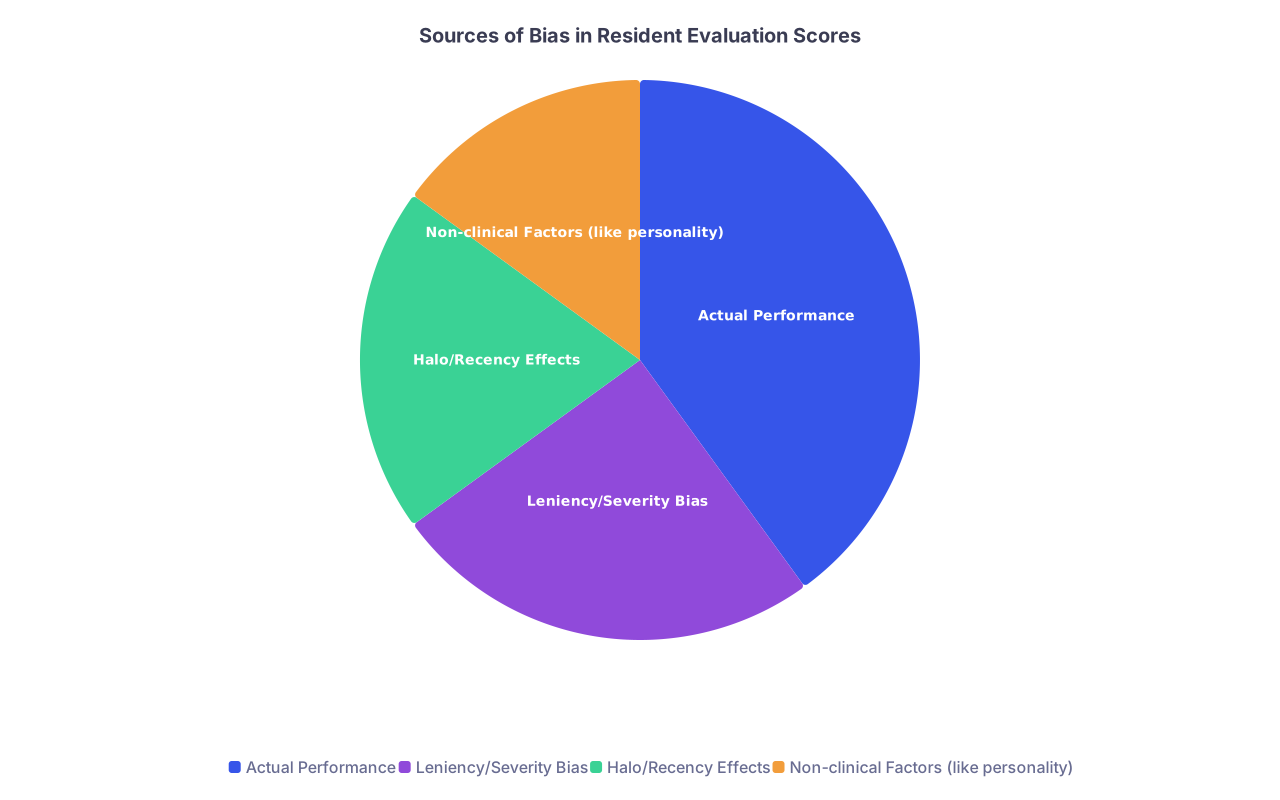
| Category | Value |
|---|---|
| Actual Performance | 40 |
| Leniency/Severity Bias | 25 |
| Halo/Recency Effects | 20 |
| Non-clinical Factors (like personality) | 15 |
So even if a program wanted to pick the objectively best clinician, the tools they have—global rating forms, narrative comments, milestone scores—don’t actually allow that level of discrimination.
You know what they can detect reliably?
Who’s organized. Who answers email. Who can be trusted not to implode when you give them an Excel template and 40 schedules. Who does not alienate half the faculty in one rotation.
That’s who becomes chief.
What Programs Actually Look For (Based on Reality, Not Lore)
Most programs will never publish their real chief selection algorithm. But if you look across surveys, PD panels, and what happens behind closed doors, the pattern is clear.
Here’s the short version: being a solid clinician is necessary. Being the best is not. Once you’re past “safe and competent,” the selection hinges on something else entirely.

You see the same themes across internal medicine, surgery, pediatrics, EM, OB/GYN. Things that repeatedly matter:
Reliability and follow‑through
I’ve watched a PD veto a star clinician for chief with one sentence: “I can’t get them to respond to a single email on time.” Programs are traumatized by past flaky chiefs. They will not risk it again.Political safety
Not in the “back‑stabbing” sense. In the “will not start a war with nursing, or anesthesia, or GME, or the CMO” sense. They want someone who can represent the program without generating constant fires.Minimal drama footprint
If your name has come up in 3+ conflict‑of‑interest meetings, you’re probably done. Even if you’re a diagnostic machine. The chief job is conflict‑heavy by default; they don’t want extra.Schedule and admin tolerance
The job is 30–70% logistics depending on specialty and program. If you visibly hate anything that looks like scheduling, meetings, or policy, you’re not getting it.Future alignment
Programs sometimes lean toward people staying academic, because this is a leadership‑track position and they want their “graduates” to become faculty, PDs, etc. Sometimes they pick someone aiming for education or admin. It’s strategic.
Where does pure clinical skill fit? Somewhere after all of that. It’s a screening tool: if you’re struggling clinically, you won’t be chief. But being the sharpest clinician does not push you over the finish line.
Here’s a rough comparison that’s closer to how many PDs actually think than anything they’d put in writing:
| Factor | Relative Importance |
|---|---|
| Reliability / follow‑through | Very High |
| Professionalism / low drama | Very High |
| Emotional maturity | High |
| Communication with peers/admin | High |
| Clinical competence (safe) | High (screening) |
| “Best” clinical skill | Moderate to Low |
| Research / academic output | Program‑dependent |
What the Data and Literature Actually Show
Hard numbers on chief selection are limited, but we do have some real signals.
Survey studies of program directors in internal medicine and other core specialties show a few consistent findings:
- PDs rank professionalism, leadership, and communication as more important than test scores or procedural volume for chief selection.
- Many programs select chiefs through informal consensus, not numerical ranking systems. Translation: this is a judgment call, not a math problem.
- A non‑trivial number of programs explicitly state they choose chiefs for their “team player” qualities—things that are only loosely correlated with raw clinical ability.
There’s also the outcomes side. Does being chief predict being a “better” doctor long‑term? Not really.
Longitudinal follow‑ups on chiefs vs non‑chiefs suggest:
- Chiefs are more likely to go into academic medicine or education roles.
- They hold more leadership positions (APD, PD, division chief) down the road.
- There’s no robust evidence they have better patient outcomes, lower complication rates, or higher long‑term clinical performance than their non‑chief peers.
That makes sense. You selected them for leadership and admin tolerance, not for being the sharpest proceduralist or diagnostician.
So no, the data does not support: “Chief = best doctor.”
What it supports is: “Chief = most leadership‑aligned competent doctor who was willing and available at the right time.”
The Unsexy Reality of the Chief Job
Residents often romanticize the chief role as “power + respect + leadership training.” That’s… partially true. The other part is less glamorous.
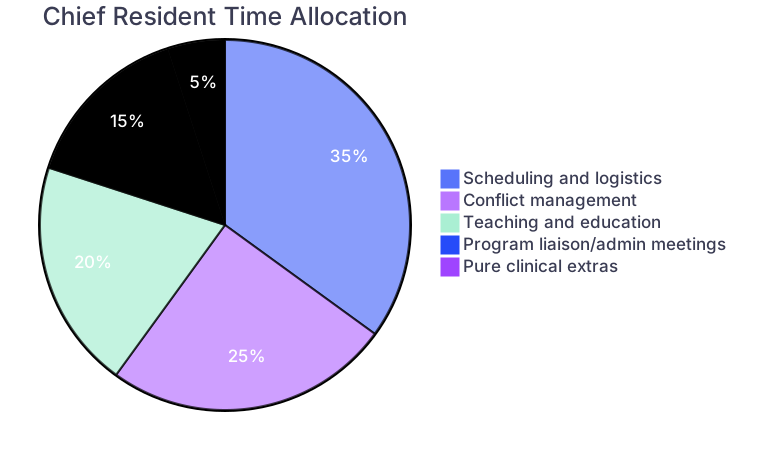
Talk to any recent chief when they’re being honest over coffee, not on recruitment day. You’ll hear some version of:
- “I spent half my life on scheduling and coverage issues.”
- “I became the complaint sink for both residents and attendings.”
- “I had less time to read and grow clinically than some of my co‑residents.”
That last line matters. Chief year can actually slow your clinical growth in some ways. You’re doing more admin, more meetings, more resident coaching, more policy. Yes, you’re still on some rotations, you still see patients, you still teach at the bedside. But your headspace is not purely clinical.
If your main long‑term goal is to be the most technically excellent surgeon, the most feared diagnostician, the absolute top of pure clinical craft, chief might actually be a distraction, not an accelerant.
Here’s the trade‑off, laid bare:
| Dimension | Chief Resident Year | Non‑Chief Senior Year |
|---|---|---|
| Clinical volume | Often slightly reduced | Often higher |
| Admin / meetings | Much higher | Lower |
| Scheduling work | Extremely high | Minimal |
| Leadership exposure | Very high | Variable |
| Time to study/reflect | Often reduced | More flexible |
If the only story in your head is “chief = best = must want it,” you’re not thinking like an adult about trade‑offs. You’re signing up for a job because someone implied it was an honor, not because it fits your trajectory.
Why the Myth Hurts Residents
This isn’t just an academic correction. The “chief = best clinician” fantasy has consequences.
1. It turns a job into a personality referendum
I’ve watched very strong residents spiral emotionally after not being chosen as chief.
Not because they actually wanted the role. Because they’d internalized that not being chosen meant:
“I wasn’t good enough.”
“I’m not respected.”
“They don’t think I’m a good doctor.”
None of those necessarily follow from the outcome.
Sometimes a program wants diversity in chiefs and already has someone with your background or career interest. Sometimes you’re going into a subspecialty that doesn’t mesh well with the chief schedule. Sometimes they literally needed someone who was staying an extra year for a partner’s fellowship and you’re leaving town.
The selection is multi‑factor, political, and constrained. It is not a full scorecard of your worth.
2. It pushes the wrong people into the job
Some residents gun for chief because they think they are supposed to. Because “everyone who’s strong goes for it.”
Result: people who actually hate logistics, hate conflict, hate admin, find themselves managing call schedules, duty hour violations, and interpersonal meltdowns.
That is a recipe for burnout. The literature on chief wellness is not pretty—chiefs have higher reported stress and significant role strain, often caught between residents and leadership.
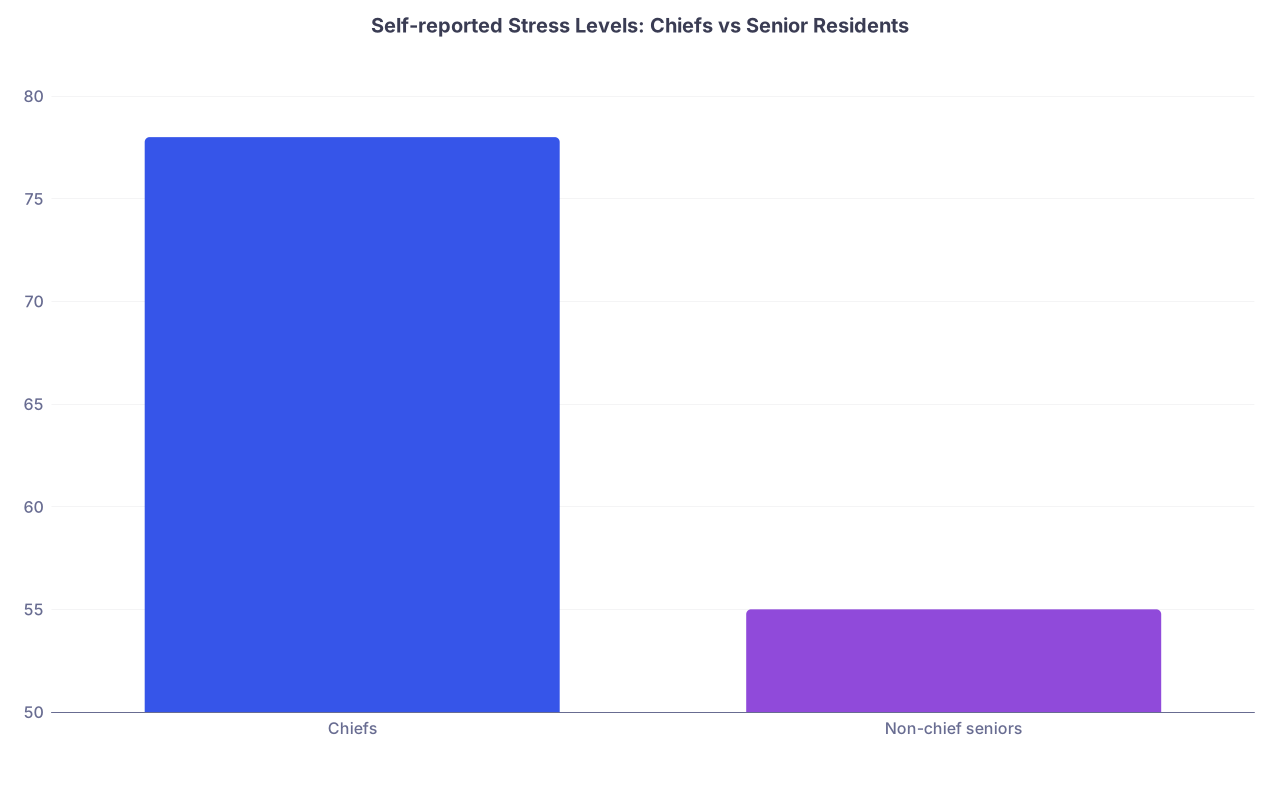
| Category | Value |
|---|---|
| Chiefs | 78 |
| Non-chief seniors | 55 |
3. It distorts what “excellence” looks like
You can be an outstanding clinician, team member, and teacher and never touch the chief role. You might be the quiet workhorse who crushes night float and is beloved by nurses but hates committee work.
If you equate excellence with titles, you’ll miss your own strengths.
I’ve seen the inverse too: very politically savvy, likable chiefs who were… clinically average. Safe, competent, but not standouts. They still did a great job as chiefs. But their title had nothing to do with being the “best doctor” on the team.
Should You Want to Be Chief?
Strip away the prestige and imagined gold star. Ask the real questions:
- Do you like organizing systems, schedules, and processes more than the average resident?
- Can you tolerate being the middleman in conflicts—often with both sides a little mad at you?
- Do you genuinely want more face time with leadership, more meetings, more policy?
- Are you interested in education, administration, or academic leadership long‑term?
If the answer to most of those is yes, chief might be a very good move. You’ll get reps at the exact skills PDs, division chiefs, and CMOs care about.
If the answer is mostly no, forcing yourself into that box because you crave validation is foolish. Better to skip the title and double down on being excellent clinically, building niche expertise, publishing, or strengthening your teaching.

And if you’re on the fence, talk to your program’s current or recent chiefs. Not on interview day. In a call room, post-call, when they’re honest. Ask:
- “What did you actually do hour‑to‑hour?”
- “Did it help or hurt your clinical growth?”
- “Would you do it again?”
You’ll get clearer in one conversation than in ten years of myths.
What If You’re Never Asked or Chosen?
Then you do what most excellent physicians in the world do: you do your job well without the word “chief” on your CV.
Here’s what being passed over for chief does not mean:
- That you’re not an outstanding clinician
- That you won’t be a future division chief, PD, or CMO
- That your attendings don’t trust you
- That you “failed” residency
Some of the most respected faculty I’ve met—absolute monsters of clinical skill—never did a chief year. Mostly because they didn’t care to. Or the spot went to someone more education‑ or admin‑oriented. Or the timing was off.
If it stings, allow that. But don’t rewrite your story around an administrative role that lasts one year and is forgotten by most people two years later.

The Reality, Without the Romance
Let me strip it down to the core.
Chief resident is a job. A useful, sometimes amazing, sometimes miserable job.
It is not a divine stamp of “best clinician in the class.”
Clinically unsafe residents will not be chiefs. But beyond that threshold, the decision is about leadership style, reliability, politics, program needs, and career alignment more than about diagnostic genius or procedural mastery.
If you understand that, a few things become clearer:
- You can pursue chief intentionally, because you want the work, not just the badge.
- You can decline or not pursue chief without guilt, and still aim for clinical or academic greatness.
- You can avoid tying your self‑worth to a selection process that was never designed to rank who’s “best” in the first place.
So, the bottom line:
- No, you do not need to be the “best clinician” to be chief, and being chief does not mean you are.
- Chief selection is mostly about leadership potential, reliability, and politics on a background of solid clinical competence.
- Your long‑term excellence as a physician has far more to do with what you do over decades than with a one‑year administrative title during residency.


