

The belief that chief residents are just the program director’s “favorites” is lazy, comforting—and mostly wrong.
Does favoritism exist? Of course. This is medicine, not a monastery. But the picture people paint in the work room—“they just pick who they like” or “it’s all politics”—doesn’t actually match how most chiefs are chosen, how the incentives work, or what data we do have.
I’ve watched this from every angle: as a resident watching chief selections, as a faculty member in rank meetings, and listening to PDs complain privately about their “charismatic but useless” past chiefs. The gossip version of how chiefs are chosen is simple. The real version is messier, more predictable, and a lot less romantic.
Let’s dismantle the myths and then reconstruct what actually drives chief selection.
Myth 1: “Chief is Just the PD’s Pet Getting Rewarded”
The most common story I hear:
“She got chief because the PD loves her.”
“He golfs with the APD; of course he’s chief.”
“They only pick people who brown-nose.”
There is usually a grain of truth surrounded by a mountain of nonsense.
Programs do not pick chiefs primarily to “reward” people. They pick chiefs to solve problems.
Chiefs are staffing, culture, and crisis-management infrastructure. They plug schedule holes, de-escalate disasters, enforce policies, and keep accreditation standards from being violated by twelve people calling out sick in the same month.
You don’t pick your favorite. You pick the person least likely to implode under that load.
Where “favorite” comes into play is this: people who consistently make faculty lives easier feel like favorites. Because they’re reliable. They communicate. They do not create messes that someone else has to fix at 10 pm. Over time, yes, they become trusted. That’s not “pet”; that’s track record.
Here’s what actually happens at many programs, once you strip away the drama.

| Step | Description |
|---|---|
| Step 1 | Identify Chief Positions |
| Step 2 | Collect Input on Residents |
| Step 3 | Shortlist Candidates |
| Step 4 | PD APD Discussion |
| Step 5 | Peer Evaluations or Vote |
| Step 6 | Faculty Only Decision |
| Step 7 | Final Selection |
| Step 8 | Resident Input Used? |
That “collect input” step? It’s where the myth collapses. Chief selection is often based on years of small data points: evaluations, informal impressions, how you handled conflicts, who stepped up when the service was drowning. It’s rarely a last-minute “who do we like?” moment.
Favorites aren’t created at the end. They’re accumulated across hundreds of tiny interactions.
Myth 2: “It’s All About Being Liked, Not Being Good”
No, you do not get chief for being the smartest on the in-service exam. But you also don’t get it for being just charming and useless.
Programs are not stupid. A “well-liked but disorganized” chief is a year-long disaster. Once you’ve seen one chief forget to submit schedules to GME or blow off duty-hour monitoring, you don’t make that mistake twice.
When PDs and APDs talk about chief candidates behind closed doors, the language they use is surprisingly consistent across institutions. I’ve literally heard the same phrases at three different hospitals in two specialties:
- “Can they run a room?”
- “Do people go to them with problems?”
- “When something goes wrong, are they the one already fixing it before we know?”
- “Will they do the unsexy work without needing applause?”
That’s not “likeability” in the social sense. That’s operational trust.
Let’s be blunt about what actually rises to the top in those conversations:
- Reliability over brilliance. The resident who always answers pages, finishes notes, and shows up—every time—beats the genius who disappears when things get hard.
- Calm under stress over charisma. If you lose your mind every bad call night, no one wants you managing a schedule meltdown or resident conflict.
- Professionalism with nurses and staff. If you’ve ever screamed at a nurse, your odds of chief drop a lot more than your peers realize. PDs listen when nursing leadership says, “That resident is great to work with.”
- Peer trust. When other residents spontaneously start using one person as the “unofficial chief” by PGY-2, faculty notice.
There is an element of being liked. But it’s not the “nice in conference” version. It’s the “I trust this person not to destroy my life on call” version.
Myth 3: “There’s No Data—It’s All Vibes”
We do not have randomized controlled trials of “who makes the best chief resident.” But we do have patterns—both from survey studies and from the repeated mistakes and course corrections programs make.
Programs that are even slightly self-aware track things like:
- Schedule error rates
- Duty hour violations
- Complaint volume (from residents, nursing, and attendings)
- Remediation cases
- Recruitment outcomes
And they know which chief years were smooth versus on fire.
What you see over and over is this: chief years run by people chosen solely because “everyone loves them” tend to be chaotic. Chief years run by people with boringly strong organizational and interpersonal skills are…quietly functional. PDs remember that when picking the next batch.
You also see specialties converging on similar criteria. Internal medicine, pediatrics, surgery, EM—they all emphasize:
- Leadership behaviors during residency (not leadership titles on your CV)
- Communication and conflict resolution
- Willingness to take ownership of system problems, not just clinical ones
- Emotional stability and maturity
To make it more concrete, here’s a rough snapshot of what actually tends to matter vs what residents think matters.
| Factor | Residents Think It Matters | Actually Matters a Lot |
|---|---|---|
| Being socially popular | High | Medium-Low |
| Being clinically excellent | High | Medium-High |
| Being hyper-intelligent | High | Medium |
| Reliability and follow-through | Medium | Very High |
| Staying calm when overwhelmed | Medium | Very High |
| Relationships with nurses/staff | Low | High |
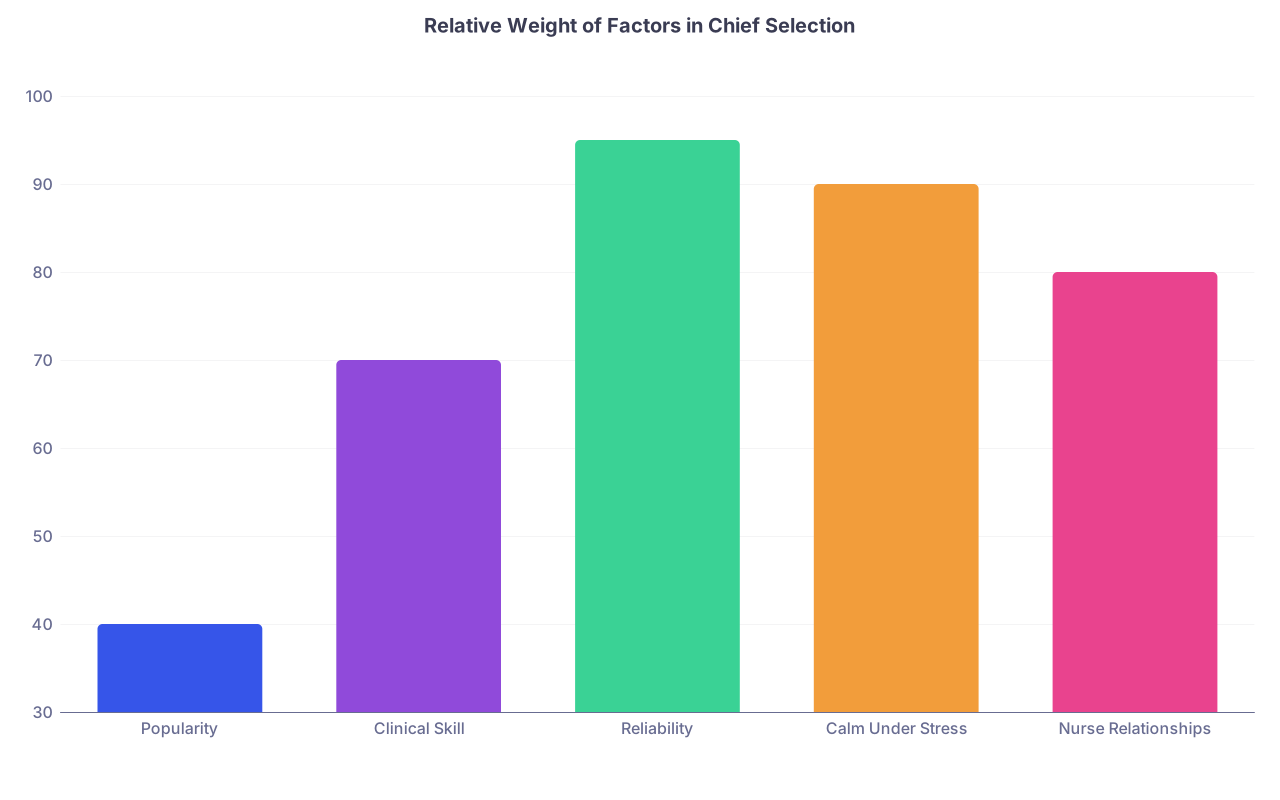
| Category | Value |
|---|---|
| Popularity | 40 |
| Clinical Skill | 70 |
| Reliability | 95 |
| Calm Under Stress | 90 |
| Nurse Relationships | 80 |
The actual selection process is closer to a long-term longitudinal assessment than a popularity contest. It just doesn’t feel that way when you only see the final announcement email.
Myth 4: “If You’re Not a Gunner or Ultra-Extrovert, You’ll Never Be Chief”
Another bad narrative: chiefs are all hyper-extroverted, committee-joining, conference-sponsoring “resident of the month” types.
The quieter reality: a lot of very effective chiefs are not loud. They just have receipts.
Programs need chiefs who:
- Answer their email
- Can read the room in a tense meeting
- Won’t set half the residency on fire with one impulsive group text
- Understand both the resident perspective and the program’s constraints
I’ve seen chiefs who were introverts that most interns barely noticed in July of PGY-1. But the senior residents and attendings all knew: “When things go bad, that’s who you want.” Those people end up chief much more often than the loud conference superstar who loves the mic but vanishes when it’s time to deal with a schedule dispute.
If you’re not the type who loves attention, your path to chief, if you want it, is simple and unglamorous:
- Be consistently good at baseline work. No chronic late notes. No chronic missed calls.
- Be the person who quietly volunteers when there’s an unassigned small task that affects everyone (sign-out templates, rotation guides, resident handbook updates).
- Handle conflicts like an adult. Listen, summarize, bring solutions, not just complaints.
- When given a small leadership role (clinic liaison, wellness rep, QI project lead), execute so well that people stop worrying about that domain.
None of that requires extraversion. It requires being less flaky than average and slightly more strategic.
Myth 5: “Resident Input Controls Everything” vs “Residents Have No Say”
You’ll hear both extremes:
“Chief is just who the residents vote for.”
“Residents’ opinions don’t matter—they do whatever they want.”
Reality sits directly in the middle and depends heavily on the program’s culture.
Common models I’ve seen:
- Faculty-driven with informal resident input
- Mixed model: resident rankings + faculty rankings combined
- Resident advisory vote that the PD can override for major concerns
Programs that have been burned by a disastrous resident-selected chief often swing hard back toward faculty control. Programs burned by a tone-deaf faculty-selected chief with no peer respect sometimes move in the opposite direction.
But there’s one quiet constant across most systems: sustained negative peer feedback kills chief chances more than anything else.
You do not need to be beloved. But if multiple co-residents have independently gone to leadership with, “I can’t work with this person, they blow up at people / throw us under the bus / manipulate schedules for themselves,” your odds are close to zero. And they should be.
On the flip side, a resident with strong peer respect but some mild faculty skepticism often gets a serious look, because chiefs have to lead residents, not just please PDs.
Myth 6: “Bias Isn’t a Big Factor” vs “It’s All Bias”
Bias absolutely exists in chief selection. Gender, race, accent, training background, IMG vs AMG, personality stereotypes—all of it can warp who gets seen as “leadership material.”
I’ve heard the code words in real conversations:
- “She’s a little too intense” (said mostly about women who are assertive in the same way men are “decisive.”)
- “He might be too laid-back for chief” (about residents of color more often than you’d like to admit.)
- “Not sure the nurses really like them” (sometimes weaponized from one complaint, sometimes entirely fair.)
If you pretend bias doesn’t exist, you’re not paying attention.
But here’s the contrarian part: bias doesn’t mean it’s all rigged. It means the bar is different and sometimes higher for some groups—and that programs that care about equity are actively trying to counterbalance that, with varying success.
There’s also a brutal flip side: some residents blame bias for outcomes that are actually about behavior and performance. I’ve seen residents with documented professionalism problems tell interns, “They didn’t pick me because I’m [insert identity].” When you’ve also seen their HR file, that’s not the whole story.
Both things can be true:
- Structural and interpersonal bias skew who is seen as “safe” or “chief-like.”
- Not every denial is because of bias; sometimes it’s because of legitimate, observed behavior patterns.
The only honest way to think about this is probabilistic, not emotional. Certain identities and styles have to be noticeably better and more consistent to get the same level of trust. That’s unfair. It’s also what many are up against.
What Actually Predicts Chief: The Boring Truth
Strip away myths, politics, and anecdotes, and what actually predicts chief resident selection looks more like this:
- You’ve been doing the chief job informally for at least a year. Juniors ask you for help. Co-residents ask you to mediate. Attendings rely on you to stabilize the team.
- You’re not a headache. No repeated professionalism flags. No chronic lateness. No pattern of “someone else will fix it.”
- You handle feedback without spiraling or retaliating. PDs will not give you power if they think you’ll weaponize it.
- You can see both sides: resident suffering and system constraints. Chiefs who only ever say “the program sucks” or “residents need to grow up” burn out fast.
- When you mess up (because you will), you own it, fix it, and don’t repeat the exact same mistake three times.
If you want a quick mental check, ask yourself this: if your program suddenly had to staff a 24/7 resident-run crisis line tonight, would you be the person at least a few attendings and residents would nominate to hold the phone?
If yes, your odds of chief—if positions and timing line up—are higher than you think. If no, threatening to “go somewhere that appreciates me” is not going to fix it.
Can You Actually Influence Your Chances?
Yes. But not with the tactics residents love to overvalue.
Things that don’t move the needle as much as you think:
- Showing off in conference
- Dropping PD’s name constantly
- Collecting meaningless “leadership roles” you never actually did work in
- Being loud on social media about how much you “love your program”
Things that quietly matter a lot:
- When the service is drowning, do you step up or vanish? People remember the night you stayed late when nobody asked.
- When a co-resident is in conflict with a nurse, do you escalate it or de-escalate? Chiefs are de-escalators.
- When a new policy rolls out that everyone hates, can you translate it in a way residents can tolerate without throwing leadership under the bus?
- Do you actually finish boring admin tasks when given them—on time, without three reminders?
One PD once put it very simply in a meeting I sat in:
“I’m not looking for the star. I’m looking for the person I don’t worry about at 2 am.”
That’s chief in one line.
The Short Version
Three points, no sugar-coating:
- Chief resident is rarely a pure “favorite” prize; it’s a risk-management hire based on years of accumulated behavior, not one year of charm.
- Reliability, calm under pressure, peer and staff trust, and low drama beat raw intelligence and superficial popularity almost every time.
- Bias and politics exist, but they operate on top of performance, not instead of it; if you want a shot at chief, act like a chief long before anyone gives you the title.


