

The worst time to “suddenly become a leader” is the year you apply for fellowship. If you’re building leadership projects during application season, you’re already late.
You’re in residency. You’re busy, tired, and squeezed from both ends. That’s exactly why you need a timeline for leadership that doesn’t implode right when ERAS opens.
You’re not just asking, “What leadership should I do?”
You’re really asking, “When do I start, scale, and showcase leadership so it actually matters for my fellowship application?”
Let’s walk the full arc: from 18 months before ERAS to Match Day. Month-by-month, then zooming into weeks when it gets tight.
Big Picture: Leadership vs Fellowship Timeline
Before we go granular, lock in this simple alignment:
Programs care about 3 leadership things:
- Can you move people or systems, not just yourself?
- Can you finish what you start?
- Is there a story that matches the fellowship’s priorities?
You have 3 time windows:
- Build – start projects, pilot ideas
- Prove – generate outcomes, present, publish, or at least complete
- Showcase – letters, ERAS entries, interviews
If your “project” begins 3 months before ERAS opens, you will not have data, outcomes, or letters that matter. You’ll have intentions. And reviewers have zero patience for intentions.
So we back up. Hard.
18–12 Months Before ERAS: Positioning and Quiet Moves
This is usually mid PGY-2 for 3-year residencies (IM, Peds, EM, etc.) or early PGY-3 for 4-year residencies (Med-Peds, some Anesthesia categories).
At this point you should stop randomly volunteering and start aiming your leadership at your future fellowship.
Step 1: Define Your Leadership Angle (1 week of thinking, not months)
You do not have time for 10 scattered “leadership things.” You need 1–2 threads that line up with your target field.
Examples:
- Applying GI → nutrition pathway, colon cancer screening QI, endoscopy efficiency
- Applying Cards → chest pain pathway, HF clinic transitions, EKG curriculum for interns
- Applying Heme/Onc → chemo safety, palliative care triggers, resident education in cancer pain
- Applying Pulm/CC → ICU rounding structure, sepsis bundle compliance, post-ICU clinic
Choose one primary lane:
- Systems/QI leader
- Education/curriculum leader
- Research team coordinator / trial lead
- Advocacy/community program lead
Then one backup. That’s it.
At this point you should:
- Write down 2–3 fellowship programs you respect and Google:
- “fellowship + quality improvement”
- “fellowship + curriculum”
- “fellowship + community outreach”
- Look for repeated themes: patient safety, health equity, advanced procedures, education.
That’s your signal.
15–12 Months Before ERAS: Pick and Launch Your Core Project
Now you’re in the project selection and buy-in phase. This is where most residents stall, because they “wait for the perfect idea.” That’s a mistake.
Month 15: Identify a Feasible Project (2–3 weeks)
At this point you should:
- Have 20–30 minute conversations with:
- Your program director
- One senior resident who matched where you’d like to go
- One faculty member in your target subspecialty
Ask them, bluntly:
- “If you were me, trying to get into [subspecialty] fellowship, what is the one leadership project you’d start now?”
- “What has actually impressed selection committees in the last 2 years?”
Then you pick something with:
- A clear start and end point within 9–12 months
- At least one faculty sponsor who cares
- Direct tie-in to patient care, education, or systems
Bad choice: “revamp residency wellness entirely.”
Better: “pilot a structured debrief for night float 1x/week for 3 months, measure burnout scores, then present.”
Month 14–13: Formalize and Get Approvals (2–4 weeks)
At this point you should:
- Draft a 1-page proposal with:
- Aim: “Increase X from A to B by Date”
- Stakeholders: nurses, residents, APPs, admin
- Timeline: 6–9 months in 2–3 phases
- Outputs: poster, presentation, protocol change, curriculum materials
- Meet with your sponsor and refine scope down. You’re almost always too ambitious initially.
- Get:
- QI committee approval if needed
- IRB screening if publishing
- Buy-in from at least 1–2 co-residents or nurses (do not lead alone if you can avoid it)
If you don’t have a signed-off, scoped-down project by 12 months pre‑ERAS, you’re already behind schedule.
12–8 Months Before ERAS: Build Phase – Heavy Lifting
This is the work window. Real change, data collection, herding cats. And you’re still on wards, nights, clinics.
The goal in this block:
Move from “good idea” to “something measurable is happening.”
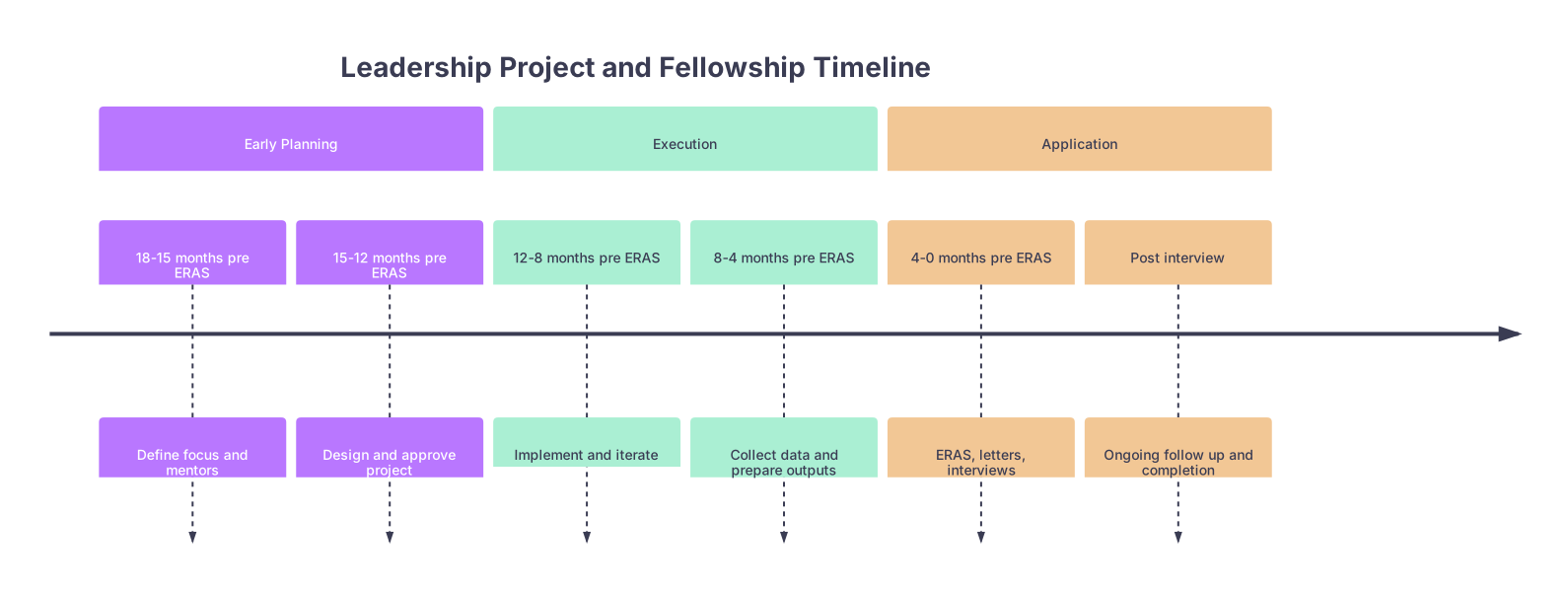
| Period | Event |
|---|---|
| Early Planning - 18-15 months pre ERAS | Define focus and mentors |
| Early Planning - 15-12 months pre ERAS | Design and approve project |
| Execution - 12-8 months pre ERAS | Implement and iterate |
| Execution - 8-4 months pre ERAS | Collect data and prepare outputs |
| Application - 4-0 months pre ERAS | ERAS, letters, interviews |
| Application - Post interview | Ongoing follow up and completion |
Months 12–10: Pilot and Prove You Can Execute
At this point you should:
- Start small-scale implementation:
- One ICU, not all ICUs
- One clinic half-day, not the entire outpatient system
- Set two or three simple metrics and start baseline collection:
- Process metric (e.g., % of patients getting evidence-based order set)
- Outcome or surrogate (readmission rate, LOS, documentation completeness)
- Engagement metric (attendance at new conference, survey completion)
This is where you demonstrate actual leadership behaviors:
- Delegating tasks to co-residents
- Running short, efficient meetings
- Handling resistance without getting defensive
- Adjusting the plan when frontline staff tell you “this will never work this way”
You do not need perfection. You need motion, structure, and documentation.
Months 10–8: Iterate and Show Reliability
At this point you should:
- Have:
- A working version of your intervention
- Started collecting pre/post or baseline data
- At least one brief update email or huddle with stakeholders
- Send your mentor a 1-page progress summary:
- What you did
- Early numbers
- Barriers and fixes
- Planned next steps + rough abstract/poster idea
Why this timing matters:
Faculty decide who to write strong letters for based on who is moving things forward now, not based on your vague promises 3 months before ERAS.
They need to see you:
- Keep commitments despite night shifts
- Communicate clearly
- Bring them usable data they can brag about in a letter later
8–4 Months Before ERAS: Convert Leadership Into Application Material
You’re now approaching late PGY-2 / early PGY-3 (for 3-year programs). ERAS is about half a year away.
At this point you should pivot from pure execution to visible outputs. Not stopping the work—just shaping it into something fellowship programs recognize: talks, posters, formal roles.
Months 8–6: Lock in Outputs and Titles
At this point you should:
- Decide on 1–2 primary outputs:
- Abstract to your local/regional conference
- Hospital QI day presentation
- Residency noon conference / grand rounds
- Educational curriculum with named role (e.g., “Resident Director for Night Float Debrief Series”)
- Apply to:
- Local or regional subspecialty meetings if the calendar fits
- Institutional events—even if it’s just your department’s research day
You’re trying to convert:
“Led a project” → “Presented results and influenced practice.”
Also:
- Negotiate official titles where justified:
- “Resident QI Lead – Sepsis Pathway”
- “Chief Resident for Education” (if applicable, obviously)
- “Clinic Workflow Champion for Heart Failure Readmission Initiative”
Do not be shy. Titles matter in ERAS leadership sections. They frame your narrative.
Months 6–4: Prepare for ERAS Wording and Letters
ERAS is coming. You can’t be scrambling to define your own leadership story in May/June.
At this point you should:
Draft ERAS activity bullets now, while details are fresh:
- 1 line: what the project is
- 1–2 lines: what you specifically led
- 1 line: outcomes (even preliminary)
Example:
- “Led resident–nurse sepsis alert redesign in MICU, coordinating 12-person working group and implementing new checklist; improved appropriate bundle use from 52% to 78% over 4 months.”
Meet with your project mentor and say directly:
- “I’m planning to apply in this cycle and would really value a letter that speaks to my leadership on [project]. Are you comfortable commenting on that?”
If they hesitate, do not force it. Pick someone else.
You want letters that say:
- “She ran the project meetings when I could not be there.”
- “He was the resident people went to when the new pathway had issues.”
- “She aligned nursing, case management, and physicians—no small feat in our unit.”
4–1 Months Before ERAS Opens: Finalize, Document, Don’t Start Anything Crazy
Here’s where people panic and do dumb things: they launch a brand-new initiative in May thinking it’ll impress programs in September. It will not.
At this point you should:
- Stop starting new major projects.
- Finish, stabilize, and package what you already started.
Month 4–3: Tighten Up and Capture Data
You’re in the polishing phase.
At this point you should:
- Freeze the main structure of your project. No more big design changes.
- Clean your data:
- Final pre and post numbers
- Clear graphs or run charts
- Short summary in ½–1 page
- Decide on:
- “Final” practice change (even if modest)
- Written protocol, order set, or curriculum document saved somewhere official (shared drive, intranet)
Ask your mentor:
- “If I disappeared tomorrow, is this sustainable?”
If not, either hand off or streamline until the answer is yes. Programs like sustainable systems change leaders, not personal heroics that collapse when you graduate.
Month 3–1: Align With ERAS Details
At this point you should:
- Confirm:
- Abstract submissions (even “submitted” is usable if honest)
- Conference dates (if after ERAS, label them “accepted for presentation” when appropriate)
- Any draft manuscripts (do not lie; label as “in preparation” cautiously)
- Lock in leadership‑relevant ERAS entries:
- Experiences
- Memberships (e.g., leading a fellowship‑aligned interest group)
- Teaching roles related to your project
Have your mentor:
- Review your leadership descriptions for accuracy and emphasis
- explicitly mention your project and leadership in their letter (ask: “Would you be willing to highlight my work on [X] in your letter?”)
ERAS Season (Application Submission → Interviews): Messaging and Maintenance
Once ERAS opens and interviews start, your leadership work changes flavor. Less building, more storytelling and steady follow‑through.
ERAS Submission Month
At this point you should:
- Have all leadership roles clearly:
- Titled
- Dated (start and “ongoing” or planned end)
- Connected to your fellowship interest in your personal statement
In your personal statement:
- Do not list 17 things.
- Use one flagship project to demonstrate how you think and lead.
- Problem you saw
- Stakeholders you engaged
- Resistance you encountered
- How you handled setbacks
- What changed
Programs want to know:
“Will this person come here and actually build/lead something, or just talk?”
Interview Season: Tell the Right Leadership Story, Chronologically
During interviews you will be asked variants of:
- “Tell me about a time you led a project or team.”
- “What are you most proud of in residency?”
- “How have you improved care in your current institution?”
At this point you should:
- Have a 3–4 minute, chronological narrative of your main leadership project:
- Spark → Design → Execution → Outcomes → Next steps
- Be honest about challenges:
- Turf issues
- Scheduling chaos
- Data hassle
- Faculty who initially didn’t care
Your tone should show:
- Ownership, not martyrdom
- Flexibility, not rigidity
- Patient-centered and system-aware thinking, not just CV padding
After Interviews and Through Match Day: Close the Loop
Here’s what most residents ignore: committees talk about “finishing capacity.” They want to know if you wrap things up or leave loose ends.
At this point you should:
- Actually complete the QI cycle or curriculum block you started:
- PDCA or PDSA cycle closed
- Final data summary sent to stakeholders
- Short handoff plan written
Send a brief email to your mentor and key stakeholders:
- Thank them
- Provide final numbers and a 3–5 sentence summary
- Offer to be available post‑residency if needed
This is not just politeness. It:
- Gives faculty concrete language for last‑minute calls or emails from fellowship PDs
- Makes you the resident people remember as “the one who actually finished their project”
Parallel Timeline: Sample Month‑by‑Month Map
To make this painfully clear, here’s what a clean 18‑month leadership timeline around fellowship apps can look like.
Assume ERAS opens September PGY‑3.
| Time Frame (relative to ERAS) | Leadership Focus | Fellowship Focus |
|---|---|---|
| -18 to -15 months | Choose lane, identify mentors | Clarify subspecialty interest |
| -15 to -12 months | Design and approve project | Light reading on programs |
| -12 to -8 months | Implement and collect baseline data | Build relationships with subspecialty faculty |
| -8 to -4 months | Iterate, generate outputs (abstracts, talks) | Draft PS themes, discuss letters |
| -4 to -1 months | Finalize data, stabilize project, confirm titles | Finalize ERAS entries, proof materials |
| 0 to +4 months | Maintain project, complete cycles, handoff | Interviews, leadership-focused storytelling |
Notice there’s no line that says, “Start major new project at -2 months.” Because that’s how you burn out and impress no one.
What If You’re Late?
You might be reading this 9 months before ERAS, not 18. Fine. Then you compress—but you do it intelligently.
If you’re at 9–10 months pre‑ERAS:
- Choose a smaller‑scope project that can realistically show:
- Measurable change in 4–6 months
- A clear leadership role for you
- Focus more on:
- Educational leadership (curriculums can move faster than hospital policy)
- Leading an existing initiative forward rather than building from zero
- Example compressed plan:
- Month 10: Take over as resident lead for existing sepsis order set rollout
- Months 9–7: Run weekly check‑ins, track compliance, create quick reference tool
- Months 7–5: Present at resident conference, submit internal QI abstract
- Months 5–3: Stabilize process, get mentor letter that emphasizes your role in “turning around a stalled initiative”
It’s still valid leadership if you take something stuck at 20% completion and drive it to the finish line. Committees respect that.
Weekly Rhythm When Things Get Busy
When rotations are brutal, leadership dies by neglect. To avoid that, commit to a bare‑bones weekly cadence.
During build/iterate phases, each week you should:
- Spend 60–90 minutes protected on:
- Updating your data tracker
- Sending 1–2 concise emails to stakeholders
- Drafting 1–2 slides or figures
- Touch base with your mentor at least monthly:
- Send them a 3–5 bullet update before each meeting
This is how you maintain leadership momentum without losing your mind on nights and ICU.
Today: One Concrete Move
You do not need a grand vision today. You need a timestamped next step.
Here’s what to do right now:
- Open your calendar and go 12–18 months before your ERAS date.
- Block one 30‑minute slot this week titled: “Fellowship leadership project – pick my lane.”
When that block comes, sit down and answer in writing:
“What is the one leadership story I want fellowship interviewers to know about me?”
That answer—today—puts a stake in the ground. Everything else on your timeline builds from there.


