

The way most residents “decide” to be chief in PGY3 is backwards. By the time everyone starts saying, “You’d be a great chief,” the real selection work is already done.
If you’re in PGY2 winter and even half-serious about being chief, you’re already in the evaluation window. At this point you should be thinking less “Do I want it?” and more “What will my PD and cores see between now and June?”
Let’s lay it out chronologically.
Big Picture: Your PGY2-Winter-to-PGY3-Spring Timeline
You’re not applying to a posted job. You’re building a clean, observable pattern.
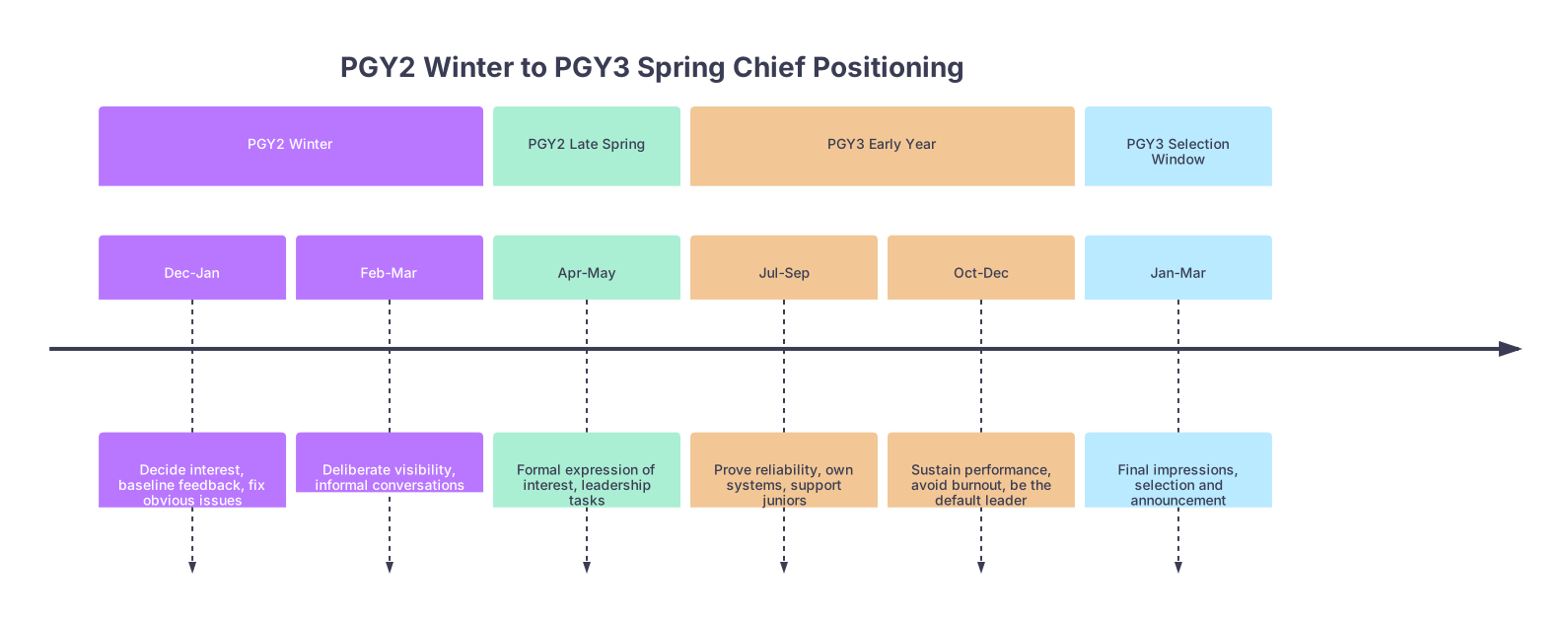
At a high level, from now until PGY3 spring, the calendar looks like this:
| Period | Event |
|---|---|
| PGY2 Winter - Dec-Jan | Decide interest, baseline feedback, fix obvious issues |
| PGY2 Winter - Feb-Mar | Deliberate visibility, informal conversations |
| PGY2 Late Spring - Apr-May | Formal expression of interest, leadership tasks |
| PGY3 Early Year - Jul-Sep | Prove reliability, own systems, support juniors |
| PGY3 Early Year - Oct-Dec | Sustain performance, avoid burnout, be the default leader |
| PGY3 Selection Window - Jan-Mar | Final impressions, selection and announcement |
Now let’s walk it month by month, with what you should be doing at each point.
December–January of PGY2: Decide You’re In (or Out)
At this point you should stop “seeing how things go” and decide whether you’re actively positioning for chief. Waffling is obvious. Program leadership can smell it.
Week 1–2: Reality check and self-audit
Sit down and grade yourself like your PD will.
Use three buckets:
- Clinical reliability
- Team behavior
- Program involvement
Be brutal. If any of these are true, you’re starting from behind:
- You’re known for showing up right at sign-out and leaving the second it ends
- You complain openly about the schedule in front of interns or med students
- You routinely turn things in late (evaluations, procedure logs, duty hours)
- Nurses roll their eyes when they see your name on the list
Fixing these in winter is still possible. Waiting until PGY3 is not.
At this point you should:
- Pull your last 6 months of evaluations. Look for recurring words: “organized,” “calm,” “defensive,” “scattered,” “team player.” That’s your brand.
- Ask one trusted faculty member, “What would I need to change if I wanted to be considered for chief?” Then shut up and write down exactly what they say.
Week 3–4: Quietly stabilize your weak spots
This isn’t the time for dramatic gestures. You’re building a streak.
Pick 2–3 concrete behaviors and lock them in:
- Always pre-round on time and be ready at start-of-day rounds
- Close every loop you open (consults, follow-ups, patient/family calls)
- Turn in every required item early for 4 straight weeks
You’re trying to go from “good resident, occasionally messy” to “annoyingly reliable.” Chiefs get chosen because PDs know they won’t have to babysit them.
February–March of PGY2: Become the De Facto Senior
By late winter, eyes are on PGY2s. Faculty start informally asking, “Who could run this place next year?”
February: Act like a chief even when no one says the word
You do not need a title to behave like a chief.
On every rotation, at this point you should:
- Run the list. Not just your patients. The whole team’s. Help the intern whose notes are lagging. Ask “What’s our discharge plan?” before attendings do.
- Protect your juniors in front of attendings and give them feedback privately. Chiefs are shields, not megaphones.
- Solve small system problems without drama.
- Pager not working? Don’t rant on group text. Get it fixed, then share the new process.
- Transfer chaos? Build a quick checklist and hand it to your co-residents.
Concrete example from places I’ve seen: The resident who started printing a simple morning list with key labs for the whole team—unprompted—was talked about as “leadership material” for months.
March: Start the conversation, carefully
By early spring, many programs are already thinking about next year’s chiefs.
Who you should talk to, and when:
- Your associate program director / PD (short meeting, 15–20 minutes)
- Timing: Mid–late March
- Script-level simple: “I’ve been thinking a lot about leadership and about this program specifically. I’d be interested in being considered for chief and would appreciate any feedback on what you’d need to see from me between now and the final decision.”
The words “what you’d need to see” are deliberate. You’re asking for observable behaviors, not vague qualities.
Write down what they say. Then actually do it. I’ve seen PDs test residents with specific asks:
- “I’d like you to take point on the new night float orientation”
- “We need someone to clean up the sign-out template”
That’s not busy work. That’s a low-stakes chief audition.
April–May of PGY2: Visible Projects and Leadership Reps
Now you shift from “good senior” to “obvious choice.”
Early April: Pick 1–2 strategic projects
Not ten projects. Not another QI poster no one remembers. One or two things that directly touch resident life.
Good examples:
- Fixing something everyone hates:
- A broken jeopardy system
- A chaotic days-off request process
- A clunky sign-out template
- Building something that will outlast you:
- A resident orientation handbook that actually gets used
- A simple onboarding session for new interns on “how to survive nights here”
Bad examples:
- Abstract QI nobody feels
- Extra committee that never meets
- Research project with a year-long timeline and no visible local impact
At this point you should be able to answer, in one sentence, “What have you done that made this program run better?”
Late April–May: Show you can manage across, not just up
Chiefs don’t just impress attendings. They hold their peers together.
On your services and in conferences:
- Stop undercutting your co-residents in front of faculty, even when they’re wrong
- Be the one who cools down drama in the resident room, not the one who escalates it
- When there’s a painful schedule change, you don’t have to love it, but don’t lead the mutiny
Your PD will absolutely ask current chiefs and senior residents for input. You want the answers to be some version of:
- “They’re solid.”
- “People listen to them.”
- “I’d trust them with the schedule.”
If instead the vibe is “great clinically but toxic when things don’t go their way”—you’re done.
June–July: Transition to Senior and Prove You Can Run a Team
For many programs, PGY3 starts July 1. By this time, your file isn’t a secret. People have opinions.

June: Finish PGY2 strong, no last-minute implosions
End-of-year fatigue is real. This is when some otherwise strong residents flame out with:
- Snapping at nurses
- Cutting corners on notes and orders
- Skipping didactics entirely “because I’m tired”
You cannot afford a weird, angry June. At this point you should:
- Show up to conferences, on time, awake
- Keep your evaluations steady or improved—especially from nurses and mid-levels
- Avoid high-profile drama: email fights, social media tantrums, blowups at sign-out
July: First month as senior = live audition
This is prime chief-evaluation footage. PDs and cores pay attention.
On day 1–2 of being a senior:
- Set expectations with your interns:
- “Here’s how I like to run rounds.”
- “Here’s how we’ll handle cross-cover and sign-out.”
- “Text me early if you’re drowning; I don’t want surprises at 4 p.m.”
Throughout the month:
- Keep the list moving. Chiefs are logistically competent.
- Teach daily, even for 5 minutes. Chiefs are educators, not just workhorses.
- De-escalate family and staff conflicts instead of dumping them on the attending.
If you look miserable and overwhelmed as a senior, no one is going to imagine you as chief solving everyone else’s problems.
August–October: Own Systems, Not Just Your Patients
By late summer, the “shortlist” for chiefs usually exists, even if no one tells you that out loud.
This is where you separate yourself.
August–September: Become the resident people go to “for how things work”
At this point you should be visibly good at:
- The schedule: understanding how it’s built, where backup is, who’s on nights
- The rules: duty hours, sick call, remediation processes, conference requirements
- The hidden curriculum: which attendings expect what, how to frame a difficult conversation with the PD, who to loop in for what
That doesn’t mean gossip. It means you know the structure and you don’t weaponize it.
Practical steps:
- Offer to help with intern orientation or mid-year check-ins
- Lead or co-lead a noon conference or board review series
- Take on one recurring administrative task (e.g., M&M case collection, didactic attendance tracker) and do it consistently well
| Category | Value |
|---|---|
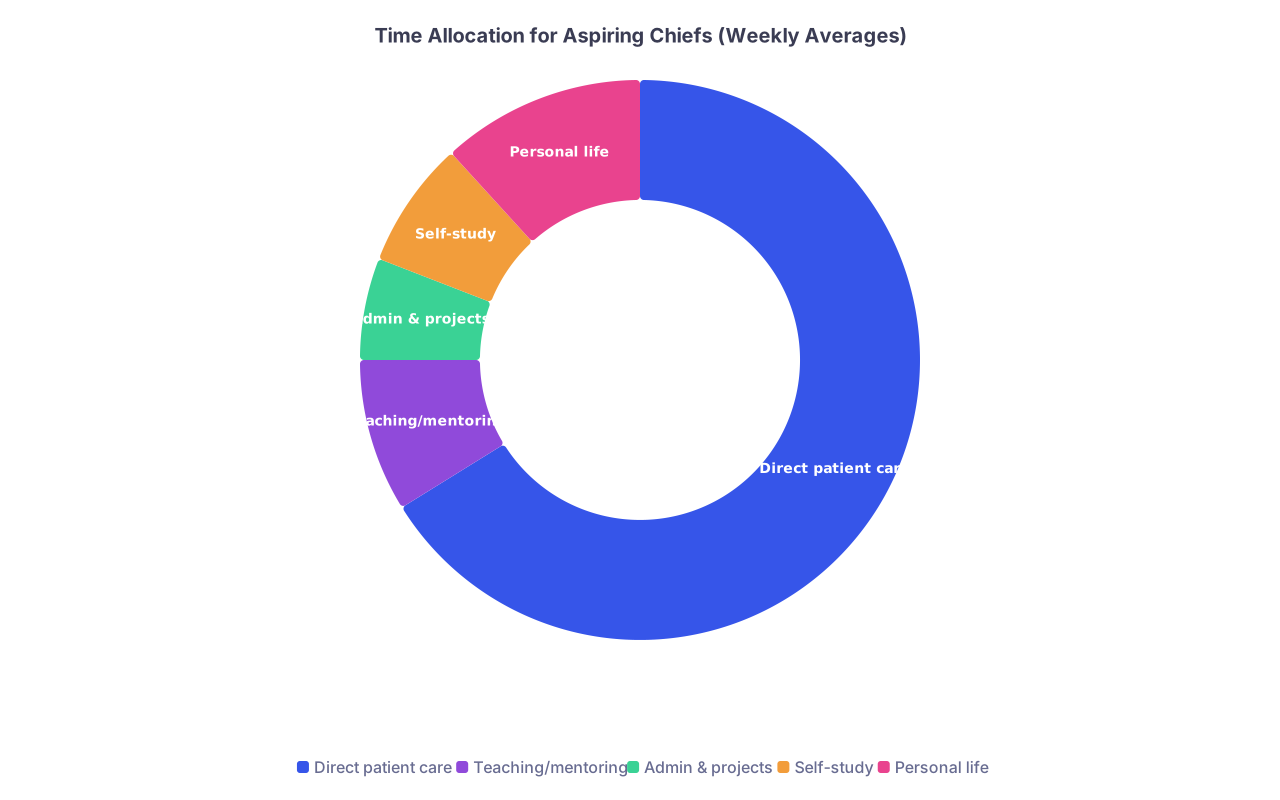
| Direct patient care | 45 |
| Teaching/mentoring | 6 |
| Admin & projects | 4 |
| Self-study | 5 |
| Personal life | 8 |
The chart above is roughly what I see in real life. If you’re aiming for chief, your “admin & projects” block will grow a bit, but if “personal life” drops to zero you’ll burn out before selection.
October: Maintain your brand under stress
By fall, residents are tired, census is high, and flu/COVID/RSV hit. PDs watch very carefully who becomes toxic in this environment.
At this point you should:
- Avoid the “dark cloud” label—chronic negativity, sighing constantly, dramatic eye-rolling
- Still treat students like humans, not extra work
- Communicate bad news clearly but calmly (schedule changes, coverage needs, new policies)
When a last-minute sick call happens and the team is drowning, the resident who steps in once without theatrics is remembered. You just don’t want to become the permanent martyr.
November–January of PGY3: The Selection Window
Real talk: in many programs, by January the chief decisions are 80–90% made. The final months are mostly confirmation.
| Program Type | Informal Shortlist | Formal Discussion | Announcement |
|---|---|---|---|
| Large IM program | Aug–Oct PGY3 | Dec–Jan PGY3 | Feb–Mar PGY3 |
| Small community IM | Jul–Sep PGY3 | Nov–Dec PGY3 | Jan–Feb PGY3 |
| Surgical programs | Earlier, PGY2-3 | Rolling | Variable |
| EM programs | Late PGY2–PGY3 | Nov–Jan | Feb–Mar |
Check how your program actually does it—ask current chiefs when they heard.
November–December: Close the loop with leadership
If you expressed interest back in spring and never followed up, you look unfocused. Don’t do that.
Schedule a brief check-in:
- “I wanted to follow up on our conversation from earlier this year about chief. I’ve worked on X, Y, and Z that we discussed. Is there anything else you’d want to see from me in the coming months?”
Keep it short. Professional. Not needy.
What you’re doing here:
- Showing follow-through
- Giving them a chance to voice any remaining concerns
- Signaling that you’re still interested, without cornering them into revealing decisions
January: Be the obvious, low-risk choice
By now, the question in PD meetings often isn’t “Who’s the most brilliant?” It’s “Who can we trust not to implode next year?”
At this point you should have:
- Zero recent professionalism issues
- A track record of solving at least one real program-level problem
- Strong support (or at least no resistance) from:
- Current chiefs
- Senior residents
- A handful of core faculty
If your name comes up and people say “great clinically but…” followed by “always late,” “complains constantly,” or “difficult with staff,” you’re in trouble.
How to Signal Interest Without Looking Desperate
This part trips up a lot of residents. They either campaign obnoxiously or act so aloof no one realizes they care.
Here’s the middle path.

Do this
- Tell your PD/APD directly you’re interested—as a professional career goal, not as a popularity contest
- Back that up with specific steps you’ve taken: teaching, projects, helping with schedules or orientation
- Support your co-residents publicly. Chiefs who look like they’re on a solo mission worry PDs.
Don’t do this
- Don’t repeatedly ask “Have you decided chiefs yet?”
- Don’t undercut other potential chiefs (“Yeah, but they’re so disorganized…”)
- Don’t try to win by volume—sending 27 project ideas, spamming the WhatsApp, jumping into every email thread
If you feel yourself performing “chief-y” behavior mainly when leadership is watching, you’re doing it wrong. Nurses, interns, and co-residents will tell the truth about you when asked.
What If You Have Red Flags?
Plenty of future chiefs have scars: a rough PGY1 eval, a formal remediation, a loud conflict. That alone doesn’t kill your chances. Hiding it does.
At this point you should:
- Bring it up once with your PD:
- “I know I struggled with X in PGY1. Since then I’ve done A, B, and C. Is that concern behind us, or is there more I need to do?”
Then your job is to stack 6–12 months of clean, boring reliability on top of that.
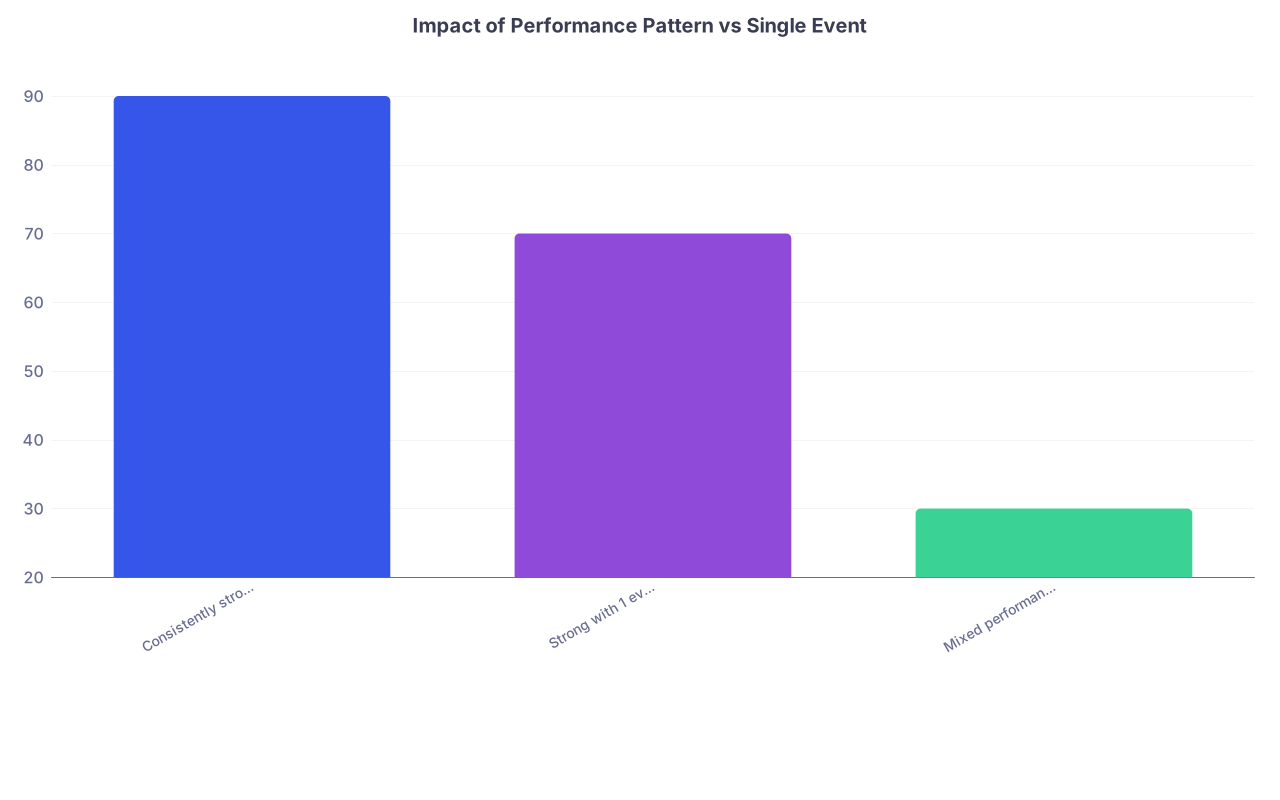
Patterns beat events. A single meltdown is survivable. A reputation is not.
| Category | Value |
|---|---|
| Consistently strong | 90 |
| Strong with 1 event | 70 |
| Mixed performance | 30 |
The numbers are illustrative, but the idea holds: PDs care far more about your pattern than one bad month.
Quick Month‑by‑Month Checklist (PGY2 Winter Onward)
Print this mentally and run through it every few months.

PGY2 December–January
- Decide if you actually want to be chief
- Self-audit using evaluations and honest feedback
- Fix the obvious: punctuality, documentation, attitude
PGY2 February–March
- Start acting like a de facto senior and team leader
- Have an initial, low-key conversation with PD/APD expressing interest
- Take on 1–2 small but real system-fixing tasks
PGY2 April–May
- Choose one meaningful program-level project
- Demonstrate you can work across the resident class, not just above interns
- Avoid unnecessary drama—be seen as even-keeled and fair
PGY2 June–July (PGY3 start)
- Finish PGY2 without last-minute professionalism hits
- Run your first senior month like an audition: organized, kind, firm
- Teach daily, manage the list, protect your team
PGY3 August–October
- Become the person people ask, “How does this work?”
- Consistently deliver on any admin tasks you’ve taken on
- Maintain positivity (or at least neutrality) under stress
PGY3 November–January
- Follow up with leadership once, professionally
- Keep performance stable—no late surprises
- Support your peers, including those also being considered for chief
The Bottom Line
Three things to walk away with:
- Chief is decided by patterns, not a single heroic month. Start in PGY2 winter and build a consistent, boringly reliable track record.
- At each stage—PGY2 winter, spring, early PGY3—you should be adding one layer: fix your weak spots, show visible leadership, then own systems and culture.
- Quiet competence plus strategic visibility beats loud campaigning every time. Be the resident everyone already treats like a chief before you ever get the title.


