

The way chief residents actually get selected is a lot more political than anyone tells you out loud.
Everyone talks about “leadership,” “professionalism,” and “role modeling.” Those are real, but they’re not what decides it when faculty close the door and talk candidly. I’ve sat in those rooms. I’ve heard the phrases that never make it into the handbook: “She’ll never say no,” “He’s too hot‑headed,” “I just do not want to deal with him for another year,” “Program Director will never go for her.”
You want to understand how it really works? Let’s pull the curtain back.
First: The Fantasy vs The Reality
On paper, the process is clean and noble. Residents apply or are nominated. There’s a vote. Faculty deliberate. The PD “carefully weighs” evaluations and chooses the best leaders.
Reality: both in community and academic programs, selection is driven by three non-negotiables:
- Who will make the PD’s life easier, not harder.
- Who faculty and staff can tolerate working with for another year.
- Who fits the unspoken political and branding needs of the program that year.
Everything else—scores, projects, nice essays—is tiebreaker material.
The difference between community and academic programs is not that one is pure and the other is corrupt. It’s that they’re playing slightly different games with the same pieces.
The Core Criteria Nobody Writes Down
Let me start with what always matters, regardless of setting. Because if you miss these, you’re not getting chief anywhere.
1. Reliability over brilliance
I’ve watched a PD cross someone off the chief list in 30 seconds with: “She’s great clinically but half the time I don’t know where she is.”
Programs will absolutely pick a solid, B+ resident over the brilliant, high‑ceiling diva. Chief is a logistics job first, prestige job second.
The questions faculty really ask behind closed doors:
- “Will they answer emails?”
- “Will they fix a schedule crisis at 10 pm without a meltdown?”
- “Can I trust them to not disappear when things get ugly?”
If your name is associated with missed notes, late duty hour logging, losing track of consults, you’re done. I don’t care how much research you’ve got.
2. Emotional temperature
No one calls it this. But they all feel it.
Every program knows exactly who the “emotional accelerants” are. The resident who can turn a mild annoyance into a full‑unit war in 24 hours. The one who loves drama, side chats, fueling resentment.
Those people do not become chiefs. Ever. You can be outspoken, you can advocate hard—but if you look like someone who will escalate rather than defuse, faculty will smile at you in public and kill your chief chances in private.
I’ve heard exact phrases like:
- “He’s a chaos magnet.”
- “She’s always in the middle of something.”
- “If we pick him, we’re stuck with his group of friends as the shadow leadership.”
That’s the level they’re thinking on.
3. Staff and nurse feedback (this is huge)
Nobody tells you this as a junior. But I’ve seen a strong candidate get buried because the nurse manager rolled her eyes when their name came up.
The PD will casually ask:
- “What do the nurses think of her?”
- “Any issues with him on nights?”
- “How does she treat the front desk?”
If a senior charge nurse or clinic manager says, “We love her, she’s fair,” you just jumped three spots. If they say, “He’s rude,” you might as well not bother applying.
Community Programs: The “Can I Trust You Alone?” Test
Now let’s split the tracks: community vs academic.
Community programs run on fewer people doing more work with less backup. Everyone knows everyone. Politics are local, personal, and fast.
How decisions actually get made
Here’s the usual pattern in a mid-sized community IM/FM/EM program:
- PD and APDs walk into a room with a short list of 3–6 seniors.
- They already have a favorite or two. This is based on three years of hallway impressions more than one formal “interview.”
- They ask: who is going to keep the machine running and not cause me trouble?
Sometimes there’s a resident vote. The dirty detail: in many community programs, that vote is advisory theater. PDs will absolutely override resident popularity if they think someone will be a disaster administratively.
One PD in a 12‑resident‑per‑year community IM program said it to me exactly:
“I’m the one who has to live with my chief. The residents get them for one year. I get the consequences for five.”
What community PDs secretly prioritize
In community settings, the unspoken checklist leans hard on:
Schedule survival skills
Chiefs in community programs are often the primary, and sometimes only, scheduling engine. Faculty know exactly who they call when the hospital suddenly opens a new unit or the night float quits.If you’ve ever proactively fixed someone’s schedule, swapped to cover a gap without drama, or offered to help with block scheduling, yes, they remember.
ED and hospitalist feedback
Community chiefs are effectively junior partners to local hospitalist and ED groups. Those attendings carry weight. If the ED director says, “Make her chief, she’s the only one who calls me with a plan, not a problem,” that lands.Loyalty to the program
This is more naked in community settings. They’re watching who trashes the program to students, who constantly talks about transferring, who says they “can’t wait to never work here again.”Those people do not get chief, no matter how strong their CV looks on paper.
Staying in the area
They won’t always say this out loud, but I’ve heard it plenty: “She wants to join the hospitalist group; he’s leaving for fellowship—we’ll get more long‑term value from her.” The chief job becomes a one‑year audition for a local attending job.
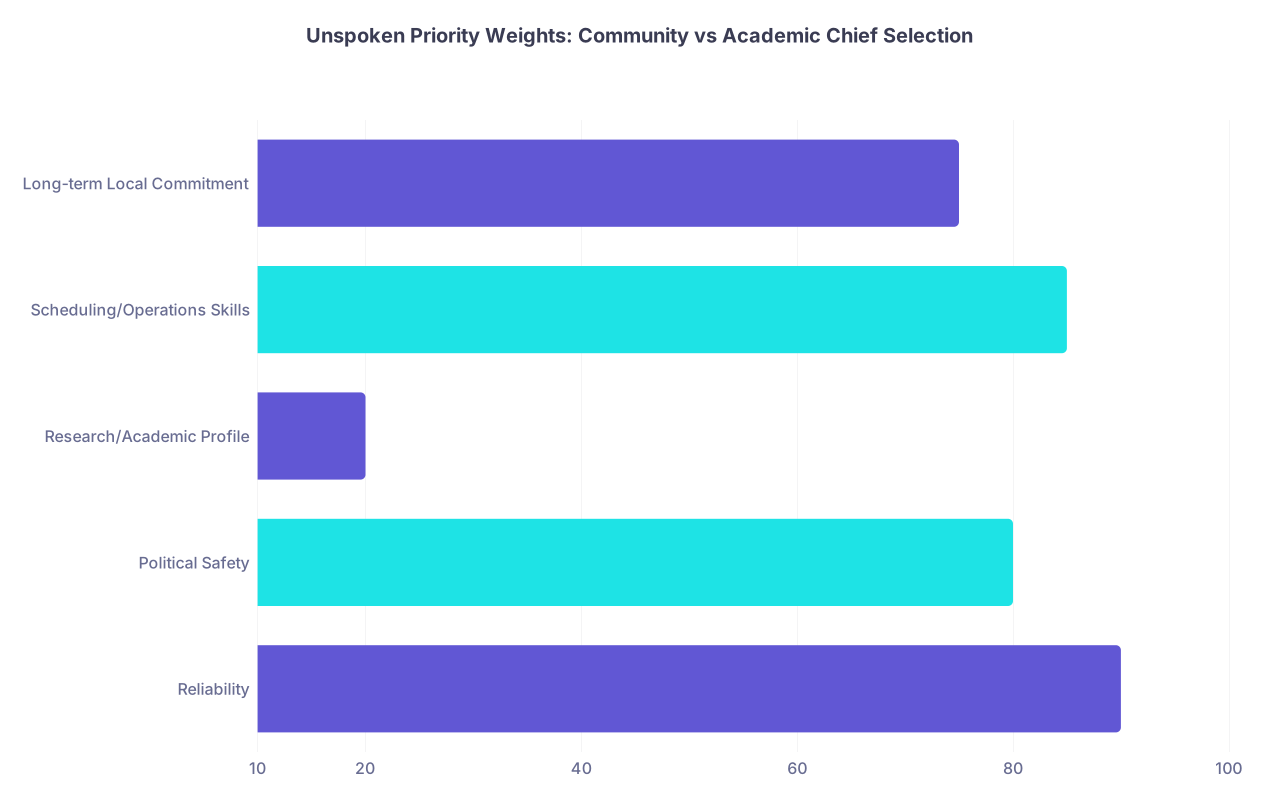
| Category | Value |
|---|---|
| Reliability | 90 |
| Political Safety | 80 |
| Research/Academic Profile | 20 |
| Scheduling/Operations Skills | 85 |
| Long-term Local Commitment | 75 |
(Those “values” reflect community weighting; we’ll contrast with academic in a minute.)
The “one more year of you” problem
In community programs, residents and faculty are already stretched. When they choose a chief, they are saying: we are voluntarily signing up for another year of this person in our face, in our inboxes, in our meetings.
So they ask:
- Will I groan when I see their name pop up?
- Will they take feedback like an adult?
- Will they bring me problems with at least one possible solution?
I’ve watched a PD eliminate a popular candidate with: “He argues with every single feedback discussion. I don’t have the energy for that every week for a year.”
That’s the community reality.
Academic Programs: The “Can You Represent Us Nationally?” Game
Academic programs are playing a double game: they need someone to run day‑to‑day operations and someone who looks good on a website, at conferences, on recruitment days.
The same core traits matter, but the weighting shifts.
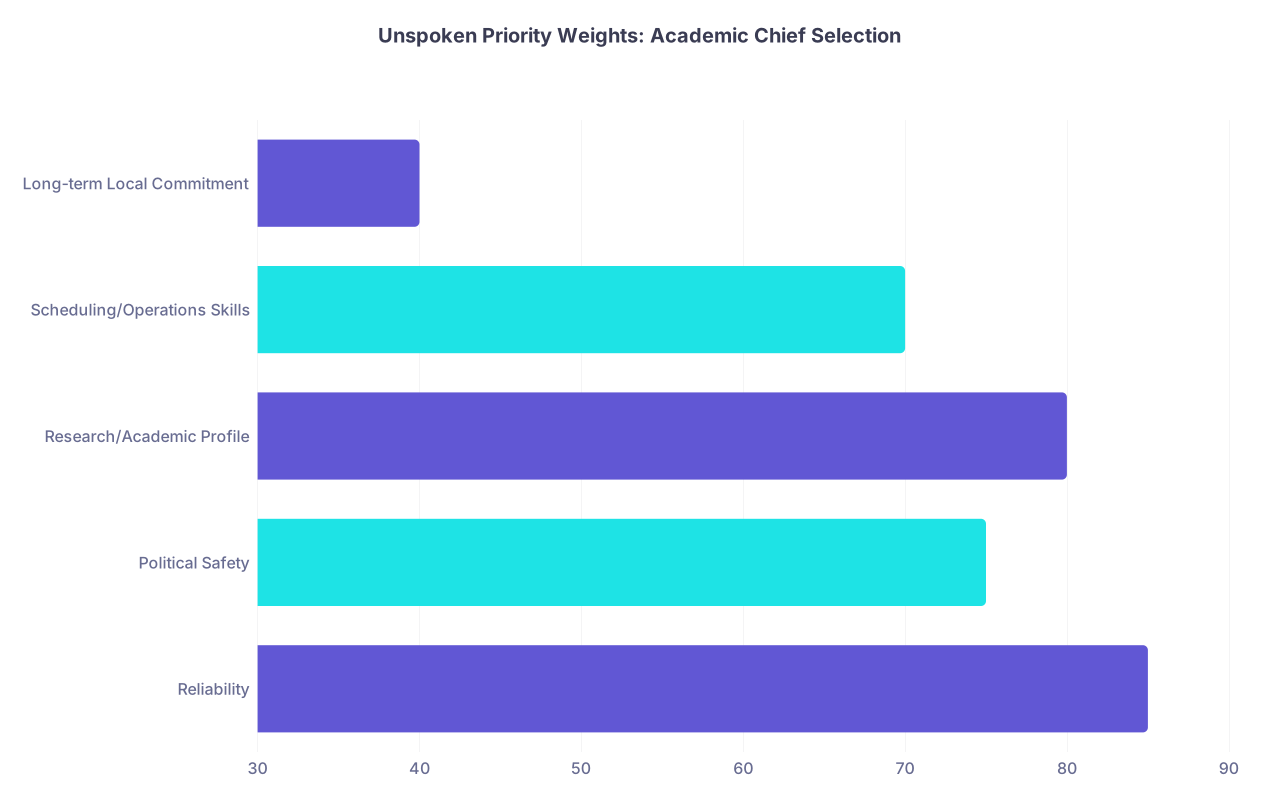
| Category | Value |
|---|---|
| Reliability | 85 |
| Political Safety | 75 |
| Research/Academic Profile | 80 |
| Scheduling/Operations Skills | 70 |
| Long-term Local Commitment | 40 |
The extra filters academic chiefs go through
In academic IM, peds, surgery, OB, anesthesia—especially at university hospitals—decisions often involve:
- PD
- Multiple APDs
- Sometimes division chiefs
- Occasionally chair input for high‑visibility roles
The discussion is less, “Who can I trust alone?” and more, “Who fits what the program wants to be this year?”
I’ve heard lines like:
- “We need a research‑heavy chief for recruitment; the last two were clinically focused.”
- “We should pick someone going into cards; it’ll help our fellowship pipeline.”
- “We do not have a single female chief next year; that’s going to look bad.”
Those comments drive final choices far more than Step scores ever will.
Academic politics: what faculty really care about
There are four invisible currencies in academic chief selection:
Branding
Chiefs become the face of the program. Their fellowship match, posters, committees, all get spun into marketing: “Look what our grads do.”Candidate A: solid clinician, no academic output, staying local.
Candidate B: decent clinician, 3 posters, first‑author paper, matched cards at a name‑brand institution.All else equal, B is getting the nod at most academic centers.
Faculty factions
This part you never see as a resident, but it’s there. Cards, heme/onc, pulm/critical care, hospital medicine—they all have their favorites.If multiple subspecialty chiefs say, “Make her chief; she’s our strongest applicant,” that stacks up. If the hospitalist group says, “We hate working with him,” that stacks up the other way.
Future faculty potential
Academic programs love turning former chiefs into junior faculty. It feeds the pipeline. They’re quietly betting on who looks like a future APD or clerkship director.I sat in one meeting where a PD said, “She’s already basically functioning like a junior faculty member. Let’s make her chief and keep her.”
Institutional politics
Sometimes the department or GME committee is pushing for visible DEI representation, or for chiefs from underrepresented groups, or for more chiefs with education fellowships. That pressure rolls downhill into the chief selection room.
Is that always fair? No. Is it happening? Yes.
Resident Votes: How Much Do They Actually Matter?
Here’s a harsh truth: the resident “vote for chiefs” process means very different things depending on the program.
In some places, especially certain academic IM or peds programs, resident input seriously influences the short list. In others, the vote is a formality—something GME wants documented.
| Program Type | Resident Vote Weight |
|---|---|
| Small Community IM/FM | Low to Moderate |
| Large Community Hospital | Moderate |
| Mid-tier Academic IM/Peds | Moderate to High |
| Big-name University IM | Variable by PD |
| Surgical Subspecialties | Usually Low |
I’ve seen:
- A medium academic IM program where resident rankings were followed exactly, unless there was a red flag.
- A community program where the PD literally said, “I’ll look at the vote after we decide. I don’t want it to bias me.”
- A surgical program where there was no vote at all—chiefs were simply “tapped” by the chair and PD.
Here’s the inside line: resident popularity can kill you more easily than it can save you.
If you’re deeply disliked by your class, it becomes risky for a PD to pick you. They don’t want a mutiny. But if you’re universally liked and faculty don’t trust you, you still won’t get picked.
Popularity is permission, not the decision.
The Stuff That Quietly Sinks Candidates
People always ask, “What do I need to do to be chief?” Wrong question.
The more useful question is: “What are the things that quietly get people crossed off the list long before the ‘selection process’ begins?”
Here’s the real shortlist from what I’ve actually seen:
Chronic complaining without solutions
Every program has residents who can point out every flaw in the schedule, curriculum, EMR, cafeteria. If you’re that person, pay attention to how you bring it up.
If your pattern is:
- Complain loudly
- Offer no fix
- Stir up peers
- Dump it in the PD’s lap like, “You fix it”
You get labeled. I’ve heard: “He always has critiques, never a plan.” That’s death to chief chances.
Whereas the resident who says, “Here’s the problem, here are two workable options, I can help pilot one” gets tagged as leadership material.
“Us vs them” energy
If you’re openly hostile to faculty—rolling your eyes in conference, arguing in front of students, blasting attendings to med students on rounds—you might get applause from frustrated co-residents, but you lose faculty trust.
No PD wants a chief who reinforces the wall between residents and faculty. They want a translator, not a revolutionary.
Recurrent professionalism “nicks”
Notice I did not say “major violations.” Those obviously kill your chances. I’m talking about the small stuff that accumulates:
- Repeatedly late to conference without explanation
- Ghosting on committee work or QI projects
- Ignoring admin emails
- Being the last to complete evaluations. Every. Single. Time.
Those details make it into the closed-door conversation: “If we can’t get him to fill out evals now, he’ll drown as chief.”
Lack of boundaries in the wrong direction
Here’s the twist people miss: being too eager also kills candidates.
I watched one PD veto a resident with: “She already says yes to everything. She’ll burn out and make bad decisions as chief.” Chiefs need to set boundaries, not just take work.
If you’re the one who agrees to every extra shift, every committee, every last‑second favor without ever pushing back, some faculty worry you’ll crumble when responsible for others’ schedules, not just your own.
How To Position Yourself Differently in Community vs Academic Programs
If you’re gunning for chief—and you actually should think hard about whether you want it—here’s how the insider calculus should shape your behavior in each setting.
In a community program
Your value is operational and relational.
Act like an unofficial junior chief before applications:
- Help solve schedule issues quietly. Offer to organize swaps or help the actual chief with weekend coverage.
- Build strong relationships with nurses, unit clerks, ED staff. Their casual “He’s great” comments travel.
- Show you can handle high‑volume, low‑glamour work without theatrics. People remember who was calm when census hit 22 overnight.
When you advocate or complain, always tether it to system fixes. “This is broken; here’s a small, realistic change we could trial.” Community PDs love concrete, low‑bureaucracy solutions.
In an academic program
You still need operational chops, but you also need some evidence you understand the academic game.
Show them:
- You can teach (and enjoy it). Lead a board review, give a noon conference, run a case session. Faculty talk about who can hold a room.
- You can produce something—a poster, QI presentation, education project. Not for the lines on the CV alone, but because it signals you know how to start and finish a project.
- You understand politics. That does not mean sucking up. It means you’re not the one trash‑talking subspecialties, mocking GME initiatives in front of med students, or blasting the program on social media.
And in both settings: be the person who brings faculty problems with a proposed next step.
The Conversation You Never Hear: PD Perspective
Let me give you a stylized, but very real, example of how these conversations go in the room.
“Alright, we’ve got four real options.”
- “A is rock solid clinically, zero drama, but totally disorganized. We’d be writing their emails.”
- “B is everyone’s favorite, med students love her, but she’s late to everything. I don’t trust her with schedules.”
- “C is a workhorse, nurses love him, no academic profile at all, but he’ll stay here as a hospitalist.”
- “D is going into cards at [Big Name], has three abstracts, clearly future faculty somewhere.”
Community PD outcome:
“C and maybe A. I need someone I can text at 9 pm and know he’ll fix it. We’ll pair him with someone a bit more polished if we can.”
Academic PD outcome:
“D for sure, plus B if we can keep her supported. A and C are great, but they’re basically already what we graduate every year. D changes our profile.”
You’re being evaluated in that matrix, whether you realize it or not.
Should You Even Want To Be Chief?
One last truth: some programs oversell chief year like it’s the golden ticket. It isn’t always.
- In community programs, it can turn into underpaid, overworked middle management with a fancy title.
- In academic programs, it can be a springboard or a year of being crushed between PD expectations and resident anger.
The smartest residents I’ve seen think about:
- What will this actually do for my next step?
- Will this PD genuinely support me, or am I just cheap labor?
- Am I okay with being the lightning rod when anything goes wrong?
If you still want it after answering those honestly, then yes, position yourself. But go in with your eyes open. You’re not just “honored with a title.” You’re stepping into the political center of the program.
And that’s not a game everyone needs to play.

| Step | Description |
|---|---|
| Step 1 | Senior Resident Year |
| Step 2 | Not Considered |
| Step 3 | Faculty Short List |
| Step 4 | Operational Fit Priority |
| Step 5 | Branding and Academic Fit |
| Step 6 | PD Final Decision |
| Step 7 | Consistently Reliable |
| Step 8 | Low Drama Reputation |
| Step 9 | Community or Academic |
| Step 10 | Resident Vote |



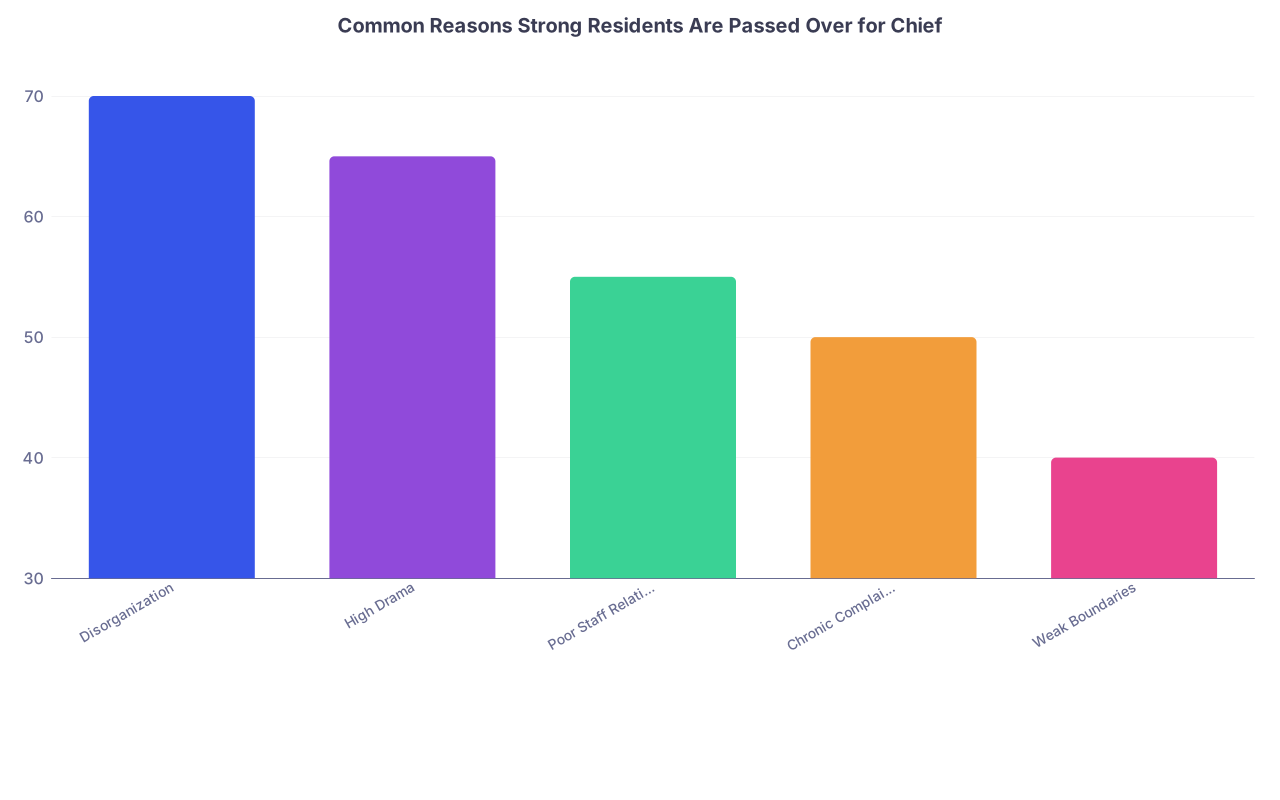
| Category | Value |
|---|---|
| Disorganization | 70 |
| High Drama | 65 |
| Poor Staff Relations | 55 |
| Chronic Complaints | 50 |
| Weak Boundaries | 40 |


