

Are you actually a “nobody” in your residency program if you are not doing research?
Let me cut straight through the insecurity: research is one path to being seen as a leader in residency. It is not the only path. And it is not even the main path in many programs.
The problem is simple. Medical culture has quietly merged two completely different status games:
- academic productivity, and
- actual leadership.
People then act like they are the same thing. They are not.
The Myth: “No Research = No Leadership”
You have heard some version of this:
- “If you want to be chief, you need publications.”
- “The leadership track is for the people who do research.”
- “Program leadership only cares about CV lines.”
There is a grain of truth buried in there, but most of it is lazy thinking and confirmation bias.
Here is the real pattern I have seen over and over sitting in meetings with PDs, APDs, and chiefs flipping through resident evaluations: research helps if it comes packaged with other leadership signals. On its own, it is a weak predictor of whether someone is trusted as a leader.
Programs do not promote PubMed IDs. They promote people they trust not to create extra work or drama.
What the Data Actually Shows
We do not have a randomized trial of “research vs. no research” for leadership roles, but we do have:
- Surveys of program directors about what they value.
- Match data correlating research with leadership-oriented roles like chief resident and fellowship selection.
- Harder-to-quantify but very real: what gets praised, rewarded, and promoted in day-to-day residency life.
When NRMP surveys program directors across specialties, what consistently ranks at the top for selection and advancement is not “number of publications.” It is things like:
- Interpersonal skills
- Professionalism and reliability
- Teamwork
- Global assessment / “would you rehire this resident?”
Research output—when it appears—is always further down the list. Nice to have. Rarely make-or-break.
That pattern does not magically change when we are talking about “leaders” inside a residency class.
What Programs Actually Look For in “Leaders”
Let’s talk about how “leadership” actually gets defined in residency, instead of how people on Reddit imagine it.
Leadership inside a program usually shows up in four buckets:
- Formal positions – chief resident, committee member, QI lead, recruitment coordinator.
- Informal influence – the person the interns go to when something is on fire.
- Institutional memory and glue – the resident who knows how to get things done and keeps the system from falling apart.
- External reputation – representing the program on a regional or national level (talks, boards, policy groups, etc.).
Research is only directly tied to #4, and only sometimes to #1.
When I have seen chief selections behind closed doors, the conversation does not start with “who has the most abstracts.” It usually starts with:
- “Who do nurses trust?”
- “Who do the interns run to when they are drowning?”
- “Who never disappears when things get busy?”
- “Who has good judgment at 3 a.m.?”
If a name comes up and someone says, “Oh, they are super productive with research, but they’re flaky on the wards,” that person drops down the list fast. If another name comes up and someone says, “They are rock solid clinically and also led that QI project that actually fixed X,” now you are in business.
In other words: leadership is behavioral, not bibliographic.
Where Research Actually Matters (And Where It Really Doesn’t)
Let’s separate the noise from the real.
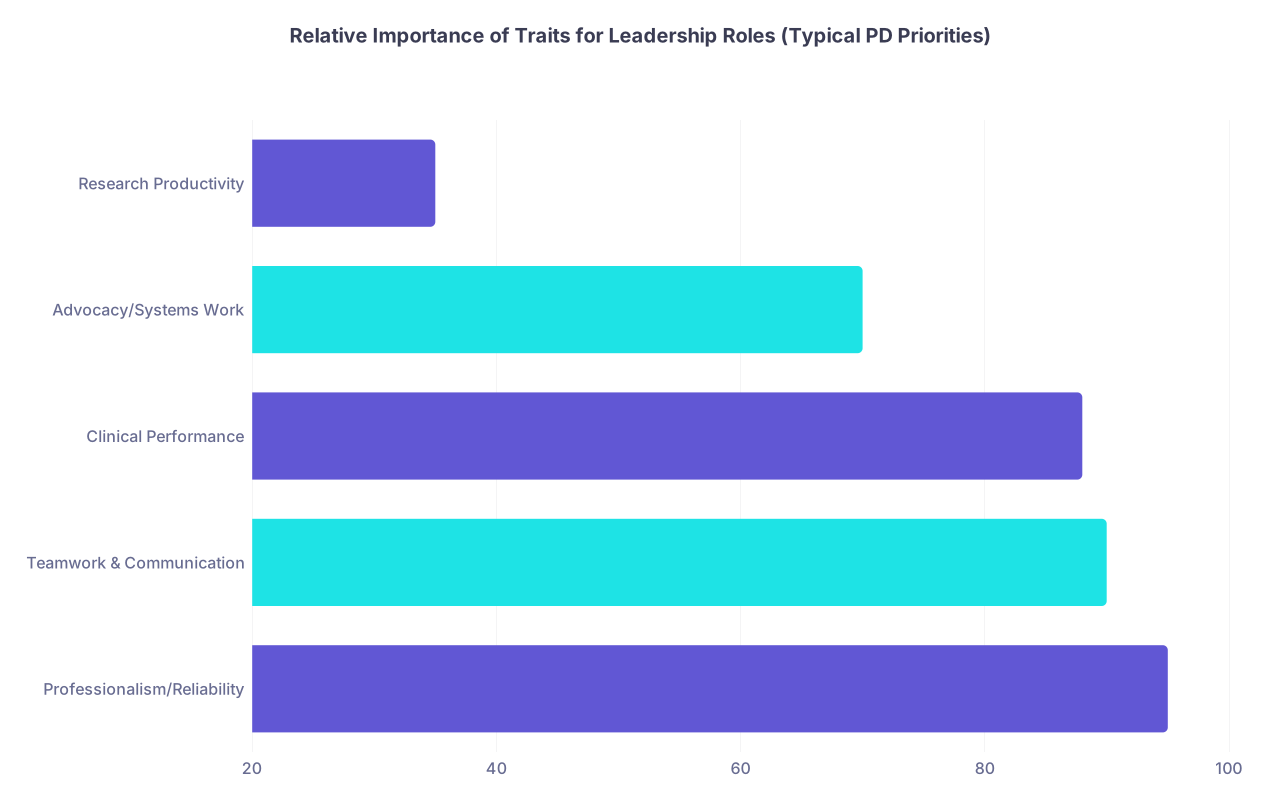
| Category | Value |
|---|---|
| Professionalism/Reliability | 95 |
| Teamwork & Communication | 90 |
| Clinical Performance | 88 |
| Advocacy/Systems Work | 70 |
| Research Productivity | 35 |
These numbers are illustrative, but they reflect how PDs commonly describe their priorities.
Situations Where Research Helps Your Leadership Image
There are a few patterns where research clearly pulls its weight.
Academic-career signaling.
If you want to be seen as a future academic attending or division chief, research is a key signal. Publications say: “I can produce, write, and survive the academic grant-paper machine.” For those paths, lack of research is a handicap.Highly academic programs.
At places like MGH, UCSF, Hopkins, Penn, etc., the culture is steeped in scholarship. Leadership there skews toward people who can bridge clinical and academic worlds. In those settings, not doing any scholarly work at all may make you look one-dimensional.When research is tied to system impact.
Research that leads to a new clinical pathway, policy change, or quality initiative can be read as leadership. Not because it is research, but because it changed how the system works.External visibility.
Presenting at big conferences, winning research awards, or publishing in high-impact journals puts your name out there. That can lead to committee invitations, guideline groups, or national task forces. That is leadership territory.
Notice the common thread: research helps when it makes you visible and impactful, not when it just adds lines to your CV.
Situations Where Research Is Largely Irrelevant
On the flip side, there are big categories where research is almost meaningless for leadership perception:
Day-to-day ward leadership.
PGY-3 running a busy medicine service. Senior in the OR managing multiple rooms. Nobody cares who has the highest h-index when the patient in 4B is crashing. They care who can take command, delegate, and stay calm.Being chosen as the “go-to” senior.
The intern does not text “Who has the most publications?” They text “Who will actually pick up and help me?”Quality of teaching.
Residents quickly identify who actually teaches on rounds, who does chalk talks, who critiques their notes in a useful way. Research background doesn’t substitute for teaching effort and clarity.Program operations.
Recruitment days. Schedule redesign. Workflow improvement. These are classic resident leadership domains. Research is not the bottleneck; willingness and follow-through are.
If you are strong in these areas and completely research-light, you will still be perceived as a leader by your co-residents and most faculty.
The Hidden Problem: Research as a Proxy for Other Traits
Here is where people get confused. Research ends up used as a proxy for attributes that are actually leadership-relevant:
- Discipline and follow-through
- Ability to work in teams
- Long-term project execution
- Writing and communication skills
When someone completes a complex research project, it is (sometimes) a sign they can handle other complex, long-horizon tasks. So attendings mentally group them as “people who get big things done.”
The problem is, that association is noisy. I have watched “highly productive” residents vanish the second chief responsibilities became inconvenient. I have also watched residents with zero publications reliably handle the ugliest family meetings and most chaotic nights without complaint.
So the real question is not “Do you do research?”
It is “Can you demonstrate those deeper traits in some concrete way?”
Other, Often Stronger, Paths to Leadership
If research isn’t mandatory, what actually moves the needle?
Let me be specific. These are things that consistently make PDs and chiefs say, “That person is a leader”:
1. Owning an Unsexy but High-Impact Problem
Not the glossy stuff. The headaches.
- Fixing a broken handoff system that kept dropping balls.
- Designing a cross-cover guide that new interns actually use.
- Leading a project that reduced page burden or improved triage.
That is leadership. You saw pain in the system, rallied people, followed through, and made something better. Some of this can be written up as QI “research,” but the write-up isn’t the leadership part. The change is.
2. Being the Resident Everyone Trusts at 3 A.M.
The senior who:
- Picks up the phone.
- Doesn’t humiliate juniors.
- Can say “I don’t know, let’s call attending” without ego.
- Can de-escalate the angry family and the overstressed nurse.
No one logs this in PubMed. They log it in their memory. When chief talks roll around, that log matters more than your poster count.
3. Running Teaching and Mentorship
Running board review, teaching conferences, intern bootcamps, or simulation sessions builds a public identity as “the teacher.” Programs badly need that. PDs notice who consistently shows up and prepares.
This kind of work is pure leadership: you’re coordinating, motivating, and improving others.
4. Showing Up in Governance and Committees
Resident-faculty committees. GME councils. Wellness or diversity initiatives. These are where policy and culture actually get shaped.
You don’t need research to be a resident rep who:
- Reads the material beforehand.
- Speaks up with clear, specific input.
- Follows through on what they volunteered to do.
That is leadership currency, not academic currency.
5. Advocacy and Policy Work
Some of the most influential “leaders” in training never publish a thing but:
- Testify at local hospital boards about unsafe staffing.
- Organize residents around parental leave policies.
- Work with state or national organizations on trainee issues.
Again, if you turn it into research, fine. But the advocacy itself is the leadership.
How Research and Leadership Actually Interact
So where does that leave you if you:
- Hate research?
- Are neutral but time-strapped?
- Or enjoy it but don’t want it to define you?
Here is the more honest, less dogmatic framing.
| Path Type | Example Activities |
|---|---|
| Research-Driven | Clinical studies, outcomes research |
| QI / Systems-Driven | Handoff redesign, workflow improvements |
| Education-Focused | Curriculum design, teaching series |
| Advocacy / Policy | GME policy, resident wellness reforms |
| Operations / Culture | Scheduling, recruitment, wellness events |
You can be seen as a leader from any of these paths. Research is just one category.
The smart play is not “research or nothing.” It is: align with the kind of influence you actually want.
If You Want an Academic Leadership Career
Then, yes:
- You should be doing research.
- You should also be doing teaching, QI, and some form of institutional leadership.
Because chiefs, medical directors, and division heads in academic centers are usually promoted on a mix of: clinical performance, scholarship, and institutional citizenship. Research is one pillar. Not the whole building.
If You Want to Be a Clinically Heavy Leader
Community hospital medical director. Group practice partner who runs operations. ED director in a smaller system.
Those jobs care vastly more about:
- Can you run a service?
- Can you manage personalities and conflict?
- Can you redesign schedules and systems without chaos?
Research is a bonus, not a requirement. A strong QI portfolio, plus visible operational leadership in residency, is often more directly relevant.
Tactical Advice: What to Do Tomorrow
You are not reading this for abstract philosophy. So here is how to stop spinning in circles about research and leadership.
Step 1: Decide What Game You Are Actually Playing
Academic leadership? Community leadership? Policy leadership? Education-focused?
Write down the type of leadership you care about. If your real goal is “be a respected senior who others trust,” then obsessing about publications is misaligned.
Step 2: Do One Visible, High-Impact Thing
One project where, at the end, you can honestly say, “The program is better because I did this.”
That might be:
- A QI project that changed practice.
- A revamped sign-out system.
- A real, functioning mentorship structure for juniors.
If someone can point to something concrete you led and finished, you are already ahead of most residents ranting about “not being seen as a leader.”
Step 3: If You Do Research, Make It Count
If you are going to spend hours in REDCap anyway, tie it to leadership:
- Pick a project that intersects with clinical operations or patient safety.
- Present it locally, then regionally.
- Use it to justify or push through a systems change.
Then people see you not just as “the research person,” but as “the person who changed how we handle X, based on data.”
Step 4: Be Unmistakably Reliable
Leadership perception lives or dies on trust.
Answer pages. Show up on time. Do not disappear. Do not leave messes for the next team. This is boring advice, but it is what faculty and co-residents quietly rank above everything else when they choose who they want in charge.
The Bottom Line
No, research is not required to be seen as a leader in residency.
It can amplify your leadership if it reflects and reinforces deeper traits: initiative, follow-through, systems thinking. But on its own, it is just another line on a CV.
Programs do not remember who had the most posters. They remember who they trusted with the worst nights, the hardest patients, and the most fragile interns.
Years from now, you will not think about whether you had three or five publications. You will remember whether you built something real, whether people turned to you when it mattered, and whether you acted like the kind of physician others would actually want to follow.


