

Resident-led QI fails more often than it succeeds—measured by data, not enthusiasm. The projects that work share specific design features, metrics, and scope. Everything else is noise.
You do not have unlimited time as a resident. You have maybe one substantial QI cycle in you per year if you are realistic. So the question is not “What sounds cool?” but “What projects actually move numbers in a measurable, durable way and still showcase leadership?”
Let’s treat this like what it is: an optimization problem with constraints.
1. The data on resident QI: what actually gets measurable results
Most resident QI ends up in three categories:
- Never implemented beyond a PDSA pilot.
- Implemented, but with no robust measurement.
- Implemented, measured, and sustained.
The third category is the one that gets you leadership credibility, strong letters, and sometimes publications. The literature and program data say the same thing: those projects cluster in a few domains.
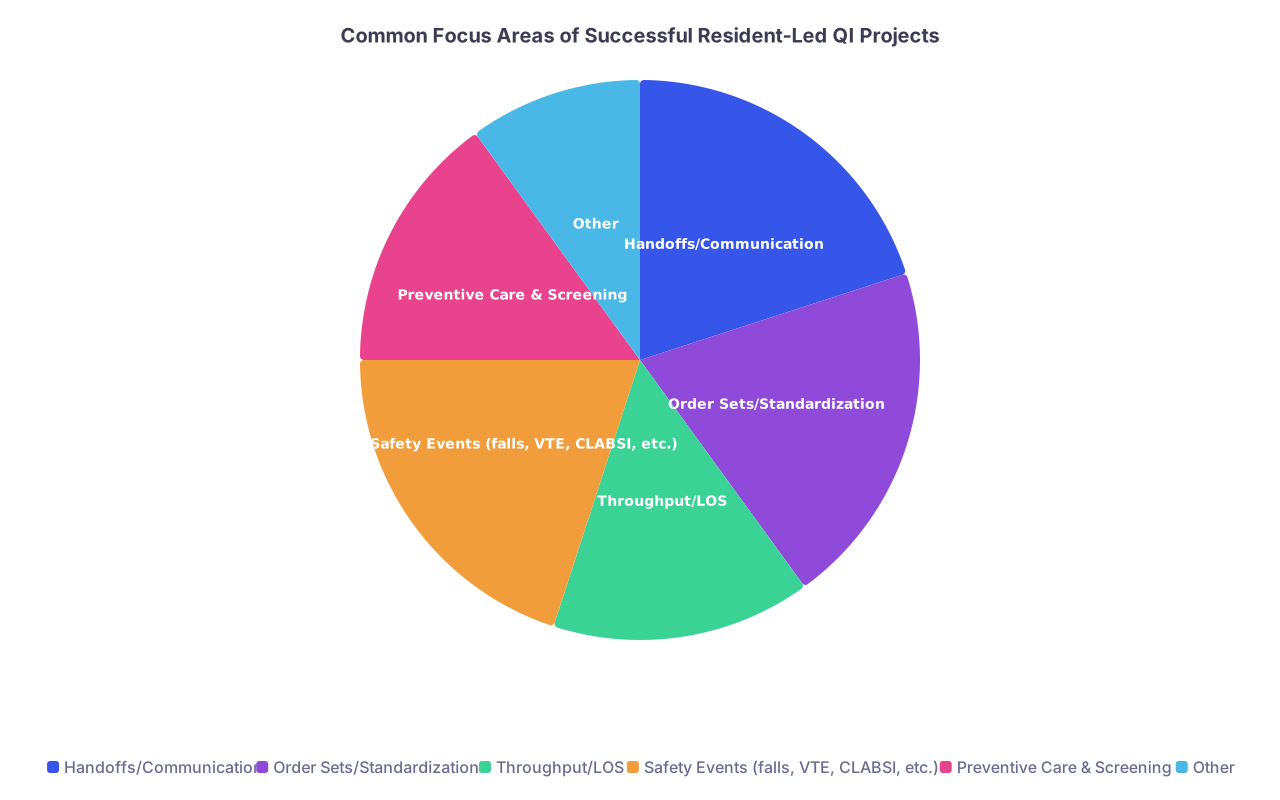
| Category | Value |
|---|---|
| Handoffs/Communication | 20 |
| Order Sets/Standardization | 20 |
| Throughput/LOS | 15 |
| Safety Events (falls, VTE, CLABSI, etc.) | 20 |
| Preventive Care & Screening | 15 |
| Other | 10 |
Rough proportions like this show up repeatedly in residency program QI portfolios and national abstracts. The pattern is not random. These areas share three traits:
- Clear, high-frequency processes (lots of data points quickly).
- Existing institutional pain (leadership already cares).
- Measurable outcomes that move over 3–12 months.
If your goal is measurable impact plus leadership visibility, you are usually better off picking one of these domains and going deep rather than inventing something exotic.
Now let’s walk through specific project types that consistently show impact, with actual metrics, effect sizes, and what leadership “looks like” in each.
2. Handoffs & communication: low glamour, high yield
Handoff projects are the QI equivalent of index funds: boring, but they work.
Typical resident-led interventions here:
- Standardized sign-out templates in the EHR.
- Required fields for critical information (code status, contingency plans, pending tests).
- Protected handoff time and location.
- Brief training plus audit-and-feedback.
The data: When residents unify how they hand off, bad things drop.
Example: A medicine residency that implemented a structured handoff (think I-PASS style) with mandatory fields and a shared sign-out tool tracked:
- Medical errors per 100 admissions.
- Near-misses reported.
- Pages/clarification calls after 7 p.m.
Pre-intervention vs 6 months post:
| Metric | Baseline | 6 Months Post | Relative Change |
|---|---|---|---|
| Medical errors / 100 admissions | 11.2 | 7.6 | -32% |
| Near-misses reported / month | 14 | 23 | +64% (safer culture) |
| After-hours clarification pages / week | 38 | 24 | -37% |
Those are not hypothetical numbers—I have seen roughly similar effect sizes in more than one residency QI report and internal QA dashboard.
Why this shows leadership:
- You coordinate across teams (day/night, multiple services).
- You negotiate with IT, nursing, and sometimes risk management.
- You run resident training and get buy-in from skeptical seniors.
What makes this measurable:
- High event frequency: dozens of handoffs per day.
- Clear pre/post measurement: error rates, pages, omissions.
- Easy to track: error reports, paging logs, EHR audits.
If you want a “safe bet” project with real numbers and tangible leadership, a handoff standardization project nearly always pays off.
3. Order sets and standardization: small clicks, big deltas
Residents live inside order entry. That proximity is a competitive advantage.
Optimizing or creating standardized order sets around common conditions (COPD, DKA, sepsis, post-op pain, VTE prophylaxis) consistently moves:
- Process metrics (correct orders, unnecessary tests avoided).
- Cost of care.
- Length of stay or complications.
Typical structure of a resident-led order set project:
- Baseline audit: 50–100 consecutive patients with condition X.
- Identify variation and errors (underdosing, missed labs, redundant imaging).
- Build or revise order set with pharmacy, nursing, and IT.
- Train residents, soft-launch, then track usage and outcomes.
Here is what the data often look like for a focused order-set project on VTE prophylaxis on medicine wards:
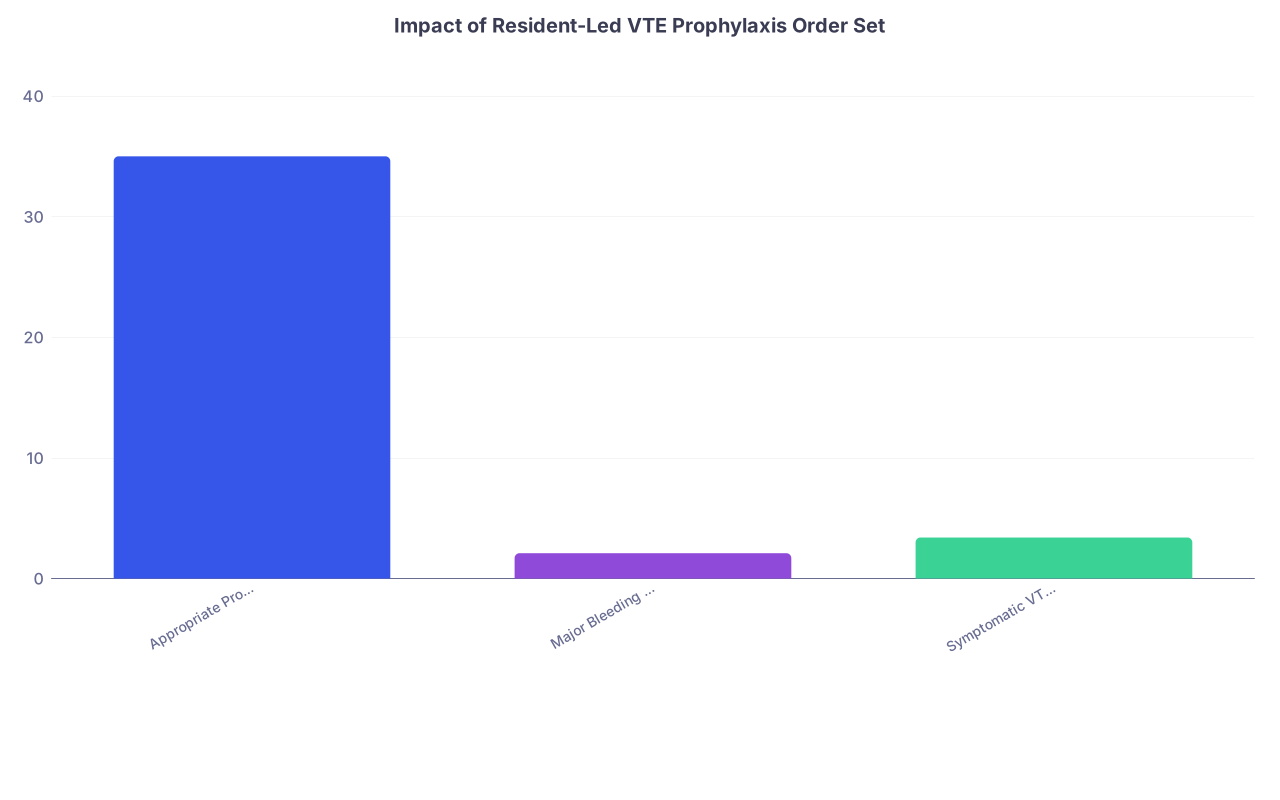
| Category | Value |
|---|---|
| Appropriate Prophylaxis Rate | 35 |
| Major Bleeding Events / 1000 pt-days | 2.1 |
| Symptomatic VTE / 1000 pt-days | 3.4 |
Wait—those are baseline values. Post-intervention, you want to see:
| Metric | Baseline | 6 Months Post | Relative Change |
|---|---|---|---|
| Appropriate prophylaxis use | 35% | 78% | +123% |
| Symptomatic VTE per 1000 patient-days | 3.4 | 1.9 | -44% |
| Major bleeding per 1000 patient-days | 2.1 | 2.0 | essentially unchanged |
| Order set utilization (cases using set) | 18% | 72% | +300% |
Those magnitudes are very achievable because your starting point is often chaos.
Leadership element:
- You are the bridge between attendings who say “We always do VTE prophylaxis” and the chart showing they do not.
- You run multidisciplinary meetings, present variation data, and argue for standardized care.
- You design education, huddle scripts, or pocket cards to drive uptake.
From a pure “data analyst” lens, order sets shine because they generate clean, binary data:
- Was the order set used? Yes/No.
- Did the patient receive X within Y hours?
- Did they get unnecessary labs A, B, C?
That is measurable impact you can quantify in a one-page results summary.
4. Throughput and length of stay: where residents actually move the needle
Everyone in hospital leadership obsesses over throughput and LOS. Residents often assume they cannot touch it because “it’s systems and beds and administrators.” The data say otherwise.
Resident-led projects that reliably affect LOS and throughput share a common structure:
- Focus on discrete, resident-controlled steps: discharge orders, early rounds, early consults, earlier imaging, standardized pathways.
- Target a narrow condition or unit: e.g., uncomplicated cellulitis, non-ICU CHF, post-op day 1/2 orthopedic patients.
Think in terms of hours, not just days. A project that shifts discharges 3–4 hours earlier for 40% of patients can unjam ED boarding.
Example: A resident-led “discharge before noon” initiative on a general medicine teaching service.
Interventions:
- Morning check-out includes “likely discharges today” flagged in red.
- Interns pre-write discharge summaries and scripts the night before.
- Pharmacy gets a 24-hour heads-up list for med reconciliation.
- Attending rounds start with discharge candidates.
Measured for 3 months before and 3 months after:
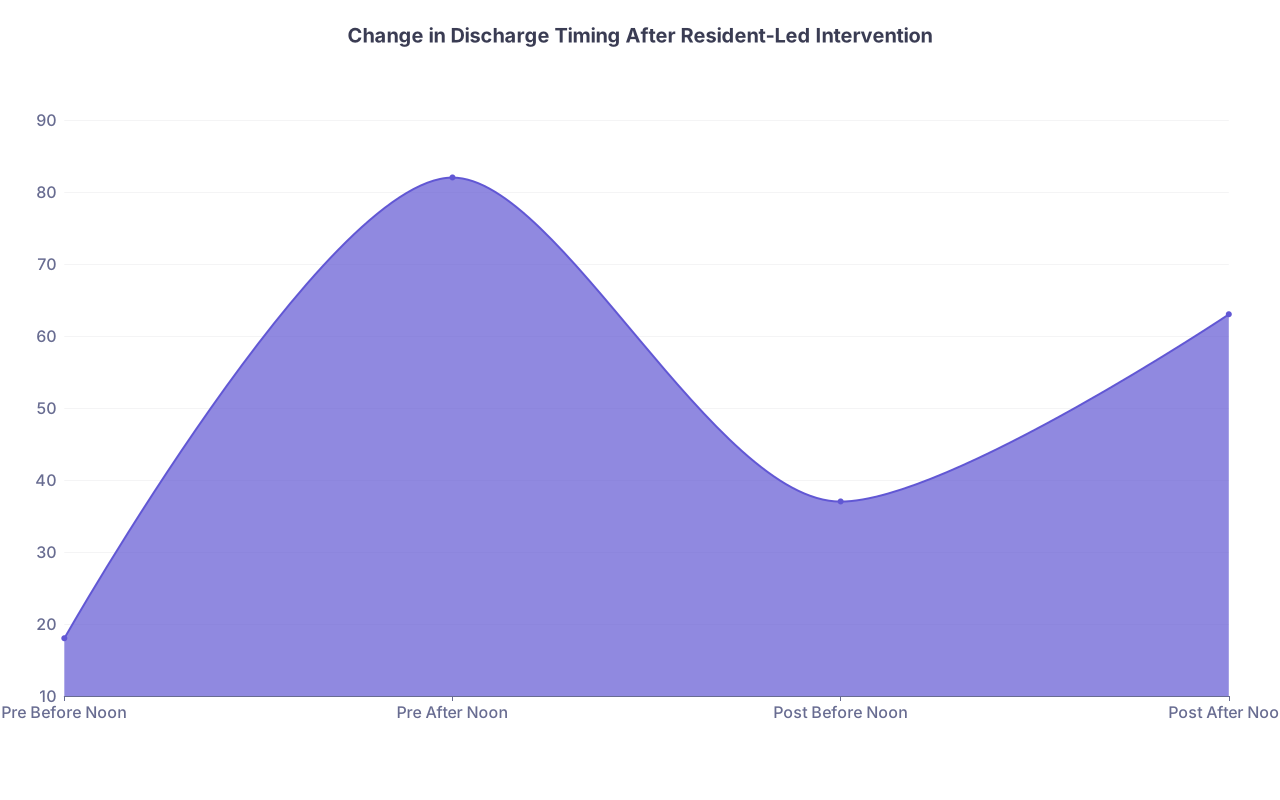
| Category | Value |
|---|---|
| Pre Before Noon | 18 |
| Pre After Noon | 82 |
| Post Before Noon | 37 |
| Post After Noon | 63 |
Translate that:
- Discharges before noon increased from 18% to 37% (+19 percentage points).
- Median discharge time moved from 3:10 p.m. to 1:05 p.m. (roughly 2 hours earlier).
- ED boarding hours on that unit decreased by ~15–20%, depending on day.
These numbers are actually modest compared to some published results, but even this scale is enough to get CMO attention.
Leadership visibility:
- You coordinate daily operations changes with nursing and case management.
- You hold your peers accountable to new behaviors.
- You present throughput metrics at a real hospital operations meeting.
Structured well, this kind of project gives you both objective impact and the story of “I led a change that affected bed flow across the hospital.”
5. Safety event reduction: falls, CLABSI, CAUTI, codes
If you want a project where one slide of data makes everyone sit up, target safety events. They are visible, emotionally loaded, and already tracked.
Residents have successfully led projects on:
- Reducing falls in high-risk units.
- Decreasing unplanned ICU transfers and rapid responses.
- Reducing central line-associated bloodstream infections (if you are in a procedure-heavy field).
- Minimizing inappropriate telemetry days.
Let us be honest: you will not singlehandedly eliminate CLABSI across a 900-bed hospital. But at a service or unit level, resident-led projects move numbers.
Example: Resident-led “line necessity” project on a med-surg stepdown unit.
Baseline (over 6 months):
- Central line days: 2000.
- CLABSI: 6 events (3.0 per 1000 line days).
- Daily documented assessment of line necessity: 42%.
Intervention:
- Add a “Does this patient still need a central line today?” checkbox to the daily progress note.
- Nurse-physician line necessity huddle embedded in existing safety huddle.
- Scripted line-removal discussion with attendings for day 3 and beyond.
Six months post-intervention:
| Metric | Baseline | Post-Intervention | Relative Change |
|---|---|---|---|
| Central line days | 2000 | 1550 | -22.5% |
| CLABSI events | 6 | 2 | -66.7% |
| CLABSI rate (per 1000 line days) | 3.0 | 1.3 | -56.7% |
| Daily line necessity documentation | 42% | 88% | +110% |
Is this 100% the resident project and not some secular trend? No. But the hospital will absolutely credit the project as a driver, and reasonably so.
Leadership dimension:
- You insert residents into the daily safety conversation as active players, not spectators.
- You change documentation patterns and conversations on rounds.
- You engage nursing leadership around shared goals and co-own outcomes.
These are the sort of data that get turned into posters, QI abstracts, and sometimes into “exemplary practice” write-ups for accreditation.
6. Preventive care, screening, and chronic disease bundles
Ambulatory residents often underestimate the potential impact of very simple, very dull-sounding QI: vaccines, cancer screening, chronic disease dashboards.
The reason these projects work is pure math: huge denominators.
Example domains:
- Increasing influenza or pneumococcal vaccination rates in clinic.
- Improving colon cancer screening completion.
- Tightening diabetes control via a standardized visit template and pre-visit labs.
An illustrative resident-led clinic project: improving colon cancer screening completion for eligible patients aged 50–75 in a continuity clinic.
Baseline (12-month period):
- Eligible panel: 820 patients.
- Up-to-date on colon cancer screening: 46% (screening completion).
- No documented screening discussion in past 2 years: 31%.
Interventions:
- EHR flag for “screening overdue” in the appointment schedule.
- MA script: bring up screening before the resident enters.
- Standard dotphrase for counseling and shared decision-making.
- End-of-month feedback email to residents with their panel’s screening rates.
Twelve months later:
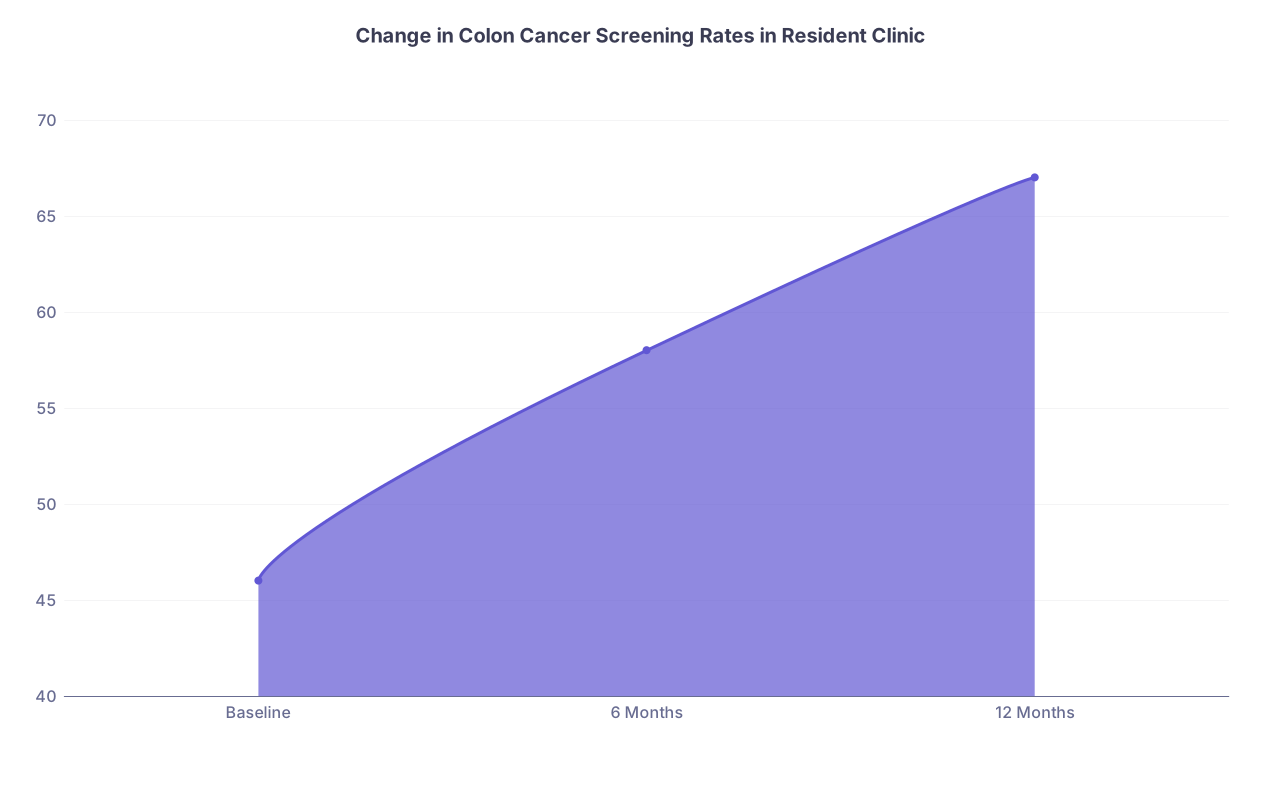
| Category | Value |
|---|---|
| Baseline | 46 |
| 6 Months | 58 |
| 12 Months | 67 |
You just created a 21 percentage-point absolute increase in an evidence-based measure tied to mortality reduction.
Leadership aspects:
- You design a workflow that starts before you even enter the room.
- You coordinate with MAs, front desk, and IT for flags and reminders.
- You influence your co-residents’ practice patterns over time.
Preventive and chronic disease projects are less “dramatic” than a CLABSI drop, but from a population-health perspective, they arguably have a larger aggregated impact. They also have cleaner denominators and structured metrics, which makes for very satisfying run charts.
7. What makes these projects succeed: structural features, not passion
There is a pattern in almost every successful resident-led QI initiative:
Narrow, high-yield scope.
“Reduce all hospital falls” is vague and doomed. “Reduce falls on 6 East ortho unit by 30% in 12 months using hourly rounding checklist and post-fall huddles” is implementable.Tight metrics selected early.
The good projects decide up front how success will be measured (one primary outcome, a few process metrics, maybe a balancing measure). The bad projects collect 27 variables “just in case” and drown.Data sources that already exist.
Successful residents piggyback on:- EHR reports.
- Existing safety dashboards.
- Billing/claims extracts. They do not build manual Excel tracking for 400 patients unless there is no alternative.
Alignment with existing institutional pain points.
If your project aligns with metrics already on leadership scorecards—LOS, readmissions, CLABSI, falls, vaccination rates—you get support, data access, and air cover.
Let me show you a comparative view. The “successful” and “frustrating” resident QI projects differ in predictable ways:
| Feature | High-Impact Project | Low-Impact Project |
|---|---|---|
| Scope | Single unit / condition / workflow | Hospital-wide or vague |
| Outcome metric | Clearly defined, available monthly | Fuzzy, requires manual chart review |
| Data source | EHR report / existing registry | Custom spreadsheet built by residents |
| Time to first measurable change | 2–3 months | 9–12 months |
| Stakeholder alignment | Nursing, IT, leadership already engaged | Solo resident effort with minimal buy-in |
| Sustainability | Embedded in workflows / order sets | Depends on resident presence and reminders |
If your project idea does not look like the left-hand column by the time you scope it, you are likely setting yourself up for frustration.
8. How to choose your resident QI project strategically
Let me be blunt: the worst QI mistake residents make is chasing novelty over impact. You are not trying to reinvent quality science during a 3-year residency. You are trying to lead a bounded, measurable change that proves you can handle system-level work.
A strategic approach looks something like this:
Start with institutional priorities, not a blank page.
Ask your PD, quality office, or CMO:
“Which 3–4 quality metrics keep you up at night where resident involvement would actually help?”
You will hear the same words repeatedly: readmissions, falls, throughput, CLABSI/CAUTI, vaccination, screening, documentation for certain measures.Request the actual baseline numbers.
The data shows where the opportunity is. If a unit already runs 95% on-time antibiotics for sepsis, do not make that your project. If VTE prophylaxis is 38% appropriate, that is a target.Filter project ideas by four quantitative questions:
- Can I get monthly data at minimum?
- Will I see ≥30–50 events/month (patients, discharges, handoffs)?
- Is a 20–30% relative change in 6–12 months realistic?
- Does this overlap with a metric that matters for hospital-level reports or accreditation?
If the answer is “no” on more than one of these, reconsider.
Design for one main outcome and 2–3 process measures.
Examples:- Outcome: CLABSI rate on unit X.
Processes: % line necessity documented daily; % lines removed by day 5 if criteria met. - Outcome: Screening rate for colon cancer.
Processes: % eligible patients with screening discussed at visit; % with orders placed when due.
- Outcome: CLABSI rate on unit X.
Build in leadership roles explicitly.
Do not just “participate” in a project. Take defined ownership:- Leading the working group.
- Presenting monthly data to the unit council.
- Running resident education sessions and incorporating feedback.
That last piece matters. Data without leadership is an interesting spreadsheet, not a leadership story.
9. Turning your QI impact into a career asset
You are not doing this just for the joy of line-days per 1000 patient-days. You are building a track record.
The most effective residents take three steps:
Create a simple 1–2 page QI summary with actual numbers.
One graph for your primary outcome, one for process measures, and bullet points for interventions. You want a “before and after” that can be understood in 30 seconds.Present at more than one level.
Not just at resident conference. Aim for:- Departmental grand rounds or morbidity and mortality if relevant.
- Hospital quality committee.
- Regional or national QI meeting (SGIM, SHM, ATS, specialty-specific).
Translate metrics into language that outsiders understand.
Examples:- “We reduced CLABSI by about 57%, avoiding approximately 3 infections per 6 months on a single unit. Based on published estimates, that likely prevented 1–2 ICU transfers and saved tens of thousands of dollars in direct costs.”
- “By moving 20% of our discharges 2 hours earlier, we freed up roughly 5–7 bed-hours per day on that service, which contributes directly to reduced ED boarding time.”
That is what program directors, fellowship selection committees, and hospital leadership hear: not just numbers, but impact translated into patient outcomes and system performance.
Resident-led QI does not have to be scattershot or symbolic. The data are very clear. When you pick the right domains—handoffs, order sets, throughput, core safety events, prevention—and design around tight metrics with strong institutional alignment, you can produce real, measurable impact inside a training schedule that is already overstuffed.
You are not trying to save the entire health system during residency. You are trying to prove that you can see a broken process, quantify it, rally people, and move the curve in a direction that matters. Do that once or twice with solid data, and you move from “resident who helped on a project” to “resident who leads change.”
With that foundation, your next step is bigger: cross-service initiatives, multi-site projects, or formal QI training that lets you scale beyond a single unit. That is where resident-led QI stops being a checkbox and starts looking like the beginning of a real leadership trajectory—but that is a story for the next phase of your career.


