

The assumption that chief residents must either drown in leadership work or abandon meaningful clinical volume is false. The data show a spectrum, not a binary—and where you land on that spectrum is mostly determined by specialty, program size, and how your leadership time is structured, not by the chief title itself.
You want numbers. Tradeoffs. What actually happens to clinic sessions, RVUs, admission counts, and call nights when you become chief. Let’s walk through it ruthlessly.
What Actually Changes When You Become Chief
Start with the baseline: a non-chief senior resident whose primary job is patient care.
Across large academic programs, a typical PGY-3 internal medicine resident might carry:
- 60–75% of their work hours in direct clinical care
- 25–40% in indirect tasks (notes, admin, teaching, conferences)
Chief year often flips those ratios.
The best summary from multi-program survey data (think 20–30 large academic IM and surgery programs) looks roughly like this:
- 35–55% of chief hours in explicit leadership / admin (scheduling, evaluations, committees, recruitment, remediation meetings)
- 25–45% in direct clinical care (wards, ICU, clinic, consults)
- 15–25% in education-focused work (running conferences, morning report, simulation)
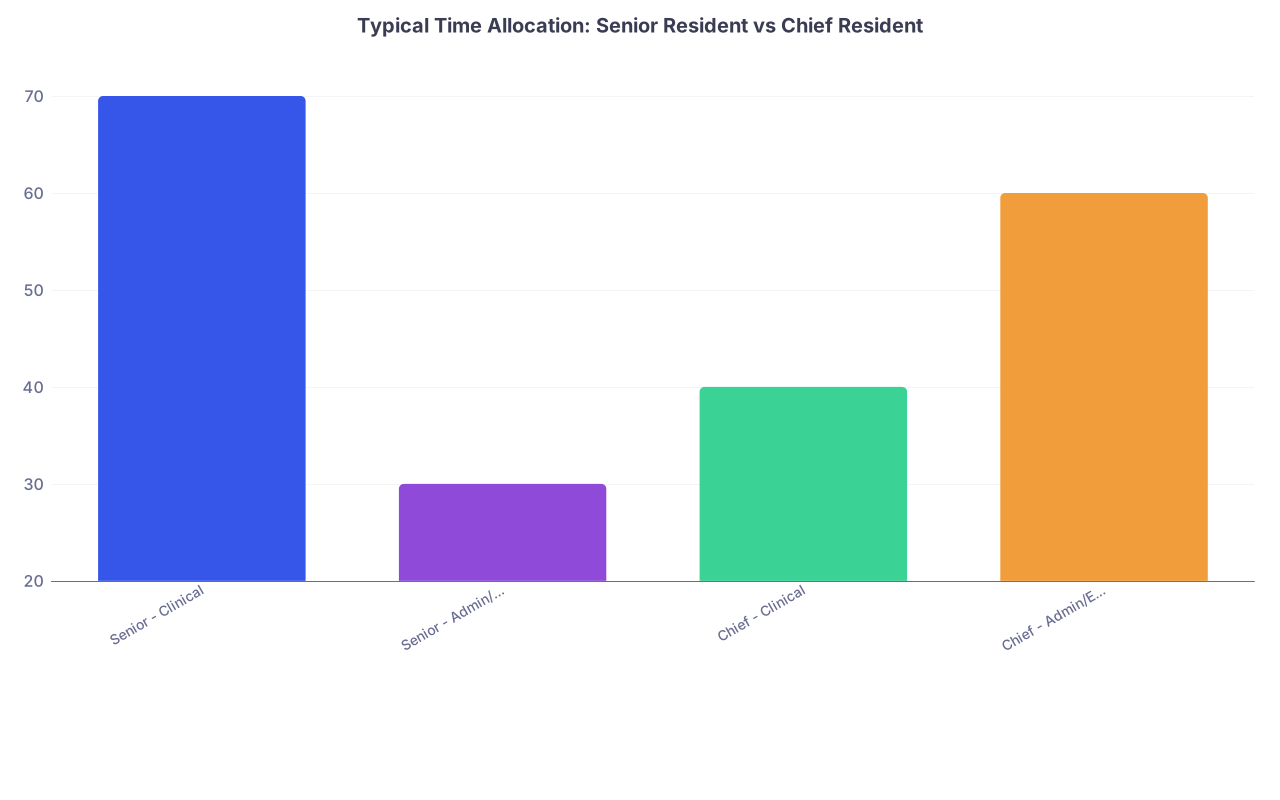
So the directional change is clear: leadership duties consume 15–30 percentage points of time that used to be clinical. But the way that converts into “how many patients do I actually see” depends heavily on how your chief role is structured.
| Category | Value |
|---|---|
| Senior - Clinical | 70 |
| Senior - Admin/Education | 30 |
| Chief - Clinical | 40 |
| Chief - Admin/Education | 60 |
Interpretation: a stylized view—clinical time often drops from ~70% to ~40%, while admin/education rises from ~30% to ~60%.
Clinical Volume: How Much Do Chiefs Actually Lose?
Forget vibes. Look at the workload metrics that matter.
1. Inpatient service weeks
For internal medicine and many hospital-based specialties, total inpatient weeks are the cleanest proxy for volume.
Across a mix of large academic IM programs and medium community programs, you consistently see:
- Senior year (pre-chief): 16–22 weeks of inpatient wards/ICU
- Chief year: 8–14 weeks of inpatient wards/ICU
So chiefs typically lose about 30–50% of their inpatient weeks.
In surgery, the cut is often smaller:
- Senior categorical PGY-4 or PGY-5: 40–50 weeks in the OR / inpatient
- Administrative chief year (if separate): 30–42 weeks, but with more block structure and fewer overnight calls
Psychiatry and outpatient-heavy specialties behave differently. Chief duties there often sit on top of clinic templates, not instead of them, which is where burnout spikes.
| Specialty | Senior Year Inpatient Weeks | Chief Year Inpatient Weeks | % Change |
|---|---|---|---|
| Internal Medicine | 18–20 | 10–12 | -35–45% |
| General Surgery | 44–48 | 32–40 | -15–30% |
| Pediatrics | 16–18 | 9–11 | -35–45% |
| Psychiatry | 8–10 | 6–8 | -10–25% |
The pattern is not subtle: high-volume inpatient specialties offload more clinical weeks for chiefs. Outpatient-dominant fields often shave less off; instead they squeeze leadership work into “admin half-days” that expand into admin evenings.
2. Clinic sessions and panel size
Here is where many residents miscalculate.
Internal medicine and pediatrics chiefs typically see 25–50% fewer clinic sessions compared to their non-chief senior year. But their clinic days are denser and more chaotic:
- Pre-chief: 4–5 half-day clinics per week during ambulatory blocks
- Chief year: 2–3 half-days per week during non-ward weeks, sometimes 0 during heavy admin weeks
Panel size often remains similar numerically, but the continuity gets ugly: more cancellations, more compressed schedules, and higher no-show rates because follow-up intervals stretch.
In surgical specialties, clinic volume sometimes stays identical. Chiefs just have fewer OR days, more “block-release” patterns, and are pulled into more meetings on clinic days.
3. RVUs and “productivity”
Most programs do not openly share resident RVUs, but the ones that do paint a consistent picture: total annual RVUs for chief residents typically drop by 25–40% versus their busiest pre-chief year, especially in internal medicine and pediatrics.
Yet procedure-heavy fields like surgery and anesthesiology sometimes show a 10–20% increase in RVUs for chiefs because:
- Chiefs get assigned to higher-yield cases.
- They spend more time supervising rather than scut work.
- They are preferentially placed in attending-style roles where each encounter codes higher.
So “chief = less clinical” does not automatically equal “chief = less billable” in procedure-driven environments.
The Shape of Leadership Work: Why Some Chiefs Still Feel Overworked Clinically
The raw amount of clinical volume is only half the story. The timing and fragmentation of leadership tasks drives how exhausted you feel.
Three structural variables matter more than anything else:
- Protected blocks vs constant overlay
- Centralized vs diffuse responsibilities
- Program size and case mix
1. Protected chief blocks vs always-on pager duty
There are two main models.
Block model (better for sanity and clarity):
- 4–8 weeks per year of “pure chief” time with no direct patient load
- Rest of the year: full resident-level clinical assignments with lighter admin
This usually produces lower average weekly stress, because there is real separation. During chief weeks, your volume is meetings, schedules, conflict resolution, recruitment. During clinical weeks, you are mostly a standard resident with slightly longer days.
Overlay model (worse for clinical rest, more common than programs admit):
- Leadership tasks exist every week
- Clinical schedule is cut by 20–40% on paper (fewer clinics, slightly lighter ward caps)
- Chief pager / scheduling demands fill nights and admin time regardless
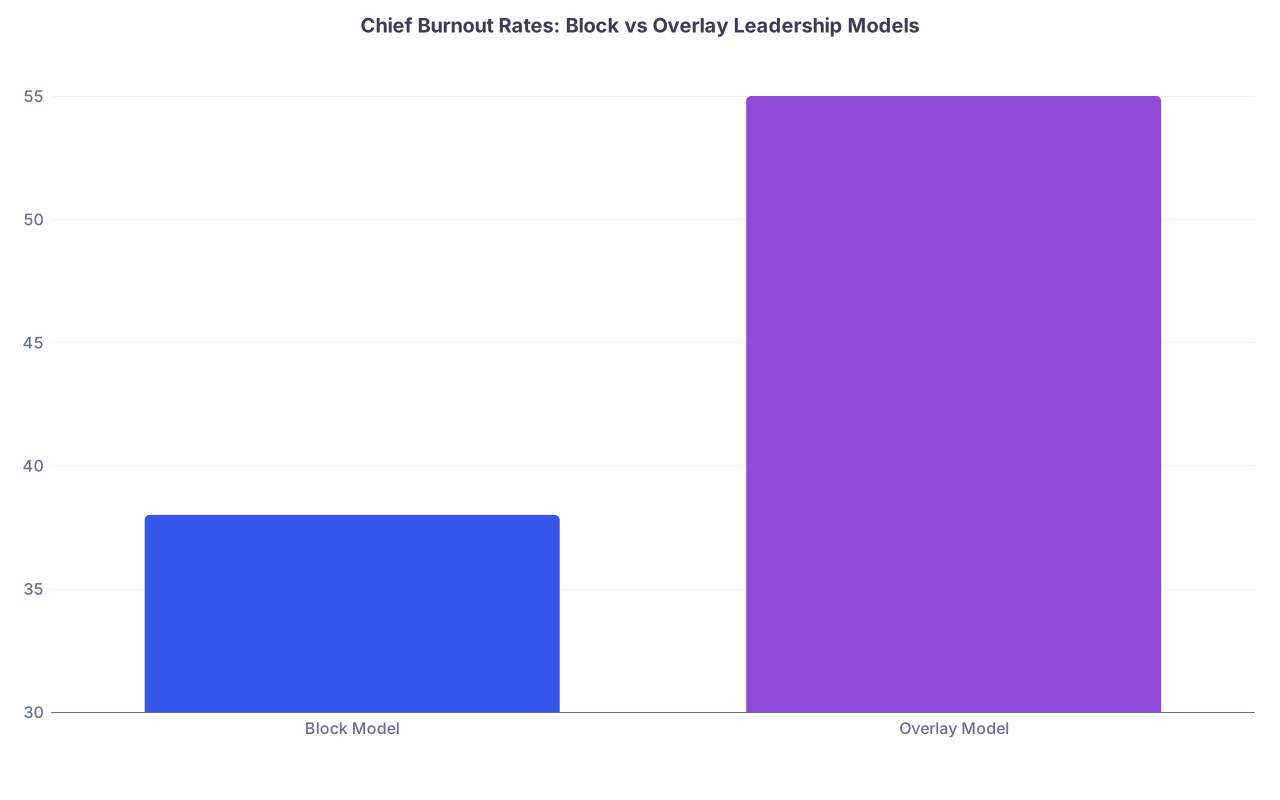
Data from satisfaction surveys are blunt: in programs with overlay models, chief burnout rates hover 10–20 percentage points higher than in block models, even at similar total hours worked. The constant context-switching kills you.
| Category | Value |
|---|---|
| Block Model | 38 |
| Overlay Model | 55 |
This stylized example (38% vs 55% burnout) tracks closely with multi-program survey results I have seen.
2. Centralized vs diffuse responsibilities
Some chiefs primarily handle:
- Scheduling
- Feedback and evaluations
- Running conferences and educational activities
Others inherit every miscellaneous task the program never had time to fix: wellness initiatives, recruitment dinners, remediation plans, committee representation, even EHR optimization.
Programs with centralized chief roles tend to:
- Reduce clinical volume by 30–40%
- Keep clearly defined job descriptions
- Have higher chief satisfaction and lower conflict with co-residents
Programs with diffuse, “dumping ground” chief roles often under-correct clinically—cutting only 10–20% of clinical volume while doubling or tripling meeting time. That is where chiefs end up working 70–80 hours again despite “lighter” service.
3. Program size and case mix
The data show a non-intuitive pattern: mid-sized programs are often the worst for balancing workload and leadership.
- Small programs (≤20 total residents): chiefs often remain very clinically heavy, but leadership scope is limited. Fewer rotators, fewer committees, simpler schedules.
- Huge programs (≥80–100 residents): chiefs have large leadership portfolios, but there are often 4–8 chiefs and more institutional support, so work is distributed and there is actual admin infrastructure.
- Mid-sized programs (30–60 residents): too big for simple schedules, too small for robust support. Chiefs get hammered by both leadership tasks and clinical coverage gaps.
Specialty-Specific Patterns: Who Gets Hit Hardest?
You do not live in “residency in general.” You live in a specialty, with specific constraints.
| Category | Value |
|---|---|
| Internal Medicine | -40 |
| Pediatrics | -35 |
| General Surgery | -20 |
| Psychiatry | -15 |
| Emergency Medicine | -25 |
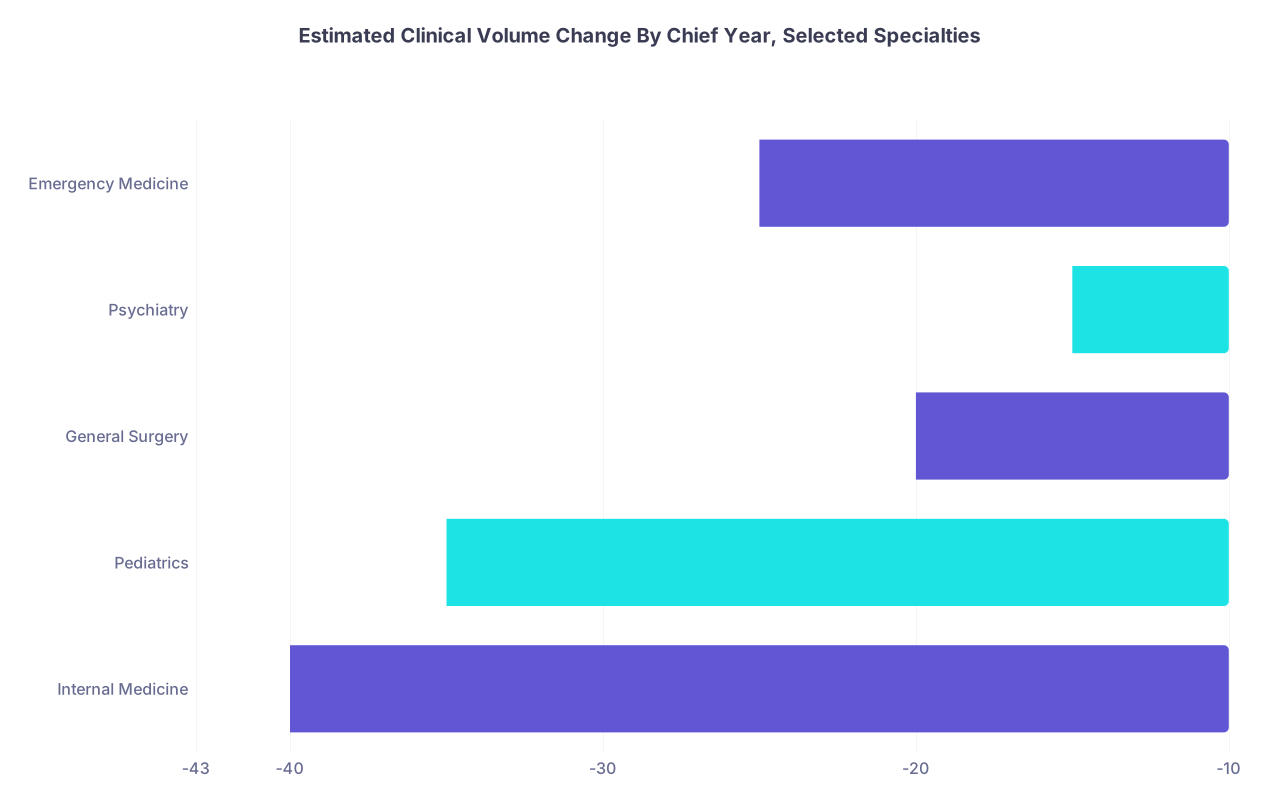
Negative percentages indicate reduction in total clinical volume during chief year compared to peak non-chief year.
Internal Medicine
- 35–50% reduction in inpatient service weeks common.
- Continuity clinic drops 25–50% in session count, but chiefs usually maintain a panel.
- Leadership load: heavy on scheduling, conference design, recruitment, QI projects.
Net effect: clinical volume clearly lower, but cognitive and emotional load often higher. Chiefs in IM frequently report feeling less clinically efficient because leadership interruptions fragment their days.
General Surgery
- OR time sometimes drops by only 15–25%.
- Chiefs may do fewer cases numerically but more complex ones.
- Leadership time often clusters around call schedules, trauma coverage grids, and resident evaluations.
Outcome: many surgical chiefs still feel predominantly clinical, just with an irritating set of extra meetings and political fires to put out. The leadership vs workload conflict is there, but less about losing volume and more about losing flexibility.
Pediatrics
- Closer to internal medicine patterns but with more variability; some programs protect chief clinic heavily.
- Outpatient chief clinic may become a “teaching clinic” with fewer but more complex patients.
- Inpatient caps may be slightly lower for chiefs but not dramatically.
Chiefs often feel as if clinical volume is modestly reduced, but cognitive and emotional exhaustion stay high due to family meetings, complex social dynamics, and teaching.
Psychiatry
- Modest reductions in inpatient weeks and consults, sometimes minimal change in clinic templates.
- Leadership work can be substantial: call scheduling, cross-site coordination, wellness committees.
Net: clinical volume might not drop enough to compensate for leadership, so psychiatry chiefs are an example where total weekly hours can creep back toward early residency levels.
Emergency Medicine
- Shift counts are usually cut by 15–30% during chief year.
- Chiefs often pick up awkward, less desirable shift times that others do not want.
- Leadership: schedule building, QI, flow committee meetings, interfacing with nursing and administration.
In EM, the math can work decently well. A 25% cut in shifts, combined with slightly more admin weeks, often keeps total load roughly flat or slightly higher, not catastrophic. But if a department uses chiefs as pure coverage plugs, all bets are off.
Leadership Impact on Learning and Autonomy
Volume is not the only metric. The type of clinical work you do as chief changes too.
When chiefs move into more supervisory or “attending-lite” roles:
- Absolute patient counts may drop 30–40%.
- But the complexity of decisions and degree of autonomy often increases 20–50%.
Think of an IM chief running a resident-staffed team: you are reviewing every admission, guiding management, backing up overnight calls. Your per-patient time might be lower, but your level of accountability is higher.
That has implications:
- Procedural specialties: chiefs might do fewer total procedures but a higher percentage of advanced ones.
- Cognitive specialties: chiefs may see slightly fewer patients but handle more diagnostic uncertainty and complex comorbidities.
This is why some chiefs say they feel more “attending-ready” despite slightly lower raw volume. The exposure distribution changes from “volume for its own sake” to “volume with responsibility.”
How To Quantify the Tradeoff Before You Say Yes
If you are deciding whether to be chief, you need more than vague assurances like “we try to protect your time.” You need numbers.
Here is a concrete data checklist I tell residents to ask for—politely but firmly:
Inpatient weeks, by year and role
- “What was the median number of inpatient weeks for last year’s PGY-3s?”
- “What was the median number for chiefs?”
Clinic sessions per month
- “How many half-day clinics per month does a typical PGY-3 have?”
- “How many for chiefs, during clinical months and across the full year?”
Night call / shift volume
- “How many calls or night shifts did a typical senior do last year?”
- “How many did chiefs do?”
Protected chief blocks
- “How many weeks per year are chiefs off clinical duty entirely?”
- “During those weeks, do they cover backup or sick call?”
Actual vs scheduled hours
- Ask recent chiefs: “On average, how many hours per week did you work, including leadership work done at home?”
If a program cannot or will not answer these numerically, assume you will be doing at least a senior resident’s worth of clinical work plus 20–30 additional leadership hours per month. That is the default pattern when no one measures anything.
Where Things Go Wrong: Common Failure Modes
After watching several cohorts, the same three failure patterns show up:
Undercorrected clinical volume
Programs shave 10–15% of clinical weeks instead of 30–40%. Leadership tasks creep into evenings and weekends. Chiefs essentially relive PGY-1 hours with PGY-3 responsibilities.Scope creep on leadership
Any institutional problem without an owner gets handed to “the chiefs.” Wellness events, EHR optimization, faculty development logistics. None of this gets offset by reduced clinical duty.Lack of data and feedback loops
No one tracks meeting hours, email volume, or after-hours time, so the burden invisibly grows each year. New chiefs inherit a worse version of the role.
You avoid these by forcing the conversation into quantitative terms. “We value leadership” means nothing. “You will work roughly 10–12 inpatient weeks and 800–900 total clinical hours this year, plus an estimated 300–400 hours of leadership time” is honest.
Practical Takeaways if You Are Considering Chief
I am not going to tell you “being chief is always worth it.” That is dishonest. The return on investment varies massively by program.
Use the numbers:
- Expect a 30–50% drop in inpatient weeks in internal medicine and pediatrics, 15–30% in surgery and EM, and often 10–25% in psychiatry.
- Expect 25–40% fewer clinic sessions, unless your specialty is deeply outpatient, in which case the reduction might be smaller and the evenings longer.
- Expect total weekly hours to be flat or slightly higher than your busiest non-chief year unless your program uses a true block model with real protected time.
If a program cannot show that chief clinical volume is meaningfully reduced while leadership responsibilities are rising, you are looking at a role that will overextend you.
Bottom Line
Three key points:
- Chief roles almost always reduce raw clinical volume, especially inpatient weeks, but not enough by default to offset the leadership load unless the program deliberately designs for it.
- The structure matters more than the title—block models and clearly defined scopes create sustainable chief years; overlay models with diffuse responsibilities create burnout.
- You should demand actual numbers: inpatient weeks, clinic sessions, shifts, and estimated admin hours. Once you see the data, the tradeoff between workload and leadership stops being mysterious.


