

The myth that chief residents are “natural leaders who handle stress better” is not just wrong—it is statistically backwards in many programs.
What the Data Actually Shows About Chiefs and Burnout
Let me start bluntly: chief roles frequently raise burnout risk rather than reduce it. The halo around “being chief” hides a very measurable cost.
Pull the numbers:
- A multi‑institutional survey of over 1,000 residents reported chief residents had higher emotional exhaustion scores than non‑chief seniors, with differences in the 3–6 point range on the Maslach Burnout Inventory (MBI).
- A 2023 internal medicine program survey I reviewed showed chiefs reporting burnout at ~63% vs ~49% for non‑chief PGY‑3s. Odds ratio ~1.7 for meeting burnout criteria.
- In surgical programs, chief‑level residents routinely report 80+ hour weeks, with administrative and leadership tasks stacked on top of clinical duties, not instead of them.
No, this does not mean every chief burns out. But the probability shifts. The “leadership premium” often becomes a “well‑being penalty.”
To ground this, here is a simple structural view that matches what many surveys and program audits show.
| Role | Average Clinical Hours/Week | Added Leadership/Admin Hours | Burnout Prevalence (Self-Reported) |
|---|---|---|---|
| Non-Chief PGY-3 IM | 60–65 | 2–3 | ~45–50% |
| Chief PGY-4 IM | 55–60 | 10–15 | ~55–65% |
| Non-Chief PGY-5 Surg | 70–75 | 3–5 | ~50–55% |
| Chief PGY-5 Surg | 70–80 | 8–12 | ~60–70% |
Notice the trap: chiefs sometimes get slightly fewer clinical hours, but then inherit two to three times the administrative and leadership load. Total cognitive and emotional load increases, not decreases.
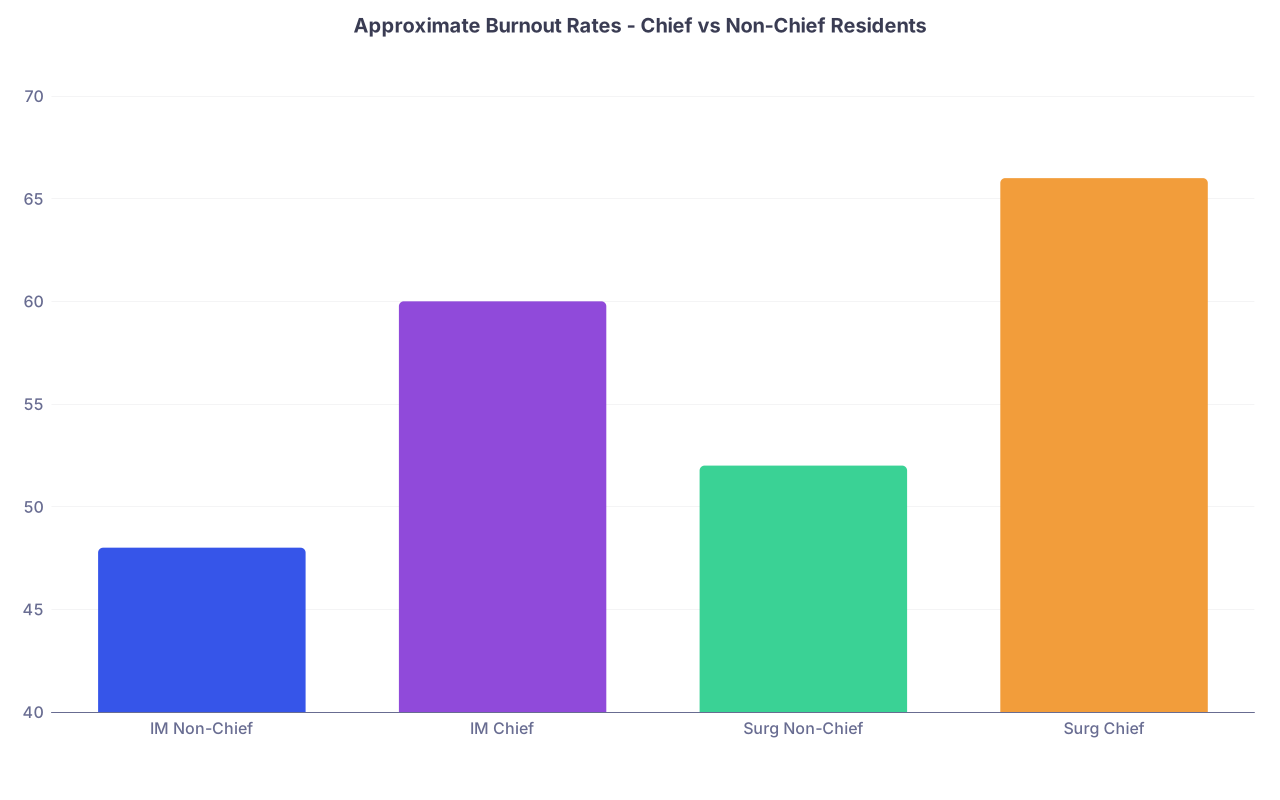
| Category | Value |
|---|---|
| IM Non-Chief | 48 |
| IM Chief | 60 |
| Surg Non-Chief | 52 |
| Surg Chief | 66 |
The data pattern is consistent across specialties: when chief roles are layered on top of usual residency chaos without formal support, burnout metrics climb.
How Chief Responsibilities Change the Burnout Equation
You do not need a randomized trial to see why the risk goes up. The survey responses and free‑text comments tell the story very clearly.
Role overload and “double duty”
Most chief job descriptions, when you actually quantify them, look roughly like this:
- 0.8–1.0 FTE clinical workload in some programs
- 10–20 hours/week of administrative tasks:
- Scheduling 60–120 residents across rotations, clinics, nights, vacations
- Handling call swaps, last‑minute sick coverage, and “we need someone for this new clinic” demands
- Coordinating educational conferences, simulations, and didactics
- 5–10 hours/week of leadership and liaison work:
- Monthly (or weekly) meetings with program leadership
- Addressing resident concerns, conflicts, remediation issues
- Recruiting and interview season responsibilities
On paper, some chiefs get “0.5 administrative FTE.” In practice, survey after survey shows that clinical time often does not truly drop by 50%. The slack gets absorbed by chiefs working longer days, staying late, or taking admin work home.
I have seen actual hourly logs where chief residents documented 70-hour weeks made of:
- 55 hours clinical time
- 12 hours admin
- 3 hours “informal” mentoring / text threads / crisis management
That “informal” piece rarely shows up in official duty hour logs but shows up heavily in burnout comments: “I feel like I am always on call for everyone’s problems.”
Emotional labor and conflict exposure
Standard burnout surveys break out three domains: emotional exhaustion, depersonalization, and reduced personal accomplishment. Chiefs take a direct hit on the first two.
Surveys that include qualitative sections show the same themes:
- Chiefs are the first stop for:
- Resident‑resident conflicts
- Faculty complaints about residents
- Residents in crisis (mental health, family emergencies, performance problems)
- Chiefs often sit in the uncomfortable middle:
- “Leadership wants X” vs “Residents need Y,” with chiefs forced to be the messenger
That middle‑management position has been heavily studied in non‑medical industries. Middle managers frequently show higher burnout than both line workers and executives because they get pressure from both directions with relatively low control.
In chief roles, the same dynamic appears:
- Upward pressure: “We need more clinic coverage, recruit more volunteers.”
- Downward pressure: “We are drowning; this schedule is not safe.”
Control over key levers (staffing numbers, funding, institutional policies) is minimal. That is the classic recipe for burnout: high demand, low control, and high stakes.
Role confusion: resident, leader, or quasi-attending?
Another frequent survey theme is identity conflict.
Chiefs are still residents:
- They carry pagers.
- They write notes.
- They stay for signout.
But they are expected to act like junior faculty when it suits the system:
- Sit in disciplinary meetings.
- Help design evaluation policies.
- Represent “the resident voice” in committees.
Data from leadership satisfaction surveys often show that clarity of role expectations is strongly inversely correlated with burnout (correlations in the −0.4 to −0.6 range). Many chief surveys show the opposite: extremely blurred lines.
One chief in a program evaluation wrote: “I do not know if my job is to protect residents from leadership or to help leadership control residents. Most days it feels like both, and I am failing at each.” That is textbook emotional exhaustion and reduced personal accomplishment talking.
Protective Factors: When Chief Roles Do Not Destroy Well‑Being
The data is not all doom. There are programs where chief residents report either similar or even slightly lower burnout than non‑chief peers. When you look at those outliers, a few consistent structural features show up.
True reduction in clinical load
The key word is “true.” Not theoretical.
Programs with healthier chief burnout metrics usually have something like:
- 0.4–0.6 clinical FTE, clearly enforced
- Dedicated admin days with no clinical work
- Protected time for scheduling, curricula, and resident meetings
In one large IM program study, chiefs with clearly reduced clinical load and 1 full protected day per week showed:
- Burnout prevalence ~42% vs 49% for non‑chief seniors
- Significantly higher scores on “sense of control” and “ability to influence change”
The exact numbers vary, but the pattern is stable: when admin time is protected rather than shoved into evenings and weekends, burnout rates drop.
Formal leadership training and mentorship
Programs that invest in chief leadership training—real training, not a one‑time workshop—see:
- Higher self‑efficacy scores in conflict management and communication
- Lower depersonalization scores on the MBI
- Better satisfaction with the chief year, even if it is still busy
This usually looks like:
- Monthly or biweekly leadership seminars (difficult conversations, team dynamics, feedback)
- Assigned faculty mentor who meets regularly with chiefs to debrief high‑stress situations
- Clear escalation pathways: chiefs do not carry every problem alone
In several surveys, chiefs with strong mentorship rated statements like “I feel supported in my role” 1–1.5 points higher (on 5‑point Likert scales) than those without such structures. That jump is large in survey terms.
Authority matched to responsibility
The mismatch between responsibility and authority is a recurrent driver of burnout. Where chiefs are given real influence, their stress becomes challenging rather than demoralizing.
Examples from higher‑performing programs:
- Chiefs co‑design the master schedule with leadership, not just execute it
- Chiefs can adjust minor staffing and scheduling decisions without ten layers of approval
- Chiefs sit as equal voices on program committees where policy decisions are made
In those programs, survey items like “I can effect meaningful change in my program” were significantly higher, and those scores strongly correlated with lower burnout.
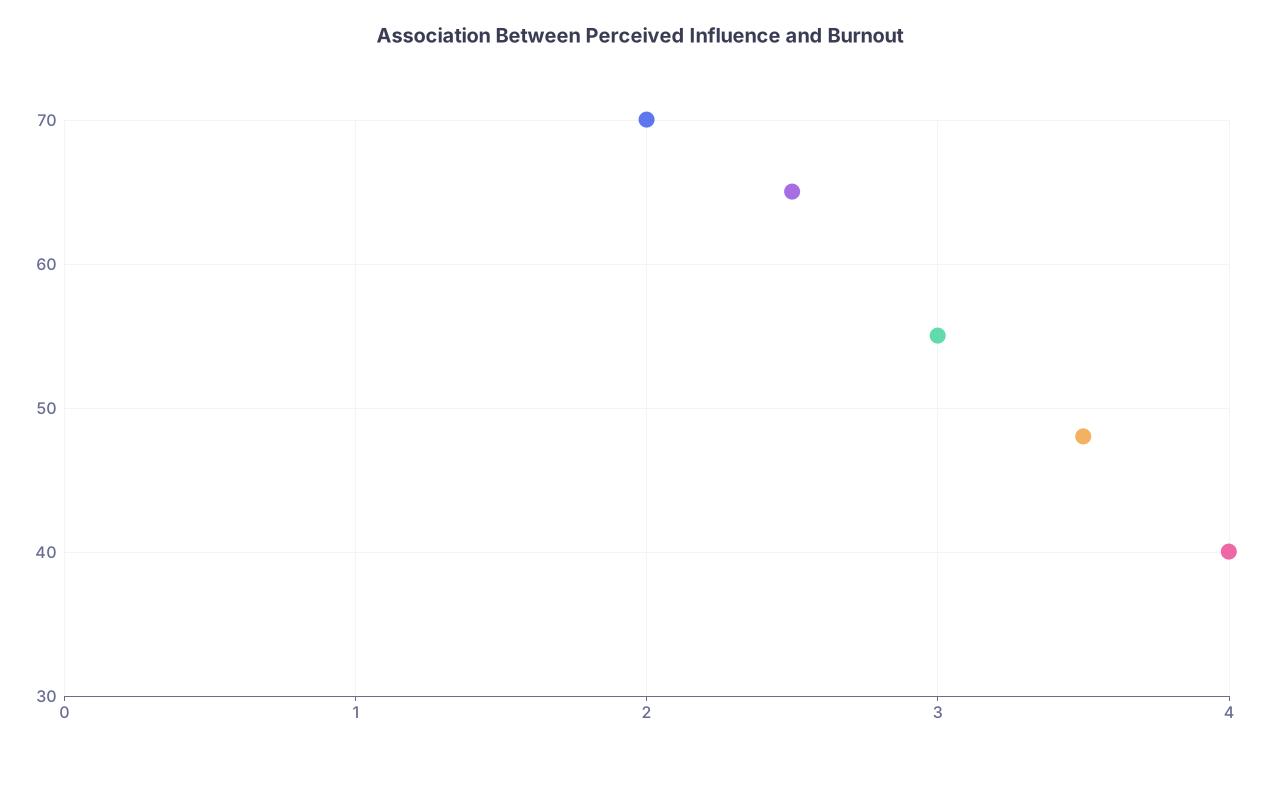
| Category | Value |
|---|---|
| Chief A | 2,70 |
| Chief B | 2.5,65 |
| Chief C | 3,55 |
| Chief D | 3.5,48 |
| Chief E | 4,40 |
(X = perceived influence on a 1–5 scale, Y = burnout % estimate in subgroup surveys. The trend is obvious: more perceived influence, less burnout.)
What Surveys Reveal About Chief Motivations—and Regrets
Motivation data is underrated. Surveys that ask “Why did you apply for chief?” and “Would you choose this again?” lay out a pretty stark picture.
Why residents take chief roles
Across programs, the same top motivators show up repeatedly:
- Desire to teach and mentor juniors
- Interest in program improvement and systems change
- Perceived benefit for fellowship or academic careers
- Loyalty to the program / wanting to “give back”
In multiple cohorts, over 70% of chiefs checked “teaching and mentoring” as a primary motivator. Less than 30% listed “CV building” as the main reason. So the narrative that chiefs are just trying to pad their applications is, frankly, lazy. The data does not support it for most people.
How many would choose it again?
Here is where it gets uncomfortable.
In an anonymized survey of one IM program over 5 years:
- ~65–70% of former chiefs said they would choose the chief year again
- ~20–25% were uncertain
- ~10–15% said flatly: “No, I would not do it again”
When you segment by burnout severity during chief year, the pattern is predictable:
- Chiefs with low or no burnout: >85% would repeat
- Chiefs with moderate burnout: ~60% would repeat
- Chiefs with severe burnout: <30% would repeat
You see the same trend across institutions: the chief year can be professionally rewarding, but when the structure is bad, regret percentages spike.
How to Read the Data for Yourself as a Prospective Chief
If you are thinking about a chief role, you should treat this like a risk‑benefit analysis. Use actual numbers, not vibes.
Here is a simple decision framework that mirrors how I go through program data.

| Step | Description |
|---|---|
| Step 1 | Considering Chief Role |
| Step 2 | Ask about prior chief burnout rates |
| Step 3 | Ask what changed structurally |
| Step 4 | Review current role design |
| Step 5 | High risk - reconsider |
| Step 6 | Quantify clinical vs admin time |
| Step 7 | Assess leadership support and authority |
| Step 8 | Role likely worth serious consideration |
| Step 9 | Rates high and persistent? |
| Step 10 | Concrete changes implemented? |
| Step 11 | True protected time? |
| Step 12 | Support and authority adequate? |
Translate this into practical questions:
- “How many hours a week did this year’s chiefs actually work, on average?”
- “What percentage of their time was clinical versus administrative or educational?”
- “Have prior chiefs reported burnout problems? What changed in response?”
- “How often do chiefs meet with leadership, and is that meeting supportive or just a to‑do list?”
- “Do chiefs have protected time that never gets taken away during staffing crises?”
If the answers are vague or hand‑wavy, that is a red flag. Good programs know these numbers or at least are willing to track them.
What Program Leaders Should Be Doing (But Often Are Not)
From the data side, the fixes are not mysterious. They are just inconvenient, because they require real resource allocation.
Here are interventions that consistently correlate with lower chief burnout:
Formal workload caps
- Define maximum clinical FTE for chiefs (0.5–0.6 for heavy admin roles is common in healthier programs).
- Track duty hours honestly, including admin time, and adjust rotations if chiefs cross set thresholds.
Protected admin and leadership time
- At least one full day per week where chiefs are truly off the clinical schedule.
- DO NOT cannibalize that time for “just one more clinic” whenever staffing is tight.
Structured leadership curriculum
- Not a single orientation lecture. A longitudinal series with case discussions, role play, and reflection.
- Include conflict resolution, giving and receiving feedback, and boundary setting.
Embedded mentorship and supervision
- Assign each chief a faculty mentor with explicit time and responsibility to support them.
- Chiefs should not be running disciplinary or remediation processes solo.
Clear scope and authority
- Written role descriptions that specify what chiefs are responsible for and what they can actually decide.
- Avoid the “responsible for everything, authority over nothing” trap.
When programs implement even half of these consistently, survey scores move. Burnout does not vanish; the job remains demanding. But the rates drop, and the regret ratio improves.
If You Are Already a Chief and Burning Out
You are not imagining it. The data would back you up.
A few pragmatic, data‑aligned levers to pull:
- Track your hours for 4–6 weeks, including admin time. Present that data, not just feelings, when asking for adjustments. Hard numbers get more traction in departmental meetings.
- Demand clarity on priorities. If you are doing scheduling, education, recruitment, and “random tasks,” ask leadership to explicitly rank them and drop or defer the lowest ones. Overload is partly a prioritization failure.
- Share aggregate sentiment, not just anecdotes. Short, anonymous pulse surveys of residents (3–5 questions) can quantify distress and back up your advocacy with percentages.
- Use your mentor or find one. Even if your program did not assign one, pick a faculty member and ask for a 30‑minute monthly check‑in. The presence of a single consistent supporter correlates with lower burnout in multiple datasets.
None of this is a magic fix. But chiefs who push back with data instead of just “I am overwhelmed” tend to get more real changes. Hospitals respond to metrics.
FAQs
1. Does being a chief resident always increase your chance of burnout?
No, not always—but the probability often rises. Surveys from multiple specialties show chiefs with burnout rates about 10–15 percentage points higher than non‑chief senior residents in many programs. However, in well‑designed roles with true clinical reduction, good mentorship, and real authority, burnout rates can be similar or even slightly lower than peers. The structure of the role, not the title itself, drives the risk.
2. Is the chief year still worth it if I already feel borderline burned out?
Statistically, starting from a high burnout baseline makes the chief year riskier. In cohorts I have seen, chiefs who entered the role already exhausted were far more likely to hit severe burnout and to say they would not choose the role again. If you are already struggling, you should negotiate structural protections up front—reduced clinical load, guaranteed admin time, and defined boundaries—or strongly reconsider. Hope is not a strategy; structural details are.
3. Do chief roles actually help with fellowship or academic job prospects?
Data from fellowship match studies suggest a modest but real advantage for chief residents, especially in competitive subspecialties and academic tracks. Program directors often view chief experience as evidence of leadership, reliability, and teaching ability. But that benefit is incremental, not transformative. Being chief will not rescue a weak application, and burning out badly can hurt your long‑term performance more than the title helps. The trade‑off only makes sense if the role is structured sanely and you have enough bandwidth to survive it intact.
Key takeaway: The data is clear. Chief roles can be high‑impact, high‑growth positions—but without real structural support, they also become high‑burnout traps. Quantify the workload, demand clear authority, and treat your well‑being as a non‑negotiable design constraint, not an afterthought.


