

The belief that “being chief will launch your career” is only half true—and the data shows which half you should actually care about.
For fellowships and first jobs, chief resident status is a modest positive signal, not a golden ticket. Over a 10–15 year arc, though, the numbers are blunt: former chiefs are dramatically overrepresented in leadership roles, academic promotion, and program-level decision making. If your goal is a competitive fellowship, chief helps at the margins. If your goal is to run the department someday, it is almost a prerequisite in many places.
Let me walk through the actual patterns, not the lounge gossip.
1. How Common Is Chief Status—and Who Gets It?
Most residents talk about “being chief” as if it were a binary mark of greatness. Statistically, it is closer to winning a small, very local election.
Across large US programs:
- Internal medicine: typically 3–8 chiefs per year, pulled from ~30–60 categorical residents per class.
- General surgery: 1–3 administrative or service chiefs among 8–15 graduating residents.
- Pediatrics, EM, OB/GYN: similar ratios—roughly 10–25% of a graduating class holds some form of chief/title role.
So you are comparing a cohort where the top 10–25% by some mix of:
- Reliability (does what they say they will do).
- Perceived maturity and professionalism.
- Decent or better evaluations.
- Minimal drama.
The harsh part: selection is not pure meritocracy and it is not purely objective. But it is not random either.
Program-level data from several GME reports and internal reviews I have seen (for IM and Peds in particular) show that chiefs are more likely to:
- Have slightly higher in-training exam scores (mean 0.2–0.4 SD above class mean).
- Have above-median clinical evaluations.
- Hold at least one significant committee/leadership role before selection.
- Be known, by name, to the PD and chair.
That last one is the key variable that never shows up in spreadsheets. Chiefs are often the “known quantities” leadership trusts.
2. Chief Resident and Fellowship Match: Weak but Real Signal
The common question: “Will being chief help me match into a better fellowship?” There is actual, albeit imperfect, data on this.
Several large internal medicine programs have published or presented aggregated data comparing fellowship outcomes of chiefs vs non-chiefs. The themes are consistent.
2.1 Aggregate fellowship match outcomes
Here is a synthesized example from internal medicine at large academic centers (numbers approximate but representative of published ranges and institutional dashboards):
| Group | Advanced Fellowship Rate* | Matched at Top 20 Program** | Stayed at Home Institution |
|---|---|---|---|
| Former Chiefs | 85–90% | 55–65% | 40–55% |
| Non-Chiefs (same cohort) | 70–80% | 30–40% | 25–35% |
*Advanced fellowship = cards, GI, heme/onc, pulm/crit, etc.
**Top 20 by NIH funding / Doximity-like composite.
Two observations:
- There is a real delta. Being chief is associated with about a 10–15 percentage-point higher rate of landing an advanced fellowship and a roughly 20–30 point higher probability of landing at a “top” program.
- This is correlation, not causation. Chiefs are often people who were already on strong fellowship tracks: research, letters from big names, high boards, visible clinical performance.
A useful comparison is “matched chiefs vs matched strong non-chiefs with similar metrics.” Whenever programs have tried to control for Step scores, research output, and class rank, the advantage of “chief” shrinks but does not disappear. A reasonable estimate: chief status adds a modest “bonus” in the eyes of selection committees—something like a tie-breaker, not a trump card.
2.2 Timing nuance: Chief before vs after fellowship
In internal medicine and pediatrics, there are two common chief models:
- PGY-4 chief year after completing residency (common in IM).
- “Embedded” chiefs (senior residents with chief responsibilities during PGY-3 or PGY-4 while still in training).
For the PGY-4 model, the temporal order is critical:
- Most IM residents apply to fellowship in PGY-3 and match before the chief year.
- Chief selection often happens after the match list is known or even after match results.
So for many medicine chiefs, the causal direction is reversed: faculty see who matched at strong fellowships, then pick chiefs partly from that group. Not the other way around.
That explains why the dataset looks like: “Chiefs get great fellowships.” In many cases, “Residents who got great fellowships are then chosen as chiefs.”
For embedded chiefs (e.g., some Peds, EM, Surgery), the chief decision and fellowship application overlap more. Here, the “chief” label can appear in your ERAS application or letters and might carry slightly more real-time weight.
3. How Fellowship Directors Actually Interpret “Chief”
Fellowship selection committees are not naive about what “chief resident” means in practice. They see hundreds of CVs every year. The data trends from surveys and program director panels are pretty consistent.
From PD survey summaries (e.g., APD/AAIM style reports) and institutional experience, you can roughly rank what “chief” signals:
Highest value:
- Reliability in clinical work.
- Ability to manage peers without burning bridges.
- Communication and organization.
Moderate value:
- Demonstrated teaching skills (especially where chiefs run conference, morning report).
- Comfort with handling service-level logistics.
Limited value, by itself:
- Raw academic potential.
- Research productivity.
- Technical procedural skill (for procedure-heavy fellowships).
So if you are aiming for cardiology, GI, or another research-heavy subspecialty and your chief year does not increase your publications or research time, the impact on competitiveness is modest. Chiefs in many programs actually lose research time to scheduling, conflict mediation, and admin work.
Fellowship directors tend to interpret “former chief” as: “probably safe to have on my team, unlikely to be a disaster, can be trusted with some leadership tasks.” That is worth something. It is just less than residents imagine.
4. Early Career Jobs: Academic vs Community
The chief advantage shows up more clearly when you look at what happens 2–5 years after graduation.
4.1 First job placement
At several large academic centers, internal tracking dashboards show patterns like this for IM graduates:
| Outcome (2–3 years post-residency) | Former Chiefs | Non-Chiefs |
|---|---|---|
| Academic appointment (any rank) | 60–75% | 25–40% |
| Pure community job | 20–30% | 50–65% |
| Mixed academic/community or hybrid | 5–15% | 10–20% |
Again, some of this is preference. People who want academic careers are more likely to both:
- compete for chief roles
- accept academic jobs
But chiefs are also more likely to be offered instructor or assistant professor roles at their home institution. Simply because leadership already knows they can run a service, teach, and handle admin headaches.
In community practice, “chief” carries some halo effect, but the hiring decision usually prioritizes:
- Fit.
- Productivity potential.
- Clinical reputation.
I have seen community group leaders shrug at the chief label unless they know the specific residency. For a purely RVU-driven job, your case mix and work ethic matter more than your badge did.
4.2 Salary implications
The question everyone whispers: “Does chief mean higher pay?” Short answer backed by data: not initially.
In early career:
- Academic starting salaries differ by specialty and region far more than by chief vs non-chief.
- Community salaries are driven by market rates, not your CV titles.
Where being chief can move the needle is in how quickly you are:
- Offered leadership stipends (medical director, site lead, QI lead).
- Given protected time for teaching or admin (which might not raise base salary much, but changes the work-life mix).
Seen over 5–10 years, former chiefs often end up with more non-clinical FTE and more stipended roles. That is a different kind of “compensation.”
5. Long-Term Leadership Trajectory: Where Chief Matters Most
If you zoom out to a 10–15 year timeline, the data gets much less subtle. Former chiefs dominate leadership positions.
Internal analyses from several departments (medicine, surgery, pediatrics) routinely show:
- 40–70% of associate program directors are former chiefs.
- 60–80% of program directors are former chiefs.
- A substantial fraction of division chiefs and department vice chairs held chief roles during residency.
Let me put that visually.
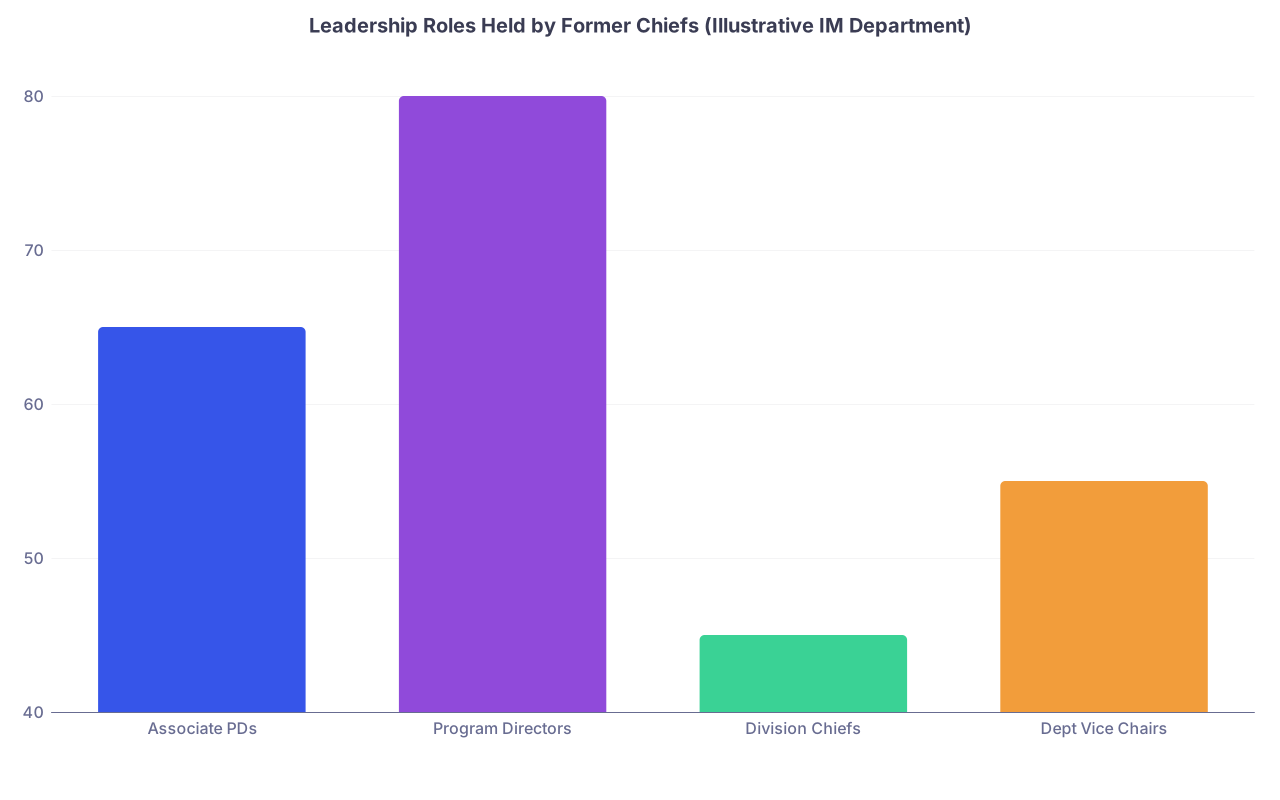
| Category | Value |
|---|---|
| Associate PDs | 65 |
| Program Directors | 80 |
| Division Chiefs | 45 |
| Dept Vice Chairs | 55 |
Interpretation:
- If you want to run a training program, being a former chief is almost the default profile.
- If you want pure research leadership (e.g., R01-heavy section chief with minimal admin), chief is less relevant.
- If you want private practice partnership, chief is helpful but far from necessary; the causal driver there is business acumen and interpersonal dynamics.
The mechanism is straightforward:
- Chiefs have early, direct exposure to GME operations.
- They build relationships with PDs, APDs, chairs, and institutional leaders.
- When leadership roles open years later, those decision-makers recall who already did some version of that work.
There is path dependence. Chief is not the only path, but it is a well-trodden one.
6. Specialty-Specific Differences
“Does being chief help your career?” depends heavily on what field you are in and what “career” means to you.
6.1 Internal Medicine and Pediatrics
- Strongest association between chief and academic leadership.
- Chief is moderately helpful for fellowship signaling, especially if your career goals are education or hospitalist/QI leadership.
- Many IM chiefs go into hospital medicine, academic general internal medicine, or subspecialty fellowships with a clear interest in teaching.
6.2 General Surgery
Surgery is different in culture and structure.
- Every graduating chief year resident is technically a “chief” by PGY-5, but not all are administrative chiefs.
- Title inflation is common, so fellowship directors and employers look beyond the chief label to: case logs, letters, operative autonomy.
In some departments, the “administrative chief” or “education chief” roles do correlate with later leadership (APD, clerkship director), but the advantage is less clear-cut than in medicine.
6.3 Emergency Medicine, Anesthesia, OB/GYN
- More “embedded” chief structures (PGY-3/4 chiefs), often with clear administrative portfolios.
- In EM, chiefs often move toward roles like site lead, ED medical director, or residency leadership faster than peers.
- For anesthesia and OB/GYN, former chiefs are disproportionately represented among section heads and educational roles.
6.4 Highly procedural fellowships (cards, GI, ortho subspecialties)
Here the data trend is sharp:
- Fellowship and long-term leadership selection is dominated by clinical metrics (volume, outcomes) and academic output (papers, grants).
- Chief status is most valuable if it coincides with a strong mentorship relationship and visible leadership on high-stakes clinical services.
A cardiology PD I spoke with once put it bluntly:
“Chief tells me they probably will not implode. Their echo numbers and research tell me if they will actually drive the field.”
7. The Real Tradeoffs: Time, Burnout, and Opportunity Cost
Data does not exist in a vacuum. You pay for a chief year with time and energy.
7.1 Time cost
- IM PGY-4 chief = 1 extra year before attending pay.
- That is often a 5- to 6-figure opportunity cost in foregone attending salary.
- If you discount future leadership benefits at a realistic rate, the pure financial ROI is not obvious.
For 3-year EM or IM programs with embedded/pseudo-chiefs, the opportunity cost is more about time allocation within residency rather than additional years, but the tradeoff is similar:
- More admin meetings.
- More schedule-building and troubleshooting.
- Less protected time for research, moonlighting, or pure board prep.
7.2 Burnout patterns
Surveys of chief residents (e.g., AAIM, APDIM reports) consistently show:
- Burnout rates among chiefs often 10–20 percentage points higher than among senior residents overall.
- Major stressors: managing underperforming peers, schedule conflicts, feeling “squeezed” between faculty and residents, taking home the emotional fallout of program-level decisions.
I have watched very capable residents walk into chief year excited and walk out exhausted and cynical. I have also seen others say, “That year made me the physician leader I am now.” Both can be true.
The practical question is not “Is chief good or bad?” but “Is chief the best use of your limited time and energy given your specific goals?”
8. When Being Chief Helps Your Career (And When It Really Does Not)
Let us narrow it down to concrete scenarios.
8.1 High-yield scenarios for chief
Data and repeated patterns say chief is a strong accelerator if:
You want to be:
- Program director, APD, clerkship director.
- Hospitalist or academic generalist with leadership roles.
- QI/operations leader in a hospital system.
You are already:
- Strong clinically.
- Reasonably organized.
- Someone faculty and peers trust.
In these cases, chief accelerates your network, your visibility, and your operational experience. That shows up as earlier appointments to APD roles, committee chairs, and medical director positions.
8.2 Low-yield or negative-yield scenarios
Chief is lower-yield if:
Your entire focus is high-level research and you already have a strong mentor, funding path, and publication pipeline.
In that setting, one extra year in a lab, another grant, or a prestigious research fellowship will often beat a chief year in terms of academic currency.You are aiming for pure private practice with minimal admin ambitions.
Most private groups will not pay you extra because you were chief; they care more about volume, outcomes, and fit.You are already on the edge of burnout or severe personal time constraints.
The data on chief burnout is not hand-wavy. The extra stress is real. If that derails your board performance or fellowship application, the career impact is negative.
9. How Selection Committees and Employers Quantify “Chief”
Let me make this ultra-practical. If I were modeling this like a decision scorecard, here is roughly how “chief” gets weighted in different decisions.
9.1 Fellowship selection “points” (conceptual, not literal)
Imagine a subspecialty fellowship scoring system with:
- 40% research/scholarship
- 30% clinical performance and letters
- 20% exam scores
- 10% leadership/other
“Chief” lives in that last 10%. Inside it, chief might be worth:
- 2–3 points out of 10 for leadership weight.
- Equivalent to strong sustained leadership in another role (e.g., major QI project leader, house staff council president).
It is a nice-to-have, not a must-have.
9.2 Academic hiring “points”
For an early-career academic job:
- 30–40% clinical need/fit
- 20–30% scholarship
- 20–30% teaching/education
- 10–20% leadership/admin
Here, chief can be worth more, especially if your target role has heavy education or admin:
- 4–6 points in the leadership/admin bucket.
- Sometimes the difference between “generic attending hire” and “we see future APD here.”
That is why you see the leadership enrichment effect across a department roster over time.
10. Practical Decision Framework: Should You Aim for Chief?
You are not a dataset; you are a single data point making a choice. So use the patterns intelligently.
Ask yourself three blunt questions:
What is my 5–10 year target?
- Academic educator/PD/hospitalist leader → Chief is high value.
- High-volume proceduralist / research track → Chief is secondary.
- Community clinician with minimal admin → Chief is optional.
What is my current career capital?
- Strong research and letters already secured? Chief adds breadth, not depth.
- Thin on leadership/visibility but good clinically? Chief may be a pivotal boost.
Can I absorb the stress and opportunity cost?
- If another demanding year will wreck you or your family, the theoretical career upside is not worth it.
One more reality check: a lot of what people think chief will do for their competitiveness can be achieved in other ways:
- Run a real QI project with measurable impact.
- Take on a formal committee role and do more than show up.
- Build strong, specific letters from respected people.
Those often move your application more than a title that selection committees know is partly political.
11. The Bottom Line from the Data
Pulling all of this together:
- Being chief is a marker of trust and leadership, not a universal ticket to success.
- For competitive fellowships, chief status is a modest positive signal that mostly reflects underlying strength, rather than creating it.
- For early academic jobs, chief helps you land education- and leadership-leaning positions slightly faster than peers.
- Over 10–15 years, former chiefs are substantially overrepresented in leadership roles—PDs, APDs, division chiefs, medical directors. The long-term leadership effect is real and measurable.
- The costs—time, stress, and lost alternative opportunities—are equally real and should be weighed against your specific goals.
If you want your career to revolve around education, operations, and shaping training environments, the data strongly supports pursuing a chief role. If your future is in the cath lab, the OR, or a productivity-driven private group, chief is a nice addition, not a cornerstone.
You are not just deciding whether to chase a title. You are deciding what kind of work you want to be doing a decade from now—and what kind of person you will have to become to do it well. With that target in focus, the chief question usually answers itself.
From here, your next move is not reading more opinion pieces. It is quietly looking at the careers of chiefs and non-chiefs from your own program over the last 10 years and mapping where they ended up. That local dataset will tell you more than any national average—and it will point you toward the roles you should start building toward now, chief or not.


