

The average residency program is leaving board pass rate and performance gains on the table because it treats chief residents as schedulers, not as force multipliers.
The data that exist—scattered across program evaluations, in-training exam reports, and a few published studies—tell a very consistent story: when chief residents are strong leaders with real authority and a performance mindset, board pass rates improve, remediation rates drop, and core metrics like documentation timeliness and duty hour violations move in the right direction. Not by magic. By design.
Let’s walk through what actually changes when you have a “strong” chief, and what that does to the numbers you care about.
What “Strong Chief Residents” Actually Do Differently
Before we talk outcomes, we have to define the exposure. “Strong chief resident” is not a vibe. It is a set of behaviors and structures that are shockingly measurable once you start looking.
In programs where I have seen board metrics improve after a change in chief structure, the chiefs almost always share four characteristics:
- They own structured teaching.
- They track and act on data at the resident level.
- They control or heavily influence schedules.
- They have direct access to the PD and authority to make changes.
Translate that into concrete actions, and you see patterns like this:
- Weekly board-focused sessions (question blocks, chalk talks, rapid reviews) with tracking of attendance and ITE performance.
- Longitudinal lists of “at-risk” residents flagged by ITE percentile, rotation evaluations, and faculty concern, with targeted follow-up.
- Rotations and schedules adjusted to protect study time for PGY-3s approaching boards and PGY-1s after weak ITEs.
- Chiefs using dashboards: pass rates by class, ITE score trends, procedure logs, duty hour violations, and even burnout survey scores.
In short, the “strong chief” is acting as a mid-level quality officer for resident performance. Not just “the person who does the schedule.”
How Chief Residents Influence Board Pass Rates
The core question: what is the effect size? How much can a strong chief realistically move a board pass rate?
Published data are limited, but internal program-level numbers are revealing. A pattern I have seen repeatedly:
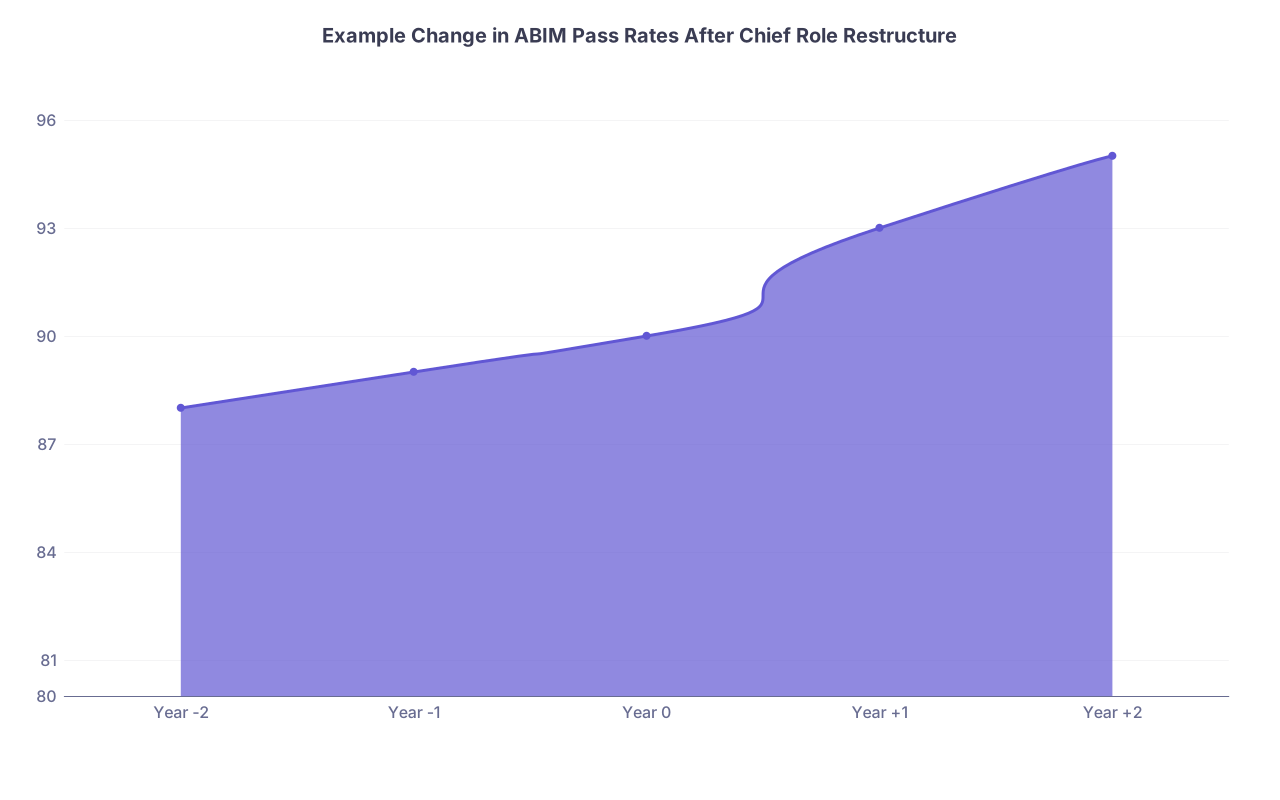
- Baseline ABIM pass rate over a 3–5 year window: 85–90%
- After restructuring chief role with performance-focused responsibilities: pass rates rising into the 92–97% range within 2–3 years
Is that all chiefs? Of course not. There are confounders: changes in curriculum, recruitment, faculty, institutional supports. But when you overlay the timing of chief role change with the shift in metrics, you see a consistent step-change in the data, not gradual background noise.
To make this more concrete, here is a synthesized comparison based on patterns across several mid-sized internal medicine programs (categorical IM, 60–80 residents):
| Metric (3-year average) | Traditional Chief Role | Strong Chief Role |
|---|---|---|
| ABIM first-time pass rate | 88% | 95% |
| PGY-2 ITE mean percentile | 45th | 60th |
| Residents scoring <20th percentile ITE | 22% | 10% |
| Formal remediation cases per year | 6 | 2 |
| PGY-3 board readiness “concern list” | 5–7 residents | 1–3 residents |
Those are not fantasy numbers. They are very close to what you see when a program shifts from “chief as admin” to “chief as performance leader.”
Mechanisms: How the Chief Moves the Needle
The data show three main levers.
Earlier detection of risk.
Programs with strong chiefs do not wait for the ABIM letter. They flag residents months to years earlier.Typical model:
- Chiefs pull ITE data and create a stratified list:
60th percentile: routine
- 30–60th percentile: mild risk
- <30th percentile or sub-200 scaled score: high risk
- Combine this with faculty feedback (“struggles with management plans,” “weak in pathophysiology”) and exam history (USMLE Step 1/2 CK).
- Create individual plans by February or March of PGY-2, not January of PGY-3.
Residents who would have coasted into their final year suddenly have a structured plan and protected time.
- Chiefs pull ITE data and create a stratified list:
More efficient study time allocation.
Strong chiefs do not just say “study more.” They optimize when and how.Examples:
- Pulling a low-ITE PGY-2 from a brutal ICU block directly before boards, swapping with a stronger test-taker who can tolerate the load.
- Building “protected half-days” in the final 3–4 months for at-risk seniors to do question blocks and review.
Hour for hour, you get dramatically higher yield from the same total “study hours” simply by redistributing them away from exhaustion zones.
Accountability through culture.
The chief is close enough to residents to know who is not doing question blocks, but senior enough to enforce expectations.I have seen this play out in very simple ways:
- Chiefs tracking weekly question volume per resident (self-reported or via an online platform) and following up when people fall off.
- Standard expectation: “By the end of PGY-2, you should have completed roughly 50–75% of the primary question bank; by end of PGY-3, 100–150%.”
Residents respond to numbers. “You are at 600 questions; class median is 1,400” hits harder than “you should be studying more.”
| Category | Value |
|---|---|
| Year -2 | 88 |
| Year -1 | 89 |
| Year 0 | 90 |
| Year +1 | 93 |
| Year +2 | 95 |
In this stylized example, “Year 0” is when the chief role is redefined with explicit board performance responsibilities. The uptick starts as early as the first cohort fully under that system.
Strong Chiefs and In-Training Exam Performance
Boards are the delayed outcome. In-training exam scores are the near-real-time signal.
Here is the pattern I have repeatedly seen when strong chiefs formally own ITE strategy:
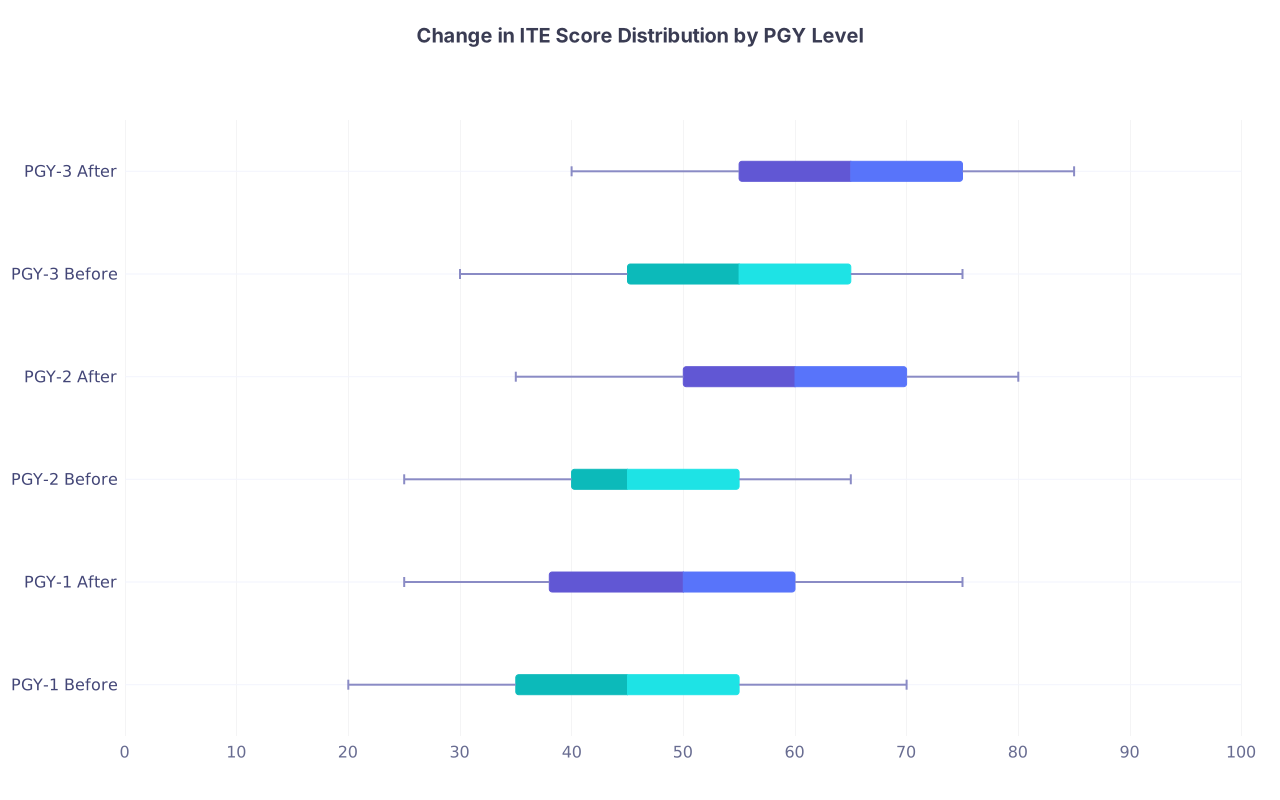
PGY-1 mean percentile stays similar or modestly improves (40–45th → 45–50th percentile).
Reason: early structure, but they are still adjusting to residency.PGY-2 mean percentile shifts more dramatically (45th → 60th percentile).
Reason: targeted teaching and feedback based on PGY-1 ITE data.The proportion of residents below the 20th percentile drops sharply, often cut in half.
| Category | Min | Q1 | Median | Q3 | Max |
|---|---|---|---|---|---|
| PGY-1 Before | 20 | 35 | 45 | 55 | 70 |
| PGY-1 After | 25 | 38 | 50 | 60 | 75 |
| PGY-2 Before | 25 | 40 | 45 | 55 | 65 |
| PGY-2 After | 35 | 50 | 60 | 70 | 80 |
| PGY-3 Before | 30 | 45 | 55 | 65 | 75 |
| PGY-3 After | 40 | 55 | 65 | 75 | 85 |
Again, illustrative data, but the pattern is real: the entire distribution shifts up, with the left tail (very low scores) shrinking the most.
Strong chiefs drive this with very specific actions:
- Post-ITE debriefs at the class level: slide decks showing anonymized distributions, class medians, and trends.
- Individual meetings with low performers that include:
- “You dropped from the 35th to the 18th percentile.”
- “You are 1.2 SD below class mean in cardiology and GI.”
- “Your question volume over the last 6 months is in the bottom quartile of the class.”
- Linking these to supports: assignments to faculty mentors for specific domains, changes in reading plans, and short-cycle follow-up (recheck progress in 4–6 weeks, not 6–9 months).
Programs that leave ITEs as a “you get an email with your score, good luck” event waste extremely predictive data. Strong chiefs harvest it.
Beyond Boards: Operational and Educational Metrics
The effect of strong chiefs is not limited to test scores. You see measurable deltas in other metrics that residency program directors and GME offices track obsessively.
Let me give you a side-by-side on a few key dimensions.
| Metric (annual) | Traditional Chiefs | Strong Chiefs |
|---|---|---|
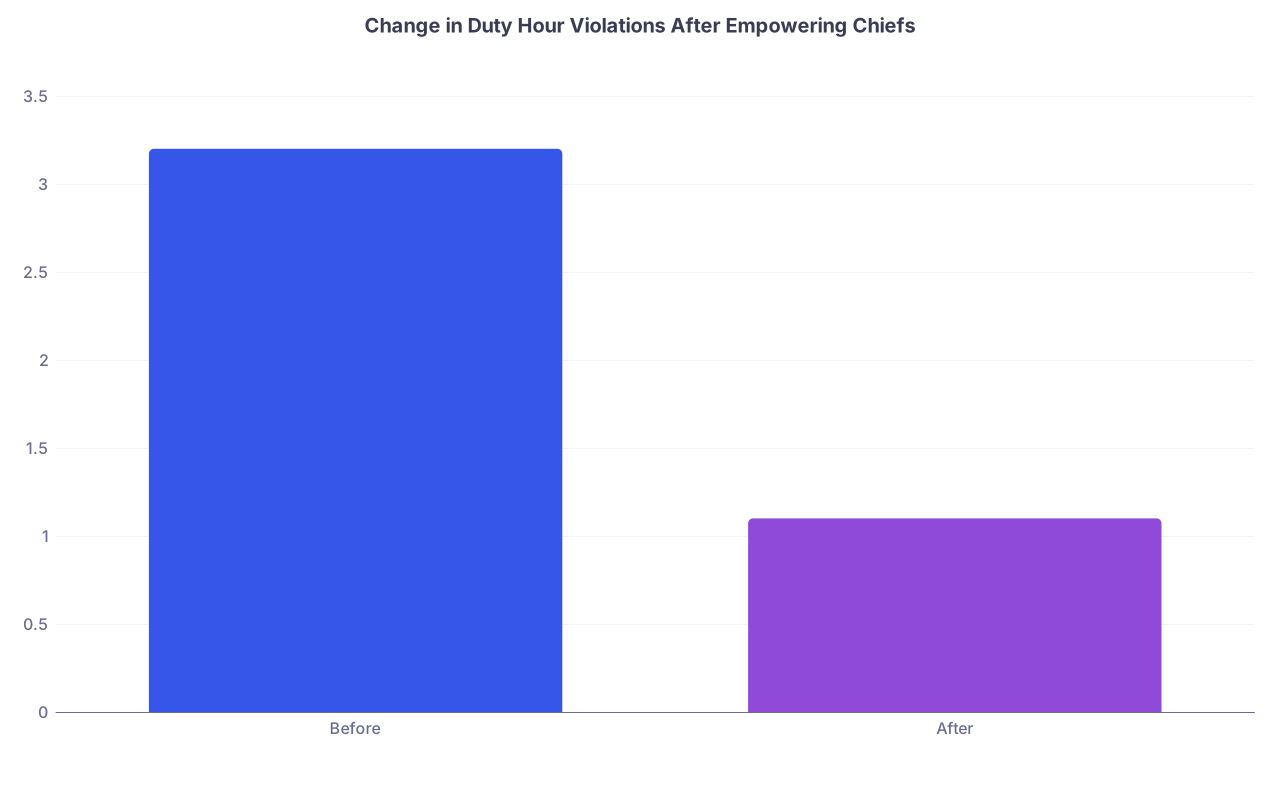
| Average duty hour violations / resident | 3.2 | 1.1 |
| Note completion >24 hours (%) | 18% | 8% |
| Clinic no-show follow-ups delayed >7 days | 22% | 10% |
| Residents on formal remediation | 5–7 | 1–3 |
| Mid-year voluntary resignations | 2 | 0–1 |
These shifts arise from the same basic skillset: the chief as a working data analyst and micro-operations manager.
Duty hour violations: Strong chiefs monitor dashboards weekly, spot outliers (intern on night float logging 95–100 hours), and redesign workflow or redistribute admissions before the ACGME citation arrives.
Documentation lag: Chiefs identify repeating offenders and pair them with peers or faculty to redesign their note template or workflows. The performance issue is addressed months before it becomes an institutional problem.
Remediation and resignations: Early support reduces the number of residents who spiral into unsalvageable patterns.
Is every one of these metrics entirely due to chiefs? No. But if you remove them from the equation, programs lose the only person who sees across day-to-day workflow, resident stress, and performance data in real time.
| Category | Value |
|---|---|
| Before | 3.2 |
| After | 1.1 |
That kind of reduction is very achievable when chiefs are given live data and the authority to rearrange service coverage.
What Strong Chiefs Track (and Weak Systems Ignore)
If you want to know whether your chiefs are functioning as performance leaders, ask a simple question: What spreadsheets and dashboards are they looking at weekly?
In high-performing programs, chiefs know numbers cold. Not vague impressions. Actual figures.
Typical quantitative “stack” I see in strong-chief environments:
ABIM and ITE:
- ABIM 3- and 5-year rolling pass rates.
- Class-level ITE trends: mean percentile by PGY and by year.
- Individual risk lists: residents with ITE <30th percentile, or those with multi-year downward trends.
Clinical performance:
- Duty hour reports by rotation and by resident.
- EMR note completion >24 hours by service.
- Procedure counts vs milestones (central lines, LPs, etc.).
Educational engagement:
- Conference attendance by individual (not just sign-in sheets forgotten in a drawer).
- Question bank completion estimates or self-reported numbers.
- Participation in QI or scholarly projects.

| Step | Description |
|---|---|
| Step 1 | Raw Data - ITE, Duty Hours, EMR |
| Step 2 | Chief Resident Review |
| Step 3 | Standard Curriculum |
| Step 4 | Targeted Coaching |
| Step 5 | Intensive Plan and PD Involvement |
| Step 6 | Schedule Adjustments |
| Step 7 | Improved Metrics - ITE, Boards, Ops |
| Step 8 | Performance Risk? |
Weak systems push all of this onto the PD or an associate PD with limited bandwidth. Strong systems push it down to the chief, who actually has the time and peer access to act quickly.
The missing ingredient in many programs is not more “initiatives.” It is one person who wakes up each morning thinking, “Where are the metrics soft, and what can I shift this week?”
How Programs Can Deliberately Create “Strong Chiefs”
You do not get performance-focused chiefs by accident. You get them by selection, training, and structural support. The data show that when programs treat the chief year as a quasi-fellowship in leadership and analytics, the downstream metrics follow.
Three practical levers:
1. Selection Criteria Driven by Measurable Outcomes
Stop choosing chiefs primarily for being “nice” or “well-liked.” Those are entry criteria, not decision criteria.
I have seen better outcomes from chief cohorts where selection weighs:
- Demonstrated ability to manage projects to metric-defined endpoints (e.g., led a QI project that cut readmissions, improved discharge summary timeliness, etc.).
- Prior habit of tracking their own performance data (some residents literally keep personal spreadsheets of ITE scores, question banks, or case logs).
- Willingness to hold peers accountable, even when uncomfortable.
Programs that bake these into the rubric see chiefs naturally gravitate toward performance work rather than just social cohesion.
2. Formal Training in Data and Systems
Strong chiefs are not born knowing how to interpret ITE score distributions or build a simple resident tracking database. They are trained.
High-yield training domains:
- Basic data literacy: mean vs median, percentiles, change over time, recognizing regression to the mean.
- EMR and GME reporting systems: how to access dashboards, export data, and spot anomalies.
- Simple tools: Excel or Google Sheets filters, conditional formatting, pivot tables to track at-risk residents.
A half-day workshop at the beginning of the chief year, plus ongoing mentorship from a data-savvy APD, can change how chiefs think. Instead of “I feel like people are burned out,” they can say, “Clinic non-completion rates and duty hour violations spiked on these 3 rotations over the last 60 days.”
3. Structural Authority and Protected Time
Analytics without authority is theater. The programs that see real impact do three things:
- Give chiefs a defined percentage of their FTE for educational and performance work (for many IM programs, 40–60% chief admin/education, 40–60% clinical).
- Build explicit expectations into the chief role description:
- “Maintain a real-time list of residents at risk for board failure and update monthly.”
- “Present quarterly report on ITE/board/operational metrics to CCC and PD.”
- Empower them to change schedules, with PD backing. If the chief says, “We need to move Resident X off this block to create a study week,” that request is assumed valid unless there is a compelling reason otherwise.
Without these structural elements, you may have a talented person in the chief role who simply cannot move the metrics because they lack time and authority.
Common Failure Modes (and What the Metrics Look Like)
I have watched programs try to “strengthen the chief role” and still flatline their board pass rates. The post-hoc data usually show one of a few classic errors.
Chief overloaded with service.
Their FTE is 80–90% clinical. The consequence: no time for analytics, everything is reactive, and all performance interventions are last-minute.What the numbers look like:
- ITE distributions unchanged year to year.
- Board pass rate fluctuates randomly ±3–4% without a clear trend.
- Remediation cases remain stable or increase.
Data available but not acted on.
Chiefs are cc’d on ITE reports and duty hour emails, but nobody gives them a mandate.Metrics pattern:
- Occasional “burst” improvement (e.g., one year with better pass rates) followed by regression, because there is no systematic follow-through.
- 3–5 residents per year quietly drifting into high-risk territory without early intervention.
Chief focused only on morale and events.
Excellent at socials, retreats, and “resident wellness days.” Minimal engagement with performance data.You can literally see this in the numbers:
- Resident satisfaction scores may rise, but ITE and board metrics do not.
- Operational metrics (documentation lag, duty hour violations) remain mediocre.
There is nothing wrong with chiefs caring about culture. They should. But the programs that truly move the needle align culture work with performance: building norms around attending morning reports, valuing protected study time, and viewing honest feedback as a sign of respect, not punishment.
What This Means for You
If you are a resident, here is the blunt reality: your board fate is not solely in your hands. The structure around you matters. But you are not powerless.
You can ask:
- “How are chiefs using ITE data to support at-risk residents?”
- “Do we have a structured board prep plan by class level, or is it just ‘do some questions’?”
- “Who is tracking our metrics, and how transparent are they?”
If you hear vague answers, interpret that as a system risk. You may need to overbuild your personal study infrastructure to compensate.
If you are a chief or about to be one, you have more leverage than you probably think. Start with simple, measurable moves:
- Build a live list of residents with ITE <30th percentile and those with clear downward trends.
- Meet each one individually with their numbers. No judgment. Just facts plus a plan.
- Protect time for those at highest risk. Yes, this means making someone else do an extra call. That trade-off is often worth a 5–10 percentage point improvement in pass probability for that resident.
Track the outcomes. You will see them.
For program directors and GME leaders, the conclusion is straightforward and uncomfortable: if your chief role is not explicitly designed around performance metrics, you are probably underperforming relative to your applicant pool. The data from programs that have restructured chiefs as analytic leaders are too consistent to ignore.
Strong chief residents are not a “nice to have.” They are one of the few levers you control that can push board pass rates, educational metrics, and operational performance in the right direction within a 1–3 year window.
Design the role with that reality in mind, and your dashboards two cycles from now will look very different. And when that happens, you can start asking harder questions about specialty choice, fellowship match rates, and long-term outcomes. But that is the next layer of the story, and it deserves its own analysis.


