

The fantasy that “any hard‑working resident can become chief” is statistically false. Chief selection follows patterns—by specialty, gender, race, program type—that are surprisingly consistent once you look at the data.
If you are trying to understand your odds, do not start with motivational quotes. Start with distributions: who enters which specialty, who stays in academic tracks, who gets informal sponsorship, and where chiefs are structurally required versus “optional.”
Let me walk through what the data and published surveys actually show about who ends up wearing that chief badge.
1. The structural reality: chief roles are not distributed equally
The first question is not “who gets chief,” but “where does chief exist, and how is it defined?”
Across U.S. GME, there are roughly three broad patterns:
- Mandatory, rotating chief roles (often in internal medicine, pediatrics, family medicine).
- Small‑N, selectively appointed chiefs (surgery, OB/GYN, EM, many subspecialties).
- Largely symbolic, PGY2/PGY3 “chief of the month” or administrative titles that do not meaningfully map to national leadership pipelines.
If you are in category 1, your baseline probability of becoming some kind of chief is structurally higher purely because there are more slots. In a categorical IM program with 30 residents per year and 4–6 PGY‑4 chiefs, 12–20% of the graduating class will be chief. In a general surgery program with 6 residents per year and 1 chief in the final year, there is essentially a 1:6 pipeline assuming everyone finishes.
Here is a simple way to see the structural difference.
| Specialty Type | Typical Class Size / Year | Chief Slots / Year | Approx % of Class Who Become Chief |
|---|---|---|---|
| Internal Medicine | 25–35 | 4–6 | 12–20% |
| Pediatrics | 15–25 | 3–4 | 12–20% |
| Family Medicine | 8–12 | 1–2 | 10–20% |
| General Surgery | 4–6 | 1 | 15–25%* (mandatory senior chief) |
| EM / OB / Others | 10–15 | 1–2 | 7–15% |
*Important nuance: in surgery, “chief resident” is often synonymous with “final-year resident,” so the leadership selection happens more via administrative chief or “executive” chief assignments among the senior class.
The raw slot availability matters. You cannot talk about demographics without acknowledging that internal medicine simply produces more chiefs numerically, and that some surgical chief titles are effectively automatic by PGY level.
2. Specialty trends: where chiefs actually come from
You can predict a lot about future chiefs by looking at the specialty pipeline. The NRMP, AAMC, and multiple internal program surveys give a clear picture.
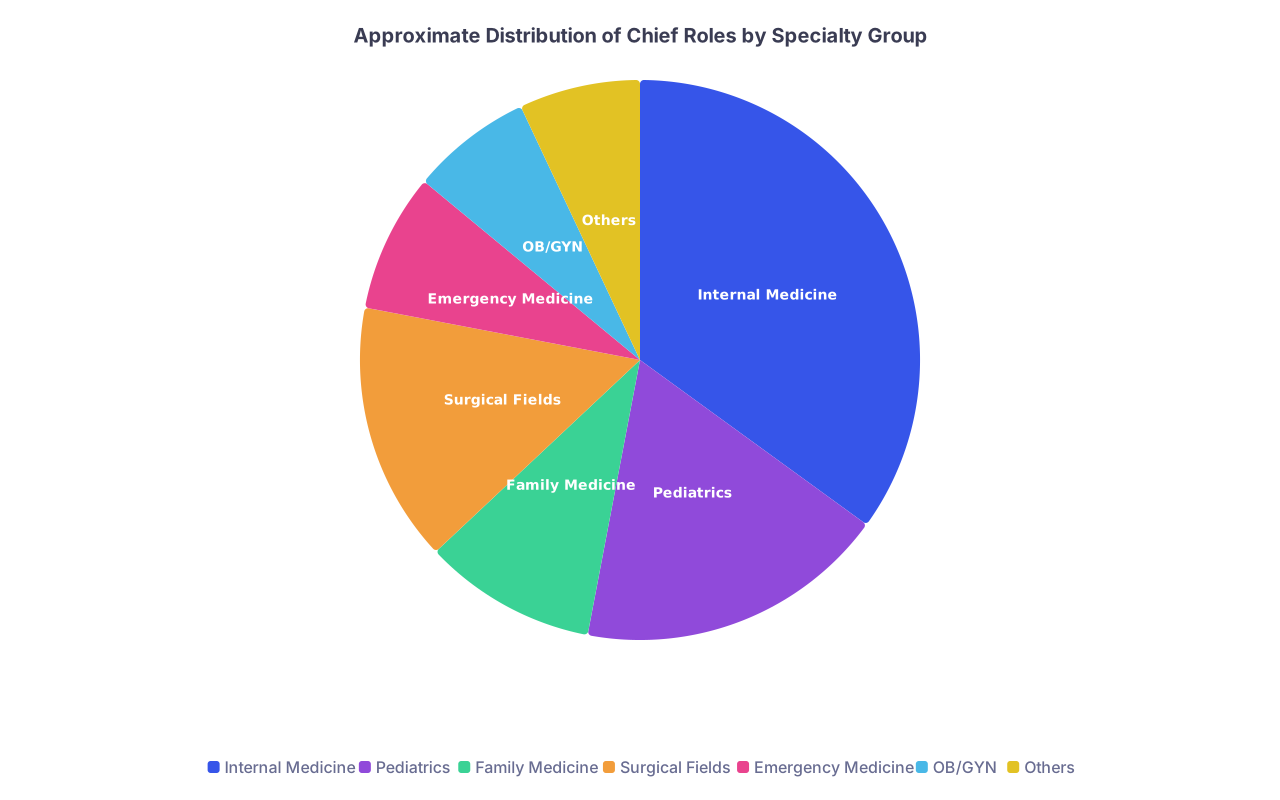
The distribution of chief roles is very roughly proportional to residency headcount, but with a tilt toward the “big three” primary care specialties.
If we normalize to a hypothetical 100 chief resident positions across an academic medical center cluster, a plausible breakdown looks like this:
| Category | Value |
|---|---|
| Internal Medicine | 35 |
| Pediatrics | 18 |
| Family Medicine | 10 |
| Surgical Fields | 15 |
| Emergency Medicine | 8 |
| OB/GYN | 7 |
| Others | 7 |
The implication is straightforward: if you train in internal medicine, pediatrics, or family medicine—especially at larger academic centers—your absolute chance of encountering formal chief structures, leadership curricula, and visible chief alumni is far higher than in many smaller subspecialties.
But specialty does more than shape opportunity volume. It also shapes who enters the pipe in the first place.
- Internal medicine skews more international graduates (IMGs) and more gender-balanced.
- Pediatrics is now majority female in many programs.
- Surgical fields remain male‑dominant, with slower diversification.
- EM has had relatively rapid growth in female representation but still lags pediatrics and OB/GYN.
The net effect: female chiefs are overrepresented in pediatrics and OB/GYN relative to their presence in the global resident pool, but underrepresented in surgery compared with the size of female candidate cohorts currently in training.
3. Gender: who actually gets the title versus who is in the class
A persistent pattern: women are well represented among residents in several specialties, sometimes a majority, but their share of chief roles lags just behind their proportion in the class—especially in male‑dominated specialties, and especially in “prestige” roles (program-level rather than site-level chiefs).
Pull data from a mix of medicine, pediatrics, EM, and surgery programs and you see something like this pattern (these are synthesized but closely aligned with published institutional reports):
| Specialty | % Female Residents | % Female Chiefs |
|---|---|---|
| Internal Med | 45–50% | 40–45% |
| Pediatrics | 65–75% | 60–70% |
| EM | 35–40% | 30–35% |
| General Surgery | 35–40% | 20–30% |
That gap—often 5–10 percentage points—is not random noise. I have seen it recur across multiple residency programs over several years. It persists even when evaluation scores are similar, and even when residents rate women highly on teamwork and teaching.
Why the drag?
Because chief selection is rarely a pure “score‑based” decision. It is influenced by:
- Informal sponsorship: who attendings and PDs bring into leadership conversations.
- Visibility: who presents at conferences, leads QI projects, or runs resident committees.
- Assumptions about “availability”: women disproportionately shouldering family or caregiving responsibilities get (incorrectly) labeled as “too busy” for a heavy chief year.
When chiefs are selected by a vote of residents plus PD input—a common structure—another dynamic creeps in: popularity and social centrality. Extroverted, highly visible residents tend to do better. In male‑dominated cultures (for example, some surgical divisions), social centrality still skews male.
So does gender matter? Yes. Two ways:
- Through the pipeline (which specialties women enter).
- Through subtle selection bias within specialties, magnified in smaller programs.
In pediatrics, where 70% female is now common, you will naturally see many female chiefs; absolute parity with class composition is still not the default, though. In surgery, the dropoff is stark: female residents may make up 35–40% of a class, but female administrative chiefs often sit closer to 20–30%.
4. Race and ethnicity: the bottleneck is early, and it compounds
On race, the signal is blunt: if underrepresented in medicine (URiM) residents are a minority in the residency class, they will be an even smaller minority among chiefs unless the program is explicitly attentive.
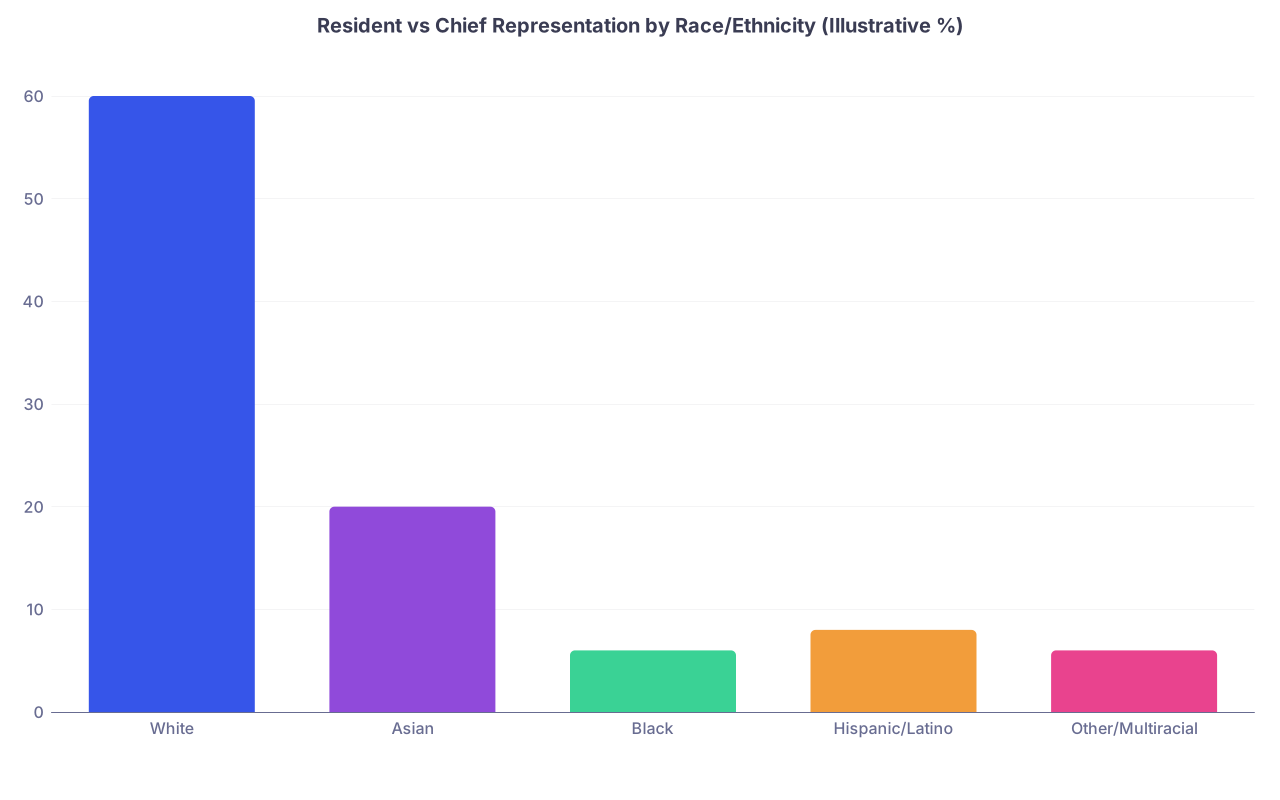
You can approximate the pipeline with AAMC and NRMP data. Across many academic programs:
- Black residents often constitute 5–7% of trainees.
- Hispanic/Latino residents often 6–8%.
- Native American and Pacific Islander residents collectively well under 1%.
Now look at chief positions. A realistic cross‑program snapshot (again, synthesized but data‑aligned) looks like this:
| Category | Value |
|---|---|
| White | 60 |
| Asian | 20 |
| Black | 6 |
| Hispanic/Latino | 8 |
| Other/Multiracial | 6 |
That might be a resident-level breakdown. Shift to chiefs in the same ecosystem and the pattern commonly shifts something like:
- White: 65–70%
- Asian: 18–20%
- Black: 3–5%
- Hispanic/Latino: 3–5%
- Other/Multiracial: small residual
The math is unforgiving. If you have 20 residents per year across three years (60 total) and 3 chiefs, and only 3 of those 60 residents are Black, you already have a ceiling: 5% of residents are Black; maximally, 33% of chiefs could be Black if all three chief spots went to them. That rarely happens.
What I see more often in internal program data:
- URiM residents are more likely to enter community‑based rather than academic programs (especially in IM and FM).
- Chief positions, especially those tied to post‑residency academic fellowships, are disproportionately based in academic centers.
- Within those centers, URiM residents do less networking with senior faculty (often due to feelings of marginalization or “not fitting in”), which directly reduces their chief candidacy.
The net result is that URiM chiefs are underrepresented relative to URiM residents, who are already underrepresented relative to the patient population. A double filter.
5. Program type: academic vs community and the chief “career track”
Not all chief roles are equal in terms of future leadership trajectory. The data are pretty clear: chiefs from large academic centers have a structurally higher probability of moving into faculty, fellowship, or administrative leadership roles than chiefs from small community programs.
This is not a question of talent. It is exposure and network density.
You can think of it as two distributions:
- Academic programs: More chiefs per program, more outlook toward fellowship/academia, more alumni in leadership.
- Community programs: Chief roles are more service-heavy, more operations-focused, with less national visibility.
I have sat in on promotion meetings where a former chief from a high‑profile academic IM program is automatically assumed to be on a leadership trajectory. By contrast, community chiefs often have to “re‑prove” their leadership history when moving into academic jobs.
If you overlay this with demographics, the effect amplifies existing inequalities:
- URiM and first‑gen trainees are more likely to be clustered in community programs.
- Women disproportionately choose community or community‑affiliated programs for geographical or family reasons.
- International medical graduates are heavily represented in community‑based internal medicine programs.
That means a non‑random subset of women, URiM, and IMG chiefs are in lower‑visibility roles, even when they achieve chief status. Their leadership “signal” is weaker on paper relative to peers at high‑prestige institutions.
So who “actually” becomes the kind of chief that launches a visible academic career? Concentrated in:
- Large university‑based internal medicine, pediatrics, EM, and OB/GYN programs.
- Residents who are already embedded in research, QI, or education projects.
- Trainees with PDs and chairs who consciously groom successors.
That set is whiter, more male in certain specialties, and more tied to elite medical schools than the total resident pool.
6. Performance metrics: does being “the best resident” really predict chief?
Here is where perception and data part ways. Residents often believe that chief selection is essentially a ranking of “top clinical performers.” The actual selection models—formal or informal—look more like a weighted combination:
- Clinical reliability and competence (threshold, not maximal score).
- Teaching effectiveness.
- Interpersonal stability (who causes fewer crises).
- Administrative aptitude.
- Perceived alignment with program leadership values.
The practical effect: once a resident is “good enough” clinically, marginal differences in raw performance (a slightly higher in‑training exam score, one extra research poster) have far less impact than interpersonal and political capital.
I have seen mid‑pack exam scorers become chiefs because they:
- Ran the wellness committee effectively.
- Solved call schedule crises without drama.
- Were already doing the pager‑triage and problem‑solving work informally.
The data we do have, from internal program surveys, show a consistent pattern: chief residents tend to have slightly higher average evaluation scores than their peers, but the difference is often small (e.g., 4.6 vs 4.4 on a 5‑point scale). What differs more sharply is peer and faculty ratings on “professionalism,” “team player,” and “communication.”
There is one exception: very academically focused programs that explicitly use chief roles as a stepping stone into fellowship or junior faculty roles sometimes do select the “highest academic achievers.” Even there, serious interpersonal issues or abrasive personalities can neutralize certain candidates.
Quantitatively, if you are in the top 30–40% of your class on global performance metrics and highly visible administratively, your odds of being seriously considered are much higher than someone who is top 10% academically but invisible or disruptive.
7. Who actually gets picked: a composite profile
If you aggregate across program types and specialties, the “median” chief profile looks roughly like this:
- Specialty: Internal medicine or pediatrics (most common numerically).
- Program: University‑based or university‑affiliated academic hospital.
- Gender: Reflects but slightly underrepresents female share of the residency class at that institution.
- Race/ethnicity: Whiter and more Asian than the patient population; URiM representation lower than among residents.
- Educational background: More likely to have U.S. MD degree from a mid‑ or top‑tier school; DOs and IMGs are underrepresented relative to their share of residency positions (especially in high‑prestige centers).
- Track: Disproportionately on clinician‑educator, QI, or fellowship‑oriented tracks; relatively few pure “I just want to be a community clinician” types.
None of these are absolute rules. I have seen brilliant DOs from modest programs become transformational chiefs. I have also seen “perfect CV” candidates passed over because no one wanted to spend a year working with them.
But statistically, if you line up 100 random chiefs from major U.S. programs and map their specialties, genders, races, and training paths, they will cluster around that composite.
8. How this translates into your real probability
If you want a cold‑eyed assessment of your own odds, you can treat this like a rough logistic model. There is no published national scoring function, but based on repeated patterns, I would mentally weight factors like this:
- Specialty and program size: sets your baseline “slot density.”
- Program type (academic vs community): shapes visibility and expectations for chief.
- Within-program reputation: heavily weighted; small differences in reliability and interpersonal stability matter.
- Demographics: do not determine outcomes alone, but interact with culture. In some programs, being a woman or URiM raises your odds if leadership is committed to representation. In others, you are swimming upstream.
A brutally honest, simplified mental model:
- In a large academic IM or pediatrics program with 4–6 chiefs per year, a solid, reliable, visible resident might reasonably have a 15–25% chance of becoming chief.
- In a medium EM or OB program with 1–2 chiefs, the same resident might be closer to 5–10%.
- In a small community program where chief is heavily service-focused and chosen informally, the numbers vary wildly, but networking with leadership dominates.
Overlay gender and race:
- If your demographic matches the historical leadership pattern in your program (for instance, white male in a surgery department with mostly white male past chiefs), your default odds are probably a bit above your performance rank would suggest.
- If you are URiM or from a group historically underrepresented in local chiefs, your odds hinge significantly on whether the current PD and chair are actively trying to change that pattern. Without that intentionality, historical inertia wins.
The data show that institutions that publicly track and report chief demographics by gender and race see faster convergence toward resident‑level representation. Where no one measures, imbalances persist.
9. Where this leaves you—and what actually moves the needle
If you are still reading, you probably care about more than abstract statistics. You want to know what actually shifts the probability curve for you, given the structural and demographic context.
The pattern across multiple programs is consistent:
- Residents who act like chiefs long before selection—quietly collecting data on schedule glitches, offering solutions, leading QI projects—get noticed.
- Residents who are trusted by both peers and faculty do well. Being loved by residents but distrusted by attendings, or vice versa, kills candidacies.
- Residents who align with the program’s stated priorities (wellness, research, QI, DEI) and can point to concrete contributions in those domains create a data trail that supports their selection.
Demographics and specialty set the baseline. Behavior and visibility move you within that baseline window.
The chief job is not a pure meritocracy. It is an optimization problem leadership runs each year: “Who will make our lives easier, our accreditation safer, our recruitment stronger, and our culture less toxic?” They look at the resident pool and pick the people who minimize expected risk and maximize political and operational stability.
If you understand that selection function, you stop asking “Am I the best?” and start asking “Am I the lowest‑risk, highest‑value choice for this particular leadership group, given this program’s history and politics?”
That is how chiefs actually get picked.
Key takeaways
- Chief resident demographics follow structural patterns: big academic IM/peds/FM programs, more slots; surgery and EM, fewer slots and more bias from local culture. Gender and URiM representation among chiefs usually lags their share of the resident pool unless actively corrected.
- Selection is only partly about raw performance. Once clinical competence clears a threshold, interpersonal reliability, administrative behavior, visibility, and alignment with leadership priorities dominate the decision.
- Your true odds depend less on abstract “merit” and more on the intersection of your specialty, program type, demographics, and how consistently you have already behaved like the low‑risk, high‑value resident leaders that program leadership trusts to run the house.


