What happens if you finally escape 80‑hour weeks for dermatology or radiology… and then AI eats your job ten years later?
Let’s cut through the myths. Because right now, medical students are making 30‑year career bets based on Twitter threads, Reddit anecdotes, and clickbait headlines about “radiology being dead” or “primary care being replaced by chatbots.”
You deserve better than vibes-based career planning.
The Three Big Myths About “Lifestyle” and AI
There are three persistent myths floating around:
- “Radiology and pathology are doomed. AI will read all the images and slides.”
- “Procedural lifestyle fields like derm, ophtho, and anesthesia are safe. You can’t automate hands.”
- “Primary care and EM are at highest risk because they’re ‘cognitive’ and text-based.”
All three are oversimplified. Borderline wrong.
Job security in an AI-heavy future doesn’t track neatly with “cognitive vs procedural” or “lifestyle vs non-lifestyle.” It tracks with a different set of variables:
- How standardized the work is
- How much liability someone is willing to assign to an algorithm
- How fragmented and underfunded the care setting is
- How much of the value comes from judgment + relationships, not just raw interpretation
So let’s actually look at what’s happening in a few key “lifestyle” specialties people obsess over: radiology, dermatology, anesthesiology, ophthalmology, pathology, and outpatient-focused primary care.
And yes, I’ll show you where I’d be personally more nervous—and where I would not lose sleep at all.
The Real Automation Equation in Medicine
Before we go specialty-by-specialty, you need the basic framework.
AI risk in medicine is highest when all of these are true:
- The input is digital, standardized, and high volume (images, EKGs, discrete labs).
- The output is a narrow task (read this, classify that, flag abnormal).
- The legal responsibility can be offloaded or buffered (screening, “second reader,” decision support).
- Payment doesn’t require a human to be visibly involved.
It’s lowest when:
- The work is messy, multimodal, and context-heavy.
- The output is a plan, not a label.
- Patients or surgeons expect a named human to own the decision.
- The procedure itself is the main billable item, not the interpretation.
With that in mind, let’s go into the “lifestyle” darlings.
Radiology: The Most Over-Hyped “Doomed” Field
Radiology is always the poster child for “AI will replace doctors.” You’ve read the Geoff Hinton quote about “we don’t need radiologists.” That was 2016. We’re now a decade into “imminent” replacement.
What’s actually happening?
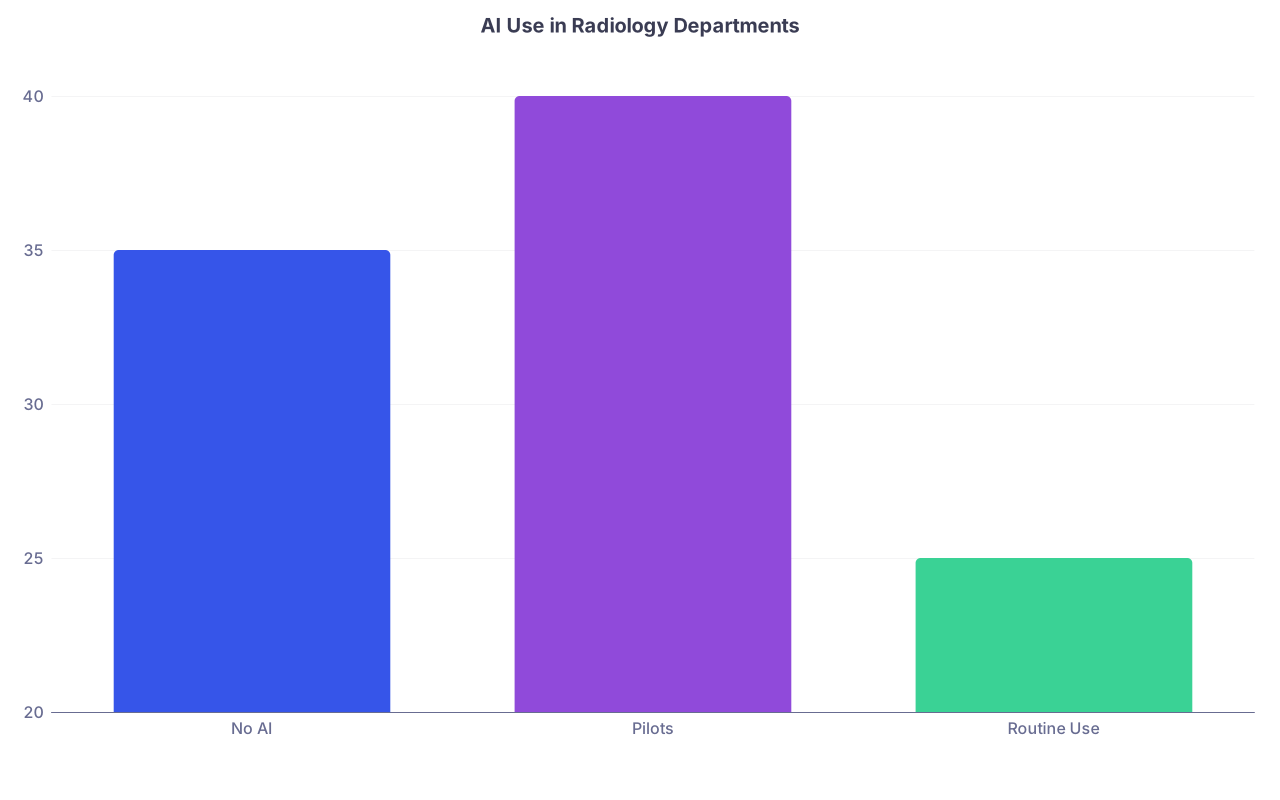
| Category | Value |
|---|---|
| No AI | 35 |
| Pilots | 40 |
| Routine Use | 25 |
The reality in most hospitals (including big academic centers) looks like this:
- AI is deployed on a few narrow tasks: lung nodule detection, brain bleed triage, PE flags on CTAs, mammography assist.
- It’s used as a second reader or triage tool, not as a standalone radiologist.
- Radiologists spend more time adjudicating edge cases and complex studies, not less.
Is radiology heavily automatable at the task level? Yes. A chest X‑ray for pneumonia? Perfect target. A head CT for ICH? Also. But a full day’s workload for a radiologist includes:
- Multi-phase CT abdomens with incidental findings.
- Trauma panscans with unclear histories.
- Interventional procedures, consults, tumor boards, multidisciplinary conferences.
- Protocoling, talking to surgeons, arguing with the ED about “stat” every 5 minutes.
What AI is really doing is stripping out some of the low-complexity, high-volume grunt work and pulling radiologists upstream into:
- Quality control (catching AI misses, system-level oversight).
- Complex imaging interpretation.
- More interventional and procedural work.
The bottleneck is not “can AI read images?” It clearly can in many cases. The bottleneck is: Who takes malpractice when the machine misses the subtle early lung cancer in a 40-year-old with a normal CXR?
Right now, nobody wants that liability without a physician buffer.
Would I avoid radiology because of AI? No. I’d avoid it if I hate sitting, pattern recognition, and risk management. But “AI will kill radiology” is a lazy take.
Dermatology: Everyone Thinks It’s Safe. Not Completely.
Dermatology has the most unrealistic aura of invincibility: high pay, controllable hours, elective cash pay, and “you can’t automate skin.”
Except… you sort of can, for a slice of it.
We’ve already got:
- Smartphone apps classifying skin lesions with near-derm-level sensitivity on select tasks.
- Direct-to-consumer telederm services with non-derm clinicians handling basic rashes and acne.
- Primary care + midlevels managing a growing chunk of bread-and-butter derm.
So what’s really at risk?
- Low-complexity, high-volume tele-rash consults.
- Simple acne, eczema, psoriasis management for well-insured, stable patients.
- Basic lesion triage (“is this obviously benign? do I need to see this?”).
What’s not going anywhere:
- Procedural derm: Mohs surgery, excisions, cosmetic work, lasers, injectables.
- High-risk oncology derm.
- Complex autoimmune dermatology.
- High-end cosmetic practices where people pay for a particular human’s brand.
Here’s the unromantic reality: the billing engine of many private derm groups is procedures and cosmetics, not reading photos of rashes. That side is extremely resilient to automation.
If the field gets squeezed, it’ll be:
- More triage and chronic disease management handled by AI + NPs/PCPs.
- Higher bar for getting in (which is already brutal).
- More concentration of power: large corporate-backed groups and cosmetic-heavy practices winning.
Lifestyle? Still excellent. Future-proof? Not perfectly. But if you like procedures and are willing to adapt, this is not a high-risk specialty.
Anesthesiology: Quietly More Exposed Than People Admit
Anesthesia has a comfortable narrative: “They’ll never replace us, too high stakes, too procedural.” That’s only half-true.
Look at what the industry is actually building:
- Closed-loop anesthesia delivery systems (titrating propofol, vasopressors based on continuous vitals).
- Decision support for intra-op hemodynamics and ventilation.
- Pre-op clearance algorithms triaging who needs further workup.
Plus:
- Massive growth of CRNA and AA utilization, especially in community settings.
- Corporate anesthesia groups pushing supervision ratios harder and harder.
So where does that leave you?
The technical components of anesthesia (drug selection, dose adjustment, ventilator settings) are very algorithm-friendly. Machines are quite good at controlling variables in stable conditions.
Where human anesthesiologists stay indispensable:
- High-risk, high-acuity, rapidly changing scenarios: major trauma, complex cardiac, ECMO, combined procedures.
- Airway disasters.
- Invasive lines, blocks, nuanced peri-op medical management.
- Negotiating with surgeons, OR management, peri-op leadership.
If AI + midlevels erodes the relatively straightforward, stable cases (think ASA I–II elective ortho), you get:
- Fewer anesthesiologist-hours per case.
- Higher concentration in complex centers and high-risk environments.
- Pressure on compensation in saturated markets.
If I were choosing anesthesia today, I wouldn’t panic, but I wouldn’t assume 40 years of “sit, chart, easy money.” I’d plan to:
- Get strong in regional, cardiac, ICU, or pain.
- Be comfortable moving toward more complex, tertiary-care settings.
- Expect supervision and oversight models, not always one-to-one hands-on care.
Lifestyle anesthesiology in a sleepy community hospital doing routine cases all day? That’s the exact scenario automation + cheaper labor will target.
Ophthalmology: Procedures Are the Moat… For Now
Ophtho is another classic lifestyle choice: clinic-based, contained emergencies, lots of procedures, great pay.
Where can AI hit?
- Automated retinal screening for diabetic retinopathy (already FDA-approved).
- Triage of common anterior segment photos.
- Visual field and OCT interpretation.
Where it struggles:
- Combining imaging, symptoms, exam findings, and systemic disease into a coherent management plan.
- Surgical skill: cataracts, glaucoma surgeries, retina procedures, corneal transplants.
And let’s be blunt: the financial core of many practices is cataract surgery volume, intravitreal injections, and high-margin refractive work. AI can assist planning, but it can’t sit at the microscope.
What I do see coming:
- More front-end screening done in primary care, optometry, and retail clinics using AI.
- More predictable, optimized surgical planning with AI-powered biometry and 3D imaging.
- Potential downward pressure on reimbursements for interpretation components as automated systems prove reliable for specific tasks.
Future-proof? Reasonably. But again, the center of gravity shifts more toward:
- Complex care.
- Surgical excellence.
- Managing the AI-enhanced diagnostic pipeline, not doing manual grunt work for simple screens.
Pathology: The Quiet Test Case for True Automation
If any specialty should be terrified of AI, it’s pathology. Digital slides, pattern recognition, classification—this is exactly what convolutional neural networks were built for.
And yet. Even in places with full digital pathology:
- AI is used as a second reader for specific cancers.
- It flags suspicious areas but does not sign the report.
- The pathologist still owns the final call—and the lawsuit.
The pathologist’s work is not just “is this malignant Y/N?” It’s:
- Integrating histology, IHC, molecular data, clinical info.
- Rendering staging and grading decisions.
- Communicating with oncologists and surgeons.
- Validating lab processes and QA.
Over time:
- The slide-count-per-pathologist may drop.
- The complexity-per-case will rise.
- Some low-level screening and quantification work (mitotic counts, margins, basic classification) will be heavily automated.
Pathology is structurally more automatable than most lifestyle fields—no patient in front of you, digital inputs, discrete outputs. But that also makes it one of the safest domains to push AI hard, precisely because there is always a human at the end of the chain to absorb liability and nuance.
If you choose path, I’d do it only if you love the work itself, not because you want “quiet lifestyle and no patient contact.” Those motivations will be increasingly commoditized.
Primary Care & Outpatient IM: “Low Lifestyle” Now, But Weirdly Resilient
You didn’t ask about this, but let’s talk about the elephant.
A lot of students run from primary care for lifestyle reasons (clinic chaos, admin overload, poor pay). Ironically, as AI matures, this is one of the hardest domains to fully automate.
Why?
Because primary care is:
- Longitudinal.
- Relationship-based.
- Multi-problem, multi-morbidity, psychosocially saturated.
The work is not just: “interpret this finding.” It’s:
- Prioritizing among 8 problems in a 15-minute visit.
- Balancing guidelines, patient preferences, social constraints, and insurance absurdity.
- Risk stratification and framing uncertainty.
AI can absolutely:
- Draft notes.
- Help with guideline-based care gaps.
- Suggest differential diagnoses.
- Auto-manage simple refills and chronic disease protocols.
But patients do not want a chatbot telling them they have new onset heart failure or cancer. Or adjusting complex polypharmacy for geriatric syndromes with no clinician involved.
The bad news: Systems will try to use AI + cheaper labor to offload easier stuff and overload remaining PCPs even more. The good news: A good primary care physician will remain very hard to replace.
Comparing Future-Proofing Across Lifestyle Specialties
Let’s be concrete. If we’re talking about AI/automation risk to core tasks, here’s the rough reality:
| Specialty | Core Task Automation Risk | Overall Job Security Outlook |
|---|---|---|
| Radiology | High (task level) | Moderate to high |
| Pathology | High (task level) | Moderate |
| Dermatology | Moderate | High |
| Anesthesiology | Moderate to high | Moderate |
| Ophthalmology | Moderate | High |
| Outpatient IM | Low (full replacement) | High but evolving |
This is not ranking of “best specialty.” It’s a reality check: almost all of them survive. They just change.
How to Actually Future-Proof Yourself (Regardless of Specialty)
The wrong question is: “Which lifestyle specialty is 100% safe from AI?”
The right question is: “Within any reasonable specialty I enjoy, how do I position myself on the AI-resistant side of the fence?”
Patterns I’ve seen (and I’ve watched attendings age through this):
You are safer if you:
- Do work where your judgment meaningfully changes outcomes.
- Own decisions that no administrator wants to defer to a black box.
- Perform procedures that patients or surgeons perceive as high-stakes and skill-dependent.
- Take on roles that require leadership, communication, and conflict resolution, not just interpretation.
You are more exposed if you:
- Spend your day on narrow, repetitive classification tasks.
- Are interchangeable with a midlevel + algorithm.
- Resist learning new tools and workflows while younger colleagues adopt them.
If I were a med student now, I would:
- Pick a specialty I can tolerate doing at 2 a.m. when things go sideways—not one that’s “easy” on paper.
- Within that specialty, lean into complexity: subspecialty expertise, procedural skill, multidisciplinary roles.
- Get very comfortable with data/AI tools so I’m the person using them, not the person being replaced by someone who does.
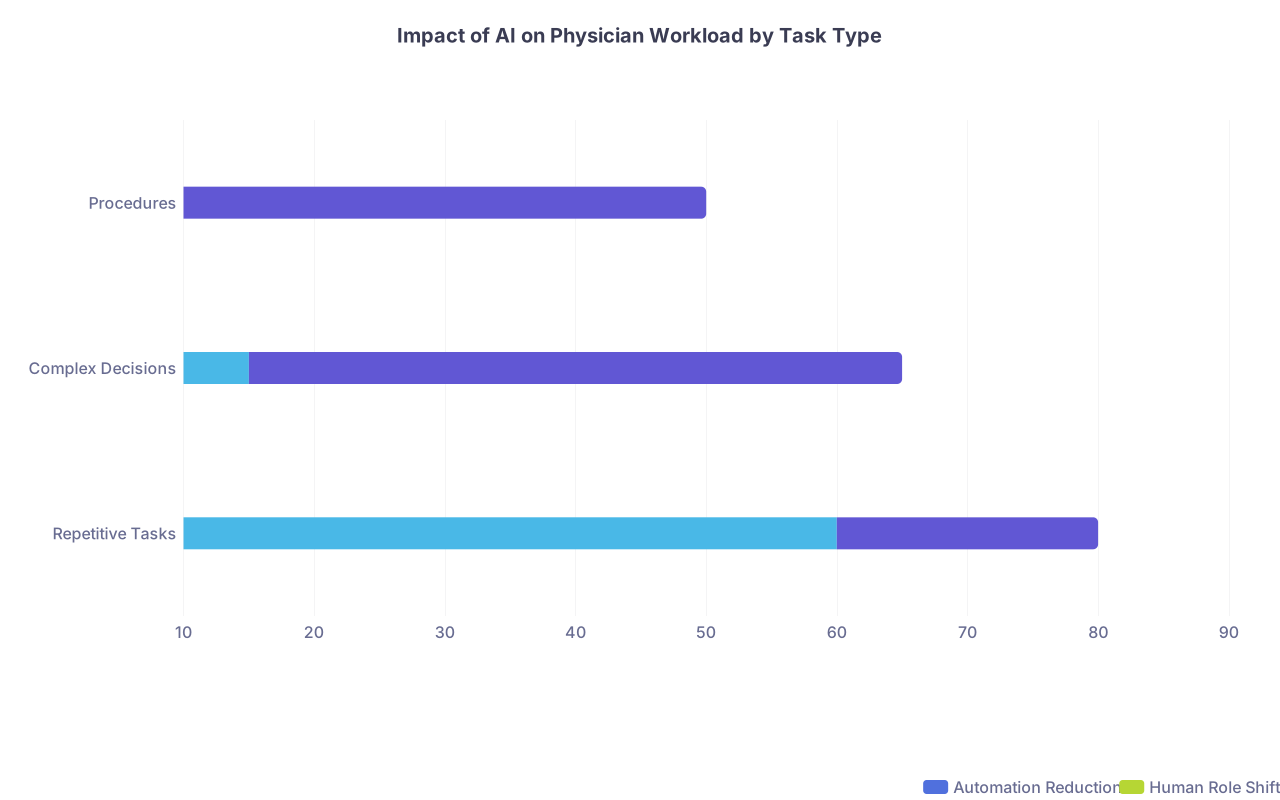
| Category | Automation Reduction | Human Role Shift |
|---|---|---|
| Repetitive Tasks | 60 | 20 |
| Complex Decisions | 15 | 50 |
| Procedures | 10 | 40 |
What This Means For Your “Lifestyle” Fantasy
The term “lifestyle specialty” is already a bit of a joke among attendings. It usually translates to:
- Better control over call and nights.
- More outpatient and procedural work.
- Less exposure to unbounded chaos (EM, ICU, trauma surgery).
AI doesn’t magically invert that.
But if by “lifestyle” you actually mean: “I want to work less, make a lot, and never be stressed,” that’s the part that’s fantasy. AI or not, the system will keep squeezing.
If instead you mean: “I want a specialty where I can have a sustainable, humane career and a life outside medicine,” then yes—fields like derm, ophtho, radiology, and even anesthesia can absolutely provide that, even in an AI-heavy world.
The price of admission will be higher adaptability, not lower effort.
Years from now, you won’t remember the panic headlines about “radiology is dead” or “AI will replace doctors.” You’ll remember which problems you chose to own when medicine changed—and whether you hid from that shift or stepped toward it.

| Step | Description |
|---|---|
| Step 1 | Traditional Tasks |
| Step 2 | Repetitive Interpretation |
| Step 3 | Complex Decision Making |
| Step 4 | Procedures and Leadership |
| Step 5 | AI and Midlevels |
| Step 6 | AI Augmented Physician |
FAQ (Exactly 5 Questions)
1. Should I avoid radiology or pathology because of AI?
No. Avoid them if you do not like pattern recognition, sitting, or high-liability interpretation work. AI will change the mix of tasks, but there’s no credible path in the next few decades where hospitals run entirely without radiologists or pathologists. What you will see: more oversight, more complex cases, fewer pure grunt reads.
2. Are procedural lifestyle specialties like derm and ophtho completely safe?
No specialty is completely safe. But procedure-heavy practices—Mohs, cataracts, retina, cosmetics—are structurally more resilient. AI might offload triage and basic screening, which could even increase demand for high-level procedural work by funneling more appropriate cases your way.
3. Is primary care at higher risk from AI than lifestyle specialties?
Not in the way people assume. Simple, protocolized chronic disease management will absolutely be attacked by AI + cheaper labor. But the heart of primary care—complex multimorbidity, uncertainty, emotion-heavy decisions—is hard to automate. The risk is not replacement; it is burnout from bad deployment of these tools in underfunded systems.
4. Will AI reduce physician salaries in these lifestyle fields?
In some markets, yes, especially where a large portion of billed work is low-complexity interpretation or monitoring that AI can assist with. But salary is driven as much by payer mix, regulation, and corporate power as by technology. Expect compression at the low-skill, commoditized end of each specialty, not uniform collapse.
5. How can I personally stay “future-proof” in any specialty I choose?
Lean into what AI can’t do well: nuanced judgment, high-stakes procedures, complex multidisciplinary decisions, and real human connection. Adopt AI tools early and position yourself as the person who knows how to use them safely and efficiently. The doctor who works with AI to deliver better, faster, safer care will always be more secure than the one trying to pretend the tools do not exist.