
The way people talk about “lifestyle specialties” is broken. Most of what you hear on Reddit, from stressed MS2s, or at the back of the lecture hall is either 10 years out of date, ripped out of context, or just plain wrong.
You are not choosing between “suffering in primary care” and “being happy in derm/anesthesia/rads”. That’s a lazy narrative. Reality is more complicated and actually more useful—if you care about data instead of vibes.
Let’s go through what lifestyle really means, which specialties actually deliver it, and how competitive they really are when you look at numbers, not forum mythology.
The Myth of the “Lifestyle Specialty”
The phrase itself is a problem. It implies there are “good” fields where people have lives and “bad” fields where they all get divorced and sleep in call rooms forever.
That’s not how it works.
People usually mean some combination of:
- Fewer hours
- More control over schedule
- Predictable work
- Less overnight call
- Better pay per hour
- Lower emotional/physical burnout
Different specialties hit different parts of that list. There is no field that wins on all of them. But there are predictable tradeoffs.
And no, “just pick derm, bro” is not an actual strategy.
What the Data Actually Shows About Hours and Burnout
Let’s start with something people love to ignore: real survey data.
Medscape, ACGME, specialty societies—none of this is perfect, but it is better than rumors. Year after year, certain patterns repeat.
- Emergency medicine: Historically 40–45 hours/week on paper, often around that in practice due to shift work. High burnout, though, from intensity, circadian disruption, and ED overcrowding.
- Radiology: Often 45–55 hours/week; better control, less patient-facing chaos; telerads and flexible setups add lifestyle options.
- Anesthesiology: 45–60 hours/week variable; good schedule control in some groups, rough in others; early mornings, fewer nights than surgery-heavy fields in many practices.
- Dermatology: Usually 35–45 hours/week; very predictable days; extremely low in-hospital emergencies; high satisfaction.
- Ophthalmology: Often 40–50 hours/week; clinic + OR, mostly elective; call lighter than most surgical fields.
- Psychiatry: 40–50 hours/week common; lots of outpatient opportunities; burnout depends heavily on setting (VA vs underfunded CMHC vs cash private practice).
- Hospitalist internal medicine: 7-on/7-off models, often 12-hour shifts; technically “full lifestyle” if you like long stretches off, but weeks on can be brutal.
Now compare that with surgery, OB/GYN, and to some extent inpatient-heavy medicine fields—where 60–80 hours/week can be standard in certain practice models. The gap is real.
But here’s the key point: most “lifestyle specialties” show up as:
- Moderate total hours
- Higher perceived schedule control
- Burnout driven more by system issues than sheer time
So why does everyone talk like derm, rads, gas, EM, ophtho, and psych are a magical escape hatch?
Because they’ve heard the label without looking at how hard they are to get—and what practice actually looks like after residency.
Competitiveness: Hype vs Numbers
Let me be blunt: a lot of MS1–MS2 talk about competitiveness is fantasy. People quote one Step score or one friend’s match and extrapolate to the entire field.
Look at match data over multiple years and you see clear tiers.
Here’s a rough, directionally accurate comparison of lifestyle-leaning specialties by competitiveness, based on US MD seniors (NRMP trends, pre–Step 1 P/F and adjusting conceptually for recent shifts):
| Specialty | Relative Competitiveness* | Typical US MD Step 2 CK Target Band |
|---|---|---|
| Dermatology | Very high | 250+ |
| Ophthalmology | Very high | 245–255+ |
| Radiology | High (rising) | 240–250+ |
| Anesthesiology | Moderate to high | 235–245+ |
| EM | Historically moderate; now variable | 230–240+ |
| Psychiatry | Moderate (rising) | 230–240+ |
*Relative to other specialties; ranges vary by program tier and year.
A few reality checks:
Dermatology
The cliché that derm is “lifestyle plus stupid money” is only half exaggerated. Yes, it’s lifestyle-friendly. Yes, it pays well. That is exactly why it’s cutthroat. Strong research, top 10–20% of the class, and excellent letters are standard, not exceptional. Calling it a lifestyle backup is delusional.
Ophthalmology
Same story. Small field, early match, strong applicant pool. Plenty of people with 245–255+ Step 2 scores and real research still scramble each cycle.
Radiology
The old “rads is chill and not that competitive” take is outdated. Once the malignant job market myth faded and telerad options exploded, interest came back. It is not derm-tier, but at good programs, you’re absolutely not strolling in with a mediocre application.
Anesthesia
Great mix of acuity and lifestyle potential. But after the CRNA panic and compensation dips came the realization: anesthesiologists are still necessary, and the field is more nuanced than doomsayers pretend. Interest rebounded. Mid-tier programs are attainable for solid applicants; top programs are competitive.
Emergency Medicine
This one is a mess. For years, EM was the lifestyle specialty: 3–4 shifts/week, no pager, no clinic. Then came crowding, staffing issues, corporate groups, and job market anxiety in certain regions. Applications recently dropped, then partially stabilized. Some programs are wide open; others still select hard. It’s not a monolith.
Psychiatry
The old “psych is a backup” narrative is dead. Exploding demand, telepsych, relatively flexible practice models. Competitiveness has risen significantly. It’s still more forgiving than derm/ophtho, but matching at a strong academic psych program isn’t trivial.
So the myth “all lifestyle specialties are impossible to match” is wrong.
But so is the myth “they’re easy and chill; just don’t be dumb.”
Lifestyle vs Control: Two Very Different Things
A lot of students talk about lifestyle when they actually mean control.
You can work 50 hours/week and feel miserable if those 50 hours are unpredictable, constantly interrupted, and emotionally draining.
You can work 55 hours/week and feel fine if you know your schedule months ahead, your weekends are mostly yours, and no one is texting you at 2 am for nonsense.
This is why dermatology, radiology, ophtho, outpatient psych, and some anesthesia gigs feel “better”:
- Clinic- or OR-centered
- Elective-heavy
- Lower pager volume
- Fewer true middle-of-the-night disasters
Compare that with inpatient internal medicine or general surgery. The hours might not be that different in mid-career practice. But the unpredictability, pages, and responsibility spread feel totally different.
Be careful when you hear “50 hours”. Ask:
50 what hours? Nights? Weekends? No control? Pager hell?
Lifestyle isn’t just hours. It’s hours × control × emotional load.
Early vs Late Career: The Hidden Variable
This part rarely gets mentioned in MS2 group chats because students rarely talk to attendings 15–20 years out outside of formal mentoring.
You’re not choosing a 3-year residency lifestyle. You’re choosing a 30-year career arc.
Radiology, derm, ophthalmology, anesthesia, psych, and EM have something in common: they offer more levers you can pull later.
- Radiology: Telerads, part-time, swing shifts, outpatient imaging centers.
- Dermatology: Cut back clinics, do more cosmetics or procedures, private practice with real control over schedule.
- Ophthalmology: Mix of clinic and OR; you can scale surgical volume up/down.
- Anesthesia: Group models, ambulatory surgery centers, office-based anesthesia, locums.
- Psychiatry: Outpatient, cash-pay psych, telehealth, consult-liaison, niche practices.
Contrast that with inpatient-heavy IM or surgery, where the “default” is hospital-based and call-heavy for a long time. Yes, people carve out concierge IM, purely outpatient subspecialty clinics, etc. But the path is longer and narrower.
So when people say “lifestyle-friendly,” what they are often sensing (without articulating) is:
“This specialty gives me knobs I can turn later to protect my time and sanity.”
That’s not hype. That’s real.
The EM and Anesthesia Reality Check: Not All Lifestyle Is Fun
Let’s kill another myth: “shift-based = lifestyle.”
Shift-based work can be lifestyle-friendly. Or it can wreck your sleep, relationships, and mental health.
Think EM:
- Nights, evenings, weekends are built in.
- You see people on the worst days of their lives.
- Boarding, hallway medicine, and corporate pressures are real.
- Burnout surveys consistently show EM near the top.
Now anesthesia:
- Early starts (5:30–6:00 am in many practices).
- OR days that go over if the surgeon’s schedule runs late.
- Some call models involve long weekends and in-house nights.
- You are responsible for keeping humans alive through high-risk events. Constant vigilance.
Both fields can give you more days off and defined time “off the clock” compared to traditional clinic + call models. But pretending they are “chill” is dishonest.
You’re trading longitudinal grind for acute intensity and circadian strain. Some people love that. Some don’t sleep properly for a decade.
Lifestyle, Money, and the “Pay per Hour” Problem
Everyone loves to point out that dermatologists and radiologists often earn more than primary care with fewer hours. That’s generally true.
But pay per hour matters more than absolute salary if you care about lifestyle.
A family physician making $260k working 60–70 chaotic hours in a problematic system may feel more squeezed than a psychiatrist making $280k working 40 controlled hours in a sane outpatient practice. A radiologist making $500k working 55 intense but predictable hours might be far “richer” in real life than a proceduralist making $700k doing 80+ hours with brutal call.
Where the myths go wrong:
- “Primary care = broke and miserable.” Not necessarily. Certain models (direct primary care, well-run concierge, high-functioning systems) are very livable. But they’re not the norm.
- “Lifestyle specialties = money with no sacrifice.” Absolutely false. You pay with board exams, competitiveness, years of pressure to match, and long-term vigilance in practice.
- “You can just fix lifestyle with moonlighting.” You can temporarily fix your bank account. Long term, more shifts in a bad system just age you faster.
Your real question shouldn’t be “what specialty pays the most?” It should be “which specialty gives me a version of 40–50 hours per week I can tolerate for 25 years, at a pay level that supports the life I actually want?”
The Match Strategy: Using Reality Instead of Reddit
Let me be very direct: choosing a “lifestyle specialty” without aligning it with your actual competitiveness is how people end up scrambling into a field they never considered.
You need two parallel tracks:
Honest self-assessment
Your Step 2 score (now the key exam), class rank, clinical performance, and research profile matter. If you are sitting at a 225–230 with no research and average evals, a derm-only rank list is not bold; it’s reckless.Real backup planning
This doesn’t mean “give up.” It means you rank based on what you can actually match and where you can actually be okay living your life.
A useful mental model:
- Tier 1 lifestyle-heavy, highly competitive: Derm, ophtho
- Tier 2 lifestyle-leaning, competitive: Rads, anesthesia
- Tier 3 lifestyle via structure more than prestige: EM, psych, some outpatient IM/FM, certain subspecialty paths
If you aim for Tier 1 or 2, you need:
- Strong Step 2 (and strong clerkship performance)
- Evidence of commitment to the field (research, electives, letters)
- A smart, appropriately broad rank list
And for god’s sake, stop trusting any post that starts with “At my school…” and ends with sweeping national conclusions.
Choosing Lifestyle Fields For the Right Reasons
One last hard truth: if you hate the core work of a specialty, no amount of lifestyle will save you.
If you find skin disease boring, derm will eventually feel like a golden cage. If looking at images all day sounds deadening, radiology will grind you down even with absurd pay. If psychiatry patients drain you, you will not magically love seeing 12–15 of them daily at 45-minute intervals just because you get weekends off.
What lifestyle-friendly specialties give you is margin. Time, control, the ability to adjust. But you still have to show up and do the work, thousands of times, for decades.
So you should be asking yourself:
- Do I actually like this patient population?
- Do I find the day-to-day tasks tolerable—even on bad days?
- Can I see myself doing the “boring middle” of this specialty 15 years from now?
If your only honest answer is, “I don’t care, I just want early clinic days and no call,” you’re setting yourself up for a mid-career crisis. With a big salary and no joy.
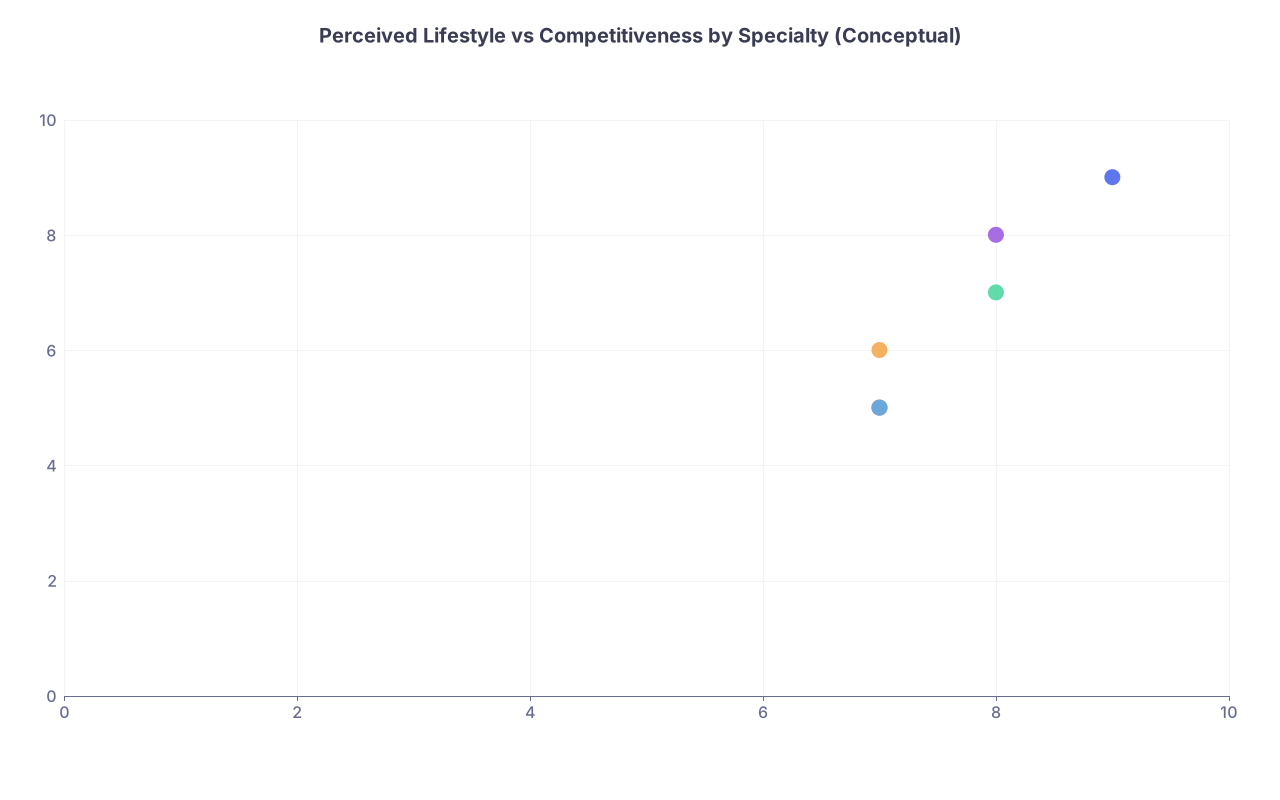
| Category | Value |
|---|---|
| Dermatology | 9,9 |
| Ophthalmology | 8,8 |
| Radiology | 8,7 |
| Anesthesiology | 7,6 |
| Emergency Med | 7,5 |
| Psychiatry | 7,5 |


| Step | Description |
|---|---|
| Step 1 | Start - Want lifestyle |
| Step 2 | Ophthalmology |
| Step 3 | Dermatology |
| Step 4 | Anesthesiology |
| Step 5 | Radiology |
| Step 6 | Psychiatry |
| Step 7 | Consider EM or outpatient IM/FM |
| Step 8 | Like procedures |
| Step 9 | Like clinic continuity |
| Step 10 | Like acute high stakes |
| Step 11 | Prefer talking more than doing procedures |

The Bottom Line
Three points, then you can go back to Anki:
- “Lifestyle specialty” is not magic; it’s a specific mix of moderate hours, higher control, and more flexible long-term options. Different fields hit that mix in different ways.
- Competitiveness in derm, ophtho, rads, anesthesia, EM, and psych is real and data-backed—not a vibe. If you want them, you need an application that matches reality, not Reddit mythology.
- The only sustainable “lifestyle” is liking the work enough to do it for decades. Use the data to inform your choice, but pick the field whose daily grind you can actually stand, not just the one whose hours look good on paper.