
It’s 11:47 p.m. You’ve finished another soul-crushing call shift. Your co-residents are obsessing over signing bonuses, RVUs, and partnership tracks. You? You’re staring at your loan balance on your phone: $312,000… 7.2% interest… and your brain is quietly screaming:
“If I do locums… am I just never paying this off? Am I totally screwing my financial future?”
Let me just say the part you’re afraid to say out loud:
You’re scared that choosing flexibility and sanity (locums) means you’ll be 55 years old, still renting, with Sallie Mae breathing down your neck.
Let’s walk through this honestly. No sugar coating. But also not the catastrophizing fantasy your 2 a.m. brain keeps running on loop.
The Core Fear: “Locums = Financial Irresponsibility”
Here’s what I hear all the time:
“I want to do locums for a few years, but I’m terrified I won’t be able to pay my loans.”
“What if I have gaps in between contracts?”
“What if I don’t get enough shifts?”
“What if the income is too unstable to plan anything?”
Your worst-case mental image is probably:
You bouncing from hospital to hospital, no benefits, paycheck swinging wildly, interest compounding, and every older attending saying, “You should have just taken a real job.”
Let’s be blunt: yes, locums is less predictable than a W-2 job.
But no, that does not automatically mean you can’t pay off loans.
In fact, I’ve seen locums physicians crush debt faster than their “stable job” classmates because they used two advantages: higher hourly pay + short-term sacrifice.
The real question is not: “Can you pay off loans on locum income?”
The real question is: “Can you tolerate the uncertainty long enough to use the upside of locums in your favor?”
But let’s stop being abstract and get numeric.
What Locum Income Actually Looks Like (Not the Fantasy Version)
You’ve probably heard some version of:
“Do locums and make $400–600k, work when you want, live your best life.”
Reality: it can be high, but it’s work. And it’s variable.
Typical ballparks (these are rough, obviously specialty-dependent):
| Specialty | Typical Daily Rate | Approx Annual (180 shifts) |
|---|---|---|
| Hospitalist | $1,800–$2,500 | $324k–$450k |
| EM | $200–$325/hr | $380k–$550k |
| Anesthesia | $2,000–$3,000 | $360k–$540k |
| IM Outpatient | $1,200–$1,800 | $216k–$324k |
| Psych | $1,500–$2,000 | $270k–$360k |
These “annual” numbers assume something like 15 shifts/month for 12 months. That’s not guaranteed. You might do more or less.
Now the part that makes you nervous: you’re not getting benefits, retirement match, CME money, etc. You’re covering your own health insurance and taxes. So no, you don’t just look at $400k and say, “Cool, I’m rich.”
But here’s the flip side: your effective hourly rate can blow a typical employed job out of the water.
Let’s say:
- Locum hospitalist: $2,200/day for 7 on/7 off
- You work 26 weeks a year → 26 × 7 = 182 days
- 182 days × $2,200 ≈ $400,400 gross
That’s working half the year. Yes, you pay higher taxes as an independent contractor. Yes, you need to buy your own disability insurance. But that still leaves a lot of room for loan payments if you don’t inflate your lifestyle immediately.
Your fear is: “Okay, but what if I have a few months with barely any work?”
We’ll get there. But look at the baseline first: if you choose contracts strategically, the raw earning power is not your problem. The problem is volatility and your tolerance for it.
Scenario 1: $300k Loans, Locums as a “Debt Attack Mode”
Let’s build the scary-but-honest scenario most people are in:
- Loans: $300,000
- Interest: 6.5–7%
- You’re just out of residency/fellowship
- No big savings, maybe $5–10k in the bank
You’re thinking of doing locums instead of signing a 3-year employed contract.
Income side (reasonably aggressive locums)
Say you’re a hospitalist doing:
- $2,200/day
- 14 shifts/month for 10 months (you leave some buffer for gaps) → 140 shifts/year
- 140 × $2,200 = $308,000 gross
Now chop off:
- 30–35% for all-in taxes (depends on state, deductions, etc.)
Call it 33%: you’re down to ≈ $206k - Health insurance: say $8–12k/year → call it $10k
- Disability + term life: maybe $3–5k → call it $4k
Net practical take-home-ish: about $192k/year.
Now expenses. Let’s say you don’t go wild:
- Rent: $2,000/month = $24,000
- Food/transport/phone/etc.: $2,000/month = $24,000
- Travel/“fun”: $6,000/year
- Misc, professional, licensing, etc.: $6,000–8,000/year
So maybe $60–65k in living/professional expenses if you’re not trying to live like a baller.
That leaves: ~$125–130k you could throw at loans.
Use a simple mental estimate:
- $300k at 7%, making ~$130k payments = paid off in about 3 years
- Aggressive 2-year payoff would need closer to ~$165–170k/year in payments
Is that comfortable? No.
Is it technically doable? Yes.
Is it faster than many W-2 folks who “can’t” pay more than $3k/month because their spending exploded? Very often yes.
The catch? You have to actually live like a resident for a few more years. While making attending money. Which most people hate.
But if you treat locums as “Debt Attack Mode,” it’s one of the most powerful levers you have.
Scenario 2: Lower Volume, More Freedom, Slower Payoff
Now let’s play your other fear:
“What if I don’t want to live at the hospital? I want to travel, or have kids, or just not burn out more.”
Okay, different setup. Same $300k debt.
Say you:
- Work 10–11 shifts/month instead of 14–15
- Daily rate $2,000
- 11 × 12 = 132 shifts/year
- 132 × $2,000 = $264k gross
After 33% taxes: ≈ $177k
Insurance, etc.: subtract $15k → $162k
Keep lifestyle same as above: $60–65k expenses.
Leftover for loans: ≈ $95–100k/year.
Now you’re talking more like 4–4.5 years to pay off $300k. Still not the rest of your life. Even if things slide and you only manage $70–80k/year to loans, you’re probably around 5–6 years.
Yes, that’s slower. Yes, interest hurts.
But this isn’t the “I’ll be paying until I’m 60” nightmare you keep spinning.
The Real Risk: Gaps, Dry Spells, and Your Emergency Fund
Here’s where your anxiety is actually onto something real: locums has friction and gaps.
- Credentialing can take 60–120 days.
- A hospital can suddenly decide they don’t need you next quarter.
- You can get burned out and want 2 months off.
- Agencies are… let’s say, “optimistic” when they talk about consistency.
So your true vulnerability isn’t that locums doesn’t pay enough. It’s that:
- Your income can drop for chunks of time
- Your loans don’t care—they keep growing
- You start using credit cards or pausing payments and things snowball
This is why I get edgy when someone says, “I’ll just do locums, I’ll figure the money out later.” That’s how you end up with high income, zero savings, and still anxious.
Non-negotiable if you’re worried:
You need a baseline cushion before or very early into locums.
Minimum target to quiet at least part of your brain:
- 3 months bare-minimum living expenses + 3 months of minimum loan payments
So if your life costs $4k/month and your loans want $2k/month minimum, that’s $6k/month × 6 = $36k. Yeah, that number is large and stressful. I know.
You don’t necessarily need the full $36k on Day 1. But you do need a plan that gets you there in the first 6–12 months.
This is where short-term grind can actually help:
First 3–6 months of locums → maximize shifts, live cheaply, hoard cash.
You’re not doing it forever. You’re buying optionality and shielding yourself from the worst-case you’re scared of.
Locums vs Traditional Job: Which Is Actually Better for Loans?
You might be wondering if you’re just making life harder on yourself.
So let’s compare two very rough paths:
- Path A: Employed hospitalist job at $260k with benefits
- Path B: Locum hospitalist at $308k gross (like earlier scenario)
| Factor | Employed Job | Locums |
|---|---|---|
| Gross Income | ~$260k | ~$308k |
| Benefits | Strong (401k, health) | You pay everything |
| Take-home (approx) | Similar ballpark | Slightly higher |
| Stability | High | Moderate |
| Flexibility | Low–moderate | High |
| Loan payoff speed | Depends on spending | Can be faster if focused |
What actually matters more than the structure? Your behavior.
- Employed doc who inflates lifestyle → $3k/month to loans → 10+ years
- Locums doc who stays lean → $7–10k/month to loans → 3–5 years
I’ve literally watched this play out. The “safe job” feels better emotionally, but people often anchor to their higher monthly income with higher fixed costs (big mortgage, nicer car, private school, etc.), and then “can’t” make big loan payments.
If you’re debt-averse and willing to grind 3–5 more years, locums can be your weapon, not your enemy.
Risk Management for the Anxious Brain (AKA How Not to Freak Out Every Month)
If you’re wired like I am, your brain is constantly:
“What if next month is dead? What if rates go down? What if the hospital cancels the contract?”
You can’t eliminate uncertainty, but you can build some guardrails:
Separate accounts.
Have a dedicated “Loan Attack” account. Every month you move a set amount there (say $6–8k), and then once a quarter you make extra principal payments. Seeing the pile grow helps your brain feel less out of control.Make a personal “floor.”
Decide in advance your minimum acceptable monthly loan payment, regardless of chaos. Even if one month you do less work, you still hit that floor (e.g., $2,500), so you’re always moving forward.One contract in reserve.
Don’t rely on just one hospital. Always be partially credentialed somewhere else or talking to agencies about a backup gig, even if you don’t plan to use it. Your brain will calm down knowing you could ramp up quickly.Time-bound debt plan.
Write down: “Locums Debt Phase: 3–4 years.” Not forever. A defined era where you accept more volatility in exchange for a finish line.
How Different Loan Strategies Combine with Locums
You might also be swirling around questions like PSLF, IDR, refinancing, etc. Quick reality check:
PSLF + locums?
Usually no. Locums are typically 1099, and PSLF requires qualifying non-profit employment. The “do PSLF later” plan plus locums now usually just drags things out unless you commit to a PSLF-eligible job for 10 actual qualifying years.Income-driven repayment + locums:
Your payments will be based on your prior year’s income. If you do a low-income residency year followed by a big locums income, you might temporarily have low payments while earning a lot. That sounds nice, but unpaid interest balloons. If you’re doing locums and actually earning, I generally prefer you not drag this out forever on IDR unless you have a coherent forgiveness strategy.Refinancing to a lower rate:
If you’re giving up PSLF/IDR anyway and have high interest (7–8%), refinancing once you’re consistently pulling in good locums money can make a big difference. A drop from 7% to 4–5% over $300k is thousands per year. Just don’t refinance until you’re pretty sure you won’t go back to low-paying public service work that could qualify for PSLF.
The Emotional Side: Feeling “Behind” While Everyone Else Sounds Settled
One of the quiet fears underneath all this math is shame.
Your co-residents sign contracts. They post about “joining X Medical Group!” They talk about their 401k match and the house they put an offer on. Meanwhile you’re like, “I… might be in North Dakota this fall? If credentialing comes through?”
It can feel like:
- You’re “immature” for not taking a “real” job
- You’re financially reckless
- You’re sacrificing long-term stability for short-term escape
Here’s the part people don’t say: a lot of those “stable” folks are just better at pretending they’re fine. I’ve seen attendings cry in their cars because they’re trapped in a job solely due to a non-compete and a giant mortgage.
Choosing locums is not inherently irresponsible. It’s a trade: you accept business risk and income variability in exchange for greater control over your schedule and, often, higher hourly compensation.
If you pair that with a deliberate loan plan—aggressive payments, an emergency fund, and actual numbers instead of vibes—you’re not behind. You’re just on a different path.
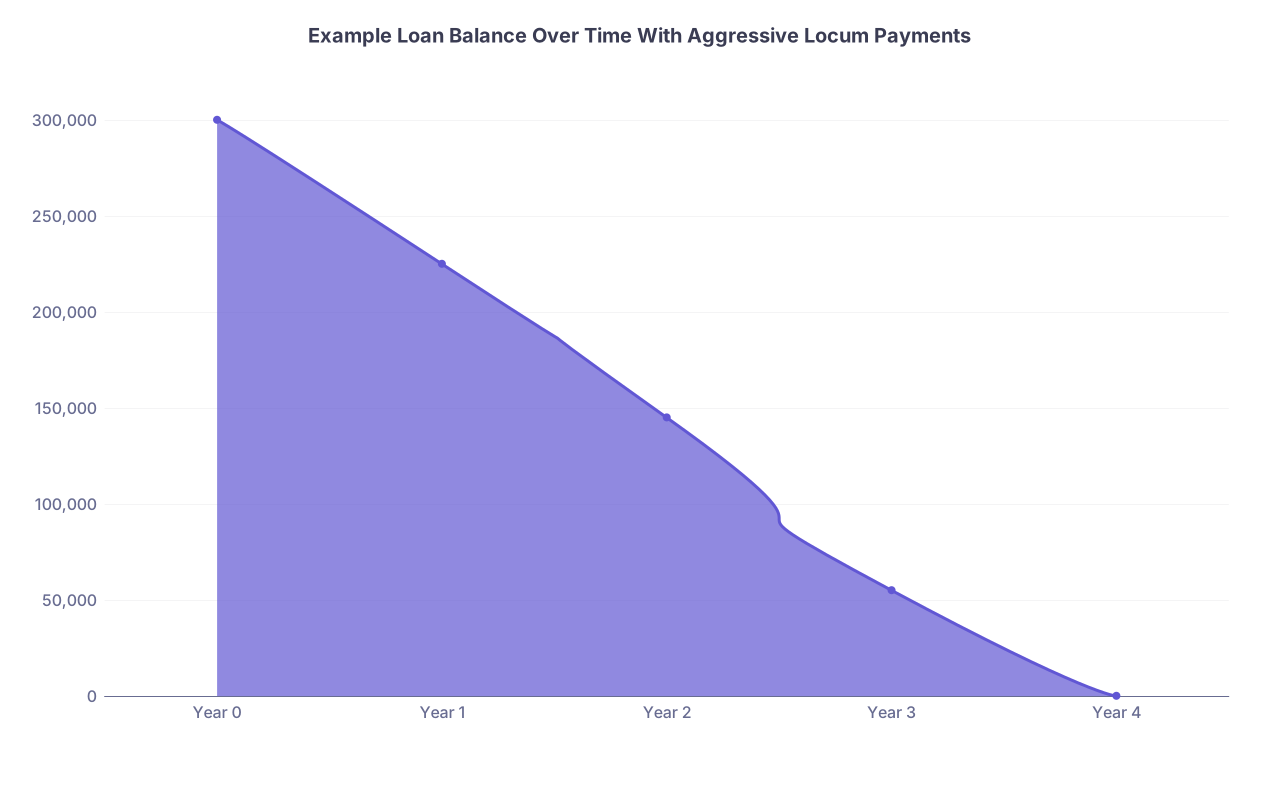
| Category | Value |
|---|---|
| Year 0 | 300000 |
| Year 1 | 225000 |
| Year 2 | 145000 |
| Year 3 | 55000 |
| Year 4 | 0 |

| Step | Description |
|---|---|
| Step 1 | Finish Residency |
| Step 2 | Build 3-6 month cash cushion |
| Step 3 | Sign first locum contract |
| Step 4 | Live on lean budget |
| Step 5 | Make aggressive loan payments |
| Step 6 | Option to ease workload or switch job |
| Step 7 | Loans under 100k? |


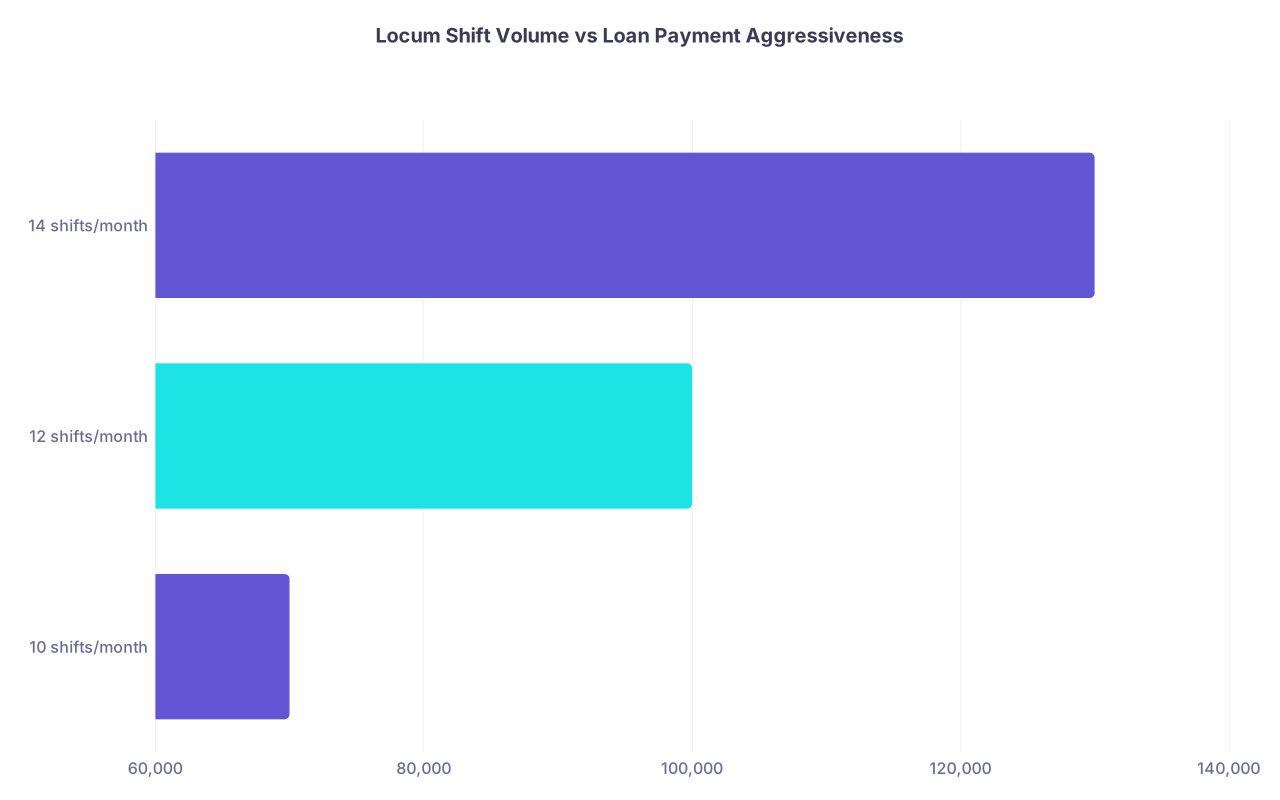
| Category | Value |
|---|---|
| 10 shifts/month | 70000 |
| 12 shifts/month | 100000 |
| 14 shifts/month | 130000 |
FAQ (You’re Not the Only One Thinking These)
1. What if I start locums and it’s a disaster—no shifts, unstable income, everything I’m afraid of?
Then you pivot. Seriously. You are not marrying locums. If after 6–12 months your income is way too inconsistent, you can take a W-2 job and re-stabilize. Worst case, you had one weird transitional year. The loans might tick up a bit more, but they’re not doubling overnight because of that.
2. Is it dumb to do locums for a few years then go for PSLF or IDR forgiveness?
Usually, yes, it’s inefficient. PSLF works best if you commit early, consistently, and stay in qualifying employment. If you spend 3–4 high-income years in locums, pay almost nothing on IDR, let the balance balloon, then jump to PSLF, you’ve wasted your prime payoff years. If you’re doing locums, pick a payoff strategy, not a half-hearted forgiveness fantasy.
3. Should I refinance my loans if I’m doing locums?
If you’re 99% sure you’re not going back to nonprofit, PSLF-eligible work and you’re committed to actually paying the loans off in 5–10 years, then yes, refinancing at a lower rate can save a lot. But wait until you’ve proven to yourself that your locum income is stable enough for the required monthly payment. Don’t lock into a big fixed payment right before a 3-month contract gap.
4. How many shifts per month do I realistically need to do to make real progress?
For most specialties and rate ranges, if you’re doing around 12–14 shifts/month and not living like an attending-in-a-TV-show, you can usually throw $6–10k/month at loans. That’s real progress. Below 8–9 shifts/month, it starts to feel tighter for aggressive payoff, unless your daily rate is very high or your living expenses are extremely low.
5. What if I want to start a family soon? Is locums just too unstable for that plus loans?
It depends on your tolerance for variability, but it’s not automatically incompatible. Many people do a hybrid: 1–2 years of higher-volume locums to crush a big chunk of the loans and build a solid emergency fund, then either loosen the schedule or move to a more stable job before or around the time they have kids. The key is not drifting; actually plan those transitions by date and financial milestones.
6. I feel behind already. Is 5–7 more years of loans just… normal?
Yes. For six-figure med school debts? Very normal. Plenty of docs are 7–10 years out still paying. The difference is whether you’re drifting with minimums or you’ve got a coherent timeline. With locums, if you stay disciplined, 3–6 years to payoff is absolutely realistic for many, even with big balances. You’re not uniquely screwed. You’re just not on the Instagram-attending timeline you imagined in M1.
Tonight, before you doom-scroll job boards again, do one concrete thing:
Open a blank note and write:
- Your current (or expected) loan total and interest rate
- A realistic locum daily rate and average shifts/month you could tolerate
- How much you’d choose to send to loans each month if you stuck with a lean lifestyle for 3–4 years
Run the math. Not vibes. Not fears. Actual numbers.
Then ask yourself: “Am I scared because it’s impossible… or because it’s uncertain?”
Those are two very different problems. And only one of them is actually true.