
The fantasy that “locums equals total freedom” is mostly a lie if there are two of you.
A dual-physician household running two locum tenens careers is not a vibe. It’s a logistics operation. If you treat it like vibes, you’ll burn out, fight about money and call, and eventually one of you quietly goes back to a W‑2 because “it’s just easier.” It does not have to go that way.
Here’s how to run this like a system, not chaos.
Step 1: Decide Your Household Model Before You Take Any Locums
Most couples skip this and then wonder why everything feels scrambled. You cannot coordinate two locums schedules until you’re brutally clear on what kind of life you’re actually trying to build.
There are four main models I see dual-physician locums couples fall into:
| Model | Core Idea |
|---|---|
| Alternating Anchor | One mostly home, one traveling, then switch |
| Same-Place Locums | Both work same site/region at same time |
| Parallel but Offset | Both travel but never fully away together |
| Hybrid with One Home Base | One semi-stable job, one true locums |
Quick rundown:
Alternating Anchor
One partner is “home base” while the other is on assignment, then you swap after a block. Works well with kids, mortgages, and a dog. Harder for super-competitive, high-earning couples because income will be lumpy and unequal month to month.Same-Place Locums
Both of you take assignments at the same facility, or at least in the same town, same dates. This can be fantastic for maximizing income quickly (pay, free housing, maybe one rental car) and avoiding relationship distance. The catch: fewer overlapping opportunities, more negotiation, and you become dependent on certain sites or agencies.Parallel but Offset
You both do locums, possibly in different places, but you plan blocks so you’re rarely both gone at once and you always build in shared weeks off. This is the closest thing to “two independent locums careers” but with guardrails.Hybrid with One Home Base
One partner has a relatively stable job (0.6–1.0 FTE, academic or employed) with predictable schedule; the other runs a flexible locums practice that bends around that. Often the sanest option if you have school-aged kids.
If you’re serious, you sit down and you commit: “For at least the next 12 months, we are going to run the Alternating Anchor model,” or whichever fits.
Then you define your constraints like you mean it:
- Minimum days per month you must both be in the same city
- Maximum number of nights per month you’re both on call
- Hard rules around childcare coverage, if applicable
- Max travel days per month for each person
Write it out. On paper or Notes app, do not care. But if it’s not written, it’s just vibes, and vibes do not hold up when a recruiter dangles $250/hour and “we just really need someone next week.”
Step 2: Treat the Calendar Like a Shared Mission-Critical Tool
If you’re using text threads and memory to run two locums careers, that’s malpractice. On yourselves.
You need one central calendar that reflects reality:
- Both of your locums blocks
- All travel days (departure and return, not just work dates)
- All call coverage, including home call
- Family events, vacations, kid schedules, big life stuff
Google Calendar works perfectly fine. Outlook if you must. The tool doesn’t matter. The discipline does.
Here’s the system that actually works:
Create separate shared calendars:
- “Dr A – Work/Call”
- “Dr B – Work/Call”
- “Home/Family”
Color-code them. Non-negotiable.
Hard rule:
“If it’s not on the shared calendar, it doesn’t exist.”
That includes that random three-day call coverage you agreed to over the phone with a medical director.Block types to use (be consistent):
- “Travel – To [Site]” (all-day event or flight time, your call)
- “[Facility Name] – Days 1–7 – Locums”
- “Home – Off but Available for Local PRN”
- “On Call – [Facility] – In House / Home”
Weekly sync (15–20 minutes, max):
Once a week, you both sit down, pull up the calendar, and run through:- Any offers pending
- Any pending requests from agencies
- Any changes from facilities (schedule tweaks, extra shifts)
- Childcare holes, if applicable
Do this with coffee on Sunday, not half-asleep on FaceTime in a hotel after a 12-hour ED shift.
Step 3: Sequence Decisions — Who Books First, Who Flexes
Here’s where most couples blow it. They treat every assignment like a tug-of-war: “My opportunity vs your opportunity.” That’s a fast track to resentment.
You need a pre-agreed priority order. Something like:
We protect fixed commitments first
Family events, pre-booked travel, major responsibilities (kid surgery, parent chemo appointments, bar exam for a sibling—you get the idea).Then we schedule the less flexible partner
Some specialties (anesthesia, EM, gen surg) may have tons of locums options; others (peds subspecialties, certain IM subs) are sparse. Or one partner has visa issues, licensure limits, or a non-negotiable part-time academic role.Decide: “Partner A gets first shot at booking their ideal blocks for the quarter. Partner B builds around that.”
Then the flexible partner fills in around that skeleton
This person chooses assignments that do not blow up the agreed home model:- No overlapping full-time travel weeks where both are gone and childcare collapses
- Respect the max-nights-on-call rule
- Keep the “together in same city” quota
If you’re both in flexible, in-demand specialties? Then you choose primary earner by quarter or by goal. Example:
- Q1: Goal = Pay down loans → Whoever gets the highest-paying string of shifts books first.
- Q2: Goal = Stability → Whoever covers more home time / childcare gets scheduling priority.
- Q3: Goal = Board prep for one of you → The studying partner’s schedule takes precedence.
You can even spell this out in a shared Google Doc: “Q1 Schedule Priority: Alex income; Q2 Priority: Jamie research block + school calendar.”
It sounds over-structured. It saves fights.
Step 4: Own Your Specialties’ Realities
Locums is not symmetrical across specialties. EM, anesthesia, hospitalist, and some surgical fields have constant openings. Derm locums? Not the same story. Peds subspecialties? Often highly niche.
You plan according to the tighter constraint.
Example:
- Partner A: EM, triple-boarded, licensed in 4 compact states, can find work anywhere
- Partner B: Endocrinology, requires specific clinic setups, fewer locums gigs, limited states
If that’s your household, blunt truth: Endo partner gets priority planning. Their assignments are the bottleneck. The EM doc can always plug in around that with short-notice locums or PRN shifts near home or near the endo site.
Do not pretend both markets are equal because it feels fair. Let reality dictate.
Step 5: Create a 3-Tier Permission System for Assignments
This is the part nobody tells you: you need rules for how many “approvals” a potential assignment must pass before it becomes real.
Think of it as three tiers:
Tier 1 – Auto-Yes Criteria
Assignments that either of you can accept immediately without a “Hey, can I…?” text, because they fit pre-set constraints.
You define something like:
- Duration: 3–7 day blocks
- Location: Within X hours flight of home OR same city where other partner will already be
- Timing: Fits into predefined open weeks on the calendar
- Call: No more than Y calls that week, combined between you
Example:
“We each have pre-approved 7-day blocks in weeks 1 and 3 of each month. If a job offer fits those weeks, and doesn’t require more than 2 call nights, we can say yes on the spot.”
Tier 2 – Quick-Check Assignments
Things that might be okay but require a 5-minute conversation.
These are:
- Longer blocks (2+ weeks)
- Higher-stress jobs (new EM site, heavy OB call, very rural solo coverage)
- Locations that impact the other partner’s ability to pick up work
Here your rule is: “Text or call. If no response in 30 minutes and it’s not urgent, tell recruiter you’ll decide by end of day.” Do not let a recruiter push you into same-call acceptance when both of your lives depend on this.
Tier 3 – Strategic Assignments
Big stuff: 3-month FT contracts, international work, lead-up to fellowship, or anything that overlaps crucial family time.
These must go through The Meeting. Not dramatic, just intentional:
- You both sit down
- Look at money, schedule, kids, goals
- Decide together
If you skip this system, you end up in the dumbest fights:
“You said yes to that three-week contract without asking me? Who’s watching the kids when my call shifts stack that week?”
Seen this. More than once.
Step 6: Build in “Reunion Time” Like It’s a Procedure
Couples doing dual locums underestimate how disorienting constant movement is. Even if you’re both strong, independent, not-clingy people.
You're operating on different shift patterns, in different hospitals, with different stress loads. Then you come home for 3 days, and the expectation is instant connection, errands, family time, maybe a date night, maybe sleep. That’s a lot.
So you plan reunion time explicitly:
Book deliberate overlap blocks
Decide on baseline: “We will be in the same place at least 10–14 days per month.” That might be:- Both off and at home
- Both working the same site
- One on, one off but same city
Declare “first 24 hours home” rules
Something like:- No extra shifts
- No big decisions (schedules, finances)
- No large family obligations if you can avoid it
One person needs to decompress; the other needs to shift out of solo-parent or solo-life mode.
Protect real off days together
Not “you post-call, me catching up on charts.” Actual off. They go on the calendar like shifts.
The couples who survive long-term locums together treat relationship time as non-negotiable, not as “if there’s a spare day in between contracts.”
Step 7: Childcare and Home Logistics — Get Ruthlessly Practical
If you have kids, animals, or dependent parents, dual-locums without a support scaffold is delusional.
Stuff you actually need to decide:
- Who is the “default parent” when you’re both in town?
- Who is default when one of you is away?
- Who is the actual backup if both of you get stuck post-call or with flight delays?
You typically need at least one of the following:
- A trusted live-in or regularly scheduled nanny
- Grandparent or other family who can do real coverage, not just “drop in” babysitting
- After-school care + emergency sitter service
Treat childcare hours as hard constraints when evaluating assignments. Example rule:
“If Partner A is gone more than 10 days this month, Partner B cannot take more than 4 call nights without extra childcare lined up.”
Do the math with real numbers. Something like:

| Category | Value |
|---|---|
| Clinical Work | 40 |
| Travel | 10 |
| Admin/Charting | 10 |
| Childcare/Household | 25 |
| Protected Couple/Family Time | 15 |
Those percentages move, but you see the point: you can’t pretend 80% of your time is “flexible.” It isn’t.
And do not be a martyr about outsourcing. Yes, it costs money to get help with cleaning, laundry, grocery delivery, dog-walking. But you’re not doing locums just to maximize W-2-equivalent savings while you burn out and never see each other. Use some of that increased hourly rate to buy back sanity.
Step 8: Use Agencies and Sites Strategically, Not Randomly
In a dual-physician locums household, your relationship with agencies and facilities is part of your infrastructure.
What works better:
- Pick 1–2 main agencies each, plus maybe one niche agency if your specialty is narrow.
- Make sure both of you are very clear with recruiters about the household model:
- “We are a dual-physician household. We prefer overlapping assignments in X regions.”
- “We cannot both be gone from home for more than 10 days at a time.”
- “If you have needs at Hospital A where my spouse works, pitch those first.”
Where it gets powerful: If both of you are valuable to the same facility or system, you negotiate as a unit.
You can push for:
- Same housing or housing stipend arrangement
- Coordinated schedules (same weeks on/off)
- Slightly higher pay because you’re filling multiple holes
- Some flexibility around start dates so you can align with childcare or family events
Think like this: you’re not just two random locums. You’re a package deal that solves multiple staffing headaches.
Step 9: Create an Annual Macro-Plan so You’re Not Just Chasing Shifts
Running month-to-month forever is exhausting. At least once a year, usually early (January-ish), you two sit down and sketch the year.
I’d literally whiteboard it or use a simple quarter-by-quarter layout:
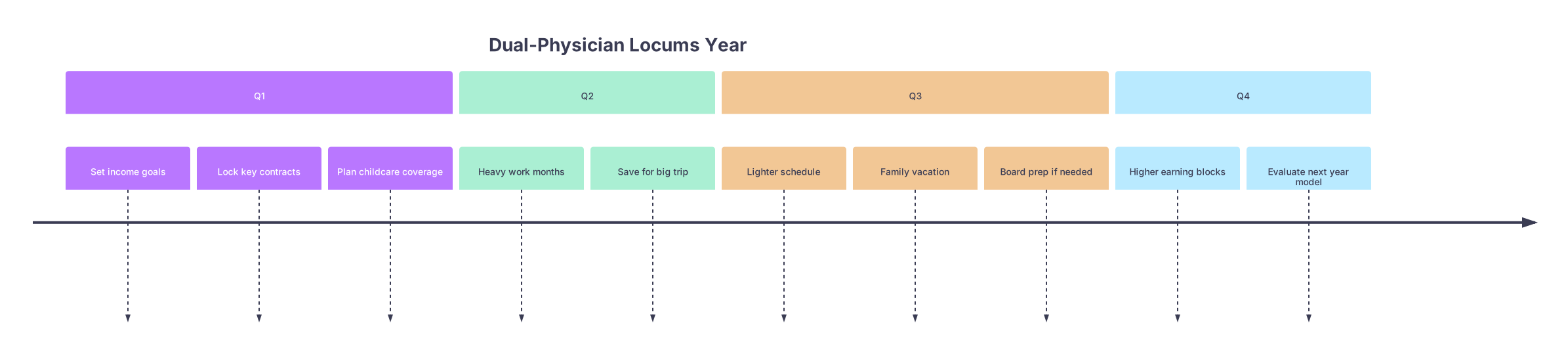
You decide:
- Which quarters are “heavy earning”
- Which quarter is lighter for family, travel, or exam prep
- If anyone is applying for fellowship, academic positions, or visas that might alter travel
Then you layer in:
- Which states you’ll prioritize for licensure
- Which facilities you want to return to (familiar systems make everything easier)
- Which ones are dead to you forever (we all have those)
When you get a random recruiter call in May dangling a three-month gig in a state you don’t care about, you can say, “We’re targeting shorter contracts closer to home this quarter. Call me again in Q4.”
You stop being reactive. You start treating your time like the finite resource it is.
Step 10: Have a “Red Flag and Reset” Protocol
Even with good planning, you’ll have moments where everything is off:
- Both of you are fried
- You snap at each other over tiny scheduling changes
- One of you is quietly resentful about always being the “anchor” parent
- A site that looked tolerable turns out toxic
You need an explicit reset rule. Something like:
“If either of us calls a Red Flag on our current setup, we sit down within 72 hours and re-evaluate the next 3 months.”
Red Flag could be:
- “This site’s volume and charting load are unsustainable.”
- “The kids are struggling with this much change.”
- “I feel like we haven’t had a real day together in weeks.”
Then you actually change something:
- Cancel a future block (with appropriate notice)
- Decline extra shifts you could do but don’t need
- Redistribute the load (maybe the higher-earning partner works a bit more while the other scales back temporarily)
There is zero prize for white-knuckling your way through a schedule that’s destroying your relationship.
Example: How This Looks in Real Life
Let me give you a concrete, simplified setup.
Couple:
- Partner A: Hospitalist, comfortable with 7-on/7-off, high locums demand, no kids from previous relationships, flexible
- Partner B: OB/GYN, does both clinic and L&D, locums options but more limited, you have 2 kids in elementary school
Household Model: Alternating Anchor with periodic “both off” weeks.
Year Plan:
- Q1–Q2: Pay down loans, higher work volume
- Q3: Lighter work, one long family trip
- Q4: Normal/steady
Calendar structure:
- Partner B books one 7–10 day L&D locums block per month, always in the same region, months planned 3–4 months ahead. During those days, Partner A is 100% home, handles school, childcare, everything. No travel.
- Partner A then books 7-on/7-off hospitalist locums around Partner B’s blocks. For 4 months of the year, Partner A takes more 7-on stretches, but at least every second month they both keep one week entirely off together.
- You hire a nanny 20 hours per week to cover after school and backup, plus one weekend per month when you’re both possibly overlapping call.
Twice a year you both take a two-week “both off” block—once in summer, once around winter holidays. That means you do say no to some high-paying shifts. But you’re playing the long game.
This is what a functioning system looks like. Not perfect, but intentional.
A Quick Visual: How Your Month Might Actually Break Down
For a typical “busy” month where both of you are doing serious locums work:
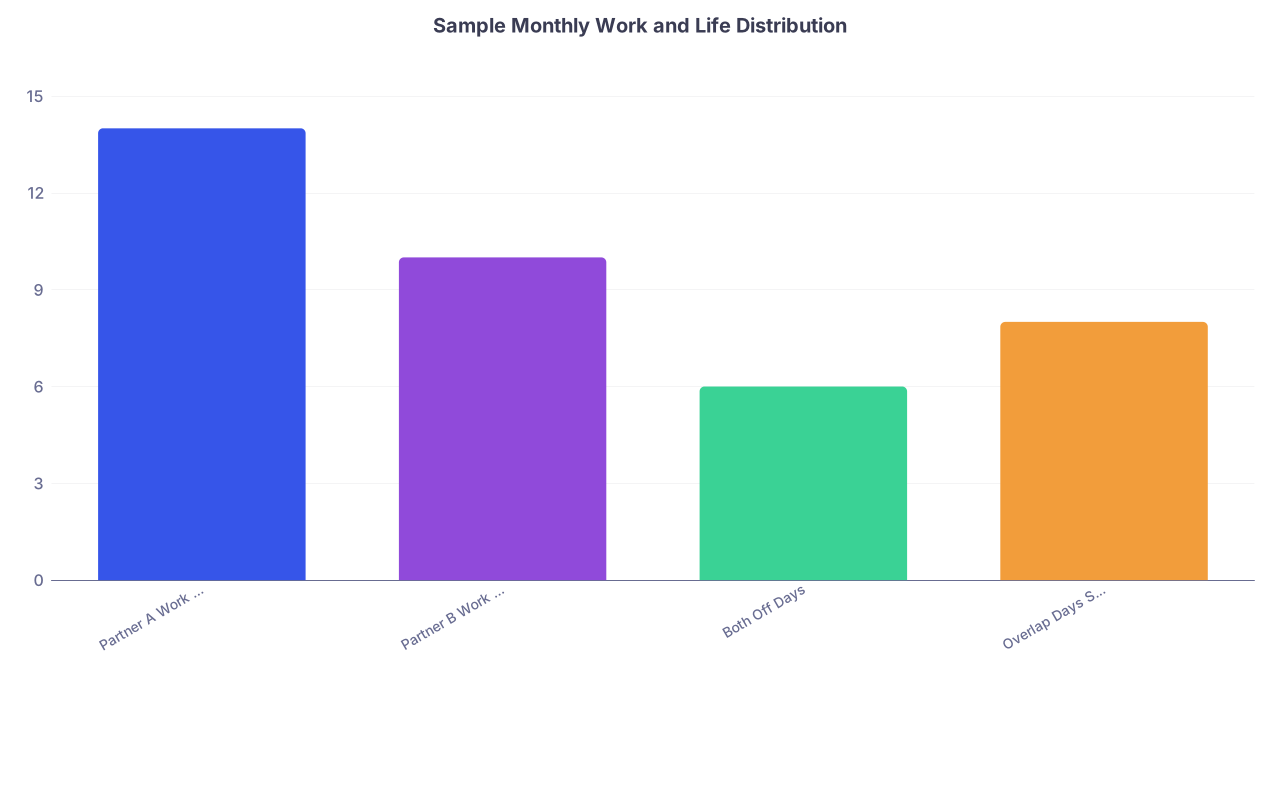
| Category | Value |
|---|---|
| Partner A Work Days | 14 |
| Partner B Work Days | 10 |
| Both Off Days | 6 |
| Overlap Days Same City | 8 |
That might mean:
- A works two 7-day blocks
- B works ten well-planned days (some overlapping with A, some while A is home)
- You still protect 6 days both completely off, at home or traveling together
It’s tight. But doable. If you plan.
Final Layer: Money and Documentation
Last thing, because it matters more than people admit: money and paperwork.
Two locums incomes = two 1099 streams, multiple states, multiple agencies. That’s admin overhead. Don’t underestimate it.
You should have:
- One shared spreadsheet or finance app tracking:
- Expected pay by month for each of you
- Actual received pay
- Business expenses (travel, licensing, CME, equipment)
- A good accountant who understands multi-state locums income
- Separate business bank accounts (LLC or sole prop) for each of you, feeding a joint household account
Why this matters for scheduling: cash flow influences how desperate you feel when a recruiter calls. If you know you’re already on track to hit your annual target by October, you can turn down terrible assignments instead of stuffing them into an already packed month.
Two Key Points To Leave With
Two locums schedules will not “fall into place.” If you do not choose a household model, set constraints, and treat the calendar as sacred, the work will expand until it crushes your actual life.
You and your partner are not just two individual locums docs. You’re a combined resource. When you plan and negotiate as a coordinated unit—time, money, support, and rest—you get the real upside of locums without sacrificing the relationship you’re supposedly doing this all for.