
The biggest risk in locum tenens is not low pay. It is volatility. The data show that most physicians underestimate how erratic month‑to‑month income can be once you leave a salaried position and depend on contracts, hours, and credentialing timelines.
Let me walk through this the way I would for a colleague sliding out of residency or their first employed job: quantify variance, size your buffers, and calculate your runway. Feelings about “this seems like enough” are irrelevant. The numbers either cover the risk or they do not.
1. The Income Profile of Locum Tenens: Not Average — Variance
Start by ignoring “average annual income” statistics for locums. They mislead more than they help.
Locum tenens income typically has three characteristics:
- High hourly rate
- Irregular hours/work weeks
- Non‑trivial gaps between contracts
The mean income can look fantastic on paper. The standard deviation is the problem.
A simple numeric baseline
Take a hospitalist example (you can adjust numbers to your specialty):
- Typical locums rate: $180/hour
- 12‑hour shifts
- Target: 14 shifts/month (168 hours) when fully booked
Gross monthly income at target:
168 hours × $180 = $30,240
If that was stable, this would be easy. It is not. A realistic year for many new locums might look like:
- 6 “good” months at 14 shifts
- 3 “light” months at 8 shifts
- 3 “gap” months at 0–4 shifts (credentialing delays, contract ends, holidays, slow season)
Assume:
- Good months: 14 shifts → $30,240
- Light months: 8 shifts → 96 hours → $17,280
- Gap months: 2 shifts average → 24 hours → $4,320
Annual gross:
- 6 × 30,240 = $181,440
- 3 × 17,280 = $51,840
- 3 × 4,320 = $12,960
- Total = $246,240
Average monthly gross = $246,240 / 12 ≈ $20,520
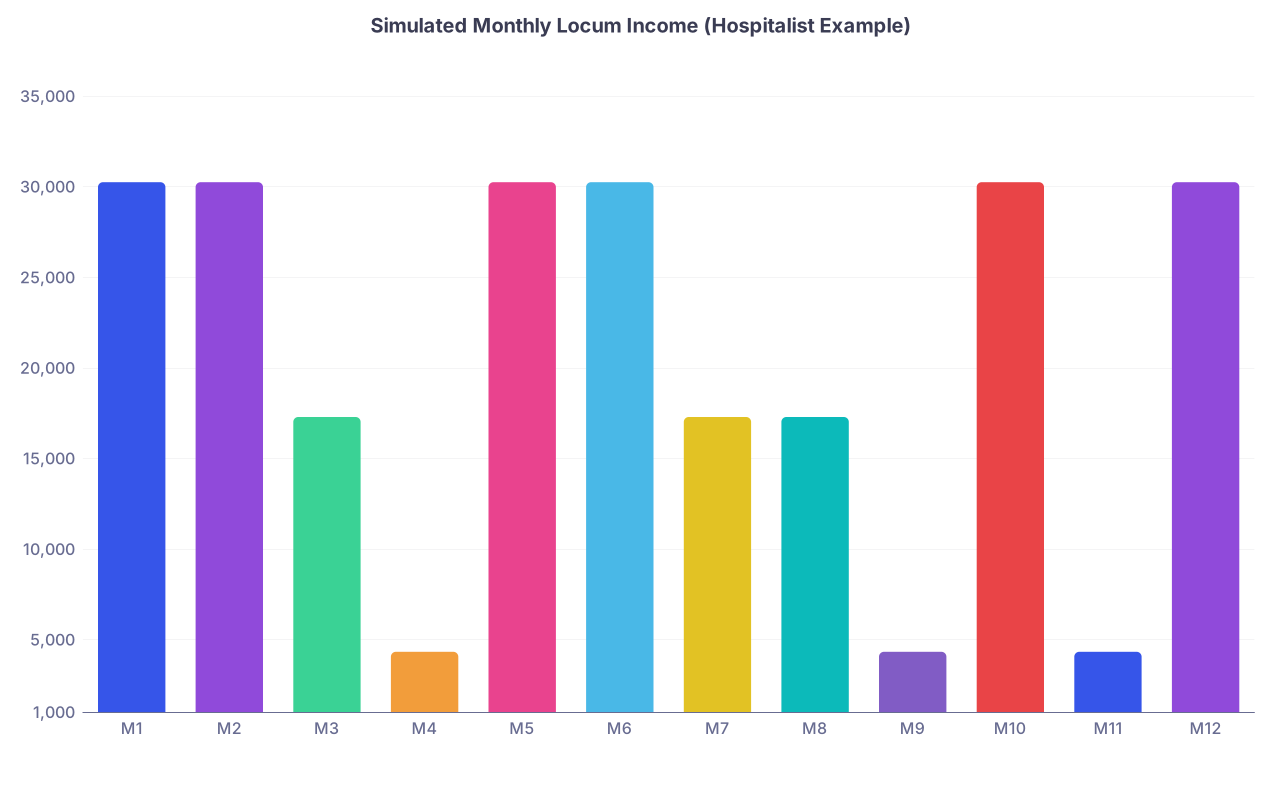
Looks fine. But month‑to‑month, cash swings from $4k to $30k+. That is what you must build around.
| Category | Value |
|---|---|
| M1 | 30240 |
| M2 | 30240 |
| M3 | 17280 |
| M4 | 4320 |
| M5 | 30240 |
| M6 | 30240 |
| M7 | 17280 |
| M8 | 17280 |
| M9 | 4320 |
| M10 | 30240 |
| M11 | 4320 |
| M12 | 30240 |
That chart is the problem in a single view: same physician, same rate, wildly different pay depending on contracts and scheduling.
2. Understanding Variance: How “Bumpy” Will This Ride Be?
You do not need a PhD in statistics. But you do need to understand variability more concretely than “it might fluctuate.”
Let’s use three simple tools:
- Range (best vs worst months)
- Standard deviation of monthly income
- Probability of bad stretches (multiple low months in a row)
Range: your immediate stress test
Using the example above:
- Best month: $30,240
- Worst month: $4,320
Range = 30,240 − 4,320 = $25,920
If your essential expenses are, say, $10,000/month, then:
- In best months: surplus ≈ $20,000
- In worst months: deficit ≈ $5,700
You do not plan buffers around the average $20,520. You plan around the deficit in the bad months.
Standard deviation: how “reliable” is your mean?
For that same 12‑month sequence, the standard deviation of monthly income is roughly $9,500–$10,000 (depending on the precise pattern you simulate). That means:
- Many months will fall within $20,520 ± $10,000
- So roughly $10k to $30k. Enormous spread.
In a salaried job, your standard deviation of gross monthly income is essentially zero. With locums, it can easily be 40–50% of your mean.
Rules of thumb I use when looking at locums cash flows:
- SD < 25% of mean → relatively stable
- 25–50% of mean → moderate volatility
50% of mean → high volatility, needs serious buffers
Most early‑career locum physicians I see land in the 40–60% range unless they have long, multi‑month block contracts with guaranteed minimums.
Sequences: the real killer is not one bad month
The distribution over time matters. One $4k month is manageable if it is sandwiched by $30k months. The damage comes from clusters of lean months.
For example, imagine this 6‑month stretch in your first year while you are ramping up:
- Month 1: finishing residency / moving → $0
- Month 2: credentialing → $4,000
- Month 3: partial schedule → $12,000
- Month 4: first full month → $26,000
- Month 5: full month → $28,000
- Month 6: contract hiccup → $8,000
Your income over 6 months totals $78,000 → $13,000/month average. But your first three months average = $5,333. If your fixed expenses are running $9–10k/month, you are behind early and catching up later.
That front‑loaded risk is exactly why post‑residency locums without a buffer end up:
- Taking bad‑fit contracts
- Agreeing to poor rates
- Or quietly panicking when reimbursements or housing stipends get delayed
You want your buffer large enough that 3 bad months in a row are survivable without lifestyle collapse.
3. Building Buffers: How Big Is “Enough”?
There are three distinct buffers you should quantify, not lump into one vague “savings” bucket:
- Emergency expenses buffer
- Income volatility buffer (to smooth locums swings)
- Transition / professional buffer (between contracts, credentialing delays)
Think of them as layers.
Step 1: Define your real monthly burn rate
You cannot size a buffer if you lie to yourself about expenses. Count:
- Housing (rent/mortgage, taxes, insurance)
- Utilities, food, transportation
- Minimum loan payments
- Insurance premiums (health, disability, malpractice if applicable, life)
- Licensure/board/DEA/CMEs averaged monthly
- Childcare or eldercare
- Baseline discretionary (you will not go to zero; be honest)
Take a typical early attending:
- Housing: $3,000
- Food: $900
- Transportation (car, gas, insurance): $800
- Student loans: $1,500
- Health insurance (individual plan): $600
- Other insurance (disability, term life): $300
- Utilities, phone, internet: $500
- Childcare: $1,200
- Misc / baseline discretionary: $1,200
Total ≈ $10,000/month
That is your minimum operating cost. If you move to a high‑COL city, add more.
Step 2: Emergency buffer (standard)
This is the classic 3–6 months of core expenses. On $10k/month:
- 3 months = $30,000
- 6 months = $60,000
This is not locums‑specific. This is your basic personal financial shock absorber.
Step 3: Income volatility buffer (locums‑specific)
Now add specific coverage for the worst income sequences you are likely to see. For a new locum right out of residency, I use this working assumption:
- Probability of at least 2 low‑income months (<50% of normal) in first 12 months: high
- Real risk of 3+ lean months in a row in year 1: non‑trivial, especially if you stack new licenses / new regions
Define a “lean month” as income below your burn rate. In the hospitalist scenario:
- Burn rate: $10,000
- “Gap” month income: $4,320
- Monthly deficit: $5,680
To survive 3 consecutive gap months, buffer needed = 3 × $5,680 ≈ $17,000
But that assumes you hit exactly the simulated low-income. Reality can be worse (complete zero if a contract falls through). I generally double it for comfort → $35,000.
So volatility buffer: $25,000–$40,000 is a realistic range for someone with a $10k/month burn rate stepping into fully independent locums, especially if relying solely on it.
Step 4: Professional / transition buffer
This is what pays for career and contract changes without panic:
- Time between ending a toxic/soul‑crushing assignment and starting the next
- Time to pursue a different region / different practice setting
- Unpaid weeks for onboarding, EMR training, or required orientation that is not fully compensated
Most physicians underestimate how much non‑billable time new situations require. I usually size this at 1–2 months of full expenses set aside specifically for “career maneuverability.”
So on $10k/month:
- Minimum transition buffer: $10k–$20k
Pulling the buffers together
You do not need three separate bank accounts (though some prefer that). But you should know the total number you are targeting.
For our $10k/month example:
- Emergency: $30k–$60k
- Volatility: $25k–$40k
- Transition: $10k–$20k
Reasonable combined target range: $65,000–$120,000
Most attendings bristle at this the first time they see it. Then they run through the math on a bad sequence of 3–4 lean months and it stops feeling ridiculous.
4. Runway: How Long Can You Last If Income Falls Off a Cliff?
Runway is not a startup concept. It is exactly what you need to track as a locum physician.
Definition here:
Runway = (Liquid savings + predictable short‑term inflows − near‑term fixed obligations) ÷ monthly burn rate
Where:
- Liquid savings = cash, high‑yield savings, short‑term treasuries, etc.
- Predictable inflows = already‑worked shifts pending payment, retainers, guaranteed minimums on signed contracts.
- Near‑term fixed obligations = known big outflows in the next 1–3 months (annual premiums, tax payments, license renewals).
Basic runway examples
Using $10k/month burn:
Physician A:
- Cash savings: $40,000
- Pending payments: $15,000
- Near‑term obligations: $5,000 (quarterly taxes due soon)
Runway = (40k + 15k − 5k) / 10k = 50k / 10k = 5 months
Physician B:
- Cash savings: $15,000
- Pending payments: $10,000
- Near‑term obligations: $7,000
Runway = (15k + 10k − 7k) / 10k = 18k / 10k = 1.8 months
Physician B is one credentialing disaster away from credit card debt.
How much runway is adequate?
For a post‑residency or early‑career physician relying mainly on locums:
- Absolute minimum runway before going fully independent: 3 months
- More defensible target: 6 months
- Ideal if you want real optionality (ability to walk away from a bad gig without fear): 9–12 months
That may sound aggressive. But look at typical risk events:
| Risk Event | Typical Duration | Income Impact |
|---|---|---|
| New license + hospital credential | 2–4 months | Near zero until cleared |
| Contract terminated early | 1–3 months gap | Zero until new contract |
| EMR change / new system onboarding | 2–4 weeks | Reduced billable hours |
| Seasonal demand drop | 1–3 months | Fewer shifts available |
Stack just two of these back‑to‑back and your 3‑month buffer disappears quickly.
5. Modeling Your Own Volatility: A Simple Framework
If you want an analytical view of your specific situation rather than generic advice, build a simple model. No need for complex Monte Carlo simulations, though you can go there if you like.
Step 1: Define “states” of your income
For a given specialty, define 3–4 monthly states:
Example for emergency medicine locums:
- High‑volume month: 14–16 shifts, $2,400/shift → $33,600–$38,400
- Normal month: 10–12 shifts → $24,000–$28,800
- Low month: 4–6 shifts → $9,600–$14,400
- Zero month: no work → $0
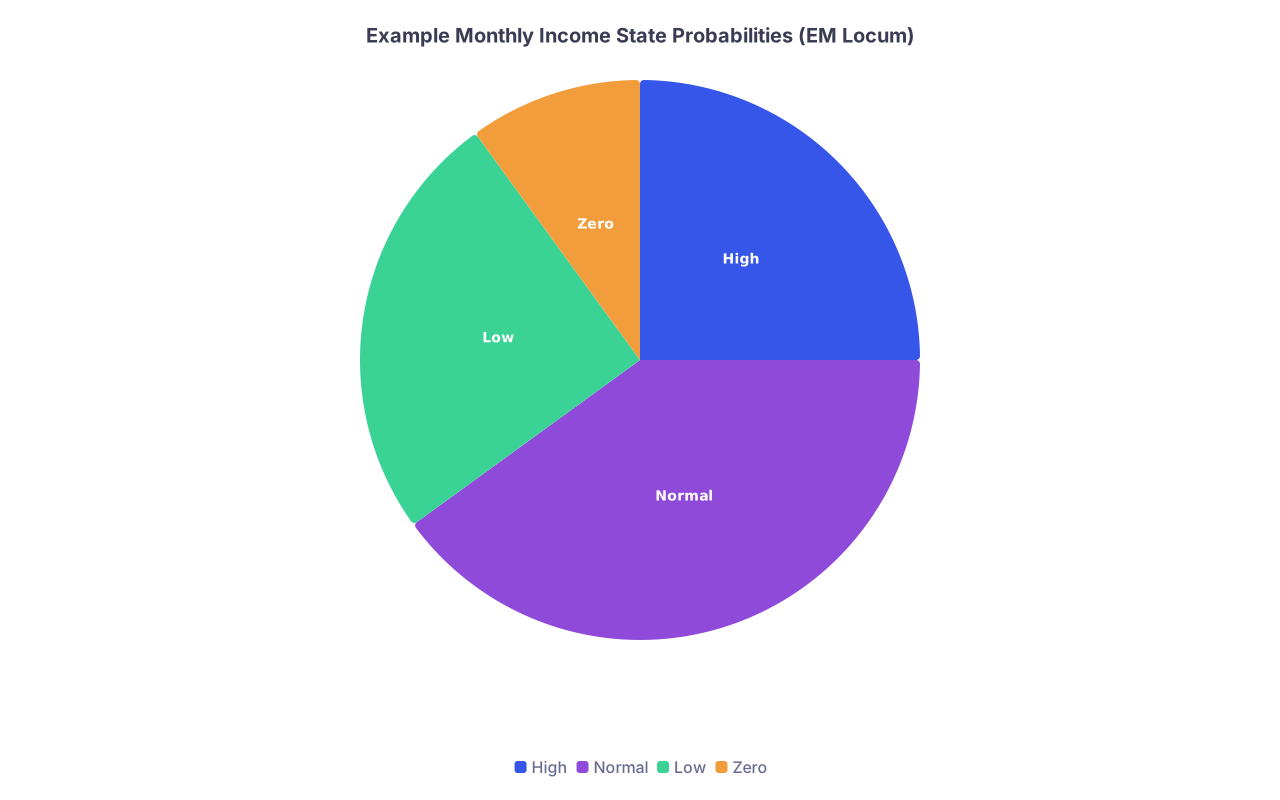
Assign rough probabilities for your first year based on your pipeline:
- High: 25%
- Normal: 40%
- Low: 25%
- Zero: 10%
Check that it sums to 100%.
| Category | Value |
|---|---|
| High | 25 |
| Normal | 40 |
| Low | 25 |
| Zero | 10 |
Now you have a qualitative probability distribution. Not exact, but much better than a gut feel.
Step 2: Simulate sequences
On paper or in a spreadsheet, generate a 12‑month sequence using those probabilities. Do 3–5 different “years”:
- Tally total income
- Identify longest stretch of low/zero months
- Compare against your expenses and runway
This is where physicians usually realize: “If I hit two zero months and one low month in a row, I am burning through 60–80% of my emergency fund.”
Step 3: Sensitivity analysis
Change assumptions and see what changes most:
- If you increase your guaranteed‑minimum contract months, odds of zero drop → volatility falls
- If you add a partner’s stable W‑2 income covering 50–70% of expenses, your required buffer drops massively
- If your monthly burn rate creeps up to $14k, your runway shortens by 30–40% instantly
The math gives you leverage points. It shows where to push.
6. Strategies to Reduce Variance (Instead of Just Increasing Savings)
You do not have to accept maximum volatility. Structuring your locums strategy can dramatically shrink the swings.
1. Anchor contracts with minimums
Favor contracts that guarantee:
- Minimum number of shifts per month
- Or a minimum monthly stipend / retainer, even during lower census
A 7‑on/7‑off hospitalist block with a guaranteed 14 shifts per month for 6 months stabilizes half your year. Even if you float extra shifts elsewhere, that base contract trims the left tail of your income distribution.
2. Diversify facilities and agencies
Single‑facility dependency = single‑point failure risk.
Spreading your work across:
- 2–3 hospitals
- Possibly 2 agencies (if contractually allowed)
- Maybe some telemedicine (if your field allows)
reduces the probability that one hospital’s budget cut or leadership change will drop you to zero.
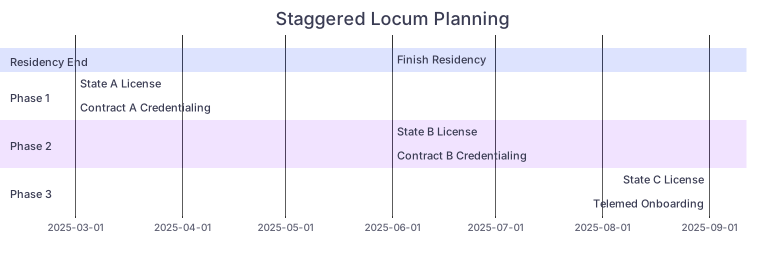
3. Stagger credentialing and licenses
The horror story I see too often: physician files multiple license applications simultaneously, assumes everything will clear roughly together, but two states get delayed by 3+ months. Result: long stretch with nothing.
Better:
- Start with 1–2 “anchor” states where work is already available
- Once you have a stable contract there, begin next wave of licenses
- Aim to never have all your future work contingent on one yet‑to‑clear license
| Task | Details |
|---|---|
| Residency End: Finish Residency | done, 2025-06, 1m |
| Phase 1: State A License | a1, 2025-03, 4m |
| Phase 1: Contract A Credentialing | a2, after a1, 2m |
| Phase 2: State B License | b1, 2025-06, 4m |
| Phase 2: Contract B Credentialing | b2, after b1, 2m |
| Phase 3: State C License | c1, 2025-09, 4m |
| Phase 3: Telemed Onboarding | c2, after c1, 1m |
This kind of staging reduces the odds of being “credentialing‑locked” out of income.
4. Layer a low‑variance income stream
Not glamorous, but powerful. Options:
- Part‑time W‑2 gig (urgent care, outpatient clinic) that covers 40–60% of fixed expenses
- Remote telemedicine shifts that can be added or removed dynamically
- Academic appointment with a smaller base salary plus locums on top
If a stable base covers housing + loans + insurance, your volatility problem shrinks to discretionary spending only.
5. Treat taxes as a non‑negotiable sink, not part of “available” income
Locums physicians are notorious for forgetting quarterly taxes until the IRS letter shows up.
Simple rule:
Automate 25–30% of gross into a separate high‑yield “tax account” off the top. Pretend it does not exist. Your usable income and runway calculations should be after this tax skim.
7. Early Post‑Residency Locums: Higher Risk, Higher Scrutiny
You are in a uniquely fragile window in the first 1–2 years post‑residency:
- No large cash cushion built from attending years
- Often moving, with upfront costs: deposits, furniture, relocation
- Student loan payments hitting full force
- New insurance premiums (especially if you lose group coverage)
If you jump straight from residency into 100% locums without a partner income or savings, you are effectively running a leveraged experiment on yourself.
The data side of this is simple:
- Burn rate: typically higher than residents estimate
- Cash buffer: typically lower than they admit
- Income variance: definitely higher than in an employed track
So for a resident planning locums right after graduation, I recommend this quantitative pre‑flight checklist:
Minimum cash saved before first day of full locums:
- If single and self‑supporting: at least $40–60k
- If partnered with stable W‑2 income covering most fixed costs: you can get by with less, but still aim for $20–30k
Signed contract with clear start date and minimum shifts before finishing residency.
At least one license and privileging fully complete with confirmed scheduling. Verbal promises from recruiters do not pay rent.
Runway calculation that shows ≥ 4–6 months even if first two months’ income are half of what is projected.
If you cannot pass that test, consider a hybrid: take a 0.6–0.8 FTE job with benefits and use locums for the rest. Use the stable job to build the buffers you will need for full independence later.
8. Putting It All Together: A Concrete Case Study
Let me synthesize the concepts with a realistic scenario.
Profile
- 33‑year‑old internal medicine hospitalist
- Leaving a $260k W‑2 job (net monthly take‑home ≈ $13,000 after taxes and deductions)
- Burn rate: $9,500/month
- Savings currently: $35,000
- Student loans: $1,400/month minimum
- Wants to move to a new state and go full‑time locums
Proposed locums plan
- Locum rate: $190/hour
- Target: 12 shifts/month
- Recruiter projects: “$25k/month easily”
Realistic adjustment:
- First 3 months: 6–8 shifts as credentialing finishes at two hospitals
- Months 4–12: mix of 10–14 shifts depending on demand and your schedule
Let’s build a conservative forecast:
- Months 1–3: average $14,000 gross (≈ 8 shifts)
- Months 4–12: average $24,000 gross
Annual gross ≈ (3×14k) + (9×24k) = 42k + 216k = $258,000 (nice symmetry with old salary).
But cash flow:
- Take 28% off top for taxes → effective take‑home ≈ 72%
- First 3 months net ≈ 3 × (14k×0.72) ≈ 3 × 10.1k ≈ $30,300
- Next 9 months net ≈ 9 × (24k×0.72) ≈ 9 × 17.3k ≈ $155,700
Total net year ≈ $186,000 → $15,500/month on average. But months 1–3 net only about $10k each, barely above burn.
Does this physician have enough runway?
Starting savings: $35,000
Monthly burn: $9,500
He moves and begins locums:
- Month 1: new apartment deposits and move add extra $5k of one‑time cost → effective burn ≈ $14,500
- Net income ≈ $10,000 → deficit −$4,500
New savings ≈ $30,500
- Month 2: normal burn $9,500, net income $10,000 → slight surplus +$500
- Month 3: same as month 2 → +$500
End of month 3 savings ≈ $31,500
Now, if month 4 contract start gets delayed by 6 weeks (not uncommon), and month 4 income ends up only $12,000 gross / $8,640 net:
- Month 4 deficit ≈ −$860
- Now savings ≈ $30,640
Runway at that point:
- Savings / burn ≈ 30,640 / 9,500 ≈ 3.2 months
One more significant delay or contract problem and he is under 2 months of runway. Not catastrophic, but uncomfortable. And definitely not the mental space you want for negotiating rates or rejecting bad offers.
If the same physician had saved to $70,000 before leaving the W‑2 job, then followed the same path:
- End of month 4 savings ≈ $65k
- Runway ≈ 65k / 9.5k ≈ 6.8 months
That extra 3–4 months of buffer is the difference between:
“I hope nothing goes wrong” and “I can fire this hospital if they become intolerable.”
Key Takeaways
- Locum tenens income is defined by variance, not just high averages. Plan around worst‑case monthly sequences, not optimistic projections from recruiters.
- Buffers and runway must be sized to your actual burn rate and realistic income volatility. For many new full‑time locums, that means total liquid reserves in the $60k–$120k range, not $10k–$20k.
- You can engineer lower volatility—through anchor contracts, diversification, staged credentialing, and partial W‑2 income—so your buffers are a safety net, not your only plan.