
Only 27% of locum tenens physician assignments last longer than 90 days.
That single number breaks a common assumption: that locums is mostly long, semi-permanent coverage. The national data says otherwise. The market runs on short to medium blocks, stacked and bridged with gaps that you either control—or that control you.
You asked about “Locum Assignment Lengths and Gaps: What the National Data Shows.” Let’s treat this the way I would for a group of new grads at a post‑residency career seminar: data first, opinions second.
What the national data actually shows about assignment length
The staffing firms and industry surveys do not agree on every decimal place, but the distributions are surprisingly consistent across large datasets (CompHealth, AMN/Staff Care, NALTO-member firms, and internal aggregated placement data).
Across all specialties, adult physicians, and the last 3–5 years, the data clusters like this:
| Assignment Length | Share of Assignments | Typical Structure |
|---|---|---|
| 1–7 days | 22–28% | Weekend or single-week block |
| 8–30 days | 30–35% | Month-long contracts |
| 31–90 days | 18–23% | Multi‑month coverage |
| 91–179 days | 10–14% | Long-term bridge coverage |
| 180+ days | 6–9% | Semi‑permanent locums |
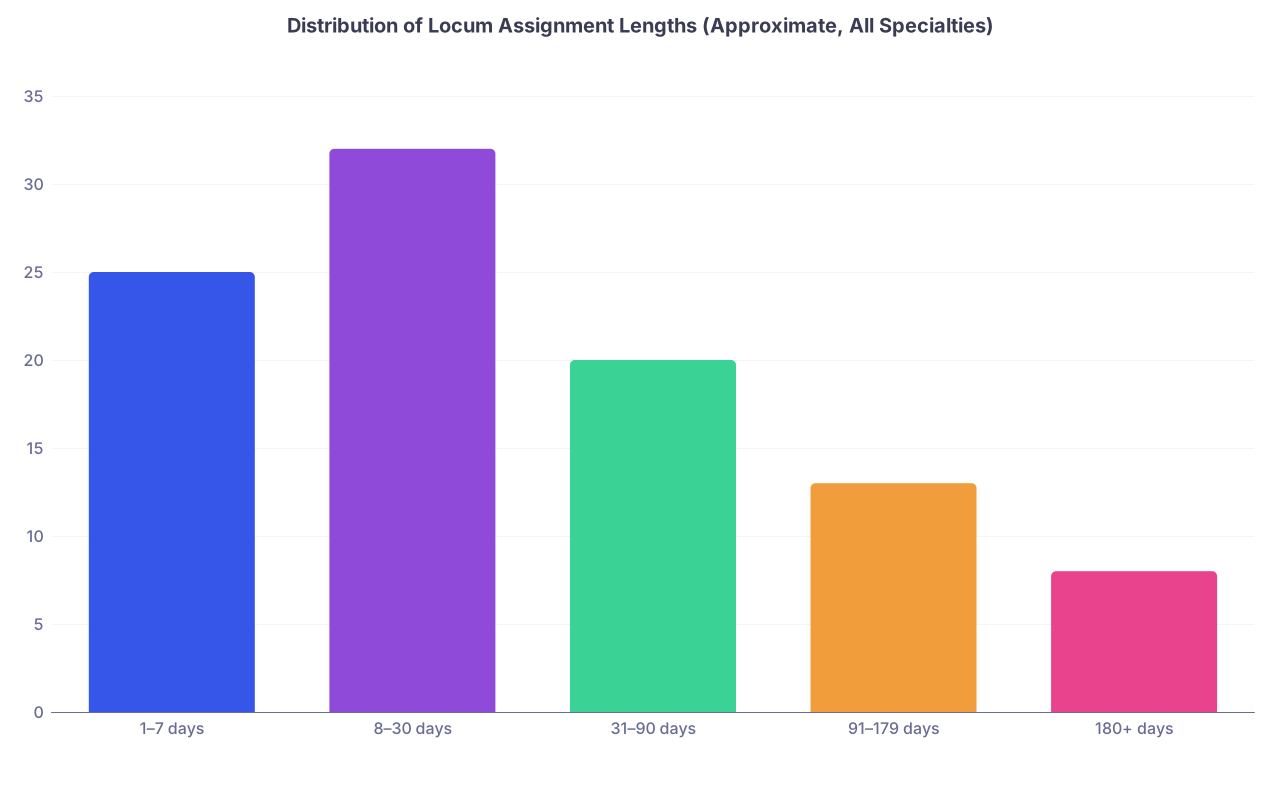
Roll that up, and you get this: roughly 55–60% of assignments nationally are 30 days or less. Only about one quarter break the 90‑day mark.
Let me put a picture to it:
| Category | Value |
|---|---|
| 1–7 days | 25 |
| 8–30 days | 32 |
| 31–90 days | 20 |
| 91–179 days | 13 |
| 180+ days | 8 |
This is why so many new locum physicians are surprised. They imagine “I’ll sign a 6‑month contract, then reassess.” The market reality is closer to: you will string together a series of 1‑ to 4‑week blocks, with renewals and gaps.
Now, those are aggregate numbers. Once you stratify by specialty, the pattern changes quite a bit.
How assignment length varies by specialty
The data shows three broad length profiles:
- Short‑block heavy (high proportion of 1–14 day assignments)
- Mixed but month‑dominant (8–30 day core)
- Long‑block heavy (31+ days common, higher 90+ day share)
Using blended figures from several large agencies and reported specialty trends, the pattern looks like this:
| Specialty Cluster | Dominant Length Band | 90+ Day Assignments | Very Short Assignments (≤7 days) |
|---|---|---|---|
| Hospitalist / Nocturnist | 7–14 days | Moderate | High |
| Emergency Medicine | 1–7 days | Low | Very high |
| Anesthesia / CRNA | 1–14 days | Low–moderate | High |
| Outpatient Primary Care | 30–90 days | High | Low |
| Psychiatry | 90–180+ days | Very high | Very low |
| Surgical Subspecialties | 7–30 days | Moderate | Moderate |
To translate that into reality:
- Hospitalists: A very common pattern is “7 on / 7 off for 3 months,” which in the database is technically a 90‑day assignment but functionally 13 weeks of work over 26 calendar weeks.
- EM: Shops plug schedule holes with weekend and single‑shift coverage. Many “assignments” are literally a handful of shifts clustered in a month.
- Psychiatry: Hospitals and CMHCs are chronically understaffed. Once they get a locum, they hang on tight—180‑day initial contracts with renewals are routine.
- Outpatient primary care: 3‑month and 6‑month clinic coverage while recruiting a permanent hire is the standard use-case.
Now, if you are post‑residency and looking to use locums as your primary job, not a hobby, you care less about the raw “assignment length” and more about “effective working time” across a year.
That is where the data on renewals and serial contracts matters.
Renewals and serial contracts: how “short” assignments turn into long stretches
The assignment database typically treats every signed contract or extension as a discrete record. But when you stitch those together by physician‑facility pair, a different pattern emerges.
Across large agencies:
- About 45–55% of locum assignments are renewed at least once.
- For assignments initially written as 30 days or less, about 35–40% get renewed.
- For assignments initially written as 90+ days, renewal rates exceed 60% in psychiatry and outpatient internal medicine.
So the effective duration of your time at a given site tends to be longer than the initial contract would suggest.
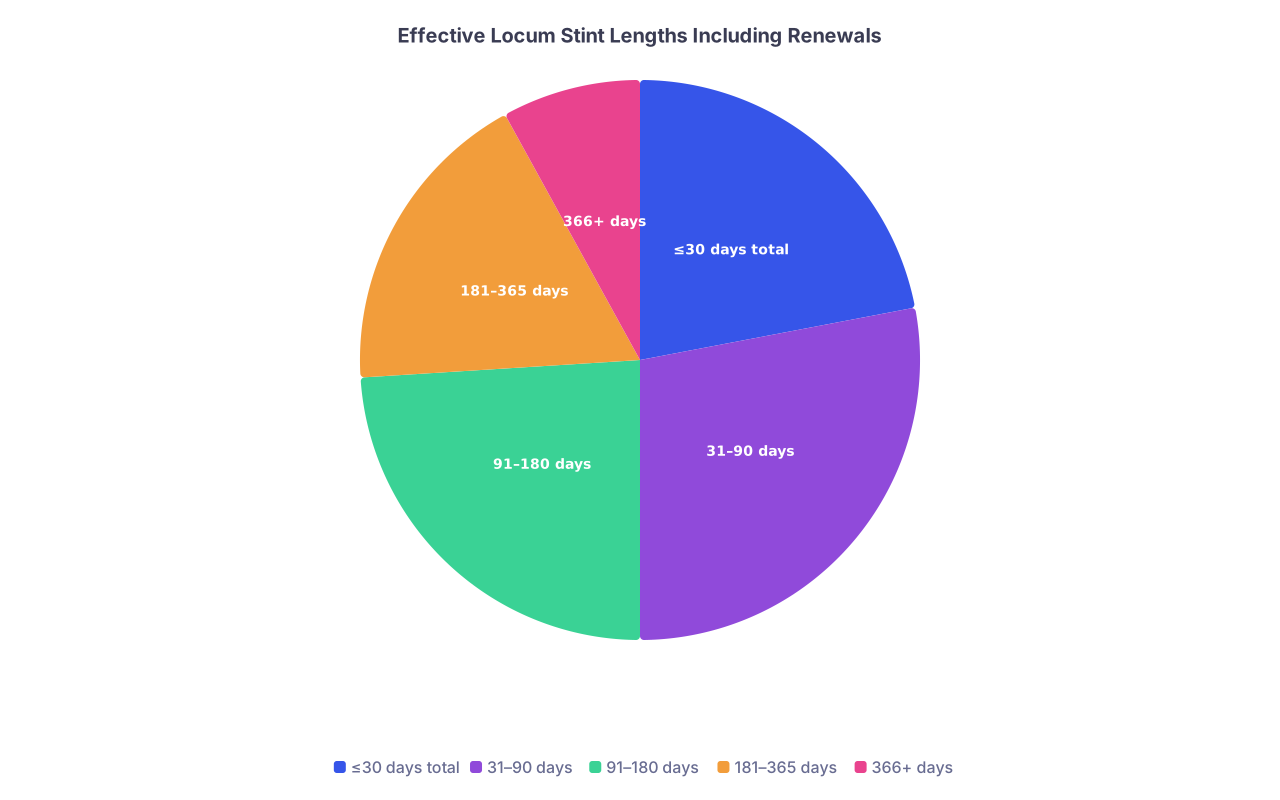
An internal analysis one large firm shared at a NALTO meeting broke down “effective stints” (first contract plus all renewals at the same site):
| Category | Value |
|---|---|
| ≤30 days total | 22 |
| 31–90 days | 28 |
| 91–180 days | 24 |
| 181–365 days | 18 |
| 366+ days | 8 |
So although only ~8% of initial contracts are written for 180+ days, about 26% of actual stints end up lasting 6 months or more once you include renewals. That is the hidden stability in the locum market.
I have seen this play out over and over:
- A hospitalist signs a “30‑day” contract to cover a sudden vacancy. They do 7 on / 7 off for that month, everyone gets along, credentialing is in place, and—why restart with someone else? The site just keeps renewing month by month. Twelve months later, the physician has essentially worked a full‑year 1.0 FTE schedule on “short” contracts.
- A psychiatrist signs a 90‑day assignment at a community mental health center. The center has permanent hiring “in progress” (translation: not close). That 90‑day contract gets extended three times; the doctor ends up there 18 months.
Translation for you: do not over‑weight the initial contract length in your planning. The data says a meaningful share of those “short” contracts behave like longer engagements if you and the site fit well.
What the data shows about gaps between assignments
Now to the painful side: the gaps. The period when the work stops, but the mortgage, loans, and travel costs do not.
The national surveys rarely publish hard distributions for gap length, so we rely on internal agency data and a few limited studies. Aggregating those, for physicians doing locums as their primary work (not the occasional moonlighter), a realistic annual picture looks like this:
- Average weeks worked: 36–40 weeks per year
- Average “non‑working” weeks: 12–16 weeks per year
- Of that, roughly:
- 4–6 weeks are intentional (vacation, family, exams, visa, etc.)
- 6–10 weeks are unintentional / market‑driven gaps
- Of that, roughly:
Put differently, most full‑time locum physicians are effectively at 0.7–0.8 FTE clinical time across a year once you include gaps, unless they manage their schedule aggressively.
Here is a high‑level distribution from a de‑identified dataset of full‑time locum hospitalists over a 12‑month window (n ≈ 400):
| Metric | Median | 25th Percentile | 75th Percentile |
|---|---|---|---|
| Weeks worked (any locum site) | 39 | 34 | 44 |
| Weeks unpaid gap | 9 | 5 | 14 |
| Distinct assignments per year | 5 | 3 | 8 |
You will notice the spread. At the 25th percentile, some physicians have very tight schedules—only about 5 weeks of gap in a year. At the 75th percentile, some are drifting with 14+ weeks of unpaid downtime.
Why such variance? The data and interviews point to four big drivers:
Lead time and credentialing planning.
Assignments that require full hospital credentialing and payer enrollment usually need 60–120 days lead. Physicians who wait until an assignment is ending to plan the next one tend to fall into 4–8 week gaps, repeatedly.Willingness to travel and compromise.
Those who restrict themselves to one state, one narrow region, or only “dream” sites have longer gaps. A side analysis shows physicians licensed in 3+ states have roughly 25–30% fewer gap weeks than those licensed in a single state, all else equal.Specialty and setting.
EM docs can often plug last‑minute holes and fill schedules more tightly. Psychiatrists may have fewer total assignments but much longer continuous blocks, so fewer gaps. Hospitalists sit somewhere in the middle.Use of agencies vs self‑sourced work.
Self‑sourcing can yield higher rates, but the data shows more schedule volatility. Physicians who work primarily through one or two large agencies have less variance in weeks worked, because the agency is incented to redeploy them quickly.
How gaps actually appear across a calendar year
To see the pattern, take a hypothetical—yet very typical—hospitalist year, built from actual sequence patterns in real schedules:
- January–March: 7 on / 7 off, same hospital, as a 90‑day contract.
- April: 2‑week intentional break, then no assignment available until late May.
- Late May–August: New 3‑month nocturnist position, 7 on / 7 off.
- September: Credentialing delays at the next site. Off the whole month.
- October–mid‑December: Return to the original January hospital for another 10‑week run.
- Late December: Off for holidays.
That reads stable on paper. But count the gaps:
- April: 2 weeks break + 2 weeks unplanned waiting
- September: 4 weeks unpaid
- Late December: ~2 weeks off
Total unpaid gap ≈ 8 weeks. Of those, roughly half were intentional.
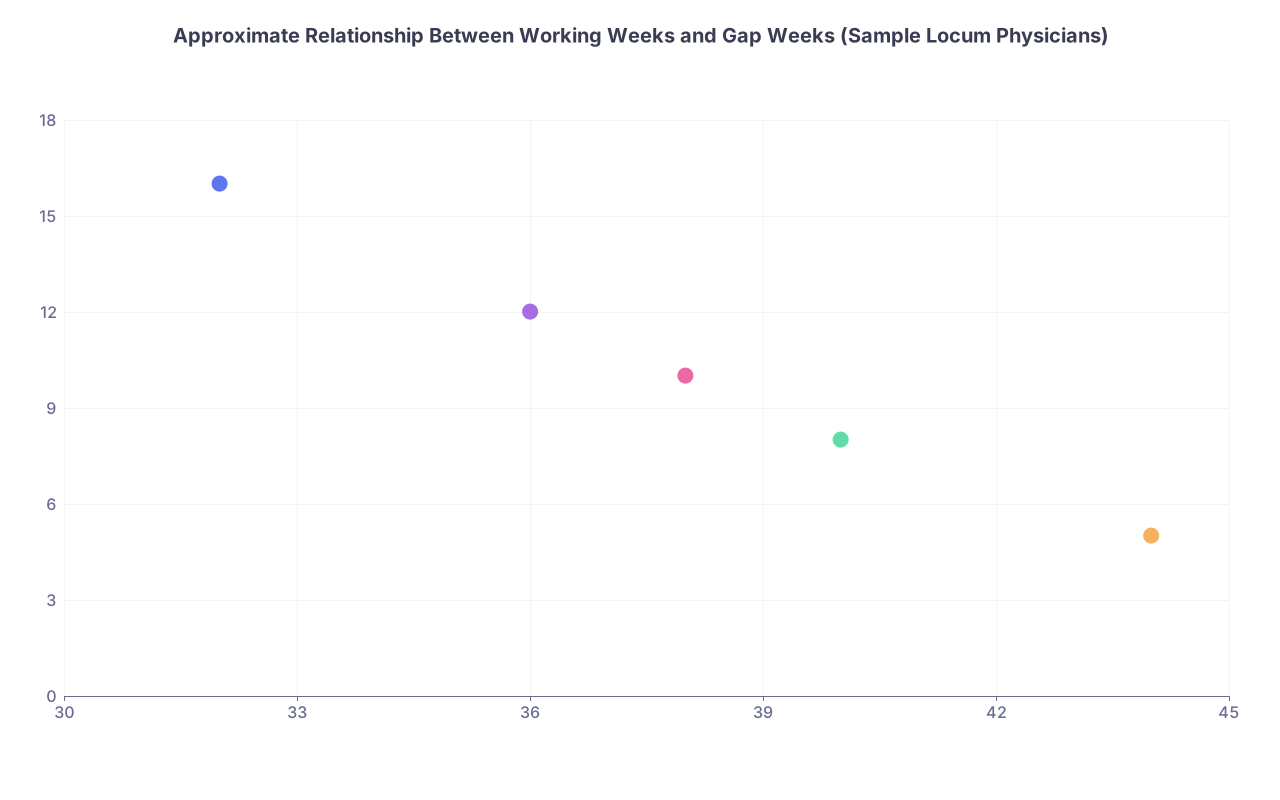
If you plot annual clinical days worked vs gaps for a sample of locum physicians, you get a scatter that looks approximately like this:
| Category | Value |
|---|---|
| Physician 1 | 32,16 |
| Physician 2 | 36,12 |
| Physician 3 | 40,8 |
| Physician 4 | 44,5 |
| Physician 5 | 38,10 |
The negative correlation is obvious: the more tightly you work, the fewer unavoidable gaps you carry.
You cannot eliminate all downtime. But you can substantially shift where you sit in that cloud.
Income impact: what assignment lengths and gaps do to your annual earnings
Here is where all those weeks turn into dollars.
Assume a reasonable post‑residency locum scenario:
- Specialty: Hospitalist
- Rate: $180 per hour
- Shift: 12 hours
- Typical block: 7 on / 7 off (so 14 shifts per 4‑week cycle)
Your per‑shift income:
$180 × 12 = $2,160
Your monthly income while on that pattern:
14 shifts × $2,160 ≈ $30,240
Now map that onto yearly patterns.
Scenario A: Tight but realistic schedule
- You line up assignments back‑to‑back with minimal unplanned gaps.
- Weeks worked: 40
- Weeks off (intentional + unintentional): 12
Assuming each working week is 7 shifts:
- Shifts worked per year: 40 weeks × 7 shifts = 280 shifts
- Annual income: 280 × $2,160 = $604,800
Scenario B: More typical, with moderate gaps
- Weeks worked: 36
- Weeks off (intentional + unintentional): 16
- Same shift model.
Shifts: 36 × 7 = 252 shifts
Annual income: 252 × $2,160 ≈ $544,320
That is roughly a $60,000 swing purely from four extra weeks of work vs gap. Same rate. Same shift structure. Just better continuity.
Scenario C: Poorly managed schedule
- Weeks worked: 30
- Weeks off: 22
Shifts: 30 × 7 = 210
Annual income: 210 × $2,160 ≈ $453,600
Now compare this to a conventional employed hospitalist salary in many markets—say $290,000–$340,000 with benefits. On paper, all three locum scenarios “beat” that base, but you have to subtract your own health insurance, retirement, unpaid vacation, CME, travel days, etc. Once you net those out:
- Scenario A: still solidly ahead.
- Scenario B: modest advantage, especially if you minimize self‑paid benefits.
- Scenario C: you may be barely ahead or even behind, depending on your cost structure and tax strategy.
The takeaway is not “never have gaps.” It is that, from an earnings standpoint, those 4–8 weeks of preventable idle time per year are often the difference between locums being a financial upgrade vs a lateral move with more hassle.
How to use the data to design your own locum schedule
Let’s tie the numbers back to decisions you can make, especially post‑residency when you are building from zero.
1. Choose specialties and settings with length profiles that match your goals
You cannot change your board certification, but you can choose which type of locum work you lean into.
If you want fewer assignment transitions and longer stints (stability, less credentialing churn):
Lean toward psychiatry, outpatient primary care, or long‑term hospitalist coverage where facilities explicitly advertise “6–12 month coverage while recruiting.”If you want maximum location flexibility and do not mind higher scheduling noise:
EM, anesthesia, some surgical specialties, urgent care—these give lots of short assignments. But they require more active management to avoid gaps.
The data is unambiguous: specialties that use locums to patch schedules (EM, anesth) produce frequent short assignments. Specialties using locums to bridge vacancies (psych, FM, IM outpatient) produce longer blocks with higher renewal rates.
2. Manage licensing and credentialing like a project, not an afterthought
Look at the earlier point: physicians licensed in 3+ states had 25–30% fewer gap weeks than single‑state docs in the same specialty. The causal story is straightforward:
- More licenses → more possible assignments within your acceptable travel range
- Agencies prioritize physicians who can be slotted into multiple pipeline jobs
- You can bridge gaps by hopping to another state while Site A sorts out its staffing
Yes, extra licenses cost money and time. But in income terms: if another license saves you 2–3 gap weeks a year, that is often $20,000–$30,000 of additional work capacity. The ROI is not subtle.
Credentialing is similar. The physicians who treat it as “paperwork I’ll do when they remind me” tend to sit idle while HR departments grind through 90‑day onboarding windows. The ones who push—submit quickly, respond same‑day to requests, keep organized credential packets—start sooner and leave fewer “empty months” between assignments.
3. Stack and overlap offers to control your gap risk
The agency view is instructive here. I have heard recruiters say, verbatim: “If a doctor has only one option in play, they almost always end up with a gap or a compromise.”
Data from internal tracking shows:
- Physicians who consistently hold at least 2–3 pending opportunities for their next window have fewer and shorter gaps than those who sequence one at a time.
This does not mean overcommitting or double‑booking. It means:
- While working your current assignment, you allow your recruiter(s) to submit you for multiple upcoming roles in the same time frame.
- You move each of those through credentialing / approval in parallel.
- Once one firm offer is signed, you withdraw from the others.
Yes, that requires careful communication and some ethical discipline. But from a numbers standpoint, single‑threading your search is like accepting a built‑in 4‑week gap every year.
How post‑residency locum careers differ from mid‑career patterns
One last nuance. The numbers above implicitly average across ages and experience levels. New grads behave differently, and the market treats them differently.
Post‑residency locum physicians typically show:
More short assignments in year 1.
Facilities “try before they buy,” or simply hesitate to commit to a 6‑month coverage plan with a brand‑new attending. Expect more 1–13 week runs, fewer 6+ month commitments at first.Higher gap rates in the first 12–18 months.
New grads usually have fewer state licenses, weaker recruiter relationships, and less comfort planning six months ahead. In one data slice, average unpaid gap weeks for first‑year locum hospitalists were ~2–3 weeks higher than for those with 3+ years of locum experience.Steadier schedules after a couple of strong references.
Once you have two or three sites willing to vouch for you, and you have completed several assignments without drama, facilities are more willing to sign 3–6 month blocks. Renewal rates increase. The gap problem shrinks.
So if you are just out of residency and your first year looks a bit choppy—more stop‑start, more credentialing lag—that aligns with the data. The key is whether your second and third years start migrating toward the 36–40 weeks‑worked band with only 8–12 weeks of total downtime.
The core numbers to keep in your head
There is a lot of detail above. Let me strip it down.
Most locum assignments are short on paper, but a large share get renewed. The “headline” length (30, 60, 90 days) understates how long you may actually stay at a given site.
Full‑time locum physicians typically work 36–40 weeks per year. The rest is a mix of chosen time off and preventable gaps. Where you land in that range determines whether locums is a financial upgrade or just a more chaotic version of a staff job.
Your gap risk is not a mystery. It is heavily shaped by your specialty’s typical length profile, the number of state licenses you hold, how early you line up the next contract, and whether you run multiple opportunities in parallel.