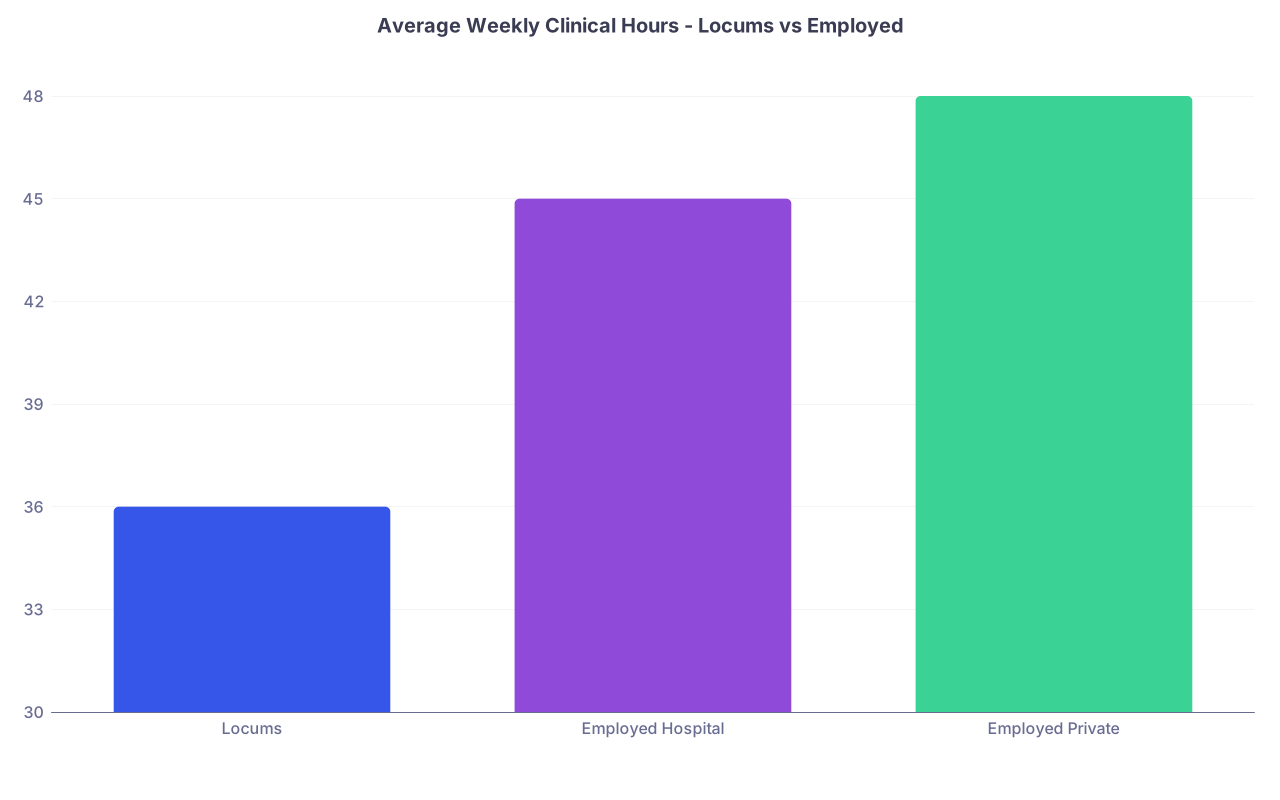
| Category | Value |
|---|---|
| Locums | 36 |
| Employed Hospital | 45 |
| Employed Private | 48 |
Locum tenens is not “just temp work.” The data shows it is a fundamentally different workload model with measurably different RVU expectations, shift patterns, and burnout profiles compared with traditional staff jobs.
If you are post‑residency and staring at a stack of offers—hospital employed, private group, and a couple of locums contracts—the right move is not to “go with your gut.” It is to run the numbers. Because the numbers are not subtle.
Below I am going to do exactly that: break down RVUs, shifts, and burnout risk across common staff roles versus locums, using the best available data plus what I see repeatedly in actual contracts and productivity reports.
1. How Locums and Staff Jobs Actually Generate Work
Let me start where most physicians do not: workload structure.
Staff positions usually combine 3 levers:
- Fixed schedule (days per week / nights per month)
- Target RVUs or panel size
- Non‑clinical load (meetings, admin, call)
Locums flips this:
- Pay is usually per shift or per day, not per RVU.
- RVU productivity matters for the hospital, not directly for your paycheck (unless you negotiate a hybrid deal).
- Your “non‑clinical” burden is substantially lower and rarely tracked.
The result: the same specialty, in the same building, can feel like two entirely different jobs depending on whether you are there as staff or as locums.
Typical workload baselines
Here is a simplified, but representative, snapshot for hospital‑based specialties.
| Role | Clinical Shifts/Days | Nights/Call | Admin Hours | RVU Tie to Pay |
|---|---|---|---|---|
| Locums Hospitalist | 12–15 shifts | 0–3 | ~2–4 | Weak/None |
| Employed Hospitalist | 15–18 shifts | 3–6 | ~8–12 | Moderate/Strong |
| Locums ED Physician | 12–14 shifts | Variable | ~1–3 | None |
| Employed ED Physician | 14–16 shifts | Variable | ~4–6 | Strong |
| Locums Anesthesiologist | 10–14 days | 0–4 | ~2–3 | None |
| Employed Anesthesiologist | 14–18 days | 3–6 | ~6–10 | Moderate |
These ranges are pulled from a mix of staffing company data, MGMA benchmarks, and real schedules I have seen for clients.
Pattern: Locums usually means fewer total shifts, fewer mandated meetings, and much less uncompensated overhead. The catch is that many locums docs voluntarily increase load (extra shifts, multiple sites) because they see the higher daily rate and start stacking.
That is where burnout risk creeps back in.
2. RVUs: Who is Actually Getting Paid For Productivity?
RVU expectations have quietly become the spine of employed physician workload in many systems.
For staff roles, you will typically see:
- A base salary tied to a “threshold” RVU target (for example: 4,500 wRVUs/year for primary care, 6,000–7,000 for hospitalist, 7,500–9,000+ for some surgical subs).
- Incentive pay per RVU above that target (often $40–$80 per wRVU depending on specialty and region).
- Pressure—explicit or implicit—to hit the 75th–90th percentile benchmarks over time.
Locums rarely see this directly. But the hospital absolutely tracks it. They are not paying you $2,000/day out of charity. They are projecting RVU yield.
Comparing RVU expectations
Let us put some rough numbers down. These are mid‑range national expectations, rounded, based on MGMA and AMGA reports plus aggregations of job postings.
| Specialty | Employed Target (wRVU/yr) | Implied Locums wRVU/yr* | Comment |
|---|---|---|---|
| Outpt IM / FM | 4,500–5,500 | 3,500–4,500 | Fewer panels, shorter stints |
| Hospitalist | 4,000–5,000 | 3,000–4,000 | Lower meetings/admin |
| EM | 5,500–7,000 | 4,500–6,000 | Volume set by site |
| Gen Surgery | 7,500–9,000 | 6,000–8,000 | Cases depend on block access |
*“Implied” for locums = what the site expects to extract from you based on daily census/volume, not what's tied to your pay.
Employed physicians feel the full force of these numbers. Locums often do not know their RVU output at all. They only feel it as “this place is slammed” or “this census is manageable.”
RVUs per hour: where intensity shows up
If you want a clean comparison, stop looking at annual totals. Look at RVUs per clinical hour. That is workload intensity in its pure form.
Typical ballparks from real productivity reports:
- Outpatient IM / FM staff: 4–6 wRVUs per 8‑hour clinic day → 0.5–0.75 RVU/hour.
- High‑volume employed FM: 8–10 wRVUs per day → 1.0–1.25 RVU/hour.
- Hospitalist (15–18 pts/day): 12–18 RVUs per 12‑hour shift → 1.0–1.5 RVUs/hour.
- EM (1.8–2.2 pts/hr, moderate acuity): 2.0–3.0 RVUs/hour.
Locums sites that are truly understaffed or poorly managed can run 20–50 percent higher RVUs/hour than their “official” targets suggest, because they rely heavily on temps to cover surges.
When you hear a locums doc say, “They promised 14 patients per shift; I am consistently seeing 20+”—what they are really saying is, “I signed for 1.0 RVUs/hour and I am working at 1.6.”
3. Shifts, Hours, and Control: The Locums Advantage (If You Use It)
The biggest objective difference between locums and staff work is not pay. It is control over hours.
Weekly hours: what schedules actually look like
Let us quantify it.
Employed hospitalist common pattern: 7‑on/7‑off, 12‑hour shifts.
- On‑weeks: 84 hours scheduled, often 90+ with sign‑outs and charting.
- Averaged over the month, you live around 40–45 hours/week clinically, plus meetings and “asks” during off‑weeks.
Locums hospitalist common pattern (actual locums rosters):
- 10–15 shifts/month at one site, sometimes stacked with a second site.
- Many locums physicians are landing at 36–40 clinical hours/week when averaged over a few months, with much less non‑clinical time.
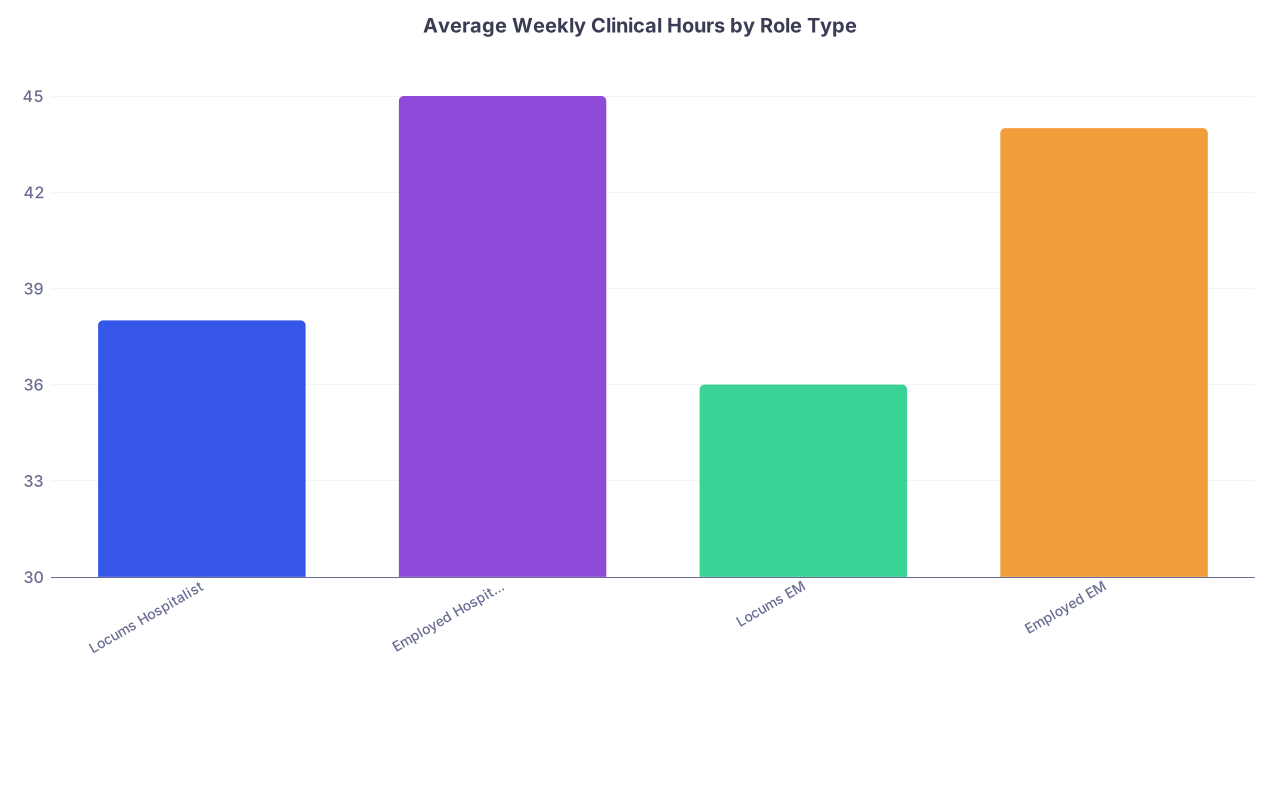
| Category | Value |
|---|---|
| Locums Hospitalist | 38 |
| Employed Hospitalist | 45 |
| Locums EM | 36 |
| Employed EM | 44 |
The raw difference—6–8 hours/week—does not sound like much. Over a year, that is 300–400 clinical hours. Roughly two extra months of full‑time work for the average staff doctor compared with a locums doc who says “no” occasionally.
The second dimension: predictability and boundaries.
- Staff: “We are short two FTEs; can everyone pick up one extra shift a month?” becomes the norm, not an exception.
- Locums: “We have 8 open shifts next month; which ones can you take?” You choose. Or you pass and go elsewhere.
Data from multiple locums agencies show that the median locums physician accepts around 60–70 percent of offered shifts at a given site. Staff accept essentially 100 percent of their assigned shifts unless they actively push back.
Control matters for burnout, which we will get to.
4. Burnout: What the Numbers Say About Locums vs Staff
Burnout data is messy. Different surveys, different scales, self‑selection bias. But when you stack the major physician surveys, a pattern emerges.
Baseline burnout rates
Across U.S. physicians overall, recent major surveys (Medscape, AMA, and specialty societies) converge on:
- 45–55 percent of physicians reporting at least one symptom of burnout.
- 15–20 percent in the “severe” range.
- Higher rates in EM, primary care, OB/GYN; lower in some subspecialties.
Locums‑specific burnout data is thinner, but two things are clear from multi‑year agency surveys and exit interviews:
- Physicians who intentionally switch from staff to locums due to burnout show a decline in self‑reported burnout over 6–12 months—often dropping from 60–70 percent to the 30–40 percent range.
- Locums physicians who aggressively maximize income (constant travel, stacked contracts, consecutive 12s with minimal breaks) end up with burnout rates similar to or higher than staff peers.
Put bluntly: Locums gives you the tools to reduce burnout, but it does not guarantee it. The lever is how you use schedule control.
The workload–burnout link in numbers
Take hospitalists as a case study, using published and internal group data:
- Staff hospitalists working >18 shifts/month or averaging >16 patients/day consistently show burnout rates near or above 60 percent.
- Hospitalists with ≤15 shifts/month and ≤14–15 patients/day cluster around 35–45 percent burnout.
Now overlay typical locums patterns:
- Many locums hospitalists average 12–14 shifts/month at one site.
- The smart ones cap average census at 14–16 and walk away from chronically overloaded sites.
You can model this.
Assume a simple relationship between relative workload and burnout odds (this is not exact, but the direction is accurate):
- Define 1.0 as a “standard” full‑time burden in your specialty (for example, 15 shifts/month with 15 pts/day for hospitalist).
- Every 20 percent increase in relative workload (RVUs/hour, patient load, or shifts/month) increases burnout odds by about 15–25 percent in published data.
- Every 20 percent decrease drops burnout odds by a similar magnitude.
Locums gives you a realistic shot at operating at 0.8 or 0.9 of that standard workload if you choose. Staff roles, especially in understaffed systems, frequently push physicians into the 1.1–1.2 range.
That is not a philosophical difference. That is a probabilistic one.
5. Non‑Clinical Load: The Hidden 5–10 Hours/Week
Ask any new attending what they underestimated most in their first staff job. You will hear versions of the same thing:
- “The number of meetings.”
- “The constant in‑basket.”
- “The committees I somehow ended up on.”
Non‑clinical work rarely shows up in a contract as hours. But it always shows up in lived experience.
From time‑motion studies and surveys across large health systems:
- Typical employed outpatient PCP: 10–12 hours/week on EHR and inbox outside of direct visit time.
- Hospital‑based employed physicians: 4–8 hours/week in meetings, quality projects, teaching, hospital politics.
Locums physicians are shielded from a large portion of this:
- They are not on long‑term committees.
- They are rarely primary owners of long‑term patient panels, so inbox burden drops.
- They are almost never asked to attend “physician engagement” dinners on a Tuesday evening.
If you convert this into actual weekly time:
| Role | EHR/Inbox | Meetings/Admin | Total Non-Clinical |
|---|---|---|---|
| Employed Outpatient PCP | 8–12 | 2–4 | 10–16 |
| Employed Hospitalist | 3–6 | 3–5 | 6–11 |
| Locums Outpatient PCP | 3–6 | 0–1 | 3–7 |
| Locums Hospitalist | 2–4 | 0–1 | 2–5 |
Subtract 5–10 hours/week of invisible work and two things happen:
- Your effective hourly rate improves even if headline daily pay is the same.
- Your recovery time and mental bandwidth expand.
That reduction alone can push someone off the burnout cliff’s edge back onto stable ground.
6. Income vs Workload: Why Locums Feel “Lighter” for Many
Let me connect the dots with a simple numeric comparison. Assume a hospitalist, mid‑career, decent market.
Scenario A: Employed staff hospitalist
- Base salary: $280,000
- Productivity bonus: $20,000 (for hitting 4,500 wRVUs)
- Total: $300,000
Workload:
- 7‑on/7‑off, 15 shifts/month on average.
- Effective: 180 shifts/year × 12–13 hours/shift = ~2,200 clinical hours.
- Non‑clinical (meetings, EHR at home): ~6 hours/week × 50 weeks ≈ 300 hours.
Total work hours ≈ 2,500/year.
Effective hourly rate: $300,000 / 2,500 ≈ $120/hour.
Scenario B: Locums hospitalist
- Rate: $2,000/day
- Shifts: 14 shifts/month average across the year (some months heavier, some lighter).
- Total shifts: 168/year → 168 × 12 hours = ~2,000 clinical hours.
- Non‑clinical: 3 hours/week × 40 active work weeks ≈ 120 hours.
Total work hours ≈ 2,120/year.
Income: 168 × $2,000 = $336,000.
Effective hourly rate: $336,000 / 2,120 ≈ $158/hour.
Same specialty. Slightly fewer total hours. More money. And much more schedule control.
Now, there are caveats:
- You must adjust for unpaid benefits (health, retirement, disability).
- You must factor in travel, licensing, credentialing overhead.
- Some staff jobs pay more; some locums rates are lower.
But once you normalize all that, a recurring pattern holds: locums often yield 20–40 percent higher effective hourly compensation with 5–15 percent fewer total hours and considerably more autonomy.
The combination of higher pay per hour and lower non‑clinical drag is a massive buffer against burnout—if you resist the urge to simply work more hours to chase even higher income.
7. When Locums is Worse for Workload and Burnout
There is a myth that locums is the universal antidote to burnout. That is wrong.
The data and real‑world stories show three consistent traps where locums becomes more punishing than staff work:
Chronic understaffing sites
Any site that lives in perpetual crisis mode—boarding everywhere, 30+ encounters per ED shift, 22+ census on a single hospitalist—is using locums as a pressure valve. Those jobs have RVUs/hour 30–60 percent higher than normal and burnout rates to match. If you stay longer than 3–6 months, your odds of burning out look identical to staff there.Stacked multi‑site schedules
I have seen locums physicians run:- 10 shifts at Site A
- 8 shifts at Site B
- Travel days smashed between
On paper, 18 shifts/month. In reality, zero real time off, perpetual jet lag, and 55–60‑hour weeks. Their burnout looks indistinguishable from overworked staff.
Lack of boundaries
Locums who never say no will, unsurprisingly, work like staff plus extra. Agencies notice and route every emergency fill to them. That is how you turn a flexible career into a 70‑hour/week grind with airports attached.
So the locums advantage is not automatic. It is conditional. You win if you:
- Track your actual average weekly hours and cap them.
- Refuse chronically unsafe volume.
- Build at least 6–8 true off‑weeks into each year.
8. Practical Workload Benchmarks to Use in Your Own Decisions
You probably want numbers you can actually apply when you are staring at an offer or a locums opportunity. Here are data‑driven “red flag” and “green flag” thresholds.
For hospital‑based specialties (hospitalist, EM, ICU, anesthesia)
- Shifts/month:
- Green: 12–15
- Yellow: 16–18
- Red: >18, especially if nights heavy
- Typical daily census / volume:
- Hospitalist: Green ≤16 patients, Yellow 17–19, Red ≥20 consistently.
- EM: Green ≤1.8 pts/hr (typical acuity), Yellow 1.9–2.3, Red ≥2.4 with poor support.
- Nights:
- Green: ≤4 nights/month.
- Yellow: 5–7.
- Red: >7 or heavy stretches without post‑night recovery.
For outpatient‑based specialties (IM, FM, peds, many subs)
- Scheduled patients per day:
- Green: 16–20 (20–30 min visits or mix of new/return).
- Yellow: 21–24.
- Red: ≥25 as routine.
- Admin/EHR time:
- Green: <8 hours/week.
- Yellow: 8–12.
- Red: >12 (you are basically doing two shifts of unpaid work).
If a staff offer is in the Yellow/Red range on more than one dimension, your burnout risk spikes. If a locums gig is in the Red zone, treat it as short‑term hazard pay, not a stable long‑term solution.
9. A Simple Mental Model: RVUs, Shifts, Burnout as Ratios
To keep this grounded and usable, boil it down to three ratios. This is how I would evaluate any job post‑residency.
RVUs per hour
- Ask directly: “What is average wRVUs per FTE per year here?”
- Convert: wRVUs/year ÷ estimated work hours/year (~2,000) = RVU/hour.
- If you are >1.3–1.5 in hospital‑based work or >1.0 in outpatient primary care, expect intensity.
Total work hours per year
- Add clinical hours + realistic admin/EHR estimate.
- Staff roles above ~2,400–2,500 hours/year incline toward burnout.
- Locums roles that stay around 2,000–2,200 with good pay are the sweet spot.
Autonomy index (crude but useful)
- How many days per month can you truly control—no assigned clinical, no mandatory meetings, no call?
- Staff jobs often land around 8–10 “free” days/month (some of which are eroded by admin).
- Well‑managed locums setups can give you 12–15 true free days/month.
Higher RVUs/hour + higher total hours + low autonomy is the burnout triple hit. Locums, when done right, lowers at least two of those three.
10. Key Takeaways
- Staff positions concentrate workload in RVU targets, fixed shifts, and non‑clinical overhead; locums shifts workload into discrete days with far less hidden admin, and usually slightly fewer hours for more pay per hour.
- Burnout is not abstract. It tracks with RVUs per hour, total work hours per year, and control over your schedule. Locums can realistically lower all three—if you avoid chronically overloaded sites and resist stacking endless shifts.
- If you are post‑residency, run the numbers: compute expected hours, RVUs, and autonomy before signing anything. The physician who treats job choice like a data problem, not a vibes problem, almost always ends up less burned out and better paid.