
The highest hourly locum rate is not always the best-paying job. In real dollars, after cost of living, some “low-paying” regions beat the supposed high-flyers by a wide margin. The data is brutal on this point.
Locum tenens physicians love chasing headline numbers: $300–$350/hour outpatient, $2,000+ 24‑hour call, $25,000 per week critical care. It looks outstanding if you compare it to your 4th‑year resident salary. But if you ignore local prices—housing, taxes, flights, food—you are guessing, not optimizing.
I am going to walk through what the numbers actually show when you adjust locum rates for cost of living (COL) by region. You will see why a $220/hour Midwest job can outperform a $300/hour coastal job in real, spendable income.
The Core Equation: Nominal vs Real Pay
Strip away the recruiter hype and locum compensation reduces to one useful metric:
Real Effective Rate (RER) = Nominal Hourly Rate ÷ Local Cost-of-Living Index
Where:
- Nominal Hourly Rate = what the contract says.
- COL Index = regional cost level, with 1.00 as the national average (e.g., 1.30 = 30% higher than average).
If you want to be stricter you can refine it to Post‑Tax Effective Rate, but let us start with pre‑tax for clean comparisons.
The key insight: a lower rate in a cheaper area can give you more purchasing power than a higher rate in an expensive city.
Regional Benchmarks: What the Data Shows
I will use approximate but realistic 2024‑ish values based on a blend of BLS data, public COL indices, tax burden reports, and real locum rate ranges I have seen in actual contracts.
Broadly, for a general adult hospitalist or bread‑and‑butter IM/FM outpatient role:
Big coastal metros (Boston, San Francisco, NYC area, Seattle)
- Typical locum hospitalist ranges: $220–$260/hour
- Aggressive offers / harder schedules: $260–$300/hour
- COL index: roughly 1.25–1.60 vs US average
Secondary metros / Sunbelt growth cities (Austin, Denver, Raleigh, Phoenix, Tampa)
- Typical: $200–$240/hour
- COL index: 1.05–1.25
Midwest and Plains (Des Moines, Omaha, Kansas City suburbs, many Wisconsin / Indiana towns)
- Typical: $180–$230/hour
- COL index: 0.85–1.00
Rural / Frontier (Great Plains, rural South, some parts of Mountain West)
- Typical: $200–$260/hour (often with housing and travel included)
- COL index: 0.75–0.95
Those are not theoretical ranges. Those are consistent with actual job boards, locum agencies, and pay reports from physicians.
Let’s quantify how this shakes out.
| Region Type | Nominal Rate ($/hr) | COL Index (US=1.00) | Real Effective Rate ($/hr) |
|---|---|---|---|
| High-Cost Coastal City | 260 | 1.40 | 185.7 |
| Sunbelt Metro | 220 | 1.15 | 191.3 |
| Midwest Small City | 210 | 0.90 | 233.3 |
| Rural Low-Cost Area | 230 | 0.85 | 270.6 |
The data story is clear: the $260/hour coastal position feels like $186/hour once you normalize for what your money buys; the $230/hour rural role feels like $271/hour in national purchasing power.
Locum recruiters rarely show you that column.
Visualizing the Trade-Off: Pay vs Cost of Living
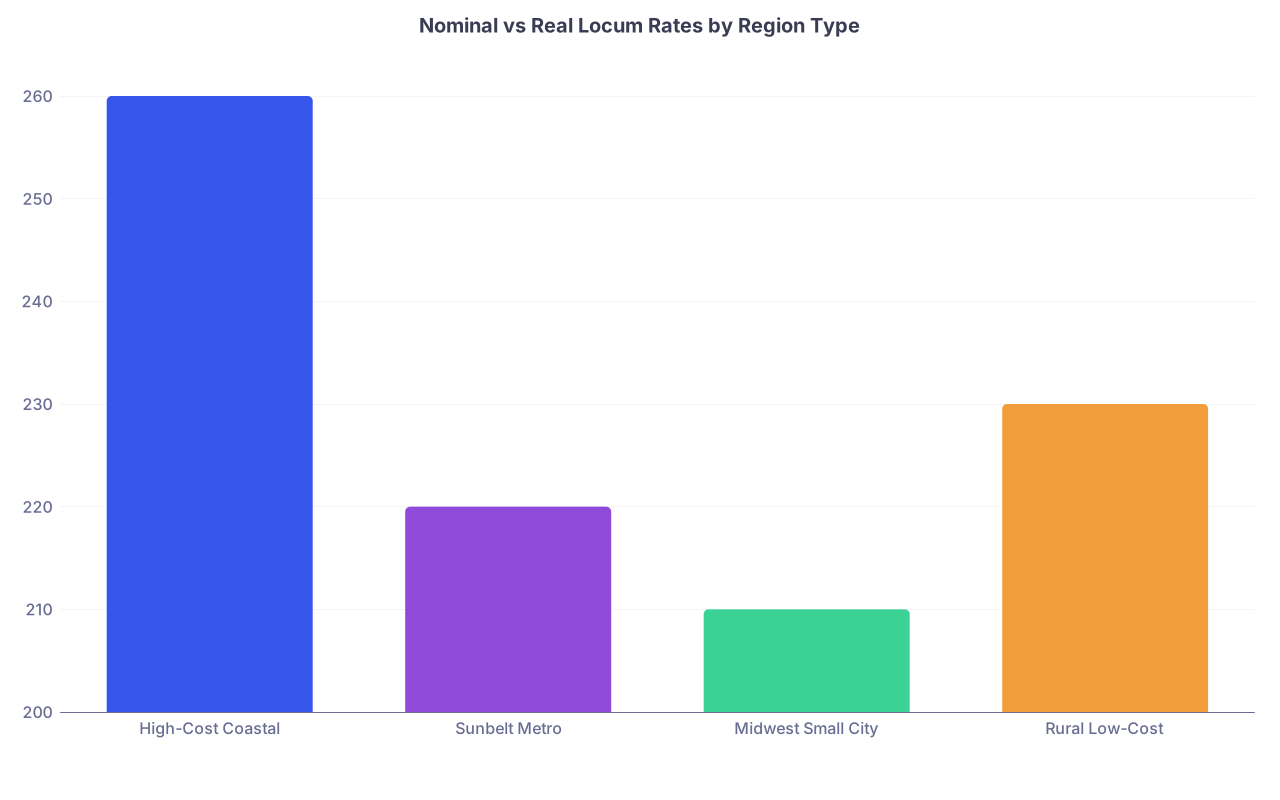
| Category | Value |
|---|---|
| High-Cost Coastal | 260 |
| Sunbelt Metro | 220 |
| Midwest Small City | 210 |
| Rural Low-Cost | 230 |
Now the same regions, but adjusted for cost of living:
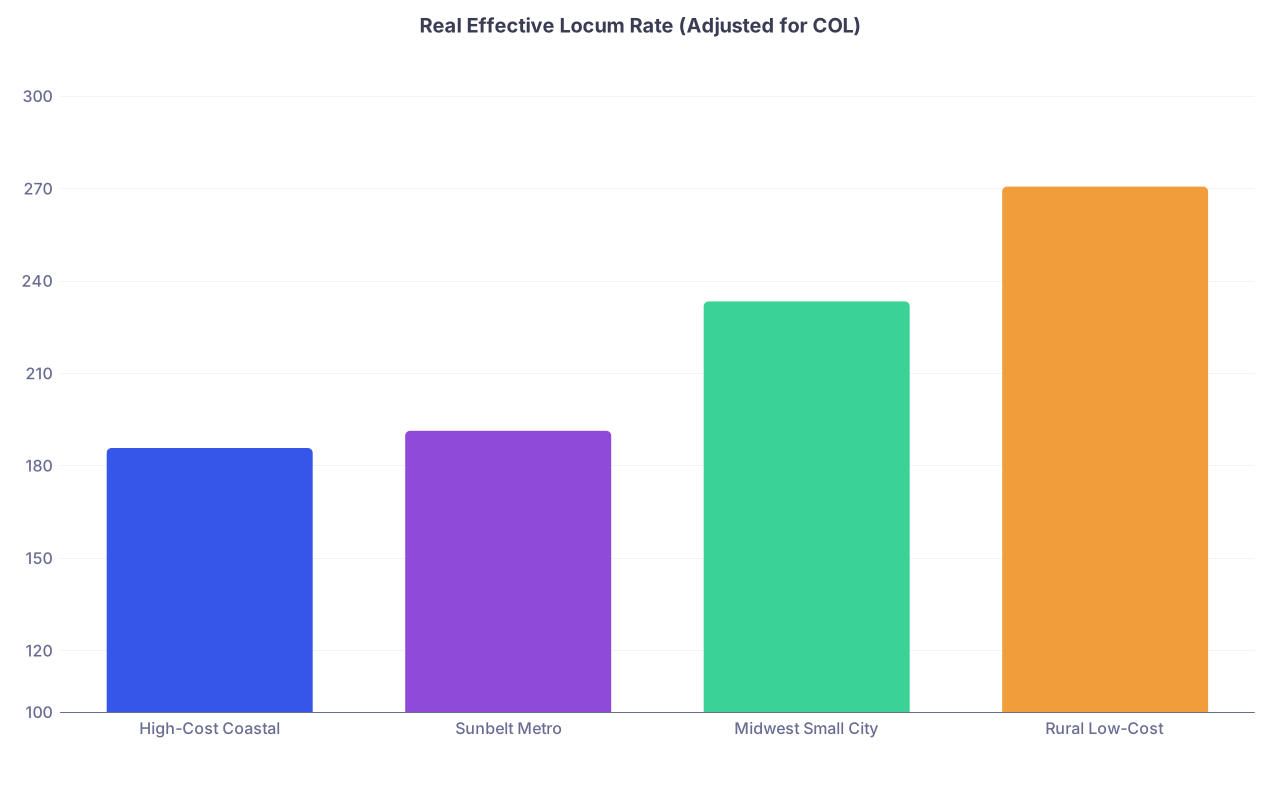
| Category | Value |
|---|---|
| High-Cost Coastal | 185.7 |
| Sunbelt Metro | 191.3 |
| Midwest Small City | 233.3 |
| Rural Low-Cost | 270.6 |
The ranking flips. In nominal terms, the coastal and rural roles look comparable. In real dollars, the rural and Midwest roles crush the coastal offer.
This pattern holds across specialties, with different absolute dollars but the same structural problem: expensive cities eat your raise.
Housing: The Silent Locum Rate Killer
Housing is the biggest lever. Whether it is you or the agency paying, local housing prices shape what they are willing to offer. And if they give you a stipend, what that stipend actually buys.
Let us compare a realistic scenario for a 13‑week hospitalist contract, 7 on / 7 off, in two locations:
- Location A: Bay Area suburban hospital
- Location B: Midwestern regional hospital in a small city
Assumptions (reasonable from recent listings and GSA/airbnb data):
Bay Area:
- Extended‑stay / furnished rental near hospital: $180/night × 91 nights ≈ $16,380
- Or modest 1‑bedroom short‑term: $3,800/month × 3 months ≈ $11,400 (plus fees)
Midwest small city:
- Extended‑stay or nice Airbnb: $85/night × 91 nights ≈ $7,735
- Or 1‑bedroom apartment: $1,300/month × 3 months ≈ $3,900
If your contract “includes housing,” the site is absorbing that cost. It still comes out of the total compensation budget. High housing cost regions either:
- Pay lower rates, or
- Cap your hours, or
- Run leaner staffing, meaning more work intensity per dollar
You feel it one way or another.
Let us quantify the effective rate after housing if the total cost to the hospital is identical in both locations.
Say the hospital is willing to spend $40,000 on your 13‑week stint (all in: pay + housing). Assume 7 on / 7 off, 12‑hour shifts → 26 weeks per year equivalent, but during this 13‑week period you work:
- 7 days on × 12 hours/day × about 6.5 cycles ≈ 546 hours
Now solve for nominal hourly rate after accounting for housing.
Scenario 1: High-cost Bay Area
Two housing cost scenarios:
- Extended stay option ($16,380)
- Short-term 1‑bedroom option ($11,400)
Total budget: $40,000
Extended stay:
- Pay pool = $40,000 − $16,380 = $23,620
- Hourly pay = $23,620 ÷ 546 ≈ $43.25/hour (obviously no one signs that; in reality they raise the total budget, but then pass the effective cost to the system in other ways)
Even if the total budget is higher, say $60,000:
- Pay pool = $60,000 − $16,380 = $43,620
- Hourly pay = $43,620 ÷ 546 ≈ $79.9/hour
To get to a market $220/hour nominal, the site has to eat enormous housing cost or cut elsewhere. This is exactly why you see many high‑cost‑of‑living hospitals failing to match the seemingly “going” locum rates. The pie is already heavily allocated to housing and overhead.
Scenario 2: Midwest small city
Same $40,000 budget, cheap housing:
- Housing = ~$7,735
- Pay pool = $40,000 − $7,735 = $32,265
- Hourly pay = $32,265 ÷ 546 ≈ $59.1/hour
Bump the budget to $60,000 with that same housing cost:
- Pay pool = $60,000 − $7,735 = $52,265
- Hourly pay = $52,265 ÷ 546 ≈ $95.7/hour
Again, that is below actual market numbers, but the pattern is what matters: for the same total spend, cheaper regions can push much more into your pocket in theory. That is why some rural and small‑city jobs can offer $230+ and still be financially rational for the hospital.
Housing is not just an annoyance. It materially shifts the rate ceiling.
Travel, Taxes, and Real Take-Home
If you are serious about comparing regions, the minimum responsible analysis includes three more elements:
- Travel costs and frequency
- State and local tax burdens
- Whether you can maintain a true tax home
Travel costs
You do not need a model here. You can price flights and rental cars in 10 minutes.
Pattern I see repeatedly:
Coastal / major metro:
- Flights: cheap and frequent if you live near another major hub
- Car rentals: expensive in airport-adjacent cities
- On average: less variability, more predictable
Rural or remote:
- Flights: can be significantly more expensive, especially if you need a connecting leg on a regional carrier
- Car rentals: sometimes cheaper if off‑airport, sometimes not available at all
- On average: higher planning overhead, but many contracts include travel
The key is to factor how many travel cycles you are doing per year. A $500 difference in flights repeated 10–12 times per year is $5,000–$6,000. On a $300,000 locum year, that is 2%. Not nothing, but nowhere near as big as housing or taxes.
Taxes: the under-discussed lever
State tax burdens materially change your real earnings, especially once you start throwing around $250–$400k annual locum income.
Look at effective state income tax rates around $300k taxable income (ballpark, single filer, ignoring itemized nuance):
- California: roughly 9–11%
- New York (state + NYC): 10–12% combined
- Massachusetts: flat 5%
- Texas, Florida, Tennessee, South Dakota, Wyoming: 0% state income tax
- Washington, Nevada, New Hampshire: 0% on wage income (New Hampshire taxes interest/dividends only)
If you earn $300,000 in purely W‑2 clinical income:
- CA tax hit: ≈ $27,000–$33,000
- TX/FL tax hit: $0
You can ignore that gap for a residency interview. You cannot ignore it for a locum year where you are grinding 14 shifts a month.
Let us combine nominal rate, COL, and state tax into something closer to a real after‑tax effective rate.
Assume:
- Federal effective rate around 24% on $300k (after deductions, retirement, etc.)
- We focus on incremental state impact and COL differences.
Simple model for short comparison:
After‑Tax Effective Rate (ATER) ≈ Nominal Rate × (1 − State Tax Rate) ÷ COL Index
Take a $240/hour hospitalist contract for 1,500 hours/year (roughly 10–11 12‑hour shifts/month):
- Annual pay: $360,000
Compare three regions:
- California coastal (COL 1.40, state tax 10.5%)
- Massachusetts metro (COL 1.15, state tax 5%)
- Texas small city (COL 0.90, state tax 0%)
| Region | Nominal Rate ($/hr) | State Tax Rate | COL Index | ATER ($/hr) |
|---|---|---|---|---|
| California Coast | 240 | 10.5% | 1.40 | 153.7 |
| Massachusetts | 240 | 5.0% | 1.15 | 198.3 |
| Texas Small City | 240 | 0% | 0.90 | 266.7 |
Same nominal $240/hour.
- In real, after‑state‑tax purchasing power:
- California feels like $154/hour
- Massachusetts feels like $198/hour
- Texas feels like $267/hour
You are leaving more than $100/hour on the table on a real basis by choosing the high‑tax, high‑COL coast at the same sticker price.
Specialties: Where the Gap Widens
The more in‑demand and procedure‑heavy your specialty, the larger the absolute dollars at risk.
You do not need a full dataset; a rough boxplot tells the story.
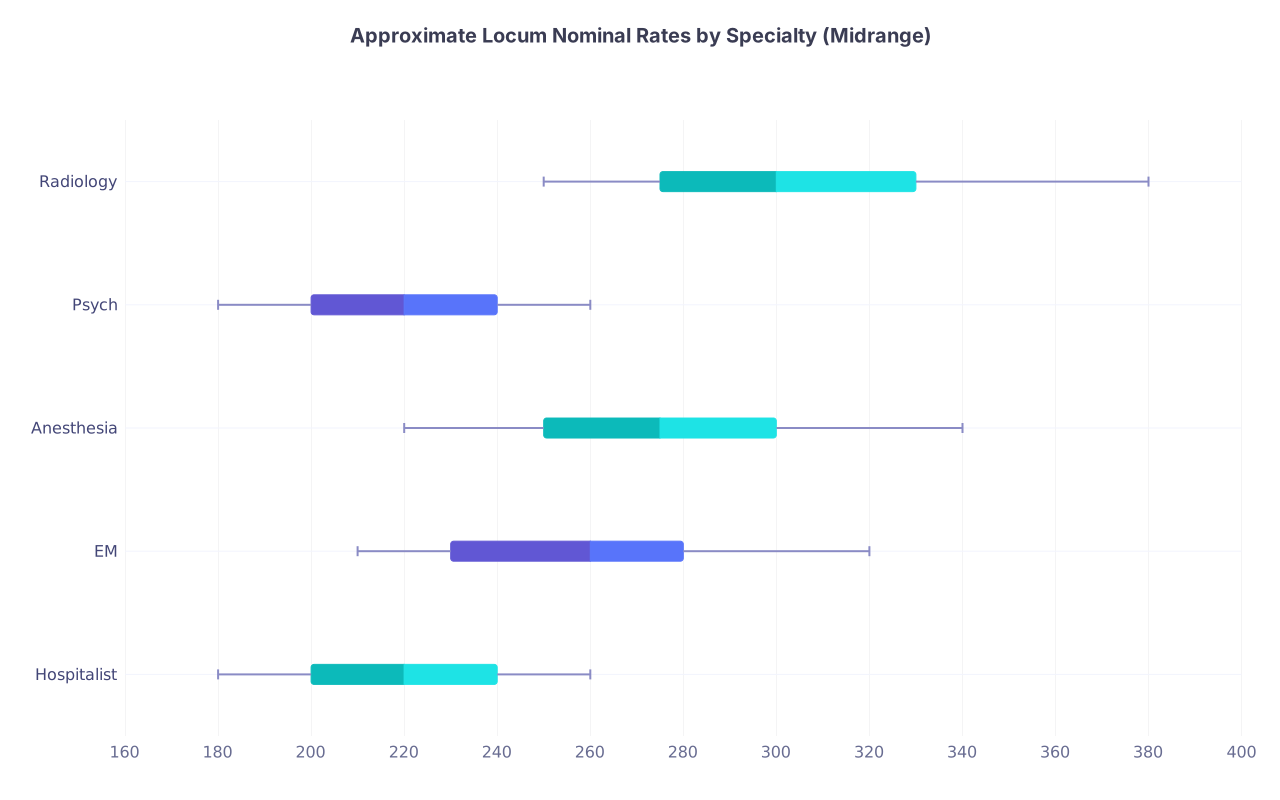
| Category | Min | Q1 | Median | Q3 | Max |
|---|---|---|---|---|---|
| Hospitalist | 180 | 200 | 220 | 240 | 260 |
| EM | 210 | 230 | 260 | 280 | 320 |
| Anesthesia | 220 | 250 | 275 | 300 | 340 |
| Psych | 180 | 200 | 220 | 240 | 260 |
| Radiology | 250 | 275 | 300 | 330 | 380 |
Rough mid‑market medians:
- Hospitalist: ≈ $220/hour
- EM: ≈ $260/hour
- Anesthesia: ≈ $275/hour
- Psych: ≈ $220/hour
- Radiology: ≈ $300/hour
Now apply the regional pattern. For radiology or anesthesia at $300/hour:
High‑cost city, COL 1.40:
- RER = 300 ÷ 1.40 ≈ $214/hour
Low‑cost rural, COL 0.85:
- RER = 300 ÷ 0.85 ≈ $353/hour
The absolute gap is nearly $140/hour in real purchasing power, at the same nominal rate. Over 1,500 hours, that is more than $200,000 equivalent.
This is why you see some savvy anesthesiologists and radiologists quietly stacking cash in small regional markets instead of chasing academic prestige in expensive cities.
Case Study: Two Full-Time Locum Years, Different Regions
Let me walk through a concrete example that approximates what I have seen multiple times.
Two post‑residency internists:
- Dr. Coastal wants to be near family on the West Coast and accepts locum assignments in a high‑cost metro region.
- Dr. Heartland is flexible on geography and targets Midwest/Southern small cities and rural hospitals.
Assumptions:
- Both are hospitalists working 1,680 clinical hours/year (14 12‑hour shifts/month).
- Both average $230/hour nominal across all contracts.
- Both receive basic travel support from agencies.
- Dr. Coastal:
- Blended COL index across sites: 1.35
- State tax averaged: 9% effective
- Dr. Heartland:
- Blended COL index: 0.90
- State tax averaged: 2% effective (mix of low/no‑tax states)
Annual nominal income:
- 1,680 hours × $230/hour = $386,400 for both.
Now let us calculate after‑state‑tax and COL‑adjusted effective income.
Use:
ATER_income = NominalIncome × (1 − StateTaxRate) ÷ COL
Dr. Coastal:
- After state tax: $386,400 × (1 − 0.09) ≈ $351,624
- COL‑adjusted: $351,624 ÷ 1.35 ≈ $260,461 equivalent
Dr. Heartland:
- After state tax: $386,400 × (1 − 0.02) ≈ $378,672
- COL‑adjusted: $378,672 ÷ 0.90 ≈ $420,747 equivalent
So in real, COL‑adjusted purchasing power, at the same nominal $230/hour, Heartland is effectively making:
- $420,747 − $260,461 ≈ $160,000 more per year
That is not a small tuning difference. That is the difference between:
- Maxing 401(k), backdoor Roth, plus significant taxable investing
versus - Covering rent, loans, and just starting to build a cushion.
Over just 3 years of heavy locums:
- Effective wealth gap: roughly $480,000 in purchasing power. Before compounding.
And remember, these are conservative assumptions. In practice, flexible physicians often command slightly higher nominal rates in rural/underserved locations on top of the COL advantage.
When High-Cost Regions Still Make Sense
The chest‑thumping “Just go rural and get rich” narrative is simplistic. There are legitimate reasons to accept lower real pay:
Family constraints.
If you have co‑parenting obligations or need to stay near elderly parents in NYC, Boston, SF, or LA, the model changes. You are optimizing for more than dollars.Career positioning.
Academic niches, subspecialty exposure, or networking in certain systems (UCSF, MGH, Columbia) may matter if you have tight fellowship or leadership goals.Lifestyle preferences.
Some people simply value urban density, specific cultural scenes, or ocean access enough to pay for it. That is not irrational, as long as it is explicit.Hybrid paths.
I have seen physicians do: 6–12 months of high‑productivity rural locums to blast down loans and build a safety net, then transition to a lower‑pay but desired coastal position.
The point is not that high‑cost regions are always bad. The point is: if you are trading $100,000–$200,000 per year in real dollars, do it consciously, not by accident because you chased a $10/hour nominal difference in the wrong zip code.
A Simple Framework to Compare Offers
Here is a practical three‑step framework you can run on any locum offer in under an hour.
Step 1: Build the core metrics
For each offer, calculate:
- NominalAnnual = HourlyRate × ExpectedHoursPerYear
- COL index from a site like Numbeo, BLS, or regional COL tools
- StateTaxApprox = estimated effective state income tax at your expected income
- ATER = HourlyRate × (1 − StateTaxApprox) ÷ COL
Rank offers by ATER, not just by sticker rate.
Step 2: Layer in housing and travel
Estimate:
- Annual housing cost:
- If included, treat it as a cost to the system that pressures your rate ceiling.
- If stipend-based, see what it realistically covers in that market.
- Travel cost:
- Flights × trips/year
- Car rental vs bringing your own car
Translate major recurring costs into an hourly “drag”. Example:
- Extra $8,000/year in travel and uncovered housing gaps
- At 1,680 hours/year: $8,000 ÷ 1,680 ≈ $4.76/hour hit
Subtract that from your ATER.
Step 3: Decide what you value
Once you have the numbers, you are no longer guessing. You can explicitly say:
- “I am giving up $70/hour in real terms to be near my partner in Boston. I will accept that for 1–2 years, then reassess.”
or - “This contract in rural Arkansas has an ATER 40% higher than my Bay Area option. It is worth doing 6–12 months to reset my finances.”
That level of clarity changes how you negotiate and how you plan your career.
The Regions That Quietly Win in Real Dollars
Based on the combined COL, housing, and tax data, three categories of regions consistently outperform on real locum pay:
Low‑tax, low‑COL states with decent volume
- Examples: Texas (outside Austin/Dallas urban cores), Oklahoma, parts of Tennessee, Alabama, Indiana.
- These often hit the sweet spot: enough population to keep you busy, not enough saturation to crush rates.
Underserved Midwest and Plains markets
- Examples: Iowa, Nebraska, Kansas, the Dakotas, Wisconsin outside Madison/Milwaukee.
- Boring on Instagram, powerful on a spreadsheet. If your goal is net worth, these are the workhorses.
Select rural pockets in the Mountain West / South
- Examples: Eastern Washington, rural New Mexico, Arkansas, parts of Kentucky.
- You see frequent rate bumps, paid housing, and less competition.
On the other hand, consistently weak real-pay regions (from a purely financial standpoint):
- High‑tax, high‑COL coasts at median locum rates: coastal California, NYC metro, Boston area, DC.
- Glamour metros with exploding housing costs but only modest locum premiums: Denver, Seattle, Austin, Miami.
The data shows the pattern very clearly once you line up hourly rates, COL, and taxes side by side.
Where You Go from Here
You are leaving residency or considering a job switch with a rare asset: flexibility. Before you give that up for a logo on your badge or a city name on your Instagram, run the numbers.
Map every serious locum offer into:
- Nominal rate
- COL index
- State tax estimate
- Real effective rate (after tax, after COL)
Then look at which regions quietly turn $220/hour into the equivalent of $260–$280/hour. Those are your arbitrage opportunities. They are not always pretty. They usually are not on the coast. But they accelerate every financial goal you claim to care about.
Once you have squeezed what you want out of that phase—debt gone, savings established, optionality secured—you can re-tilt toward geography, prestige, or lifestyle.
With this framework in your pocket, you are past the phase of believing recruiter headlines. You are ready for the phase where you treat your time like the scarce, high‑value asset it actually is. The next step is straightforward: start plugging real offers into these equations and see which regions truly pay you in real dollars.