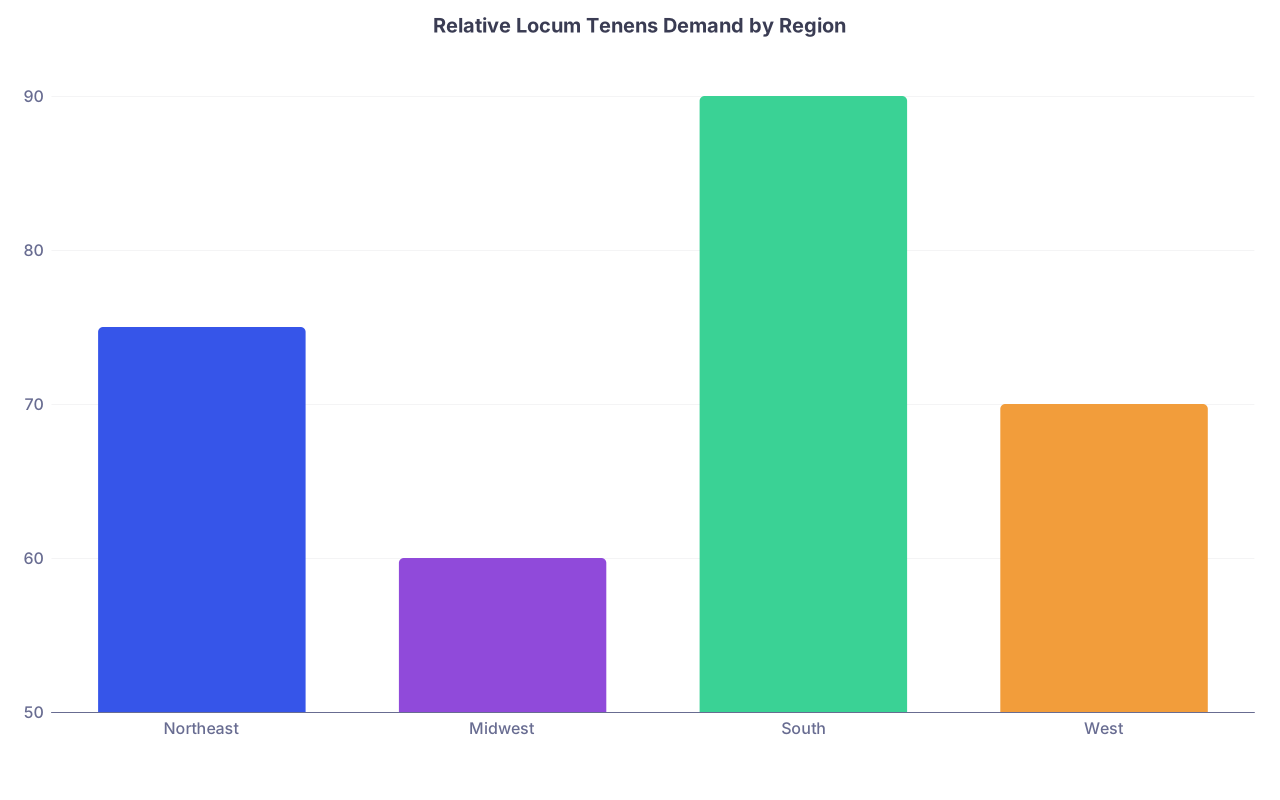
| Category | Value |
|---|---|
| Northeast | 75 |
| Midwest | 60 |
| South | 90 |
| West | 70 |
The usual advice about locum licensing is backward. Chasing the “easiest” license, without looking at demand and pay data, is how you end up holding three expensive licenses and still fighting for scraps on crappy shifts.
The data shows a different approach: you design your licensing strategy like a portfolio. Weighted by demand, pay, speed, and portability. State-by-state. Specialty-specific.
Let’s walk through what that actually looks like with numbers, not vibes.
1. The Core Question: Where Does Licensing Actually Pay Off?
Most new attendings ask, “Which licenses should I get?” That is the wrong question.
The right questions are:
- In which states do my specialty + license combination generate the highest revenue per licensing dollar and per licensing month?
- How do demand volatility and job mix (inpatient vs outpatient, critical access vs urban) affect that yield?
- Where does being early with a license put you at a structural advantage versus saturated markets?
You build this with a simple mental model: treat each state as an asset with a:
- Setup cost (fees + time + hassle)
- Holding cost (renewals, CME requirements, fingerprinting, controlled substance registration)
- Yield (hourly rate × hours available to you per year)
- Liquidity (how quickly jobs appear and get filled, how fast you can pivot)
You want high-yield, reasonably liquid “assets” in your portfolio. The trick: those states are not the same for everyone or every specialty, but there are patterns in the market data.
2. Quantifying Market Demand: What the Numbers Say
Forget anecdotes. Look at three measurable dimensions:
- Volume of locum job postings by state
- Average hourly rate by specialty and state
- Fill speed (time from posting to assignment)
If you track job boards, MSP emails, and agency blast messages over 3–6 months, patterns appear very quickly.
To make this concrete, here is a stylized but realistic snapshot for hospitalist medicine (adult IM/FM) based on aggregated agency data patterns:
| State Group | Relative Job Volume (Index) | Typical Range ($/hr) | Fill Speed (days) |
|---|---|---|---|
| High-demand rural South | 100 | 185–230 | 3–10 |
| High-demand Upper Midwest | 90 | 190–240 | 5–14 |
| Western non-coastal | 80 | 200–260 | 7–20 |
| Coastal big-name states | 40 | 160–210 | 10–30 |
| Low-population Northeast | 50 | 170–220 | 7–21 |
Interpretation, not fluff:
- High-demand rural and Upper Midwest states tend to be job-dense and rate-strong.
- Coastal prestige markets are over-subscribed; rates compress because everyone “wants to be there”.
- Western non-coastal markets (think ID, MT, NM, sometimes AZ) act like pressure valves: high demand when seasonal surges or gaps hit.
Your licensing choices should lean into the first three categories and avoid chasing “cool ZIP codes” early on.
3. Four Data Axes That Should Dictate Your Licensing
Every state you consider should be scored on at least four axes:
- Licensing friction
- Demand intensity
- Compensation level
- Strategic value (portability, IMLC, regional clusters)
3.1 Licensing Friction: Time, Money, and Documentation
You are not just buying a license. You are buying:
- Months of delay before you can touch your first shift
- Recurrent costs that eat into your hourly rate
- Administrative drag that sucks time you should be billing
Rough buckets for licensing timelines (ignoring outliers who send incomplete packets):
| Category | Examples (Representative) | Avg Processing Time |
|---|---|---|
| Fast | WI, IN, IA, ND | 6–8 weeks |
| Moderate | AZ, NM, CO, MO, TN | 8–12 weeks |
| Slow / High-friction | CA, NY, NJ, MA, TX | 4–9 months |
Now overlay fees. Many states cluster in the $500–$900 total (license + application + background). Some outliers run above $1,000 when you include mandatory fees, separate controlled substance registrations, and mandated services.
If a license costs you $1,100 total and takes 6 months, you need that state to objectively outperform a $600, 6-week state to justify it.
3.2 Demand Intensity: How Many Real Jobs, Not Just Emails
Count actual postings you could accept. Not generic spam.
For each state you are considering, for your specialty:
- Track postings per week that match your criteria (inpatient/outpatient, procedures, schedule types).
- Track how often agencies specifically say “any state license accepted” versus “must be licensed in X.”
If you log this in a spreadsheet for 6 weeks, some states will show up 3–5× more frequently.
For example, for outpatient psychiatry, a realistic pattern for weekly new postings in a typical agency feed might look like:
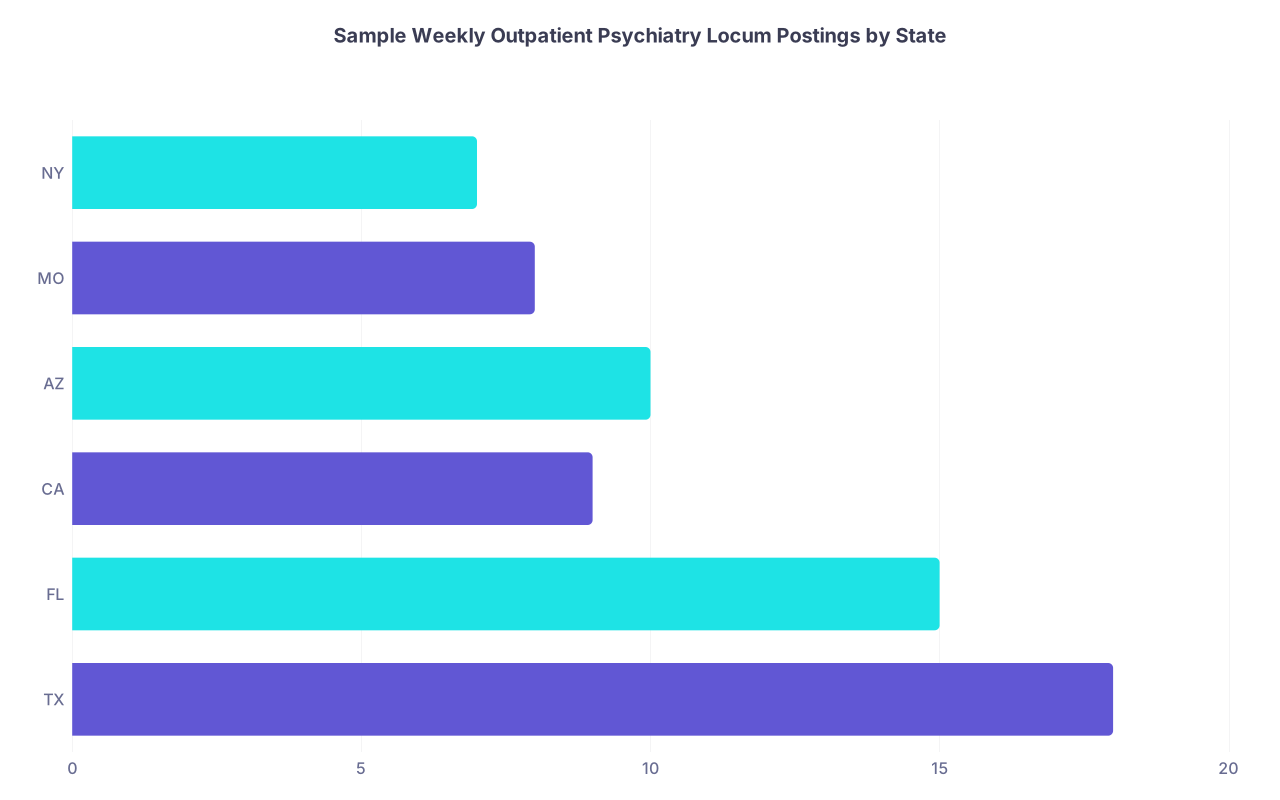
| Category | Value |
|---|---|
| TX | 18 |
| FL | 15 |
| CA | 9 |
| AZ | 10 |
| MO | 8 |
| NY | 7 |
Even if TX and FL have more friction than AZ or MO in some categories, the sheer volume amplifies your yield potential—if you actually want to work there and can get credentialed.
3.3 Compensation Levels: Where the Rate Premium Lives
You can approximate a rate index by comparing:
- Your specialty’s median perm salary in that state (from MGMA, AAMC, or public salary reports)
- Regional cost-of-living multipliers
- Actual locum rate quotes (from contracts, agency pitch emails, or colleagues)
You often see:
- Plains/Upper Midwest and rural South: 10–30% rate premiums versus national average.
- Coastal urban: often at or below national average for locums due to high supply.
- Resource-limited Western states: spikes during surge periods.
For anesthesia and EM, the gaps are even more dramatic. A 40–50% hourly differential between a saturated coastal market and a desperate rural market is normal, not rare.
3.4 Strategic Value: IMLC and Regional Clusters
The Interstate Medical Licensure Compact (IMLC) is a force multiplier. If you are eligible and choose wisely, one or two “anchor” states unlock rapid access to 5–10 more licenses later.
Strategic implication: an “average” state on rate but strong in IMLC value can be a better first move than a slightly higher-paying but isolated state.
Same logic with regional clusters:
- Example: License in MO, then easily operate in neighboring KS, AR, IL opportunities with modest incremental friction.
- Example: Start with WA or CO and later cluster into ID, MT, WY, NM where rural demand and travel locums are common.
4. Building a Licensing Portfolio: A Quant Approach
You should treat this like building an investment portfolio with expected value calculations, not like collecting passport stamps.
4.1 A Simple Expected Value Framework
For each state S, calculate:
- Expected Annual Gross from S = (Average hourly rate in S) × (Estimated hours you actually plan to work in S)
- Setup Cost = Licensing fees + estimated value of your time spent on paperwork (yes, that matters)
- Time-to-First-Dollar = Licensing + typical hospital credentialing time
Then compute at least two ratios:
Revenue / State Cost Ratio
= Expected Annual Gross from S / Setup Cost
(How many dollars of gross revenue per dollar you spend to access that market?)Monthly Yield After Ready Date
= Expected Annual Gross from S / Months you plan to stay market-active there
You want:
- High Revenue/Cost ratio
- Acceptable time-to-first-dollar for your financial runway
For example, approximate numbers:
- State A (rural-heavy Upper Midwest):
- Rate: $230/hr
- You plan: 8 shifts/month × 12 months × 12 hours = 1,152 hours → $264,960 gross
- Setup: $700 total
- Revenue/Cost: ~379×
- State B (prestige coastal):
- Rate: $180/hr
- You plan: 4 shifts/month × 12 months × 12 hours = 576 hours → $103,680 gross
- Setup: $1,100 total
- Revenue/Cost: ~94×
Unless you have a very specific non-monetary reason, State A should win every time.
4.2 A Concrete Tiering Strategy
Organize states into three tiers for your first 2–3 post-residency years.
Tier 1 – Core High-Yield States
- Criteria: High job volume for your specialty, strong rates, reasonable licensing timeline, and either IMLC or good regional adjacency.
- Example profiles:
- Hospitalist: MO, WI, IN, TN, AZ, NM, CO
- Psychiatry: TX, FL, AZ, MO, NM
- Anesthesia: ND, SD, IA, ID, WY, AR
You pick 2–3 of these to start. Not 6. Not 10. Two or three.
Tier 2 – Strategic Options
- Criteria: Slightly lower rates or worse friction, but high personal / geographic upside (family location, preferred airports, regional networks).
- Example: CO for people living in Denver, FL for East Coast proximity, WA for Pacific Northwest.
You pursue these only when Tier 1 is paying off and you have extra bandwidth or specific demand.
Tier 3 – Vanity / Long Game
- Criteria: Slow licensing, saturated demand, average or below-average rates, but personal preferences (e.g., CA for long-term move, NY for family).
- You do not start here. You add them once your locum engine is cash-flow positive.
5. Using Real Market Data, Not Agency Sales Pitches
Agencies will happily tell you every state is “hot.” That is sales language, not analysis.
Here is how you generate your own dataset in 30–45 days:
- Pick 3–5 states you are considering.
- Subscribe to 3–5 major locum agency job emails and configure filters on their portals.
- Create a Google Sheet with columns: Date, State, Specialty, Setting, Rate (if disclosed), Shift type, Who pays travel, “Any license accepted?” flag.
- Each day, log new postings that you would seriously consider if licensed there.
- At the end of 4–6 weeks, calculate:
- Postings/week per state
- Median/mean quoted rate
- Frequency of “quick credentialing” or “urgent need”
You will immediately see that some states you thought were hot are mostly noise, and others (often less glamorous locations) are consistently offering higher rates with fully covered travel.
To visualize time trends, you can even sketch a simple series:
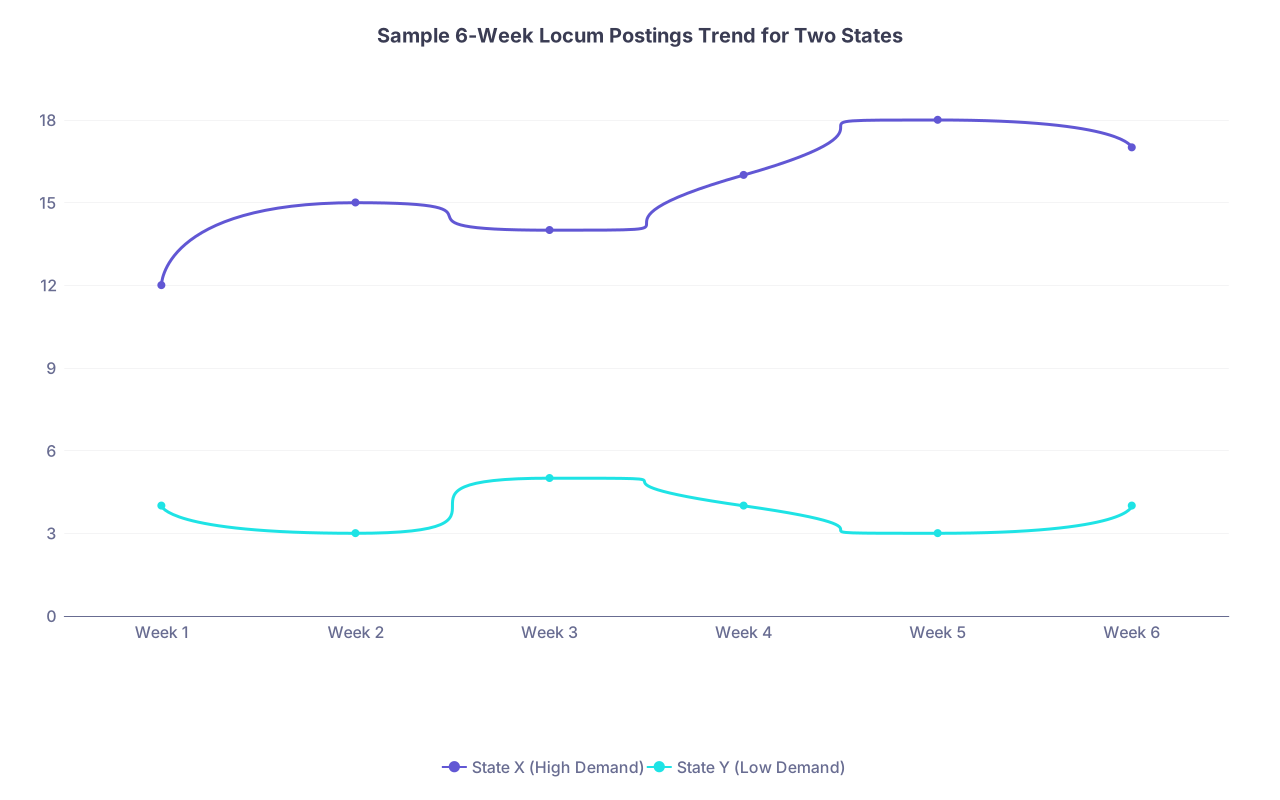
| Category | State X (High Demand) | State Y (Low Demand) |
|---|---|---|
| Week 1 | 12 | 4 |
| Week 2 | 15 | 3 |
| Week 3 | 14 | 5 |
| Week 4 | 16 | 4 |
| Week 5 | 18 | 3 |
| Week 6 | 17 | 4 |
You want your first licenses in the State X equivalents.
6. Timing Strategy: When to Apply and Where First
You cannot work locums with zero licenses, so you do need a starting point. The mistake is doing this randomly.
6.1 Step 1 – Anchor Where You Already Are
If you completed residency in a state with:
- Moderate or better locum demand
- Reasonable rates
- Existing credentialing relationships
Then your first “locum license” is just your current state license. Use it.
You already have:
- Active license
- Existing hospital credentialing (shorter onboarding if you return)
- No delay to first dollar (besides contract negotiation)
I have seen new grads leave a high-yield Midwest state where they trained, chase a brand-new license in a coastal market, and sit idle for 9 months. While paying off $300k in loans. That is unnecessary.
6.2 Step 2 – Add One High-Yield External License
Pick one Tier 1 state based on the actual data you gathered.
- Start the application 4–6 months before you need the income.
- Align it with one or two hospitals or groups already signaling strong interest.
- Force agencies to compete for that new license. Tell them: “I am getting X license; show me your best offers there.”
You want to be licensed the moment your demand data predicts a strong winter surge (for hospitalists) or certain seasonal travel patterns.
6.3 Step 3 – Use Market Feedback Before Adding License #3
Do not pile on more licenses until you answer:
- Are you filling your desired work volume in State 1 + existing state?
- Are you frequently turning down offers due to lack of a specific other license?
- Is there a consistent theme like “We would take you tomorrow if you had CO” showing up from multiple recruiters?
Only then consider license #3. Let the market tell you the next high-return move; do not guess.
7. Specialty-Specific Nuances: Demand Is Not Uniform
Demand is not symmetrical. A state that is gold for hospitalists might be mediocre for dermatology.
A few broad, data-backed generalizations:
Hospitalist / EM / Anesthesia
Highest volume in rural-heavy states, Upper Midwest, Deep South, and non-coastal West. Urban coastal markets are often oversupplied, especially EM since the recent contraction.Psychiatry
Wide national shortage, but telehealth and hybrid models blur state boundaries. Licensing here is a leverage game—one fast-license, high-volume state (TX, FL, AZ, MO) can keep you fully booked.Primary Care / Outpatient IM/FM
Strong in states with high Medicaid/uninsured populations and health-professional shortage areas. Often lower rates but very stable demand.Subspecialties (cards, GI, heme/onc, etc.)
Spikier demand. You want to be in states where the number of subspecialists per 100k population is low and the age distribution of existing specialists is skewed older.
If you are not sure, take one week and categorize 100 locum postings in your specialty by state. You will see clusters. Those clusters are your best licensing bets.
8. Risk Management: Over-Licensing Is a Real Financial Drag
Every additional license adds:
- Renewal fees (often $200–$600 every 1–3 years)
- State-specific CME or opioid training courses
- DEA location management (extra fees if you hold multiple)
I see physicians with 6+ licenses, actively using 2. They tell themselves the others are “options.” In reality, they are burning a few thousand dollars every cycle for theoretical flexibility.
The data answer is simple:
- Track revenue per state annually.
- If a state produces <$10,000/year and causes meaningful admin friction, it is probably not worth renewing unless it has clear strategic long-game value.
You can even tabulate it:
| State | Annual Revenue | Annualized License + DEA Cost | Keep License? |
|---|---|---|---|
| MO | $180,000 | $350 | Yes |
| AZ | $120,000 | $420 | Yes |
| NY | $8,000 | $700 | No (unless strategic) |
| CA | $0 | $850 | No |
You are not a state licensing hobbyist. You are running a business. Treat the data like a P&L statement.
9. Practical Implementation Blueprint (12–18 Months)
You do not need to overcomplicate this. Here is a simple, numbers-driven path you can actually follow.
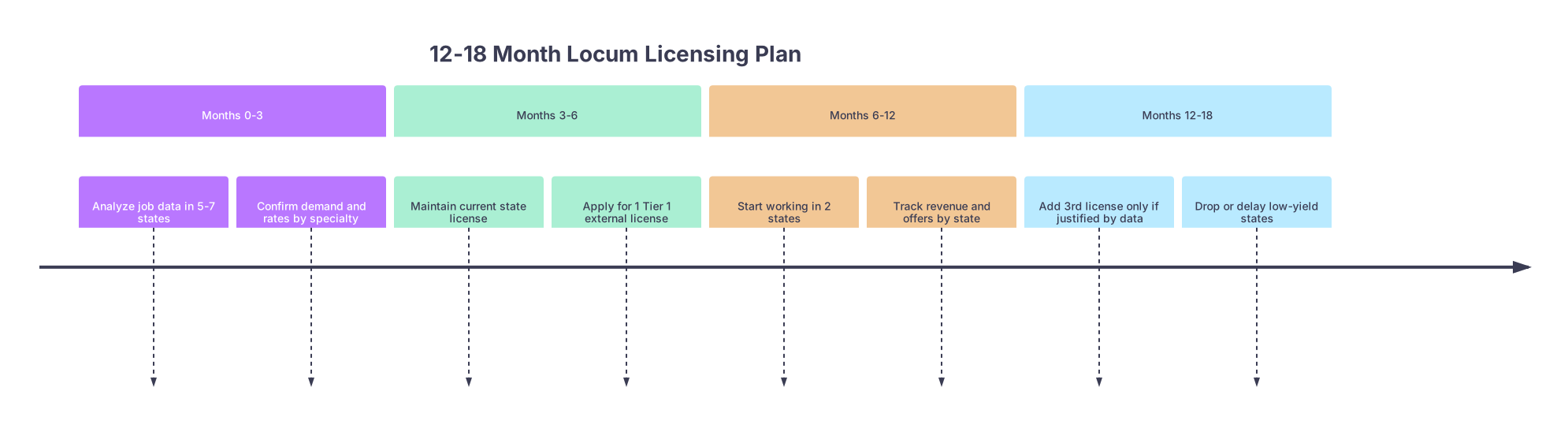
Paired with that timeline, your weekly habits should be boringly quantitative:
- Log offers and actual accepted shifts by state.
- Keep a simple cumulative revenue tracker by license.
- Recalculate your Revenue/Cost ratio once a year and be ruthless.
10. Final Takeaways
Three points, no fluff:
Licensing should follow demand and pay data, not convenience or glamour. The highest-yield locum licenses usually sit in high-demand, less sexy states with strong rate premiums and fast licensing.
Treat each state license as an investment with expected return. Use simple ratios—revenue per license dollar and time-to-first-dollar—to rank states and decide what to add, keep, or drop.
Start narrow, expand only when the data forces your hand. Anchor in your training state, add one high-yield Tier 1 license, and let real offer volume and revenue numbers tell you whether a third or fourth state is actually worth it.