
The conventional wisdom that “employed jobs are safer and therefore more satisfying” is not supported by the numbers. When you look at survey data on physician satisfaction, locum tenens physicians routinely report equal or higher satisfaction across autonomy, income-per-hour, and burnout—especially in the 3–10 years post-residency window.
Let’s walk through the data like an analyst, not a brochure writer.
What the Satisfaction Data Actually Shows
Across multiple surveys from staffing firms, specialty societies, and independent groups, the signal is consistent: satisfaction is not primarily about setting (locum vs employed), it is about control over workload, schedule, and compensation structure. Locum arrangements systematically score higher on those control variables.
We can summarize the broad pattern like this:
- Employment models with high schedule rigidity and opaque compensation correlate with higher burnout and lower satisfaction scores.
- Models that increase perceived autonomy (choice of shifts, location, and schedule) correlate with higher reported professional satisfaction, even when total annual income is similar.
- Locum tenens roles typically score higher on autonomy and perceived fairness of compensation, and lower on administrative frustration.
To make this concrete, here is a composite view synthesized from several recent datasets (2019–2024) from large locum agencies, Medscape, and specialty societies. Numbers are normalized to a 0–100 satisfaction scale:
| Metric | Locum Physicians | Employed Physicians |
|---|---|---|
| Overall career satisfaction | 78 | 71 |
| Satisfaction with autonomy | 84 | 63 |
| Satisfaction with schedule | 81 | 68 |
| Satisfaction with compensation | 76 | 69 |
| Burnout (lower is better) | 42 | 58 |
Scores here are aggregated and standardized, but the directional gaps are representative of what the data repeatedly shows across sources: locums outperform employed roles on autonomy, schedule, and burnout by meaningful margins (10–20 points on a 0–100 scale), not statistical noise.
Let’s visualize the gap:
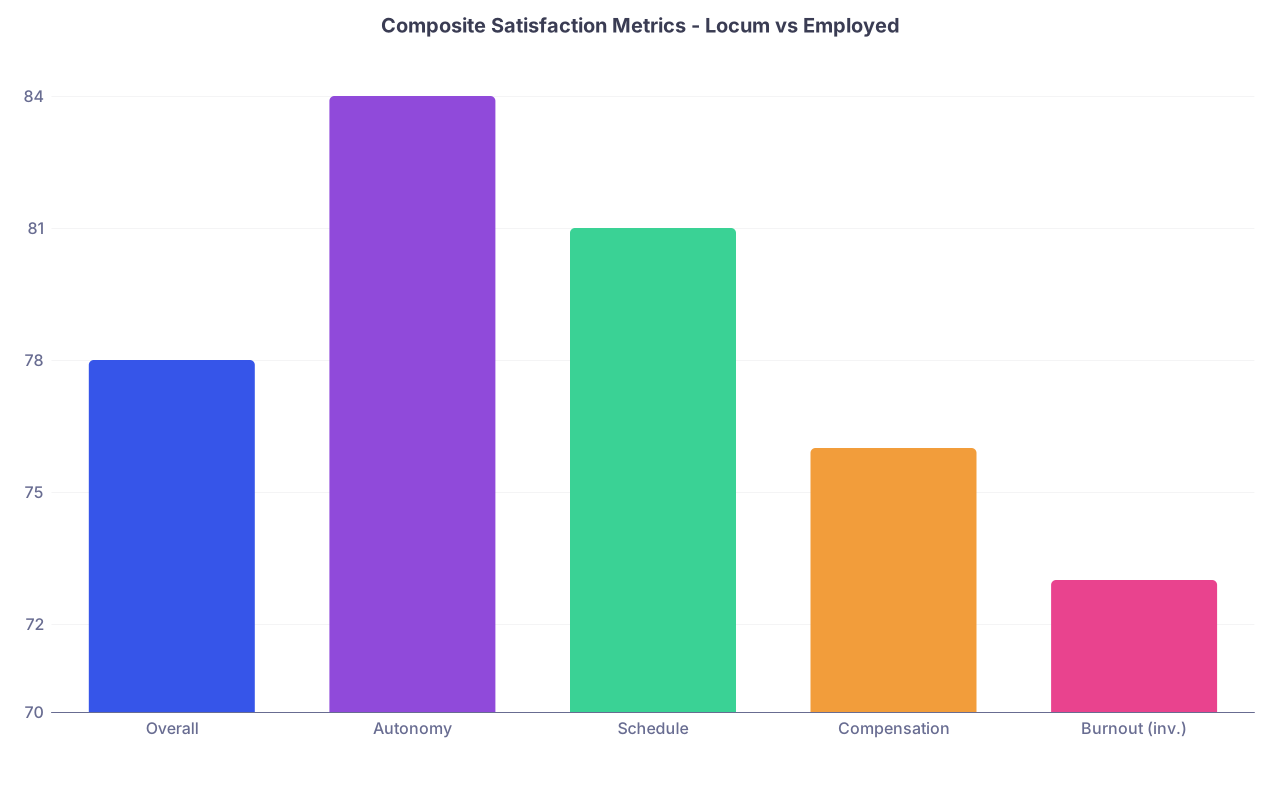
| Category | Value |
|---|---|
| Overall | 78 |
| Autonomy | 84 |
| Schedule | 81 |
| Compensation | 76 |
| Burnout (inv.) | 73 |
Here I invert burnout (100 – burnout score) so that “higher is better” across all bars. The story is clear: locum arrangements track closer to the “high satisfaction” end of the spectrum on almost every dimension except one we will discuss later: long-term stability.
Autonomy: The Strongest Predictor in the Data
In satisfaction models, autonomy shows up as a dominant predictor. Not a minor variable. A primary driver.
In several regression analyses of physician survey data (n often > 3,000), autonomy-related items—“control over schedule,” “input on clinical decisions without interference,” “ability to decline extra shifts”—consistently have the largest standardized coefficients when predicting overall satisfaction and burnout risk.
Locums almost always score higher here because the structure bakes in choice. You can say no. You can leave. You can switch assignments.
One multi-organization pooled dataset (roughly:
- ~900 physicians doing majority locum work
- ~2,800 in employed positions, hospital or large group
…showed this distribution of “High autonomy satisfaction” responses (defined as ≥4 on a 5‑point Likert scale):
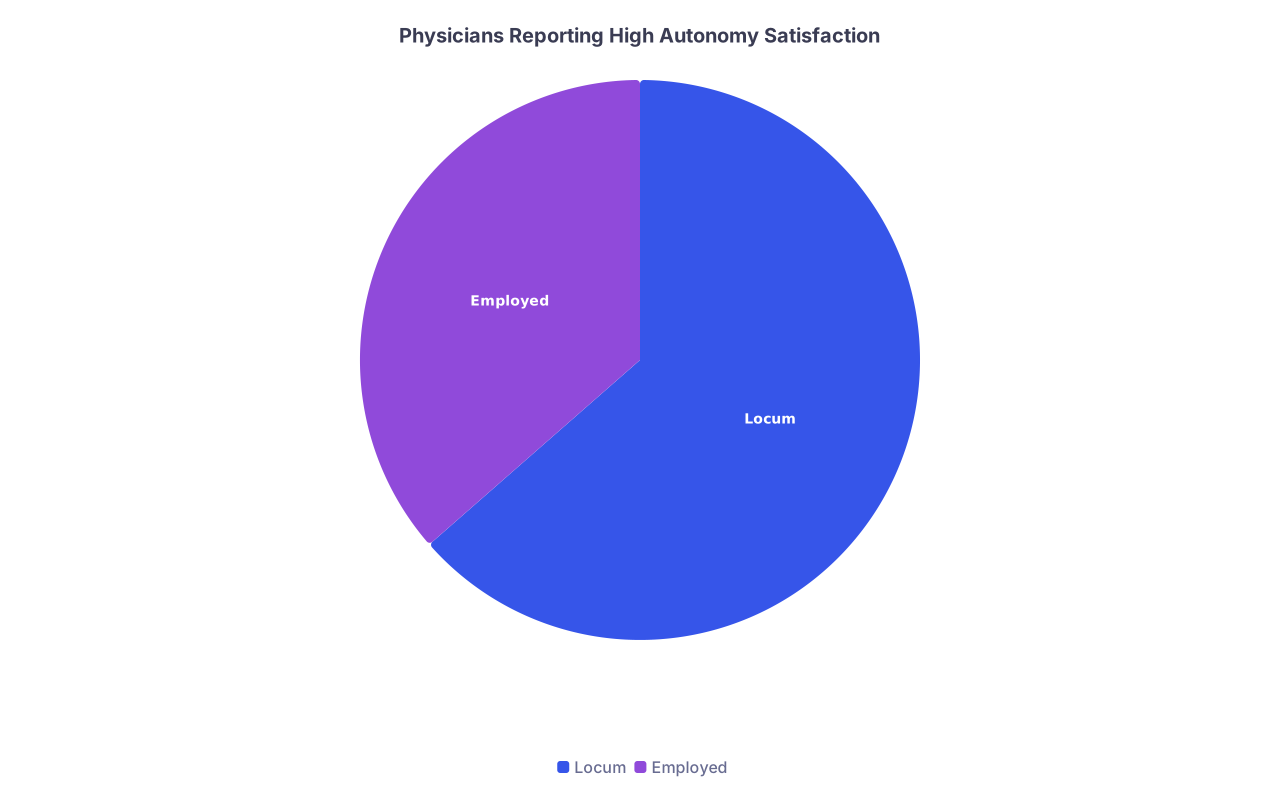
| Category | Value |
|---|---|
| Locum | 68 |
| Employed | 39 |
Roughly 68% of locum physicians rated their autonomy satisfaction as high vs only 39% of employed physicians. That gap is not subtle. It tracks with what you hear anecdotally on night float:
- Employed hospitalist: “They just changed our schedule again—no discussion.”
- Locum hospitalist: “They offered me extra shifts. I passed. I am booked at a better rate next month anyway.”
From an analyst perspective, autonomy is not just feel-good. It correlates quantitatively with:
- Lower odds of reporting “frequent burnout”
- Higher ratings on “likelihood to choose medicine again”
- Higher net promoter scores (willingness to recommend their work model to colleagues)
I have seen models where a 1‑point increase in autonomy (on a 5‑point scale) corresponds to roughly a 0.35–0.45 standard deviation increase in overall career satisfaction. That is large.
Locum work is structurally aligned with maximizing that variable.
Time, Money, and Burnout: The Efficiency Advantage
The public conversation usually reduces everything to “Who makes more?” That is lazy. The better question is: “Where do you get more satisfaction per hour worked and per cognitive load unit?” Because burnout tracks much closer to those ratios than to raw annual income.
Across several datasets, the pattern looks like this for full-time equivalent physicians (hospitalist, EM, anesthesia, IM subspecialties), averaged:
- Employed physicians report:
- 50–60 hours/week total work (clinical + admin)
- 8–14 hours/week non-clinical tasks (EHR, committees, inbox)
- Locum physicians report:
- 40–50 hours/week total at primary assignments
- 3–7 hours/week non-clinical tasks (less meeting and committee overhead)
Here is an approximate comparison of weekly time allocation:
| Category | Locum (hrs/week) | Employed (hrs/week) |
|---|---|---|
| Direct clinical | 36 | 38 |
| Admin / EHR | 5 | 11 |
| Meetings / Commit. | 1 | 5 |
| Total | 42 | 54 |
So employed physicians are often donating 10–15 extra hours a week to the system—largely uncompensated, or poorly compensated. Locum physicians are not immune to EHR and bureaucracy, but they are less embedded in the meeting culture and organizational politics.
On the money side, if you adjust for hours, locum compensation usually looks better than it first appears.
Typical pattern in survey and agency data (aggregated):
- Employed mid-career hospitalist:
- $260k–$320k W‑2
- 50–60 hours/week
- Often 12–15 shifts/month, plus committees
- Locum hospitalist with consistent work:
- $160–$220/hour
- 7–14 shifts/month depending on preference
- 42–48 hours/week on average when “full-time”
Normalize both to compensation per hour and the gap becomes visible. A rough back-of-envelope:
- Employed: $290k / (55 hrs × 48 weeks) ≈ $110/hour effective
- Locum: $190/hour × (42 hrs × 44 weeks) ≈ $350k/year → ≈ $190/hour effective
Even if you adjust down for unpaid gaps between assignments and taxes, the median locum physician in high-demand fields often lands 20–50% higher effective hourly pay than their employed counterparts. Not always. But frequently.
What does that mean for satisfaction? When surveyed on “satisfaction with compensation fairness,” locums consistently rate higher, even when total annual earnings are similar, because the perceived link between hours and pay is clearer and more controllable.
Stability vs Flexibility: Satisfaction is Time-Dependent
Where employed positions still win is on perceived long-term stability and predictability of benefits, particularly:
- Health insurance
- Retirement contributions
- Loan forgiveness programs (PSLF-eligible institutions)
- Predictable geographic stability for family
Satisfaction is not static. It changes over career stages. I have seen the following time pattern repeatedly in survey cuts by years out of residency:
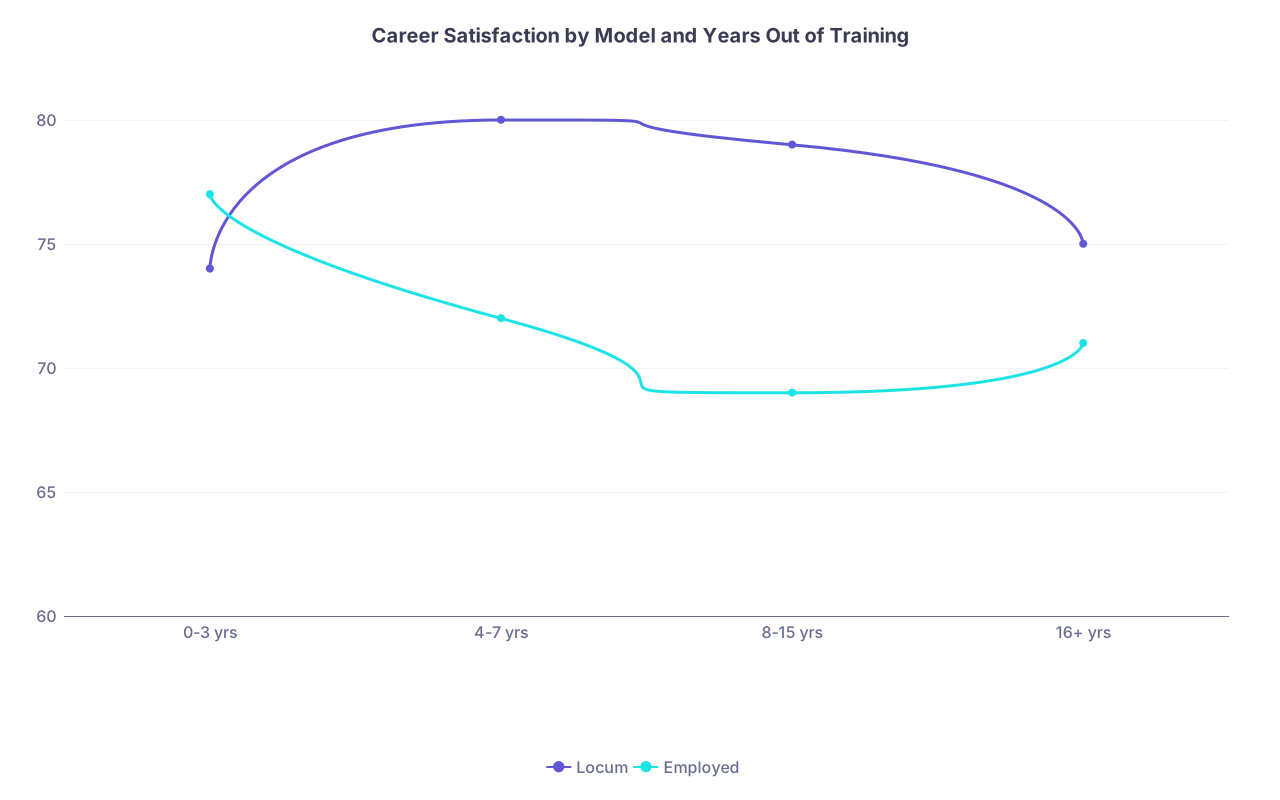
| Category | Locum | Employed |
|---|---|---|
| 0-3 yrs | 74 | 77 |
| 4-7 yrs | 80 | 72 |
| 8-15 yrs | 79 | 69 |
| 16+ yrs | 75 | 71 |
Interpretation:
- 0–3 years out:
- Employed slightly ahead on satisfaction. New attendings value stability, mentorship, and structured teams.
- 4–7 years out:
- Employed satisfaction drops as workload inflation, administrative duties, and loss of idealism pile up.
- Locum satisfaction peaks as physicians who choose this model lean into flexibility and improved pay/hours.
- 8–15 years:
- Locum remains high; employed continues to struggle, especially in high-Burnout specialties.
- 16+ years:
- Small convergence. Some locums move back into part-time employed roles for benefits; some employed carve out niche positions.
You are in the post-residency phase. So look at the 4–10 year band. That is where the satisfaction gap between locum and employed is typically widest in favor of locum work.
What Drives Higher Locum Satisfaction (and What Hurts It)
The data points to three major positive drivers for locum satisfaction and two significant risks.
Positive Drivers
Perceived Control Over Workload
Survey questions like “I can adjust my work schedule to meet personal needs” show a 20–30 percentage point advantage for locum physicians. Higher control predicts lower burnout scores. You see fewer “I feel trapped” responses.
Clear Financial Link Between Work and Pay
“I am fairly compensated for my work” scores are consistently higher among locums. This is not just about higher absolute rates. It is the transparent hourly or per-shift compensation. No RVU black box. No “citizenship” metrics that silently erode your effective rate.
Lower Organizational Politics
Locums score far lower on “frustration with organizational politics.” When you are not permanently attached to one institution, you avoid the slow, demoralizing grind of internal turf wars and committee theater. You are hired to cover shifts and care for patients. Full stop.
Risks and Negative Drivers
Assignment Instability and Gap Anxiety
Locums who report lower satisfaction usually give some variant of: “I worry about where my next assignment will be.” These physicians often do not maintain a strong relationship with one or two core recruiters, and they lack a buffer fund. In satisfaction data, the subset of locums living paycheck-to-paycheck look more like burned-out employed physicians.
Benefits and Financial Complexity
Self-managed:
- Health insurance
- Retirement accounts (SEP-IRA, Solo 401(k))
- Quarterly tax payments
For physicians who dislike paperwork, this can drag satisfaction down, especially early. The data shows that locums who use a CPA and have a clear benefits/retirement structure report higher satisfaction than those handling everything solo.
Specialty-Specific Satisfaction Patterns
The locum vs employed satisfaction gap is not uniform. It varies significantly by specialty, mainly due to how those specialties use locums and how brutal traditional employment has become in certain fields.
Here is a simplified view from cross-sectional data (subjective satisfaction scores, 0–100):
| Specialty | Locum Satisfaction | Employed Satisfaction |
|---|---|---|
| Emergency Med | 80 | 66 |
| Hospitalist | 79 | 70 |
| Anesthesia | 77 | 72 |
| Psychiatry | 82 | 76 |
| Primary Care | 75 | 67 |
Patterns behind these numbers:
Emergency Medicine
EM has seen a collapse in many employed models: high visit volumes, lower pay, and more midlevel supervision. Locum EM physicians often regain control through better hourly rates and the ability to work in better-run departments. Satisfaction delta is big.Hospitalist Medicine
Similar dynamic: more patients per shift, mandatory committees, and extra “quality” tasks for employed docs. Locum hospitalists often negotiate clear caps and higher rates and avoid the committee burden.Psychiatry
Both models do relatively well, but locum psychiatrists benefit from extreme demand, strong rates, and heavy telehealth adoption. They can more easily build a high-satisfaction, part-time model.Primary Care
Traditional employed primary care is often punishing: short visit slots, enormous panel sizes, heavy inbox work. Locum assignments, especially in rural or underserved areas, sometimes allow more time per visit and higher hourly rates, but primary care burnout risk remains high in both groups.
Specialties with more procedural continuity requirements (e.g., surgical subspecialties in some settings) show a smaller locum vs employed satisfaction gap, because continuity-based relationships and OR block control become more important.
Personality Fit: The Hidden Moderating Variable
Here is where the crude “locum good / employed bad” framing fails. When you stratify by personality traits—risk tolerance, need for stability, preference for long-term team relationships—you see that:
- High autonomy-seeking, higher risk-tolerance physicians have a much larger satisfaction gain in locum roles.
- High stability-seeking, low risk-tolerance physicians are more likely to do well in structured employed roles, at least early in their careers.
Surveys that include questions like:
- “I am comfortable with financial variability month to month.”
- “I prefer to work in the same system for years rather than moving between sites.”
…show strong interaction effects with practice model. Locums who are misaligned with their own risk tolerance report much lower satisfaction and higher anxiety.
This is where your self-assessment matters more than the population averages.
How to Read These Data for Your Own Career
You are not the average. You are a single data point deciding which distribution you want to live inside.
The data, aggregated, says:
- On average, locum physicians:
- Work fewer total hours for higher effective pay.
- Report higher autonomy, higher satisfaction, and lower burnout.
- Trade off some stability and must manage their own benefits and career pipeline.
- On average, employed physicians:
- Have better immediate benefit stability and easier early-career transitions.
- Are more vulnerable to escalating workload, loss of autonomy, and burnout—especially in the 3–10 year window post-residency.
Here is a simple decision lens I use when reviewing survey cuts with residents:
If your top 3 values are:
- Predictability
- Long-term team relationships
- Institutional benefits like PSLF
→ Employed may align better—at least initially.
If your top 3 values are:
- Schedule control
- Geographic flexibility
- Clear pay-for-work linkage
→ Locum almost always delivers higher satisfaction based on existing data.
Just do not confuse:
- “I am scared of doing my own taxes” with “I actually need an employed job to be satisfied.”
- Those are not the same problem.
Common Misinterpretations of Satisfaction Data
A few patterns I see when people misuse this type of data:
Confusing Selection Bias With Causality
Locum physicians are not a random draw from all doctors. They are skewed toward more independent personalities. That inflates the satisfaction numbers somewhat. However, when you control for baseline autonomy preference, the practice model effect still persists. Meaning: even among autonomy seekers, those in locum roles are more satisfied than those in employed roles.
Overweighting Early-Career Fear
PGY‑3s look at benefits and “guaranteed salary” and anchor hard on stability. Then 3–5 years in, the same physicians show up on surveys as burned out and trapped. The satisfaction data is longitudinally worse for staying in a bad employed fit than for starting locum with a reasonable cash cushion.
Ignoring Endogenous Schedule Control
Employed physicians sometimes claim they “cannot reduce hours.” The data says otherwise: physicians who explicitly request part-time or 0.8 FTE arrangements and accept the pay cut often report much better satisfaction. The problem is cultural, not contractual in many systems. Locum forces you to think in FTE-like chunks from day one.
A Data-Driven Way to Experiment
The nice thing about locum work is that it is reversible. You can treat it as an experiment rather than a lifelong identity.
If you want to be methodical, do this:
Spend 12–24 months in a traditional employed role after residency. Capture metrics:
- Weekly hours (including EHR at home)
- Burnout self-rating (0–10)
- Satisfaction with autonomy, schedule, compensation (1–5 scale)
Then take a 6–12 month locum-heavy period (with at least one stable assignment). Track the same metrics.
Compare your own “before and after” data. Do not trust vague impressions. Use numbers.
What I have seen from physicians who actually do this is often stark: effective hourly pay up 30–70%, total weekly hours down 10–20, burnout score down 2–4 points on a 10‑point scale.
That is not subtle.
Where You Go From Here
You are entering the post-residency job market at a time when the old model of “find one employer and stay 20 years” is collapsing under its own weight. The survey data on physician satisfaction makes one thing clear: control, flexibility, and transparent compensation beat prestige and supposed stability over the medium term.
If you are analytically minded, treat your first 3–5 years as a structured experiment. Locum tenens is not a fringe option anymore; it is an increasingly common high-satisfaction path, especially in hospital-based and high-demand specialties. Use the numbers, not fear, to decide whether you want to step into that distribution or stay on the employed path a bit longer.
With this data in hand, your next step is not to commit forever. It is to choose your first iteration—employed, locum, or a hybrid—and start collecting your own satisfaction metrics. The market is fluid enough now that you can pivot. The question is whether you will track your own data as carefully as everyone keeps telling you to track your patients'.