
Locum tenens does not automatically put a malpractice target on your back. The fear around locums and lawsuits is wildly overstated—and often driven by people who either sell insurance or have never actually worked a day as a locum.
Let’s tear this apart.
Most residents and early attendings hear the same story in the workroom:
“If you do locums, you’ll have higher malpractice risk. New environment. No support. You’ll be thrown under the bus.”
Sounds scary. Also mostly wrong.
The reality is more nuanced and, frankly, more favorable to you than the rumors suggest—if you understand how coverage actually works and avoid a few dumb mistakes.
Myth 1: “Locums Physicians Get Sued More”
They do not. In fact, the data we do have points in the opposite direction.
There’s no massive national registry dividing malpractice claims neatly into “staff” vs “locums,” but look at proxies:
- Malpractice carriers that insure large locum agencies report no consistent evidence of higher claim rates for locums compared with comparable full-time physicians.
- The big locums firms (CHG, CompHealth, Weatherby, Jackson & Coker, etc.) insure tens of thousands of provider-years of coverage. If locums were lawsuit magnets, their premiums and rate sheets would reflect that. They don’t.
- Specialty and setting matter way more than employment model. An EM, OB, or neurosurgery locum shares the same risk profile as an EM, OB, or neurosurgery staff doc doing equivalent work.
Most malpractice risk is driven by:
- Specialty (high-risk vs low-risk)
- Patient acuity and setting (ICU vs clinic)
- Procedure intensity
- Case volume
- Documentation quality
- Systems issues (handoffs, follow-up, communication)
“Locums vs employed” is way down the list.
What does happen: when a locums doc gets sued, everyone talks about it. It’s “proof” of the danger. Meanwhile, the hundreds of claims against full-time staff at the same hospital are just background noise.
Survivor bias, but in reverse.
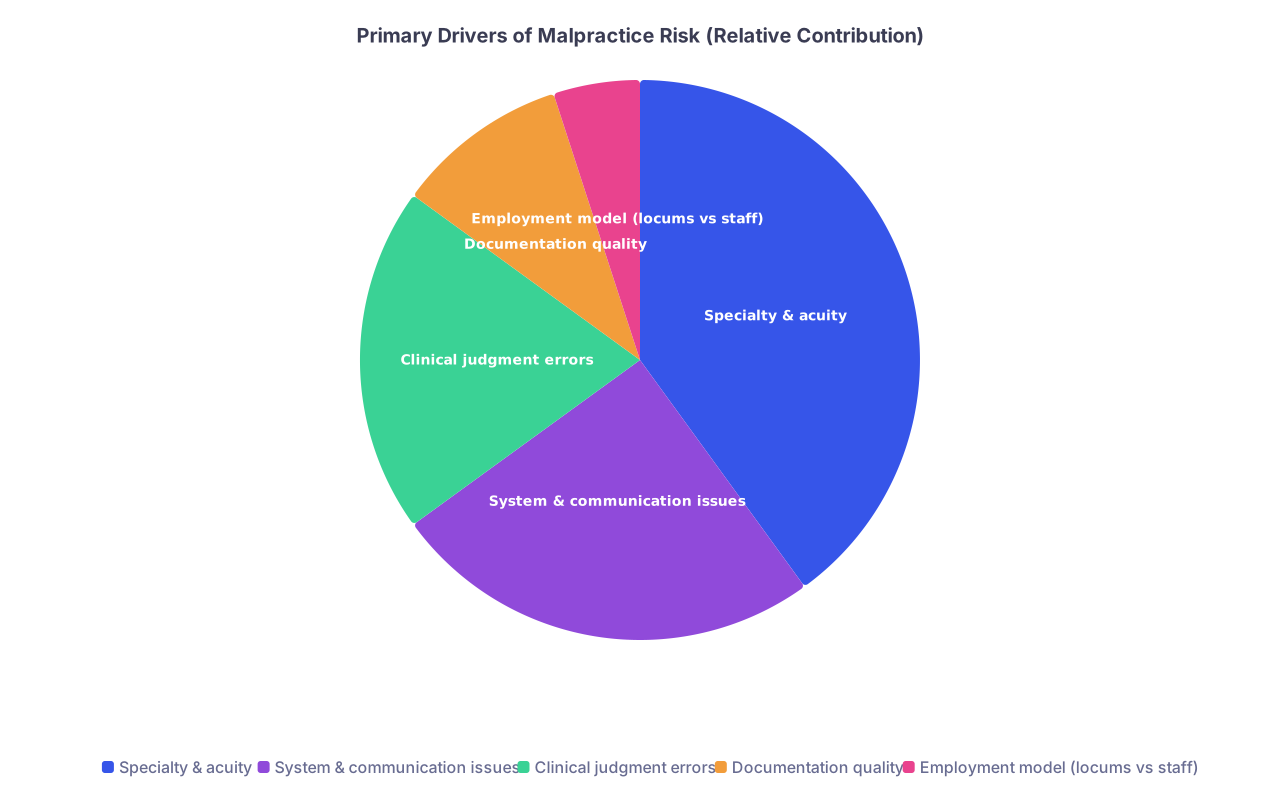
| Category | Value |
|---|---|
| Specialty & acuity | 40 |
| System & communication issues | 25 |
| Clinical judgment errors | 20 |
| Documentation quality | 10 |
| Employment model (locums vs staff) | 5 |
The uncomfortable truth: your choice of specialty and practice environment dominates your risk profile. Whether you are locums or employed is mostly an administrative detail—as long as insurance is handled correctly.
Myth 2: “Locums Coverage Is Shaky and You’ll Be Left Exposed”
The more common scenario is the exact opposite: locums coverage is often clearer and better-defined than what many hospital-employed physicians can explain about their own policies.
Here’s the baseline structure for most reputable locum gigs:
- The agency provides malpractice insurance.
- Coverage is usually claims-made with tail included OR occurrence-based.
- Limits are typically around $1M / $3M (per claim / aggregate), which matches or exceeds what staff docs have.
The risk is not “locums vs staff.” The risk is you signing contracts you do not understand.
If you remember nothing else, remember this:
You never accept a locum assignment without crystal clarity on:
- Who is providing malpractice coverage (agency vs facility vs you)
- Type of coverage (claims-made vs occurrence)
- Whether tail is included, and who pays it
- Limits per claim and aggregate
- Whether coverage starts from day one on site (no retro gaps, no “once credentialed plus 30 days” nonsense)
Here’s a clean comparison:
| Feature | Typical Locums Setup | Typical Employed Setup |
|---|---|---|
| Who buys policy | Locum agency (sometimes facility) | Hospital or large group |
| Policy type | Occurrence or claims-made with tail | Claims-made, tail often NOT included |
| Tail responsibility | Usually agency (if claims-made policy) | Often physician if leaving after X years |
| Limits (per claim/agg) | Commonly 1M / 3M | Commonly 1M / 3M |
| Portability | Follows you across assignments (same firm) | Tied to that employer only |
You know what quietly burns more physicians than locums ever will?
Employed jobs that:
- Use claims-made policies
- Have language that says: “Tail coverage is the responsibility of the physician in the event of resignation or termination”
- And that tail bill shows up when you want to leave: $40,000–$80,000 for some high-risk specialties
Locums agencies, for their own risk management reasons, usually do a better job covering that tail automatically. Because high physician turnover is the business model.
So yes, if you do this recklessly—say yes to random 1099 gigs, buy no personal coverage, never read your agreements—you can blow holes in your protection. But that’s not a locums problem. That’s a “not treating malpractice like a real part of compensation” problem.
Myth 3: “New Environment = Higher Clinical Risk”
This one has a grain of truth—but it’s weaponized into nonsense.
Yes, stepping into an unfamiliar system carries real risk:
- You don’t know the EMR shortcuts
- You don’t know how to reach certain consultants at 2 a.m.
- You don’t know what unwritten norms exist (“We admit all chest pain to X; Y never takes direct admissions,” etc.)
Those are systems and communication risks, not “locums” risks per se. Because new hires face the exact same problem their first 3–6 months. They just get to pretend they’re “learning the culture” instead of being called “the locum.”
I’ve watched both sides. The brand-new employed hospitalist and the seasoned hospitalist locum start on the same day. Guess who usually adapts faster?
The locum. Because they’re used to adapting.
The real difference isn’t the environment. It’s how you behave walking into it.
Smart locums do a few things that slash risk:
- Show up early the first day and ask bluntly: “What are the top 3 ways locums get burned here?”
- Learn how to call for help: rapid response, code, specialty coverage, backup attending, transfer process
- Nail the handoff procedures: who to notify, how to document “follow-up needed,” what triggers callbacks or rechecks
- Refuse unsafe setups: solo overnight coverage with 60 high-acuity patients and no backup? Hard pass.
Is there extra cognitive load in a new place? Sure. But you can compensate—by slowing down on high-risk decisions, over-documenting your rationale, and erring on the side of admission, observation, or close follow-up when the system is unfamiliar.
The lazy version of locums (show up, wing it, assume “it’ll be fine”) is dangerous. The deliberate version can be safer than burned-out staff operating on autopilot.
Myth 4: “Locums Are Scapegoats When Things Go Wrong”
I’ve heard this more times than I can count:
“If something goes bad, the hospital will just blame the locum. You’re disposable.”
Let’s be blunt: in a big, bad case, everyone gets named.
- The ED doc
- The admitting doc
- Consultants
- The hospital
- Sometimes the nurse, rarely solo
Plaintiff attorneys sue broad, then sort it out later. Whether you’re “locum” or “employed” is background noise compared with your role in care.
Here’s what actually happens in blame games:
- Hospitals try to protect their brand and leadership
- Groups try to protect partners and long-term producers
- Everyone looks for the lowest-friction story that explains the bad outcome
If you’re a locum, that can cut both ways:
- You’re lower on the internal political food chain
- But you’re also not integrated into the long, messy internal power struggles
I’ve seen hospitals quietly distance themselves from a long-time partner after repeated quality flags—while the locums doc in the same lawsuit simply floated out when the contract ended, fully defended by the agency’s carrier.
The key difference isn’t your employment status. It’s how strong your defense is:
- Do you have a clear, written contract obligating the agency (or facility) to provide malpractice defense and indemnification for your work there?
- Does your policy include consent-to-settle (or at least not railroad you)?
- Is your documentation clear enough that a defense attorney can reconstruct your thinking two years later without calling you at 10 p.m. begging for clarity?
The locum with good coverage and good notes is in a far better spot than the employed physician with vague contract language, marginal documentation, and a hospital eager to throw someone under the bus.
Myth 5: “More Jobs = More Exposure = More Lawsuits”
This one sounds logical and is still mostly wrong.
Yes, more patient encounters can increase the raw probability of being sued. But look at how locums actually use their schedules.
Many full-time employed physicians:
- Work 1.0+ FTE
- Pick up extra shifts to meet RVU expectations
- Let burnout crush their attention and empathy over time
A lot of locums:
- Work 0.6–0.8 FTE for similar pay
- Choose lower-volume or better-supported sites
- Take meaningful time off between assignments
Less chronic fatigue. More control over environment and pace. More willingness to say “no” to completely unsafe conditions.
From a risk perspective, that matters. A lot.

| Category | Value |
|---|---|
| Burned-out 1.2 FTE employed | 120 |
| Standard 1.0 FTE employed | 100 |
| 0.8 FTE structured locums | 85 |
| 0.6 FTE selective locums | 75 |
Are these precise numbers? No. But the pattern tracks with what insurers and defense attorneys keep repeating: fatigue, rushed care, and poor communication crop up constantly in malpractice cases. Locums is one of the few models that lets you structurally avoid chronic overload—if you use it correctly.
If, instead, you treat locums like a cash grab, stack 20 shifts a month across three hospitals, and live on Red Bull and adrenaline, yes, your risk will spike. That’s not about locums; that’s about hubris.
How to Make Locums Safer than a Traditional Job
Locums can be malpractice-neutral or malpractice-advantageous. You decide which side you land on.
Here’s the playbook if you actually want to tilt the odds in your favor.
1. Treat Malpractice Terms Like Compensation, Not Fine Print
You’d negotiate an extra $20–$50/hour without blinking. Do the same with risk.
Non-negotiable questions before accepting an assignment:
- “Send me the malpractice declarations page for the policy that will cover me.”
- “Is this claims-made or occurrence?”
- “If claims-made, is tail fully included for all work I perform on this assignment?”
- “What are the limits per claim and aggregate?”
- “Do you have any coverage gaps—like needing me to start before the policy is in force?”
If they will not answer clearly, that is your answer. Walk.
2. Standardize Your Own Practice Habits Across Sites
You can’t control every EMR or call schedule. You can control how you practice.
- Create your own mental checklist for high-risk scenarios: chest pain, possible sepsis, neuro deficits, OB bleeding, peds fevers, psych + safety concerns.
- Use your own consistent thresholds for admission vs discharge, imaging, and consultation, instead of letting “what they usually do here” drag you lower.
- Over-document when something goes against your usual threshold and explain why.
Your goal: if a plaintiff’s expert reads ten of your charts from three different hospitals, your thinking and standards look consistent and defensible.
3. Front-Load Communication in New Environments
The first 2–3 shifts somewhere new are not the time to be a hero.
- Introduce yourself to nurses and ask them bluntly: “What do covering docs screw up here?” They’ll tell you.
- Ask: “Who is my backup if I’m in trouble?” and “What’s the transfer pathway if this place can’t handle something?”
- Clarify call expectations: who you must notify, and how, when you admit, sign out a borderline patient, or change a code status.
Poor communication after a bad outcome is malpractice gasoline. Locums can’t afford that.
4. Say No to Unsafe Assignments. Aggressively.
Unsafe setups look like:
- You are the only doc covering massive volumes or high acuity with no real backup
- No consultant coverage for critical services (e.g., no surgery overnight in a trauma-prone setting, and no clear transfer process)
- Chronically understaffed nursing or ancillary support, documented repeatedly in reviews and word-of-mouth
Your agency will say, “Other docs do this all the time.” Of course they do.
You’re not other docs.
If you say no a couple of times early in your locums life, you train both yourself and recruiters that you take clinical safety seriously. That saves you more future risk than any clever contract clause.
When Personal Coverage Makes Sense
Do you need your own separate malpractice policy as a locums doc? Often, no. If your agency fully covers all clinical work, including tail, for every assignment, you’re probably fine.
But there are cases where a personal policy is smart:
- You’re doing direct 1099 independent gigs not through an agency
- You do telemedicine, chart reviews, or side consult work outside of agency contracts
- You want the ability to walk away from a bad agency without coverage anxiety for past work
A relatively inexpensive, low-limits policy that covers independent medical work can plug weird gaps. Not mandatory, but intelligently paranoid.
The Actual Risk You Should Worry About
The biggest malpractice risk of locums isn’t that you’ll be sued more.
It’s that:
- You’ll accept an assignment with vague or bad coverage,
- Work in a system you do not understand,
- Under unsafe volume or acuity,
- While assuming “the agency has my back,”
- And then discover, two years later, that the fine print says otherwise.
That’s fixable by you, right now, before you sign anything.

| Step | Description |
|---|---|
| Step 1 | Offered Locums Assignment |
| Step 2 | Request docs or walk away |
| Step 3 | Decline assignment |
| Step 4 | Standardize practice and document well |
| Step 5 | Complete assignment with lower risk |
| Step 6 | Malpractice terms clear and in writing |
| Step 7 | Clinical setup safe and supported |
Bottom Line: Fear vs Facts
Let’s strip it down.
- Locums does not inherently increase malpractice risk. Specialty, acuity, volume, and your own habits matter far more than your employment label.
- Coverage quality is often better with good locum agencies than with many employed jobs that stick you with tail. The risk is not locums; it is ignorance of what policy you’re practicing under.
- You control most of the risk levers. Say no to unsafe assignments, insist on clean malpractice language, standardize your clinical practice, and over-communicate in new systems.
You are not a victim of “the locums model.” You’re only a victim if you treat malpractice like an afterthought.