

The lease is signed, you did not match, and the logistics look like a financial train wreck. It’s survivable—but only if you stop reacting emotionally and start running it like a business decision.
You’re not dealing with a “life theory” problem. You’re dealing with:
- A real lease
- Real rent due dates
- Maybe a long-distance move already scheduled
- A residency income that isn’t coming
I’m going to walk you through this like we’re sitting at your kitchen table with your lease printed out and a calendar open.
Step 1: Freeze the Panic, Get the Documents
Do not start with, “What am I going to do?” Start with, “What am I legally on the hook for?”
Grab:
- Your lease (full copy, not just the signature page)
- Any emails/texts with the landlord or property manager
- Your Match results / SOAP outcome / any pending prelim or research offers
- Your moving contracts (U-Haul, movers, flights, storage, etc.)
Now, you’re going to strip the problem down.
Read your lease like a lawyer, not like a tenant
You’re looking—line by line—for:
Early termination clause
- Keywords: “early termination,” “reletting fee,” “liquidated damages,” “break lease,” “lease buyout.”
- Some large complexes have a set formula: for example, “60-day notice + 2 months’ rent + relet fee of 85% of one month’s rent.”
Subletting / assignment clause
- Is subletting allowed?
- Is written consent required?
- Are there fees or rules about screening the subtenant?
Mitigation of damages
- Some states require landlords to make “reasonable efforts” to re-rent and reduce your loss. Others are looser. The lease might mention this.
Notice requirements
- 30 or 60 days?
- Does notice have to be written, email, portal-based?
Any “special addenda”
- Sometimes there’s a separate move-in addendum, attached with extra penalties. Do not ignore the last 3 pages.
Once you’ve done this, write down:
- Minimum you owe if you walk away completely
- Whether subletting is possible
- What notice you must give and how
This turns the situation from “catastrophic” into “expensive but calculable.”
Step 2: Decide: Stay Put, Move Anyway, or Cut the Lease
There are three realistic scenarios. Each has a different playbook.
| Option | Main Use Case | Financial Impact |
|---|---|---|
| Stay in leased city | Strong chance of local research/prelim | Medium–High, but useful |
| Move anyway, no residency | Already relocated / better resources | High, must cut costs |
| Break or sublet the lease | No reason to be in that city now | Variable, can be mitigated |
Option A: Stay in the residency city even though you’re unmatched
This is underused and sometimes smart.
You consider this if:
- You almost matched at that institution or they’ve said, “We’d love to have you in a research role”
- There are known research positions, prelim/TY spots, or future PGY-2 opportunities there
- You have a support system or job opportunities in that city (scribe work, hospitalist extender, tutoring, etc.)
If you stay:
Immediately pivot the narrative
- You’re not “stuck with an empty apartment.”
- You’re “physically positioned near X Program to work, do research, and be available for any off-cycle opportunities.”
Start hunting for:
- Clinical research coordinator roles
- Postdoc or research fellow roles (yes, MDs do these)
- Non-ACGME fellowships / gap-year jobs at the hospital system
Email program leadership
- Subject: “Unmatched applicant in [City] seeking research / gap year role with [Dept]”
- Mention you’ve already relocated and can start immediately.
Financially: you now treat the apartment as your base of operations. But you must optimize.
- Get a roommate into the extra bedroom if you have one.
- If it’s a studio: consider time-limited Airbnb sublet while you stay with friends for part of the month.
- Cut everything nonessential: premium internet, fancy parking, gym if not needed for mental health.
This option makes the most sense if being there increases your re-match odds in a visible, direct way.
Option B: Move anyway, no residency yet, but you already relocated
You’ve already driven cross-country. The keys are in your hand. And then you unmatched or failed SOAP.
At this point, screaming about the lease doesn’t reverse the U-Haul charges. Work the problem from where you stand:
Confirm exactly how long you must stay to minimize penalties
- If the lease gives a cheaper termination path after a minimum stay (e.g., must give 60-day notice), use that.
- Sometimes staying 2–3 months and actively searching for a subtenant is cheaper than vanishing day 1.
Immediately maximize your income in that city
Think: bridges, not careers. You’re looking for jobs that pay bills and keep your application story coherent.Good options:
- Clinical research assistant / coordinator
- MA/scribe (if your license status allows)
- Test prep tutor (MCAT, Step, etc.)
- Nursing home / rehab facility work in a non-licensed role
Use the city strategically
- Attend department grand rounds
- Ask for per-diem observer positions
- Network quietly with residents and attendings who might advocate for your re-application
If, after 1–2 months, it’s clear this city offers you nothing strategically (no job, no research, no mentorship), then you pivot to Option C: cut the lease as cleanly as you can.
Option C: Break or Sublet the Lease (Even If It Hurts)
You’ll probably lose money. The question is: how little can you lose?
You attack this on three fronts: landlord negotiation, subletting, and time.
Step 3: Talk to the Landlord Like a Professional, Not a Panicked Student
The worst thing you can do is disappear and “ghost pay” nothing. That’s how you buy yourself collections, lawsuits, and a torpedoed credit report right before you’re trying to rent in a residency city again.
You need a calm, written communication. Something like:
Dear [Manager/Landlord Name],
I recently signed a lease for [unit/address] starting [date]. Due to an unexpected change in my medical residency placement, I will not be able to move to [city] as planned.
I understand the lease is binding, and I want to work with you in good faith to minimize the impact on both of us. Could you please let me know:
- Whether there is an early termination option or reletting fee in my situation
- Whether you allow tenants to assist in finding a qualified replacement or subtenant
- What minimum notice and payments would be required for an early release
I’m hoping we can find a solution that avoids a long vacancy for you and a major financial hardship for me.
Thank you for your time,
[Name]
[Phone]
Key points:
- You acknowledge the contract. This lowers their defensiveness.
- You present yourself as a professional (which you are).
- You explicitly ask about helping find a replacement, which often saves you money.
Then you:
- Save every email
- Confirm any agreement in writing
- Do not rely on phone calls only
Some large complexes will say, “Our policy is X: you owe Y months and Z fee.” Terrible, but clear. Smaller landlords may be more flexible, especially if the rental market is hot.
Step 4: Numbers First: What Are You Actually Losing?
Stop guessing. Build a quick grid of your options.
| Scenario | Months Paid | Extra Fees | Total Cost |
|---|---|---|---|
| Stay full 12 months | 12 | 0 | $18,000 |
| Break with 2-month penalty | 2 | 1 month | $4,500 |
| Sublet after 2 months vacant | 2 | 0 | $3,000 |
| Walk away, get sent to collections | 4–6 est. | Legal/credit | $8,000+ & credit hit |
Pick numbers for:
- Monthly rent
- Utilities you’d still be on the hook for
- Reletting/break lease fee
- Time to find a subtenant if allowed
Once you can see the spread, it becomes obvious which plan is “least bad.” That’s what you’re choosing now. Not perfection. The least damaging path that preserves your long-term career and credit.
Step 5: Subletting Without Getting Yourself Evicted
If your lease allows subletting or assignment, this can save you thousands.
Steps:
Get written confirmation you can sublet and what the process is.
- Application the subtenant must complete
- Screening fees
- Whether you stay ultimately responsible (you usually do)
Price aggressively
- If your rent is $1500, list at $1300–1400 to fill it faster.
- The goal is to stop your losses, not make a profit.
Post widely
- Hospital/med school Facebook groups (“[City] Residents and Fellows Housing”)
- Institutional listservs
- Apartments.com / Zillow / Facebook Marketplace
- Ask GME office if they have a housing board
Be brutally honest in the listing
- “Lease takeover for PGY-1–style schedule, 10 minutes from [Hospital], quiet building, 1 bed/1 bath, available [date], must qualify with landlord.”
Once someone bites:
- Hand them off to landlord per protocol
- Do not hand over keys until the landlord signs off in writing that they’re approved and your responsibility is defined
Yes, this takes time and energy. But I’ve seen people cut 8–10 months of wasted rent down to 1–2 months plus a small fee by doing this efficiently.
Step 6: Protect Your Credit and Future Rentals
You’re going to be applying for new housing soon—maybe in a different state, maybe in 12 months when you actually match.
Landlords care about:
- Prior evictions
- Collections
- Serious late or missed rent
- Broken leases that went ugly
So your priorities:
- Never let unpaid rent quietly roll into collections without at least a conversation/plan
- Get any negotiated deal in writing: “If Tenant pays X by Y date, Landlord agrees to release Tenant from further obligations under Lease.”
- If you break and pay the agreed penalty, save proof of payment and the final correspondence permanently.
If a future landlord asks, “Why did you only stay 2 months at [Address]?” you’ll say:
“I had a medical residency lined up in that city. My match outcome changed, so I could not continue there. I worked with the landlord, paid the agreed early termination fee, and the account was closed in good standing.”
That’s an acceptable story. You’re not the flaky 23-year-old who bounced to chase a boyfriend. You’re a physician whose training path shifted.
Step 7: Cut Your Burn Rate Aggressively
You’re now in survival-business mode. You’re not a resident with a fixed salary. You’re basically a freelancer with a medical degree and a big exam history.
Short checklist:
- Cancel or downgrade: streaming, subscriptions, meal kits, any paid study platform you’re not using
- Move in with family or friends if feasible once the lease is resolved or sublet started
- Sell things you genuinely don’t need and can re-buy later: extra furniture, decor, gadgets
- Consider short-term roommates if you stay in the lease: another unmatched grad, gap-year student, traveling nurse
Your goal is runway. Enough months of low expenses that you can:
- Work
- Strengthen your application
- Re-apply with a clear, coherent story
Step 8: Use the Situation in Your Next Application (Without Sounding Chaotic)
This situation will show up in your timeline. “Why were you in X City with a lease but no residency?” or “What did you do after you didn’t match?”
You frame it as:
- A logistical consequence of a planned match that changed
- A moment where you responded with maturity, financial responsibility, and strategic planning
- A bridge year where you worked, did research, and prepared for a stronger application
You do not:
- Whine about the landlord
- Talk about being “trapped” by the lease
- Make it sound like life just happens to you
Instead:
“I had already signed a lease near [Hospital] based on my interview season. When I did not match, I worked with the landlord to minimize my financial obligation and then used my time in that city to join a [research/clinical] team in [Department]. That year clarified my goals in [specialty] and strengthened my skills in [X, Y].”
You turned a logistical mess into a narrative about responsibility and resilience. Programs like that.
Step 9: If You Haven’t Moved Yet but Lease Starts Soon
Different angle: you signed, unmatched, and the lease start date is in the future.
You’re in the best version of this bad scenario.
Do this immediately:
Contact the landlord before the lease begins
- Many will be more flexible before you take possession.
- Some will keep your deposit or charge 1 month but release you from the full term.
Ask specifically:
- “Can we cancel this lease before the start date with [X] fee?”
- “Can I help find a replacement tenant for a full lease takeover before move-in?”
If they say no and insist on full lease enforcement, still push for:
- Subletting
- Reduced penalty compared to walking away mid-lease
This is where speed matters. The earlier you move, the more likely they’ll say, “Fine, we’ll just rent it to someone else.”
Step 10: Quick Reality Check: When Is It Actually Better to Eat the Loss?
Sometimes, after all the math and emails, you realize:
Staying in that apartment, in that city, with no residency and no clear advantage for your application is more expensive than just paying the penalty and leaving.
Clarity points:
- If staying drains your savings so much you can’t afford Step exams, ERAS fees, or travel for interviews next cycle, that’s too high a price.
- If there are zero meaningful professional opportunities in that city (no research, no jobs, no mentorship) and you have strong options elsewhere, it’s probably not worth lingering.
- If family support (financial, emotional, housing) is significantly better in another city, that often wins.
You’re not just protecting your bank account. You’re protecting your ability to rebound and re-enter the match with momentum.

| Step | Description |
|---|---|
| Step 1 | Unmatched & Lease Signed |
| Step 2 | Contact landlord before start date |
| Step 3 | Stay, find work/research, cut costs |
| Step 4 | Try sublet with landlord approval |
| Step 5 | Negotiate early termination |
| Step 6 | Try to cancel or reduce penalty |
| Step 7 | Have you already moved? |
| Step 8 | Is this city good for research/jobs? |
| Step 9 | Sublet or Break Lease? |
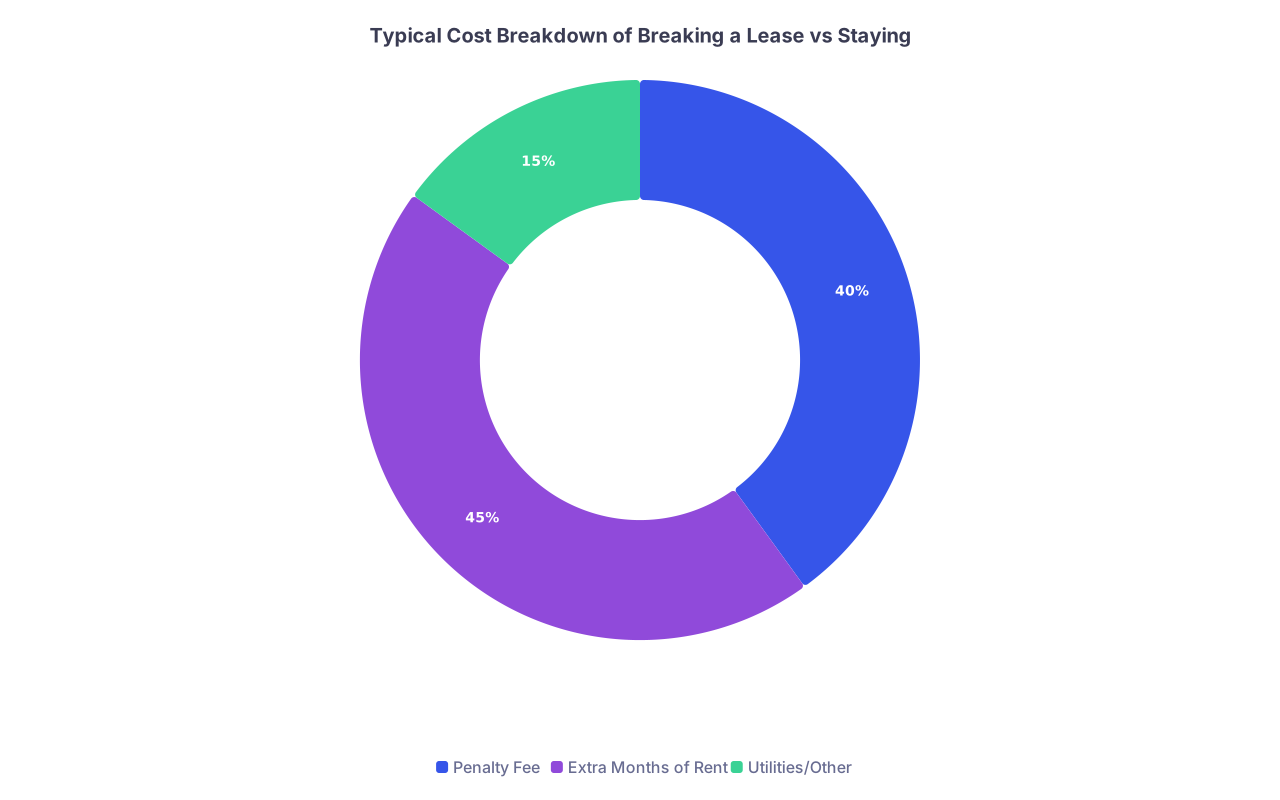
| Category | Value |
|---|---|
| Penalty Fee | 40 |
| Extra Months of Rent | 45 |
| Utilities/Other | 15 |
FAQ (Exactly 4 Questions)
1. Can I just walk away from the lease and hope they don’t chase me?
You can, but it’s usually dumb. Landlords—especially big management companies—send unpaid rent to collections. That hammers your credit, shows up on background checks, and can make it harder to rent when you finally match. If you absolutely have to walk, at least communicate, get a written final balance, and try to negotiate a lump-sum settlement. Silent disappearing acts are the worst-case option long term.
2. Is it ever smart to keep paying rent on an apartment I’m not living in?
Sometimes, yes—short term. If you’re a month or two from likely filling it with a subtenant, or your landlord has promised to actively market it and release you once it’s re-rented, paying 1–2 months can be cheaper than a big early termination fee or legal mess. But paying for 6–12 empty months almost never makes sense unless you’re sitting on large savings and prioritizing credit score above everything (which most unmatched grads are not).
3. How do I explain this situation during residency interviews without sounding irresponsible?
You emphasize planning and responsibility. “I had signed a lease based on my match expectations. When I did not match, I immediately contacted the landlord, negotiated a fair resolution, and used the year to work in [research/clinical role]. It taught me to handle unexpected outcomes directly and responsibly.” Programs care less that this happened and more about whether you melted down or handled it like an adult.
4. What’s the first concrete step I should take if I just found out I’m unmatched and I already signed?
Today: print your lease, read every clause about termination and subletting, then send a short, professional email to the landlord or manager asking about options in light of your residency change. Do not wait a week hoping it “resolves itself.” Every day you delay shrinks your negotiation window and your chance to find a replacement tenant. Open the lease right now and circle every paragraph that mentions termination, reletting, or subletting. Then draft that email.


