

42% of unmatched applicants who SOAP into categorical spots go on to match into competitive fellowships at rates comparable to their traditionally matched peers.
That single number already cracks the most common myth wide open: that SOAP is some scarlet letter that follows you forever and brands you as “less than.” It is not. And the people who matter most—program directors—generally do not treat it that way once you’re in the door.
Let’s rip this apart carefully, because there’s a lot of mythology, shame, and flat-out bad hallway gossip around SOAP.
What SOAP Actually Signals (And What It Does Not)
SOAP is not a universal stamp of “you were not good enough.” It’s a systems artifact.
Program directors who’ve been at this more than five minutes know exactly how noisy the Match is:
- Interview hoarding and over-application
- Geographic constraints
- Couples matching chaos
- Late exam scores or CS-style disruptions in past years
- A couple of “meh” interview days that tanked an otherwise strong season
I’ve heard PDs in internal medicine, EM, and psych say variations of the same line on rank meeting days:
“Good applicant, but I bet they end up in SOAP if they aimed too high.”
They know that not matching is sometimes a strategy miss, not a competency failure.
Here’s the key distinction most residents and students never make:
SOAP tells you something about how you entered residency.
It tells you almost nothing about how you’ll perform once you’re there.
And PDs care a lot more about the second part.
Do Program Directors See SOAP Residents as “Second-Class”?
Short answer: in the vast majority of cases, no. But there are nuances.
Let’s separate three phases:
- How PDs view SOAP applicants during SOAP week
- How PDs view SOAP residents after they arrive
- How future PDs (for fellowship or second residency) view prior SOAP history
1. During SOAP Week
SOAP week is triage. Programs are terrified of having unfilled positions. They’re not sitting in a leather chair stroking a cat and ranking people by the purity of their Match status.
They’re asking three questions:
- Can this person do the job safely?
- Will this person be a headache?
- Is there any glaring reason we’d regret this?
I’ve seen SOAP selection spreadsheets. They are simple. Board scores, school, red flags, a rapid scan of the application, maybe one brief phone call. That’s it. No one has the time or emotional bandwidth to psychologize your unmatched status.
Here’s what SOAP does sometimes signal to them in the moment:
- You may have overreached in your initial list
- Your application might have one or two weaknesses
- You were unlucky in a saturated specialty or region
What it does not signal to most of them:
- That you’re lazy
- That you’re incompetent
- That you’re “second-rate” as a human being or a trainee
2. Once You’re a Resident
This is where the “second-class” myth really collapses.
By October of intern year, 90% of PDs and faculty honestly don’t remember who matched in the main Match versus SOAP. I’ve watched chiefs try to reconstruct it and give up after two names.
What do they remember?
- Who is reliable on call
- Who reads before cases
- Who owns their mistakes instead of hiding them
- Who makes the team better, not worse
SOAP status fades fast unless you keep resurrecting it in your own head.
If someone is treated like “second-class” in a program, it’s almost always for one of three reasons—and they apply to any resident, SOAP or otherwise:
- Consistent performance problems
- Major professionalism issues
- Persistent victim mentality (“everyone is against me”) that wears on the culture
SOAP is not the cause of that. At worst, it’s a pretext someone might grab onto after the fact to rationalize a resident they already see as problematic.
I’ve talked to residents who started via SOAP and are now chiefs, fellowship-bound, or staying on as junior faculty at the same institution. Their PDs introduce them to medical students with, “She’s one of our best residents,” not “She came in through SOAP.”
Because no one cares at that point. Outcomes, not entry path.
What the Data Actually Shows (Where It Exists)
No, there is not a giant, tidy dataset labeled “SOAP vs non-SOAP career outcomes.” But we do have several proxies:
- Board pass rates within programs are strongly driven by in-program teaching and resident work ethic, not how they matched.
- Fellowship match rates correlate with letters of recommendation, in-training exam scores, and research much more than with original Match status.
- PD surveys (NRMP Program Director Survey, specialty society polls) rarely if ever mention SOAP as a meaningful predictor of resident performance.
When you look at the reality on the ground in mid-tier IM, Peds, Psych, FM, and even some surgical programs, SOAP interns blend in performance-wise with their main Match peers within 6–12 months.
To make it more concrete, here’s how PDs generally don’t differentiate you once you’re in:
| Factor | Weight in PD’s Mind After You Start |
|---|---|
| Clinical performance | Very high |
| Professionalism/reliability | Very high |
| In-training exam scores | High |
| Research/productivity | Moderate to high |
| SOAP vs main Match entry | Near zero |
SOAP is a big psychological event for you. For them, it’s a logistical solution that’s already done and filed.
When SOAP Can Hurt You (And When It Doesn’t)
Let me be blunt: SOAP is not nothing. It’s just not what people dramatize.
Where SOAP Might Actually Matter
Pattern recognition for future selection committees
If you SOAPed, then later apply to an ultra-competitive fellowship with mediocre in-training scores and soso letters, someone might piece together: “They didn’t match the first time either.” It becomes one weak data point in a pile of weak data.If SOAP reflects a deeper underlying issue
Chronically low exam performance. Repeated professionalism problems. Multiple attempts at Steps. If SOAP was just the first time the system signaled those facts, PDs care about the pattern, not the SOAP label.In programs that are already obsessed with hierarchy
Some malignant or status-obsessed programs will use any difference to stratify people: US vs IMG, MD vs DO, home vs outside grads. In that context, SOAP could become another stupid badge they whisper about. That’s a program culture problem, not a SOAP problem.
Where SOAP Really Does Not Matter
For solid categorical positions in non-ultra-elite programs
Community IM, mid-tier academic FM, many psych, peds, neurology, pathology programs—SOAPed residents routinely become chief, go to fellowship, or stay as faculty. Talk to them; this is not theoretical.Once you’ve built a strong track record in residency
A glowing letter from a PD who says, “This is the best resident I’ve had in 10 years,” obliterates the memory of SOAP for fellowship programs. People trust colleagues they know, not a label from ERAS history.For stepping-stone or lateral moves in similar-level programs
Switching from one community program to another, or going from mid-tier residency to mid-tier fellowship, SOAP vs main Match rarely enters the conversation if your performance is solid.
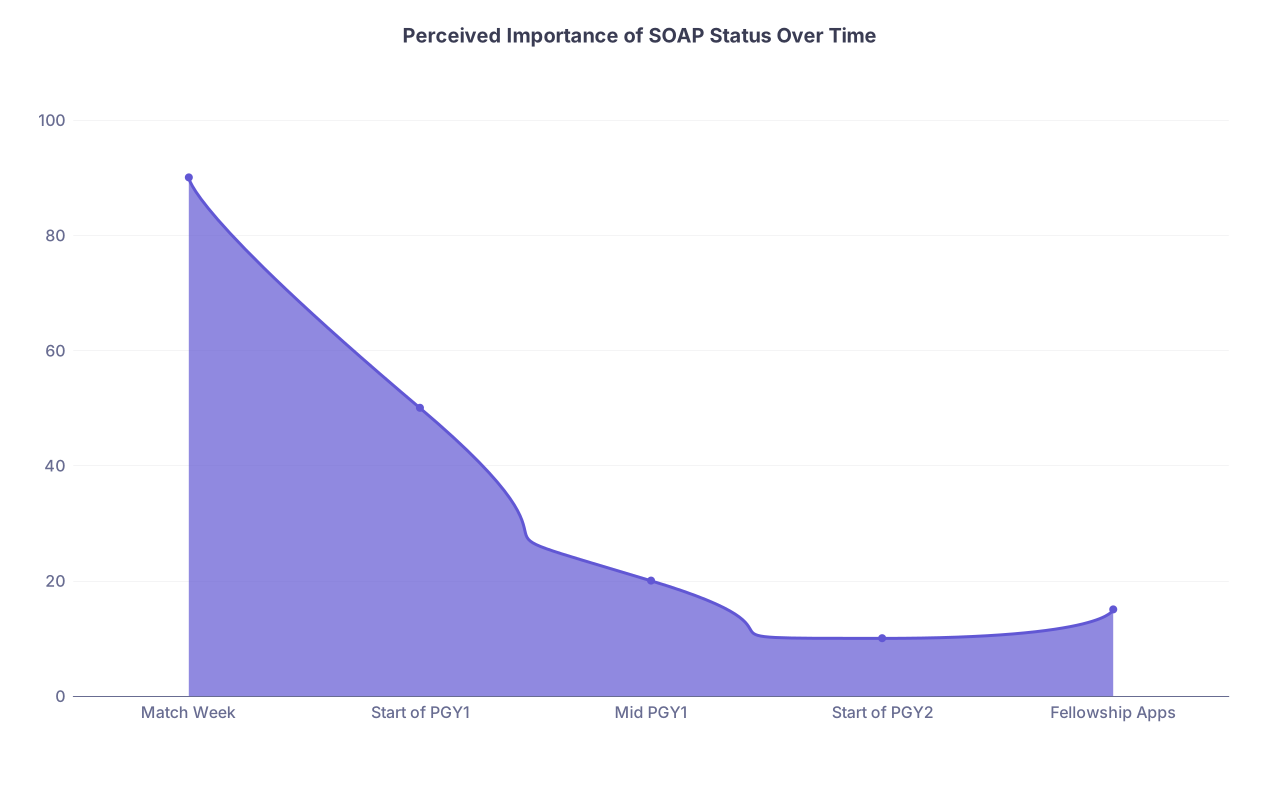
| Category | Value |
|---|---|
| Match Week | 90 |
| Start of PGY1 | 50 |
| Mid PGY1 | 20 |
| Start of PGY2 | 10 |
| Fellowship Apps | 15 |
Interpretation:
Match week, it feels like SOAP is 90% of your identity. By mid-PGY1, in most programs, it’s barely a background fact. It may tick up slightly when you apply for fellowships, but only as a minor historical curiosity, not a decisive factor.
How to Avoid Being Treated as “Second-Class” After SOAP
You can’t control people’s biases completely. You can control how much raw material you give them to work with.
If you came in through SOAP, here’s how you keep it from defining you:
Stop talking about it like it’s your tragic origin story
Mention it only when absolutely necessary (e.g., explaining a gap year, or in a personal statement if you actually learned something meaningful from it). The more you bring it up, the more people think it matters.Outperform expectations early
Medicine has a short memory but a strong recency bias. Crush your first 3–6 months:- Be early, not just on time.
- Be prepared for rounds.
- Read about every interesting case and actually apply it.
Once faculty see you as “the reliable intern,” origin details evaporate.
Earn one or two heavy-hitting advocates
A PD, APD, or respected faculty member who is all-in on you is functionally more powerful than your Match history. I’ve heard fellowship PDs say, “If Dr. X says they’re excellent, I don’t care how they got into residency.”Do not internalize “second-class citizen” status
The fastest way to make people treat you differently is to act like you expect to be treated differently. Self-consciousness becomes self-sabotage: apologizing too much, not volunteering, playing small. PDs pick up on that.Document your competence in obvious ways
Strong in-training scores, a poster or two, maybe a small QI project. Nothing crazy. Just enough visible signal that you’re not marginal. These are easier to brag about on applications than “I survived SOAP.”

| Step | Description |
|---|---|
| Step 1 | SOAP Entry |
| Step 2 | First 3 Months Performance |
| Step 3 | Positive Reputation |
| Step 4 | Neutral/Questioned Reputation |
| Step 5 | Fellowship/Job Opportunities |
The point: SOAP is not the defining node in your career. How you perform right after is.
The Ugly Truth: Where the Stigma Actually Comes From
Most of the “second-class” anxiety does not come from PDs. It comes from:
- Med student culture (which is vicious about status)
- Online forums that turn any deviation from linear success into a cautionary horror story
- Your own perfectionism and shame
Watch how residents talk when no attendings are around. You’ll hear “SOAP” weaponized as an insult in some circles, just like people throw around “community program” or “DO” or “IMG” when they’re trying to one-up each other.
That peer-level toxicity colors how you imagine PDs see you. But PDs are not sitting in those Reddit threads. They’re trying to staff night float and get the ACGME off their backs.
The people actually evaluating you day-to-day tend to be much more pragmatic than your classmates.
So, Are SOAP Acceptances “Second-Class” In Reality?
No. They’re second-chance, not second-class.
Here’s the unvarnished truth:
- You will feel marked by SOAP longer than most faculty will remember it.
- You might run into an occasional jerk (resident or attending) who uses it to score points. That’s about them, not about you.
- If you build a strong clinical reputation, SOAP becomes a minor footnote, not your headline.
The main real damage SOAP does for most people is psychological, not structural. It shakes your confidence. If you let that calcify into a permanent “I’m behind” narrative, that will hold you back. Not the SOAP code in ERAS history.
Stop asking, “Do PDs see SOAP as second-class?” and start asking, “Am I giving them current reasons to see me as first-rate?”


