
The worst way to explain being unmatched is to pretend it didn’t happen or to over-explain it.
You need a clean, confident, matter-of-fact story that makes programs think: “Okay, that makes sense. And this person has learned from it.”
Here’s exactly how to do that.
The Core Script: What You Should Actually Say
Let me start with the template everyone is really looking for. You can tweak the details, but the structure should stay almost identical.
Use this as your 60–90 second answer for interviews, emails, or networking calls:
- One sentence acknowledging it directly
- One short, concrete reason (not 5)
- One “what I did about it”
- One “why I’m stronger now”
- One sentence pivoting back to the future
Something like:
“I went unmatched last cycle in internal medicine. I applied pretty narrowly and underestimated how much my late Step 2 score and limited home institution support would hurt my application. Since then, I’ve completed a dedicated medicine prelim year, added strong inpatient evaluations and letters from academic hospitalists, and improved my Step 2 score. The experience forced me to be more proactive and realistic about my weaknesses. I’m confident I can contribute immediately as a resident, and I’m excited to bring that maturity and persistence to your program.”
Notice what this does:
- States the fact. No drama.
- Gives a plausible, specific reason.
- Shows action, not excuses.
- Ends looking forward, not stuck in last March.
If your current explanation doesn’t hit those beats, fix it.
The Mindset Shift: You’re Not on Trial
Most unmatched applicants walk into these conversations like they’re in court. That’s when the defensiveness leaks out.
You start piling on:
- “Well, the Match was unusually competitive this year…”
- “My school didn’t help me at all…”
- “ERAS had issues, and my application didn’t…”
- “I had a lot going on with family stuff…”
Programs hear that as: “This person explains problems instead of fixing them.”
The better mindset: you’re a candidate with a gap year, not a criminal with a record. Programs want:
- A quick risk assessment
- Evidence you’re coachable
- Proof you’ve stayed clinically and professionally active
They’re not looking for a 10-minute saga of how unfair it all was.
Your job is to:
- Own it.
- Contain it.
- Show how you upgraded.
That’s it.
Step-by-Step: Build Your Non-Defensive Explanation
Step 1: Name the Reality in One Sentence
Say it once, clearly:
- “I went unmatched in categorical pediatrics last cycle.”
- “I initially went unmatched in EM and then SOAPed into a transitional year.”
- “I didn’t match into orthopedic surgery and pursued a research year.”
Do not:
- Say “I had challenges with the Match process.”
- Avoid the word “unmatched.”
- Start with five other details to soften it.
You sound more defensive when you dance around it. Programs respect directness.
Step 2: Choose ONE Primary Reason
You probably have ten reasons in your head. They don’t need ten. They need one or two credible and fixable factors.
Common legitimate reasons:
- Very competitive specialty with borderline scores
- Very narrow geographic or program list
- Late or low Step 2
- Weak or generic letters
- Very limited clinical experience in the U.S. (for IMGs)
- Red flag that is now explained and stable (health, academic issue, personal crisis)
Your job is to:
- Pick the main one
- Own your part of it
- Stop there
Examples that sound non-defensive:
“I applied almost exclusively to top-tier academic programs and only in one geographic area. In hindsight, that strategy wasn’t realistic given my Step scores and lack of a home program in the specialty.”
“My Step 2 score was lower than programs in this specialty usually expect. I didn’t adjust my list appropriately and didn’t have a backup plan early enough.”
These work because:
- You’re not blaming “the system”
- You’re acknowledging judgment errors
- You’re implying you’ve learned
If your reason is “the system is broken and unfair,” you may feel right and still lose the room.
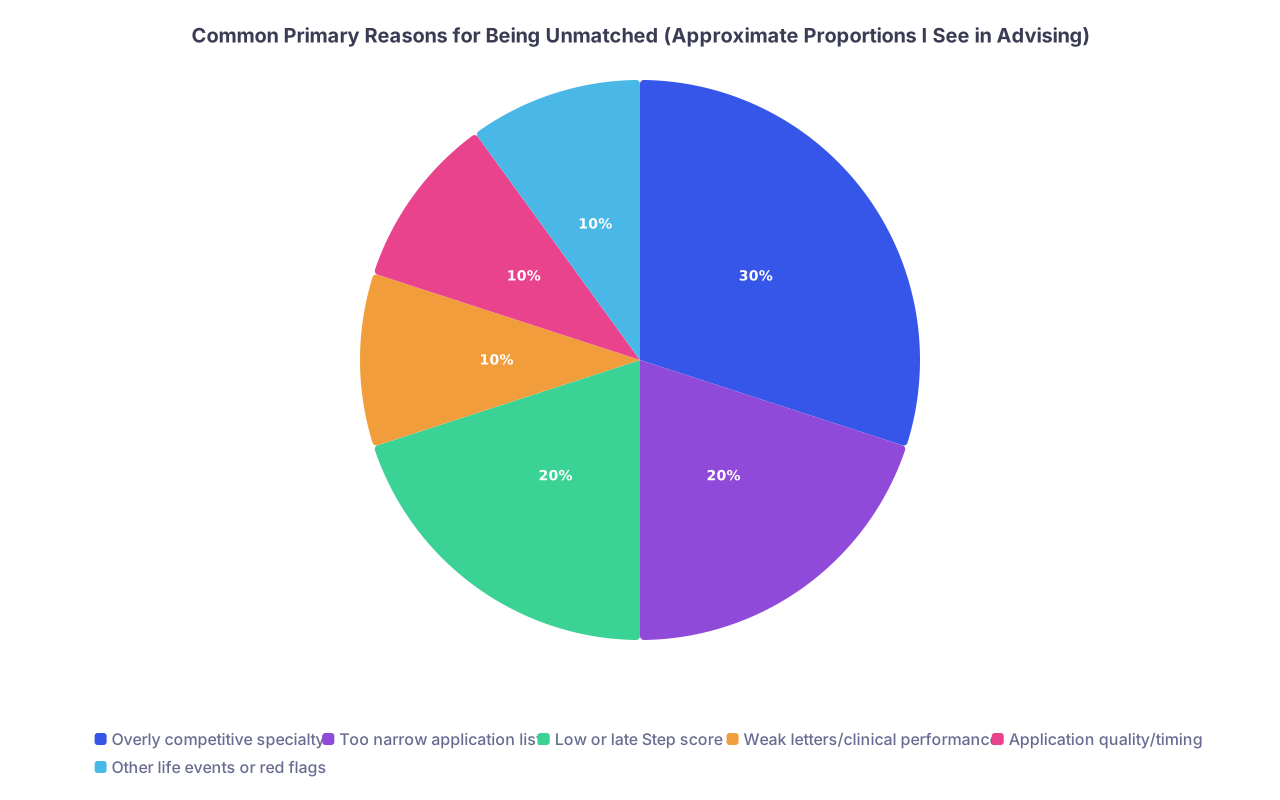
| Category | Value |
|---|---|
| Overly competitive specialty | 30 |
| Too narrow application list | 20 |
| Low or late Step score | 20 |
| Weak letters/clinical performance | 10 |
| Application quality/timing | 10 |
| Other life events or red flags | 10 |
Step 3: Show Concrete Corrective Action
This is where most people either get vague or emotional. Do neither.
Programs want to hear:
- You did not spend a year waiting for better luck
- You placed yourself in a clinical, academic, or related role
- You sought feedback and changed behaviors, not just your narrative
Match your reason to your action.
If your scores were marginal:
- Took additional exams early and improved (CK, OET, language, etc.)
- Completed rigorous clinical work where your performance was objectively rated
If you had weak clinical exposure/letters:
- Did a prelim or transitional year
- Completed sub-internships/externships with documented strong evaluations
- Got new letters from people who actually supervised you on the floor
If your application strategy was bad:
- Worked with an advisor/PD/faculty mentor
- Expanded specialties or geography
- Applied earlier and completed ERAS in a polished, timely way
How to phrase it:
“After not matching, I immediately sought feedback from my dean’s office and two program directors who interviewed me. They pointed out that my application list was narrow and that I lacked strong inpatient medicine letters. I pursued a prelim year where I’ve had high-volume inpatient exposure, improved my evaluations, and secured new letters from three academic hospitalists.”
Very little fluff. 100% action.
Specialty-Specific Angles (What You Emphasize)
You don’t explain “unmatched in derm” the same way you explain “unmatched in family medicine.”

Competitive specialties (Derm, Ortho, ENT, Plastics, Neurosurgery, Ortho, Urology)
You emphasize:
- Oversubscribed field
- Realistic reassessment
- Mature backup planning
Example:
“I initially applied to dermatology with solid but not standout scores and limited home program support. In hindsight, my odds were low, and I didn’t build a strong parallel plan. After not matching, I chose a medicine prelim year at a program with strong derm connections, focused on clinical excellence, got involved in outcomes research, and have strengthened both my letters and my understanding of the field. I’ve also developed a more realistic application strategy with guidance from faculty who know my work.”
If you changed specialties entirely, don’t apologize to the new field like you’re “settling.” Frame it:
“After going unmatched in orthopedic surgery, I took a hard look at what I enjoyed day-to-day and realized I was more drawn to managing complex medical patients and longitudinal care than to the OR itself. I completed a transitional year and have loved my medicine rotations. My focus now is internal medicine, and I’ve built my application around the work I’ve actually enjoyed and excelled in.”
Less competitive specialties (FM, Psych, Peds, IM, Pathology)
You can’t hide behind “my specialty is insanely competitive.” Programs will assume:
- Weakness in scores
- Weakness in performance
- Chaotic application process
So you counter that specifically:
“I went unmatched in internal medicine last cycle. My Step scores were in range, but I applied late and didn’t have any strong U.S. clinical letters as an IMG. Since then I’ve completed six months of U.S. inpatient rotations, all with strong written evaluations, and obtained three letters from program directors and associate program directors who know my work. I submitted ERAS on day one this cycle and applied broadly. My focus now is stable, solid clinical performance and being a reliable team member.”
That tells them: this was fixable, and I fixed it.
What NOT to Say (Red-Flag Phrases)
These phrases instantly make you sound defensive or unaware:
- “I honestly still don’t understand why I didn’t match.”
- “I think programs just preferred U.S. grads.”
- “My school didn’t help me at all.”
- “It was just bad luck.”
- “The Match is broken; everyone says it’s a lottery.”
Even if there’s truth there, you sound like:
- You didn’t get real feedback
- You don’t accept your share of responsibility
- You might blame the program when things go wrong
Better replacements:
- “I didn’t fully appreciate how my [X] would impact my chances.”
- “I overestimated [Y] and underestimated [Z].”
- “I was late to adjust my strategy once I saw how the season was going.”
Short, accountable, adult.
Handling Different Contexts: Email, PS, Interview
Emailing a program / networking
Keep it brief. Your unmatched status is one line, not a monologue.
“I went unmatched in pediatrics last cycle and have since been completing a pediatric prelim year at [Hospital], where I’ve focused on strengthening my clinical skills and letters. I’d be very grateful if you’d consider my application for any open PGY-1 or PGY-2 positions.”
If they want details, they’ll ask.
Personal statement
Do not turn your personal statement into a Match autopsy.
One short paragraph is enough:
“I applied to internal medicine last cycle and did not match. In reflecting with mentors, I recognized that my application list was too narrow and that my letters did not fully capture my strengths on the wards. Over the past year, I’ve completed a medicine prelim year, taken on additional responsibility in managing complex patients, and earned strong evaluations and letters from faculty who have seen my growth. This experience has reinforced my commitment to internal medicine and to continual improvement.”
Then move on to who you are as a physician.
Interview
This is where you must sound calm and rehearsed, not robotic or bitter.
Structure:
- Acknowledge
- Reason
- Actions and growth
- Pivot
And then shut up.
If they probe deeper, you answer. But don’t answer the 30-second question with a 6-minute emotional TED talk.

| Step | Description |
|---|---|
| Step 1 | Unmatched Last Cycle |
| Step 2 | State It Directly in One Sentence |
| Step 3 | Choose One Primary Reason |
| Step 4 | Describe Concrete Actions Taken |
| Step 5 | Highlight Growth and Readiness |
| Step 6 | Pivot Back to Future and Fit |
What If There Is a Real Red Flag?
Some of you have more than “strategy error”:
- Leave of absence
- Health or mental health crisis
- Academic probation or failure
- Professionalism concern
You still use the same structure, but with slightly more explanation and a clear stability statement.
Example:
“During my third year, I faced a significant health issue and took a short leave, which contributed to weaker clinical performance and delayed exams. That instability affected my application, and I went unmatched. Since then, I’ve fully recovered, completed a full transitional year without any health interruptions, and received strong evaluations from my supervisors. I’ve also developed better habits around time management and asking for help early. I’m confident that I can meet the demands of residency reliably, and my recent performance reflects that.”
You must:
- Be honest but not graphic
- Show it’s addressed and stable
- Offer recent evidence that things are different now
Quick Self-Check: Does Your Explanation Work?
Run your explanation through this checklist:
- Can you say it in under 90 seconds?
- Do you say “unmatched” or “SOAP” once, clearly?
- Do you name exactly one main reason?
- Do you clearly describe what you did, not just what you “learned”?
- Do you end looking forward, not backward?
- Did you avoid blaming “the system,” your school, your PD, or vague “bias”?
If you miss more than two, rewrite it.
FAQ (Exactly 5 Questions)
1. Should I ever NOT mention that I went unmatched?
If you’re in the same specialty the very next cycle, they’ll see the dates and figure it out. You should address it briefly. If you’re several years out, in a very different field, and have completed training (e.g., switching specialties after finishing another residency), then you don’t need to center your unmatched history. But you still should be honest if asked directly.
2. How much detail should I give about personal or family crises that affected my Match?
Less than you think. A sentence or two is enough to provide context. The real focus must be on your current stability and performance. “I had a significant family obligation that impacted my ability to complete applications on time” plus “those circumstances have resolved, and my recent year in X role shows I can meet residency demands” is usually sufficient.
3. Is it okay to say my specialty was too competitive for my stats?
Yes, if you own it. “I applied to a very competitive field without a realistic parallel plan, given my scores and research profile” is honest and mature. Don’t frame it as “the specialty is impossible” or “programs only take perfect applicants.” Program directors are allergic to that kind of complaining.
4. How do I handle this question if I get emotional talking about it?
Practice out loud. With a friend, advisor, mirror, or recording. You want the emotion processed before you’re in front of a PD. If you’re still actively upset, write it all out in detail for yourself, then condense it to the 60–90 second version. Stick to that script in interviews so you don’t drift into raw territory.
5. Can I mention that my advisors or dean thought I would match and were surprised?
You can, but do it carefully. “My dean’s office and mentors were surprised I didn’t match, which prompted a thorough review of my application” is fine. “Everyone told me I was a shoo-in and the result made no sense” sounds naïve and bitter. Always pivot from “surprised” to “so we analyzed what to improve and then I did X, Y, Z.”
Key points: Own the fact that you went unmatched in one clean sentence, give one clear and realistic reason, and spend most of your energy on what you’ve done since and why you’re stronger now. If you do that, you won’t sound defensive. You’ll sound like someone who got knocked down, learned, and is now ready to work.