
Do I Need to Retake Exams as a Reapplicant After an Unsuccessful Match?
What do you do when you did not match, your Step scores are already on the low side, and someone casually tells you, “You should probably just retake and fix your application”?
Here’s the real answer: most people should not immediately retake exams after an unsuccessful Match. But some absolutely should. The trick is knowing which group you’re in.
Let me walk you through it like I would with a fourth-year sitting in my office in March, holding a SOAP rejection email in one hand and a Step score report in the other.
First: Do Programs Even Care About Retakes?
Yes. But not always in the way you think.
Programs care about three things with your exams:
- Did you pass (and on which attempt)?
- Are your scores acceptable for their specialty/program?
- Is there new evidence that you can handle their workload now?
A retake only helps you with #3. And sometimes slightly with #2. It never erases a fail. It never hides your original score. Every prior attempt stays visible.
If you’re hoping a retake will magically make programs forget a low score or failure, that is wrong. They will see all of it, side by side.
So the real question is not “Should I retake to hide my old score?”
The real question is: “Will a new, higher score materially change how programs view me next cycle?”
That’s the bar.
When You Probably Should Not Retake Right Away
Let’s start with the common scenarios where retaking is usually a bad or low-yield idea.
1. Your Scores Are Average and You Just Didn’t Match
Example:
- Step 1: Pass on first attempt (no score)
- Step 2: 235 (US MD or DO)
- Failed to match categorical IM or peds
In this case, exams are probably not the reason you did not match. Retaking Step 2 to aim for a 245+ is usually a waste of time and money. Programs won’t reject you for a 235. They will reject you for:
- Weak letters
- Limited clinical experiences
- No home program support
- Poorly organized application strategy
- Late ERAS submission or very few applications
- Awkward/fumbled interviews
If your scores are within the usual match range for your specialty and background, a retake is rarely the lever that moves the needle.
2. You Already Have a Respectable Score for the Specialty
If your Step 2 is, say, 245–250+ and you aimed at IM, peds, psych, FM, or neurology, a retake is just masochism. You’re already fine on paper. Programs do not need to see more.
In this situation, doubling down on research, clinical work, or networking is dramatically higher yield than chasing a vanity score bump.
3. You’re Burned Out and Barely Studied the Last Time
If your last Step attempt took everything out of you and you barely passed or just squeaked by, you’re at high risk of failing again if you jump into a retake without changing anything.
Programs look very harshly on multiple failures. One fail can be explained. Two or more becomes a pattern.
If your mental health, finances, or living situation are unstable, a retake this year may do more harm than good. Fix your foundation first.
When a Retake Might Be Worth It
Here’s where it gets more nuanced. There are a few specific, defensible scenarios where a retake can actually help you as a reapplicant.
1. You Failed an Exam, Then Passed With a Marginal Score
Example:
- Step 1: Pass
- Step 2: Fail first attempt, then 212 on second attempt
- Aiming for IM / FM
You’re carrying two problems: a fail and a borderline Step 2. What programs want to know is: are you genuinely able to perform at residency level, or did you barely get by?
In this situation, a third attempt is risky—but if you can realistically jump from low 210s to 235+, that new score can:
- Show sustained improvement
- Reassure PDs that the fail was an outlier
- Get certain community and mid-tier academic programs to take a second look
You cannot make this decision casually. You need:
- Honest self-assessment of why you failed
- Evidence you can now score significantly higher on practice tests
- A plan for what you’ll do differently (not just “I’ll work harder”)
If your likely improvement is 10–12 points, it’s probably not worth the risk. If you can jump 20–25+ points, then it starts to look rational.
2. Your Score Is Far Below the Typical Range for Your Specialty
If you aimed high—say ortho, derm, ENT, gas—and your Step 2 is 215–220, a retake only makes sense if:
- You’re either switching to a less competitive specialty and want to look reasonably strong there
- Or you’re determined to stay in a competitive specialty and your current score is a deal-breaker almost everywhere
Even then, for the most competitive fields, a retake is necessary but not sufficient. A 235 from 215 may still not open doors in plastics or derm, but it might make you viable in gas, anesthesia prelims, or IM as a pivot.
Specialty competitiveness matters. Rough orientation:
| Specialty | More Competitive? | Typical Matched Range |
|---|---|---|
| Dermatology | Very High | 250+ |
| Orthopedic Surg | Very High | 245–255+ |
| Anesthesiology | High | 235–245 |
| Internal Medicine | Moderate | 225–240 |
| Family Medicine | Lower | 215–230 |
If you’re 20–30 points below the rough range for your realistic target specialty, a retake can change your trajectory—but only if you’re confident you can close that gap.
3. You Took Step 2 Very Early With Clearly Unprepared Circumstances
I’ve seen this: someone rushed Step 2 during a chaotic clinical year, took it right before a major family crisis, scored 205–210, then spent the next year doing strong sub‑I’s and clearly improving clinically.
If all your recent performance signals (shelves, in‑service exams, practice tests) now suggest you’re at a 230+ level, a retake can:
- Align your score with your current ability
- Provide a fresh, more accurate data point for programs
This is still not automatic—but if the original score clearly doesn’t reflect who you are now, a retake is reasonable.
Where Retakes Fit in the Bigger Strategy
Retaking an exam is just one tool. For reapplicants, it’s often not the main one.
Here are high-yield levers that frequently matter more than a retake:
- A strong, sustained clinical role this year (prelim year, research year with clinical contact, hospitalist scribe, or similar)
- New, glowing, recent letters from US attendings who explicitly compare you favorably to current residents
- A tighter, smarter application strategy (more programs, broader geographic range, realistic specialty choices)
- Repairing obvious red flags: professionalism concerns, unexplained gaps, disastrous personal statement, weird interview behavior
If you spend a year obsessing about a 10–15 point score bump and do nothing else, you will usually still be unmatched.
How Programs Actually View Retakes
Programs generally see three types of retake stories.
Clear, convincing comeback
- Fail or low score → strong consistent prep → big jump (20–30+ points)
- Backed by strong current letters and clinical performance
This can be a redemption arc. PDs like redemption if it’s real.
Lateral move
- 218 → retake → 225
- Multiple attempts, small gain
This doesn’t help much and adds risk perception.
Train wreck
- Fail → low pass → another fail or small bump
- Now there are multiple concerns about consistency, stamina, readiness
This closes more doors than it opens.
So the question you must answer honestly: which arc are you likely to create?
Special Situations: DOs, IMGs, and Timeline Issues
For DO Graduates
- If you already have COMLEX and a decent USMLE Step 2 (if taken), retaking often adds limited value unless your scores are well below typical ranges for your target specialty.
- Many community programs care more about: US clinical experience, letters, and whether you seem committed to their program and community.
For IMGs
Scores carry more weight for IMGs, especially for first-pass screening. If you’re an IMG with:
- Step 1 pass / Step 2 ~210–220
- No US LORs, limited USCE
Then a strong Step 2 CK retake outcome (if allowed and feasible) may help—but only together with:
- Substantial new US clinical time
- Strong US letters
- A realistic specialty choice (FM, IM, peds, psych more than ortho, derm, etc.)
For many IMGs who didn’t match, the problem is not just scores. It’s an entire portfolio that isn’t competitive yet.
Timeline and Exam Expiration
Also pay attention to:
- Program-specific requirements: some places require a “recent” Step 2 (within 3–5 years).
- State licensing boards: some have a max number of total attempts or time limits across all Steps.
In some edge cases, a retake is forced by timing rules. That’s not strategy; that’s compliance.
How to Decide: A Simple Framework
Use this quick triage:

| Step | Description |
|---|---|
| Step 1 | Unmatched |
| Step 2 | Do NOT retake; fix other parts |
| Step 3 | Retake risky & low yield |
| Step 4 | Address habits & support first |
| Step 5 | Reasonable to plan retake |
| Step 6 | Scores obviously below range? |
| Step 7 | Can you improve 20+ points? |
| Step 8 | Underlying issues fixed? |
Then sanity-check with someone who sees applications regularly: a trusted PD, advisor, or faculty mentor, not just a friend on Reddit.
Also: look at practice test trajectories. If your best NBME/CCSSA equivalents are clustered within 5–10 points of your current score, you are unlikely to magically score 20+ points higher on test day.
Practical Exam Strategy If You Do Decide to Retake
If you’ve gone through all of this and a retake still makes sense, don’t wing it.
Anchor your decision in data
- Take a formal practice exam now.
- Set a target score difference before you even register. If you’re not within striking distance 4–6 weeks out, push the date or cancel.
Change your approach
- Different resources, structured schedule, more mixed-question practice.
- Build in repeated self-testing and full-length practice, not just Anki and reading.
Protect your mental health
- Schedule rest days.
- Have at least one person (friend/family/therapist) who knows you’re retaking and can check in.
Integrate with your reapplication plan
- Don’t wait until after the exam to start lining up clinical work or letters.
- You should be improving your entire application in parallel.
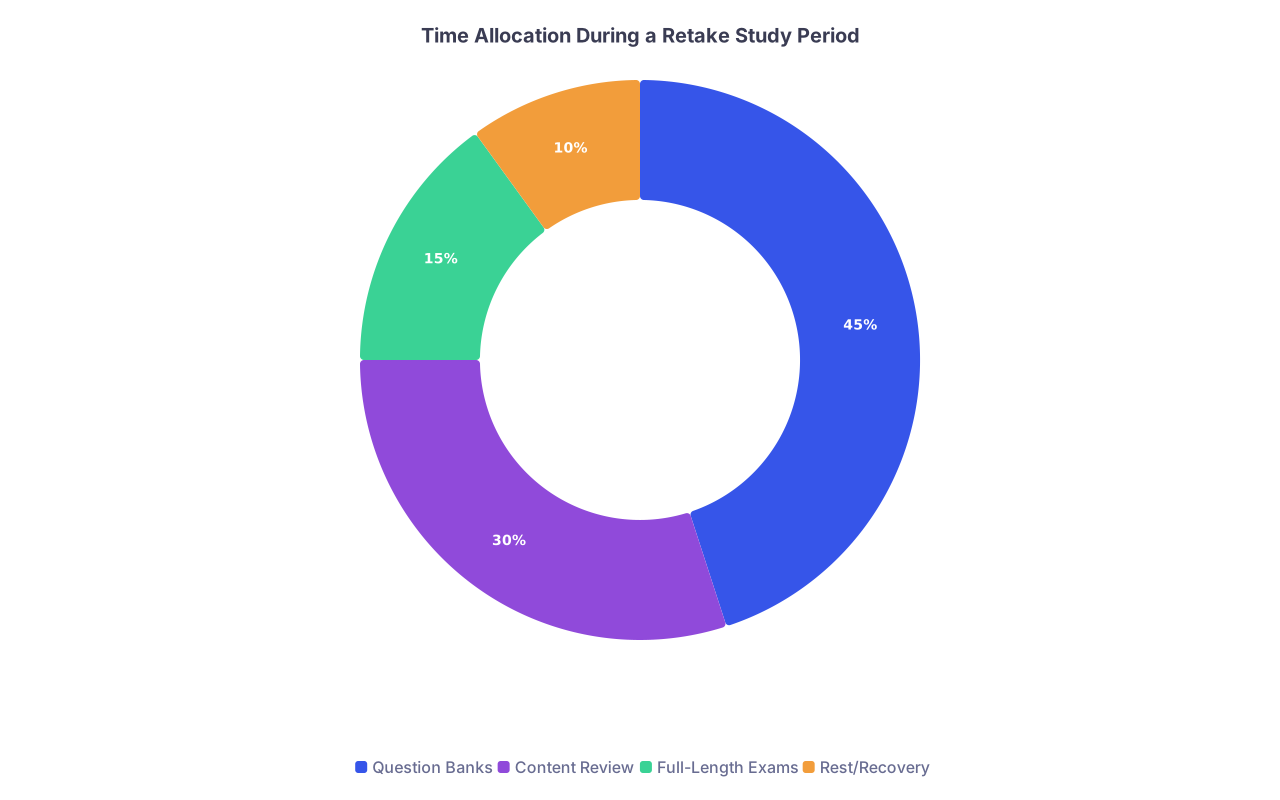
| Category | Value |
|---|---|
| Question Banks | 45 |
| Content Review | 30 |
| Full-Length Exams | 15 |
| Rest/Recovery | 10 |
The Bottom Line
You don’t automatically need to retake exams just because you didn’t match. Most reapplicants are better served by strengthening clinical experience, letters, and application strategy rather than obsessing over squeezing a few extra points out of a high-stakes test.
You consider a retake only if:
- Your current score is clearly below the realistic range for your desired (or backup) specialty, and
- You have a credible, evidence-based path to a 20+ point improvement, and
- You’ve addressed the underlying causes that hurt your prior attempt.
Otherwise, keep your money, protect your sanity, and focus on the parts of your application that programs actually talk about behind closed doors: how you work on a team, how your attendings describe you, and whether it feels safe to hand you the pager.
Today, here’s your next step: pull up your score report and your last few practice tests, and write down—on paper—your current score, your highest realistic target, and the gap between them. If that gap is less than 15–20 points, stop planning a retake and start planning how to strengthen the rest of your application.
FAQ: Retakes After an Unsuccessful Match
1. If I didn’t match, do programs expect me to retake Step 2 or COMLEX?
No. There is no blanket expectation that unmatched applicants must retake. Many successfully reapply with the exact same scores, focusing on stronger letters, broader applications, and better clinical experiences. A retake is only expected if your current scores are clearly insufficient or expiring for licensing/program requirements.
2. Will a higher retake score “replace” my old one in ERAS?
No. Programs see all attempts and all scores. A higher retake doesn’t erase a low score or a failure. It just sits next to it and can change the narrative from “chronically borderline” to “clear improvement and current readiness” if the jump is large enough.
3. How big of a score jump actually matters to residency programs?
A 3–8 point increase is basically noise. A 10–15 point increase might mildly help borderline applicants but rarely changes your tier of competitiveness. A 20+ point increase can shift how some PDs view you, especially if it follows a failure or very low score and is supported by strong clinical performance and letters.
4. Is it worse to have one low score or multiple attempts with small improvements?
Usually, multiple attempts with small gains look worse. One low score can be explained by circumstances. Repeated testing without significant improvement suggests deeper issues with test-taking or knowledge gaps. That’s why you should only retake if you have strong evidence you can substantially outperform your prior result.
5. I’m an IMG with a low Step 2 score who didn’t match. Should I retake or focus on USCE and letters?
For most IMGs, you need both stronger US clinical experience and more competitive scores to stand out. If your Step 2 is below ~220 and you’re aiming for IM/FM/psych/peds, a retake can be helpful if you can realistically reach the mid‑230s or higher. But if your likely gain is small, you’ll get more mileage from significant USCE, excellent US LORs, and a smart, broad application strategy.
6. Does a retake help if I’m switching to a less competitive specialty after not matching?
Sometimes. If you originally shot for a very competitive field with a weak score, then pivot to a less competitive specialty (e.g., from ortho to FM or IM), you may already be “good enough” without a retake. If your score is still quite low for the new specialty, a strong retake can help you look solid in that new lane—but again, only with a meaningful score increase.
7. How do I explain a fail and retake in my personal statement or interviews?
Be direct and brief: acknowledge the failure, clearly explain what went wrong (without excessive drama or excuses), then focus on what you changed and how your subsequent performance (retake score, clinical evaluations, in‑service exams) shows growth. The story should end with, “I identified the problem, changed my habits, and the results speak for themselves,” not with a plea for sympathy.