
The brutal truth: most people who will eventually match do so within two cycles. After that, the odds drop—and the cost (time, money, mental health, skills decay) climbs fast.
You’re not just asking, “How many match cycles should I try?” You’re really asking, “When does persistence become denial?” Let’s answer that directly.
The Short Answer: 1–2 Cycles for Most, 3 at the Very Most
If you want a clear number, here it is:
- For most U.S. MD/DO grads:
2 cycles is a reasonable maximum before a serious pivot. - For IMGs or applicants with major red flags:
2–3 cycles can be reasonable if there’s clear, objective improvement each time. - More than 3 full cycles?
You’re almost always better off pivoting rather than doubling down.
This isn’t me being pessimistic. It’s based on what actually happens to people I’ve seen keep reapplying, plus the way programs think:
- Programs get wary of “professional applicants” with 3+ failure cycles.
- Clinical currency decays. The further you are from graduation, the worse your file looks unless you have strong, recent U.S. clinical work.
- Each year you wait, you lose real earning years and build more sunk cost.
So the real decision is not “Should I keep trying forever?”
It’s “Do I have enough signal that another cycle will meaningfully change my odds?”
Let’s break that down.
What Changes Between Cycles Actually Matter?
If you’re going to attempt another match cycle, something meaningful has to change. “I’ll write my essays earlier this time” is not enough.
Here’s what actually moves the needle:
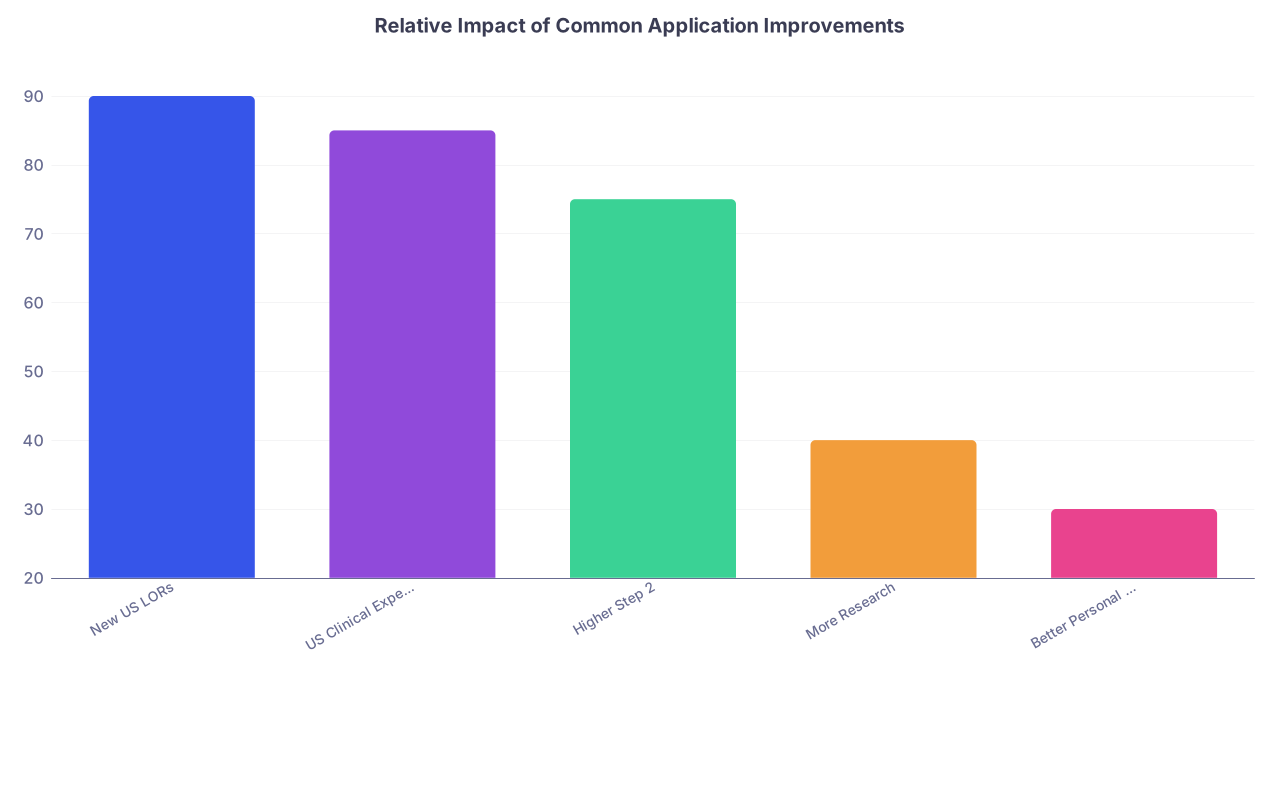
| Category | Value |
|---|---|
| New US LORs | 90 |
| US Clinical Experience | 85 |
| Higher Step 2 | 75 |
| More Research | 40 |
| Better Personal Statement | 30 |
High-impact changes:
- Raising Step 2 CK by a significant chunk (e.g., from 215 → 235, or 225 → 245)
- Securing strong new U.S. clinical experience with real, specific letters (not generic “hardworking” fluff)
- Switching to a less competitive specialty where your stats are actually competitive
- Massive behavioral changes in strategy:
- Expanding number and type of programs
- Targeting community programs, new programs, less popular locations
- Actually applying where you’re competitive, not where you wish you were competitive
Moderate impact:
- New research in the same specialty you’re targeting
- Improved personal statement and more tailored experiences section
- Better interview prep if you had a few interviews but no rank
Low impact (on its own):
- Reworded personal statement only
- One extra weak LOR
- Reorganizing your CV but no substance change
- “Just trying again and hoping for better luck”
If you’re going into another cycle and your only real change is “I’ll apply earlier and write better essays,” you’re basically replaying last year’s odds.
A Simple Framework: Should You Try Again or Pivot?
Here’s the decision framework I’d use if you were sitting across from me.

| Step | Description |
|---|---|
| Step 1 | Unmatched after cycle |
| Step 2 | Rebuild file & consider pivot |
| Step 3 | Refine strategy & reapply once |
| Step 4 | Serious pivot now |
| Step 5 | 1 more targeted cycle |
| Step 6 | Any interviews? |
| Step 7 | Real improvements possible? |
| Step 8 | Major changes possible? |
Ask yourself these questions after each cycle:
How many interviews did you get?
- 0 interviews = your application is fundamentally not competitive for where you applied.
- 1–3 interviews = borderline. There’s a signal, but something’s off: competitiveness, geography, or how you present yourself.
- 4+ interviews = you’re in the game; your issue is likely ranking, interviewing, or list strategy.
Did you realistically apply where you’re competitive?
- Example: 215 Step 2 and no significant research? Applying to 60 university IM programs was never going to work.
- Or you applied to 40 programs total in a field where most people apply to 80–120.
What can you change substantively in 6–12 months?
- Step 2 score improvement?
- New, robust U.S. clinical rotations?
- Switch specialties?
- Better visa or immigration status?
If:
- You had some interviews,
- You can clearly fix weaknesses,
- And you’re willing to change strategy (not just try harder),
→ One more cycle is reasonable.
If:
- You had 0 interviews despite a broad application for multiple years,
- Or you’re 3+ years out from graduation with no strong U.S. experience,
- Or your exam performance is consistently borderline/low with no realistic path to big improvement,
→ It’s time to pivot hard, not “just one more time.”
What Each Cycle Really Costs You
People massively underestimate the opportunity cost of each extra match cycle.
Money cost:
- ERAS fees + NRMP + data transmission: easily $1,000–$3,000+ depending on number of programs
- Interview travel if in-person (or time off work if virtual)
- Lost earning potential from not taking a different career path earlier
Time/skills cost:
- Clinical skills atrophy if you’re not actively practicing somewhere
- You get further from graduation, which programs hate seeing unless you have strong, recent U.S. clinical work to compensate
Psychological cost:
- Another year of uncertainty, explaining your status to family, friends, partners
- More shame/embarrassment (even though you shouldn’t feel that way, people do)
- Decision fatigue and burnout
Every extra year you reapply, that stack gets higher. That’s why blind persistence is not noble; it’s expensive.
When a Third Cycle Might Still Be Reasonable
So, when would I not yell “pivot now” at someone considering a third try?
You might reasonably attempt a third cycle if:
You had clear signal in cycle 2:
For example:- 5–10 interviews
- Ranked programs reasonably
- You improved your app between cycle 1 and 2
→ That tells me you’re in range.
You can still change geography or specialty strategy:
- You’ve been extremely geographically limited (e.g., only California/NYC). Now you’re willing to apply literally anywhere.
- You’re willing to switch from something like categorical surgery to prelim surgery + reapply, or from radiology to internal medicine, etc.
You’ve made objectively significant upgrades between cycles:
- New strong U.S. LORs from recent rotations
- Substantial Step 2 CK improvement
- Real structured gap year in research or a clinical role that programs respect
Even then, third cycle should be framed mentally as:
“This is my final full attempt. If I don’t match now, I pivot.”
Not, “I’ll just keep trying until it works.”
Red Flags That You’re Past the Point of Diminishing Returns
There are a few patterns I’ve seen that almost always predict continued non-match unless there’s a big pivot.

You should be seriously considering a pivot if:
You’re 5+ years out from graduation and:
- No recent, strong U.S. clinical experience in the specialty you want
- No major new credentials (MPH, research fellowship with strong output, etc.)
You’ve had 2+ cycles with 0–1 interview each time, despite:
- Broad applications (80–120+ programs)
- Reasonable targeting (not just top-tier or super competitive cities)
Your exams are clearly below typical cutoffs for your target specialty:
- And you’ve already retaken what’s realistically retakable, without major change
- And you’re still insisting on a specialty where your scores are out of range
You’re relying on “maybe they’ll see my passion” as your differentiation
- Programs don’t pick passion over risk when they have 5,000+ applicants
Once you see that pattern, another cycle isn’t “being persistent.” It’s refusing to update your strategy in the face of data.
How to Pivot Smartly (Not Desperately)
Pivoting isn’t “giving up on medicine” unless you want it to be. A smart pivot is choosing a realistic path where your background, scores, and timeline actually fit.
Here are three broad pivot types:
1. Pivot Within Medicine (Residency-Adjacent or Different Specialty)
Options here:
- Less competitive specialties where your scores fit:
- Example: switching from derm or ortho ambitions to FM, psych, IM, pathology, etc.
- Non-residency clinical roles (depending on country and licensing):
- Clinical research coordinator
- Hospitalist extender roles in some systems
- Physician extender / associate roles in certain countries (varies a lot by location)
This works best if:
- You’re not too far from graduation
- You have at least passing exams and some clinical credibility
- You’re willing to let go of the prestige battle
2. Pivot to Non-Clinical but Health-Related Careers
This is where a lot of unmatched grads ultimately thrive (even if it stings initially):
Common paths:
- Clinical research (coordinator, manager, regulatory roles)
- Pharma / biotech (medical affairs, drug safety, clinical operations)
- Public health (local health departments, NGOs, MPH + applied roles)
- Health tech / digital health (product, clinical strategy, implementation)
- Medical education (content development, test prep, curriculum work)
These paths value:
- Medical knowledge
- Ability to communicate with clinicians
- Understanding of healthcare systems
Residency helps but is absolutely not mandatory for many of them.
3. Pivot Outside of Medicine Entirely
And yes, that’s allowed. You’re a person, not a sunk cost.
People go into:
- Data science / analytics (with additional training)
- Software / product management (especially for health-related products)
- Finance / consulting (healthcare-focused tracks)
- Entrepreneurship
This path usually needs some re-training (bootcamps, short programs, master’s, certificate), but I’ve seen people end up happier here than they ever would’ve been doing 80-hour call weeks in a specialty they forced themselves into.
A Realistic Way to Decide Your Personal Cutoff
If you want a concrete rule, use something like this:
| Applicant Type | Typical Reasonable Max Cycles | Notes |
|---|---|---|
| US MD, no red flags | 2 | 3 only if clear signal + changes |
| US DO, mild red flags | 2–3 | Strongly consider pivot after 3 |
| IMG, strong profile | 2–3 | Each extra year hurts clinical currency |
| IMG, significant gaps | 2 | Use 2nd as final test before pivot |
Then add this personal rule:
- Before cycle 1: “If I’m unmatched after 2 cycles without clear improvement in interviews, I will pivot.”
- After cycle 2, if you’re tempted to move the goalposts, ask yourself:
“What hard evidence suggests the third time will be fundamentally different?”
If you can’t name specific, significant changes, you’re not planning. You’re gambling.
How to Use Your Final Attempt (If You Decide on One More)
Let’s say you’re going for one last cycle. Don’t half‑commit.
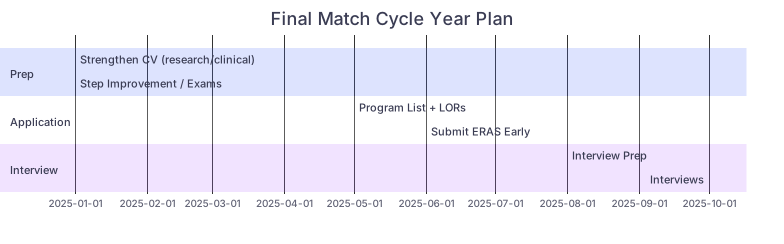
| Task | Details |
|---|---|
| Prep: Strengthen CV (research/clinical) | a1, 2025-01, 5m |
| Prep: Step Improvement / Exams | a2, 2025-01, 4m |
| Application: Program List + LORs | b1, 2025-05, 2m |
| Application: Submit ERAS Early | b2, 2025-06, 1m |
| Interview: Interview Prep | c1, 2025-08, 2m |
| Interview: Interviews | c2, 2025-10, 4m |
Use that final attempt to:
- Switch to a specialty where your stats are clearly in range (even if it bruises your ego).
- Apply very broadly and strategically:
- Community programs
- Underserved locations
- Places known to take IMGs or non-traditional applicants
- Get at least one or two recency anchors:
- Recent U.S. hands-on clinical work
- Letters that say “I supervised this person this year and I’d take them in my program”
- Treat your interviews like the high-stakes performance they are:
- Mock interviews with people who’ll be brutally honest, not nice
And in parallel:
Start preparing your pivot path. Courses, networking, exploring roles. You don’t wait for another “Unmatched” email to finally consider other futures.
Don’t Let Shame Make This Decision for You
Last thing. The biggest reason people stay stuck in endless match cycles isn’t hope. It’s shame.
They’d rather keep rolling the dice than say out loud, “I’m changing direction.” But here’s the reality I’ve seen play out:
- No one is tracking your match cycles as hard as you are.
- The colleagues whose opinions you fear? Half of them are secretly burned out and envy people who got out.
- Your life is not an exam that you either “pass” (match) or “fail” (anything else).
You’re allowed to say:
“I gave this a fair shot. The data is clear. I’m choosing a path where I can actually move forward.”
That’s not giving up. That’s doing something most people in medicine are terrible at: cutting losses and making a strategic move.
Key Takeaways
- For most people, 1–2 match cycles is reasonable; 3 is the upper limit only if there’s clear, objective improvement and strategic change. More than that, you’re usually better off pivoting.
- Don’t reapply without real changes: higher scores, new U.S. clinical work, better specialty choice, and a broader, smarter program list. Repeating the same application is just rerunning the same odds.
- Start defining your pivot path early. If you’re on cycle 2 and not clearly moving closer to a match, your best long-term move may be to redirect your training, not wait for a miracle.